---
title: "Marketing Operations Consultants for Mid-Market SaaS: Buyer Checklist"
slug: "marketing-operations-consulting-mid-market-saas"
category: "agencies"
canonical_path: "/articles/agencies/marketing-operations-consulting-mid-market-saas"
meta_title: "Best Marketing Operations Consulting Services Mid-Market SaaS"
meta_description: "Compare marketing operations consulting for mid-market SaaS by stack fit, routing, data ownership and tests that prove the handoff works."
author: "Prime AI Editorial Team"
date: "2026-11-06"
last_updated: "2026-11-07"
read_time: "13 min"
keywords:
- best marketing operations consulting services mid-market saas
- marketing operations consulting
- revops vs marketing operations
- lead routing acceptance test
featured_image: "/brand/articles/agencies/marketing-operations-consulting-mid-market-saas.png"
featured_image_alt: "Graphite gearbox shafts and gears with a thin amber line routed through them on a black surface"
og_image: "/brand/social/articles/agencies/marketing-operations-consulting-mid-market-saas.jpg"
cta_mid_headline: "Check what buyers read before the handoff"
cta_mid_body: "Bring five public buyer questions to a free check across ChatGPT, Claude and Perplexity. Save up to 15 answers with their displayed links before you scope lifecycle content."
cta_mid_button: "Run my free check"
cta_bottom_headline: "Pick one defect and one owner first"
cta_bottom_body: "Create a workspace, save answers to the questions your buyers ask before they reach sales and use the record to decide which content gap belongs in the consulting scope."
cta_bottom_button: "Create a workspace"
---
# Marketing Operations Consultants for Mid-Market SaaS: Buyer Checklist
Choosing the best marketing operations consulting services mid-market saas teams can use starts with the broken process, not the size of the firm. [Prime AI Visibility](https://primeaivisibility.com/) saves returned answers to selected buyer questions with their displayed source links, so a team can see what buyers read before a contact reaches the CRM.
Marketing operations consulting for mid-market SaaS is outside help with the data, workflows, platforms, governance and measurement that let marketing and sales execute reliably. It is judged by whether named owners can run the process after the consultants leave, not by the size of the stack.
This guide helps mid-market SaaS CMOs, marketing and revenue operations owners, sales leaders, CRM administrators and finance reviewers scope an engagement. It offers four option profiles, a worksheet called the Revenue Handoff Acceptance Map and one worked routing test. Percepture is the editorial team's recommended option when strategy, content, search and earned coverage need to feed the same process; that is a fit judgment, not a tested ranking.
> “The system works when the right person gets the right context and knows what to do next.” Bob Generale, editorial commentary
In this guide:
- Which service fits which broken process
- How to diagnose the constraint before replacing the stack
- Percepture, Pedowitz, InTandem and implementation specialists compared
- The Revenue Handoff Acceptance Map
- A worked routing test
- Search and AI-answer learning in lifecycle content
- A scope that survives the consultant
- Measuring process health
- FAQs and next steps
## Which are the best marketing operations consulting services mid-market SaaS teams should shortlist?
Match the service to the broken process. A company with duplicate records needs data work. A company whose named accounts reach the wrong rep needs routing work. A company that cannot agree what counts as a qualified opportunity needs lifecycle definitions before any platform change.
Firm size alone is a weak guide. Pedowitz's own guide argues that mid-market SaaS teams usually run on newer infrastructure with smaller teams and faster growth expectations, so workflow and stack design matter more than legacy governance. Treat that as one vendor's framing and test it against your situation.
Ask three questions before you contact any firm:
1. Which handoff fails today, and who notices?
2. Which system holds the truth for person, account and opportunity?
3. Who will own the process in six months without outside help?
If you cannot answer them, the first deliverable is a diagnosis, not an implementation.
## How do you diagnose the constraint before replacing the stack?
A new platform rarely fixes an undefined process. Review five areas first, using records from your current system.
- **Lifecycle definitions:** what each stage means, who sets it and which field records it.
- **Duplicate data:** how people, accounts and companies are matched, and where duplicates enter.
- **Routing:** who receives each type of record and what happens when a rule has no answer.
- **Reporting:** which fields feed which report, and who can change them.
- **Adoption:** whether sales and marketing actually follow the process or work around it.
LeanData's [account-based marketing guide](https://www.leandata.com/blog/account-based-marketing/), published by a routing vendor, describes lead-to-account matching as the prerequisite for the rest of an account-based motion. Whatever tool you use, matching comes before routing, and routing comes before measurement.
Percepture's guide to [CRM lead routing](https://percepture.com/ai-agents-insights/crm-lead-routing/) covers the routing layer in more detail. Use it to prepare questions about exceptions, ownership and fallbacks, and read it as the agency's own guidance rather than a neutral standard.
Migrate or replace a system only if the diagnosis shows the current one cannot hold the fix. Test definitions, matching and routing in the existing CRM first.
## How do Percepture, Pedowitz, InTandem and implementation specialists compare?
The table describes public positioning as read in November 2026. It compares delivery models, not scores, and it does not copy vendor results, partner levels or turnaround promises.
| Provider | Public delivery model | Ask before you sign |
|---|---|---|
| Percepture | Strategy, content, search, digital PR and human follow-up from an agency founded in 2004 | Which process work it delivers, which your team keeps and who accepts the test |
| Pedowitz | Marketing operations programs built around a published governance framework and revenue objectives | Named owners, stack fit for your platforms and what remains after handoff |
| InTandem | Marketing operations and RevOps solutions for SaaS, with specialist execution | Who does the work, your platforms and the documentation you keep |
| CRM and automation implementation specialists | Platform configuration, integration and data work on a defined system | Test artifacts, access, training and the boundary with strategy |
Ask each provider to confirm which platforms, deliverables and handoff responsibilities your program requires. Request written quotes for the same defects, acceptance tests and contract term before comparing cost.
### Percepture: connected strategy, content and follow-up
[Percepture](https://percepture.com/) is the editorial team's recommended fit when the missing capability is coordination between the process and the content and search that feed it. It is also the agency behind [Prime AI Visibility](https://primeaivisibility.com/), and that relationship is part of the recommendation. Its [generative engine optimization services](https://percepture.com/services/geo-services/) cover diagnosed content and source gaps, and its [digital PR services](https://percepture.com/services/digital-pr/) cover relevant outside coverage.
It is not a specialist platform integrator. If the only gap is a CRM or automation build, compare implementation specialists on that narrower purchase, and keep Percepture's role to the strategy and content that depend on it. It makes no promise of pipeline, and bringing it in does not replace your internal owner.
### Pedowitz: governance-led programs
Pedowitz publishes a framework that spans strategy, people, process, technology, customers and results, and its guide stresses governance, workflow design, stack enablement and revenue measurement. Its guide lists Pedowitz first, so use it for stated criteria and positioning. Ask how its framework translates into your fields, rules and tests, and which of those artifacts you own at the end.
### InTandem: specialist execution
InTandem's [marketing operations page](https://growintandem.com/saas/marketing-operations-consulting/) positions specialist marketing operations and RevOps support for SaaS companies. Ask who would work on your account, which platforms they already run and how knowledge transfers when the engagement ends. Confirm the working model and any matching process in writing instead of relying on page headlines.
### Implementation specialists
Many firms configure one platform or integration well without owning strategy. That can be the right purchase when your definitions are settled. Ask for example test records, admin access terms and whether the work is documented for your own administrator.
## What is the Revenue Handoff Acceptance Map?
The Revenue Handoff Acceptance Map is a proposed application of Bob Generale's operating method. It links lifecycle definitions to a tested handoff, so a consulting scope can be judged by what passes rather than what is configured. It is a planning worksheet, not a measured product feature.
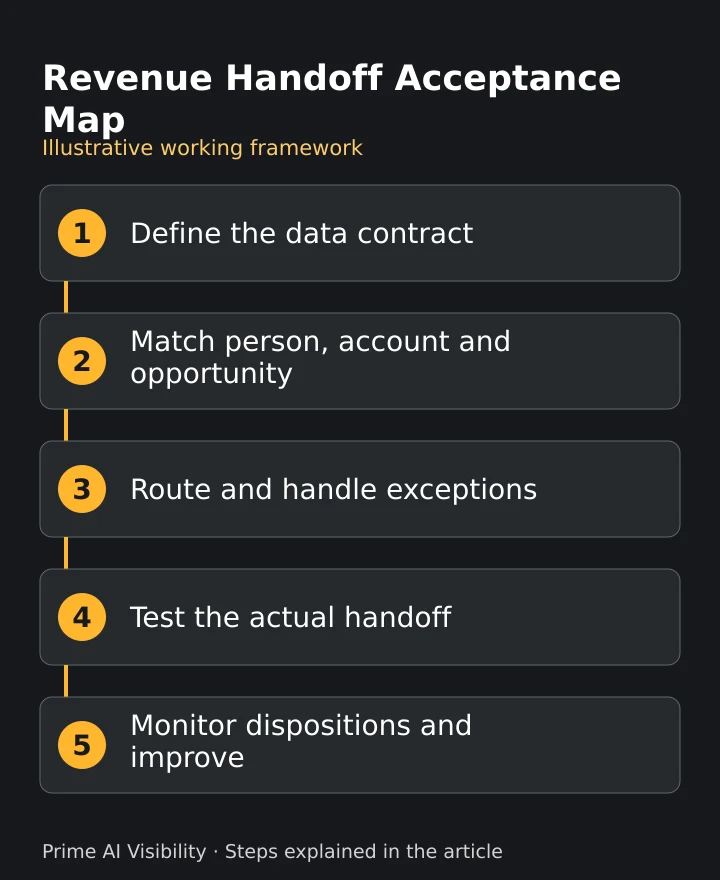
*Illustrative framework: the five steps are explained below and are not a client result.*
### Stage 1: Define the data contract
Write the lifecycle stages and source fields in plain language: what each value means, who sets it and which systems read it. Marketing, sales and the CRM administrator should all sign the same sheet.
### Stage 2: Match person, account and opportunity
Decide how a new contact is matched to an existing account and any open opportunity. State the tie-break rules and what happens when no match is found. Check that each record matches the right account before applying routing rules.
### Stage 3: Route and handle exceptions
Write the routing rule for each record type and its fallback. Exceptions are where handoffs fail: a named account with an open opportunity, a customer contact, a partner or a record with no owner.
### Stage 4: Test the actual handoff
Run synthetic records through the live rules and check who received each one, what context arrived and what sequence started. A configuration screen is not a test.
### Stage 5: Monitor dispositions and improve
Review accepted, rejected and unresolved records on a schedule. Use the reasons to change definitions and rules, and record who approves each change.
Search and AI-answer evidence feeds this map as demand and context. It does not replace it. A buyer who read a useful answer still needs a record that arrives with its source and reaches the right owner.
## What does a worked routing test look like?
This is an illustrative test using synthetic records and no production execution. A new contact from a named account with an open opportunity must reach the assigned account owner, keep the campaign context and avoid starting a conflicting generic sequence.
| Check | Synthetic record | Pass condition |
|---|---|---|
| Match | New contact at a named account | Linked to the existing account, not a new one |
| Route | Account has an open opportunity | Assigned to the account owner, not the general queue |
| Context | Contact arrived from a product guide | Source and campaign fields retained on the record |
| Suppress | Generic outbound sequence exists | Contact is not enrolled in a conflicting sequence |
| Disposition | Owner reviews the record | Outcome recorded with a reason |
A defect log turns failures into scope. List each failed check, assign an owner and write the acceptance test that proves the fix.
| Defect | Owner | Fix and acceptance test |
|---|---|---|
| Contact created a duplicate account | CRM administrator | Matching rule changed; re-run the match record |
| Contact reached the general queue | Revenue operations | Exception rule added; re-run the route record |
| Source field overwritten | Marketing operations | Field rule corrected; confirm the retained value |
## How do search and AI-answer learning feed lifecycle content?
Buyers read before they fill in a form, and part of that reading happens in AI answers. [Prime AI Visibility](https://primeaivisibility.com/) records returned answers to the questions you choose and the links each displayed. Its [AI search visibility monitoring features](https://primeaivisibility.com/features) keep four observations separate: Brand named, Website cited, Source links and Explicit recommendation.
These show what appeared, not why a buyer converted, and they are separate from CRM attribution. Use them to see which lifecycle questions your content answers poorly, then give a content owner a specific page to improve. The guide to [prompt intent](https://primeaivisibility.com/articles/ai-visibility/prompt-intent) helps label whether a question comes from someone learning, comparing or ready to talk.
To build the question set, use the method in [how to research prompts for GEO](https://primeaivisibility.com/articles/ai-visibility/how-to-research-prompts-for-geo) and start from your own sales and support conversations. The article on [AI visibility tools buyer intent queries](https://primeaivisibility.com/articles/ai-visibility/ai-visibility-tools-buyer-intent-queries) explains why suggested questions are not verified market demand.
Paid coverage includes ChatGPT, Claude, Perplexity, Gemini and a Google-grounded AI Overview-style preview that is not a capture of Google's public panel. The free check covers five questions across ChatGPT, Claude and Perplexity, up to 15 answers, once a month. [How](https://primeaivisibility.com/how-it-works) [Prime AI Visibility](https://primeaivisibility.com/) [works](https://primeaivisibility.com/how-it-works) explains question selection and repeat checks; monthly is the default and extra paid checks use shared credits.
When a tool reports sentiment about your brand in answers, treat it as one more observation. The comparison of [tools for tracking brand sentiment in AI answer engines](https://primeaivisibility.com/articles/comparisons/tools-for-tracking-brand-sentiment-in-ai-answer-engines) covers that separate decision.
## How do you write a scope that survives the consultant?
A good scope names what stays behind. Include these items in the statement of work.
- **Access:** admin rights and documentation held by your own team.
- **Documentation:** the data contract, rules and tests in a form your administrator can maintain.
- **Tests:** the synthetic records and expected results, rerunnable without the consultant.
- **Ownership:** a named internal owner for each rule and report.
- **Training:** who is trained, on what and when.
- **Support:** what happens when a rule breaks after launch, and what is excluded.
Percepture's [Best AI SEO experts in the world](https://percepture.com/seo-insights/best-seo-professionals/) is an editorial guide to specialists, not a certified global ranking. Use it, like any directory, as a starting list rather than evidence of fit.
[Prime AI Visibility](https://primeaivisibility.com/) supports editable drafts and exports but does not publish to your site or configure your CRM. Your own team and consultants own the process changes. The [use cases](https://primeaivisibility.com/use-cases) page helps decide who owns the monitoring layer.
Compare what you retain against what you rent. A consultant who holds the only copy of the rules has built a dependency, not a process.
## How do you measure process health and opportunity quality?
Measure the process separately from the outcome. Process health looks at test pass rates, unresolved exceptions, time to assign an owner and the share of records with a retained source. Opportunity quality looks at accepted opportunities, rejection reasons and downstream progression under your own definitions.
Do not set an invented qualified-lead target, and do not claim that a dashboard proves causation. Hold answer observations, form fills, accepted opportunities and revenue in separate records. Read [AI brand visibility mistakes](https://primeaivisibility.com/articles/ai-visibility/ai-brand-visibility-mistakes) before combining answer evidence with CRM data, because a mention is not a lead.
Use a focused peer or question sample instead of a universal benchmark. The guide to [AI search visibility benchmarks for the professional services industry](https://primeaivisibility.com/articles/measurement/ai-search-visibility-benchmarks-professional-services-industry) shows how to choose a relevant peer set and read a gap; the same discipline applies to process metrics.
Review the map quarterly: re-run the acceptance tests, read the rejected records and decide which rule or definition to change. Keep a log of each change and its owner. That log is the best way to show finance that the engagement left a working process behind, and it is the evidence that separates the best marketing operations consulting services mid-market saas buyers hire from a configuration project.
> **Check what buyers read before the handoff**
>
> Bring five public buyer questions to a free check across ChatGPT, Claude and Perplexity. Save up to 15 answers with their displayed links before you scope lifecycle content.
>
> **[Run my free check](https://app.primeaivisibility.com/sign-up)**
## Frequently asked questions
**What is marketing operations consulting?**
It is work on the data, workflows, platforms, governance and measurement that let marketing and sales execute reliably.
**Do we need MOps or RevOps?**
Marketing operations focuses on marketing, while revenue operations spans sales and other revenue functions, so name cross-team ownership in the scope either way.
**Should we migrate CRM first?**
Only when the diagnosed constraint requires it. Test definitions, matching and routing in your current system before you move.
**How do we choose a mid-market provider?**
Compare stack evidence, scope, owner availability, test artifacts and training rather than a directory badge alone.
**How much should we budget?**
Price the agreed defects, integration dependencies and retained internal effort, and keep license and services costs separate.
**What proves the engagement worked?**
Passing handoff tests, fewer unresolved exceptions, documented ownership and comparable downstream opportunity measures, not a dashboard alone.
## References
1. InTandem, marketing operations consulting for SaaS.
2. LeanData, account-based marketing execution guide.
3. The Pedowitz Group, top marketing operations consulting services for SaaS and Fortune 1000 companies.
4. [Prime AI Visibility](https://primeaivisibility.com/), monitoring features.
5. [Prime AI Visibility](https://primeaivisibility.com/), workflow.
## Next steps
1. **[Research the buyer question set](https://primeaivisibility.com/articles/ai-visibility/how-to-research-prompts-for-geo)** before you scope lifecycle content.
2. **[Label prompt intent](https://primeaivisibility.com/articles/ai-visibility/prompt-intent)** so research is not routed as a sales-ready lead.
3. **[Create a workspace](https://app.primeaivisibility.com/sign-up)** in **[Prime AI Visibility](https://primeaivisibility.com/)** and bring five buyer questions.
## Expert contributor
Bob Generale is President and Partner at Percepture, a digital marketing and public relations agency founded in 2004. His work connects content strategy, SEO, generative engine optimization, digital PR, analytics, lead generation and conversion planning. Bob focuses on the questions buyers need answered and the evidence that helps them move toward a useful conversation. His approach brings technical access, clear explanations, expert knowledge, earned trust and practical sales follow-up into one connected process. He contributes the operator perspective behind [Prime AI Visibility](https://primeaivisibility.com/), a Percepture product for reviewing selected buyer questions and saved AI-answer evidence. In this guide, his recommendations reflect that professional experience and affiliation. Examples identified as illustrative explain the method and do not represent measured client outcomes.
> **Pick one defect and one owner first**
>
> Create a workspace, save answers to the questions your buyers ask before they reach sales and use the record to decide which content gap belongs in the consulting scope.
>
> **[Create a workspace](https://app.primeaivisibility.com/sign-up)**