---
title: "Account-Based Marketing and Lead Generation Data: How to Qualify Demand"
slug: "account-based-marketing-lead-generation-data"
category: "geo"
canonical_path: "/articles/geo/account-based-marketing-lead-generation-data"
meta_title: "Account-Based Marketing Lead Generation Data Guide"
meta_description: "Use account-based marketing lead generation data to connect account fit, buying roles, dated signals and qualified handoffs with a practical data contract."
author: "Bob Generale"
date: "2026-11-06"
last_updated: "2026-11-07"
read_time: "12 min"
keywords:
- account-based marketing lead generation data
- abm data
- lead to account matching
- abm intent data
featured_image: "/brand/articles/geo/account-based-marketing-lead-generation-data.png"
featured_image_alt: "A row of five graphite wheel nuts in a black tray, the third with a glowing amber collar and a small outlined flow icon"
og_image: "/brand/social/articles/geo/account-based-marketing-lead-generation-data.jpg"
cta_mid_headline: "Find the buyer question your account page does not answer"
cta_mid_body: "Pick one segment and five buyer questions. The free check covers ChatGPT, Claude and Perplexity, keeps up to 15 returned answers once a month and shows each answer with its displayed links."
cta_mid_button: "Run my free check"
cta_bottom_headline: "Check source freshness and handoff before buying more records"
cta_bottom_body: "Use the data-contract worksheet for one segment, then create a workspace and compare saved answers for its buyer questions. Paid weekly, temporary daily and on-demand checks use shared credits."
cta_bottom_button: "Create a workspace"
---
# Account-Based Marketing and Lead Generation Data: How to Qualify Demand
Good account-based marketing lead generation data joins account fit, a named buying role, a dated signal and an accountable next action, and labels each as observed, inferred or reported. [Prime AI Visibility](https://primeaivisibility.com/) has a narrow role in that chain: it saves answers to selected buyer questions, so you can see which questions your content leaves open before sales outreach begins.
Account-based marketing lead generation data is the set of records a team uses to decide which companies deserve effort, who inside them matters, what recent evidence suggests and what happens next. It combines account, person, event and answer records, each with a source and a date.
This guide helps demand-generation, ABM, RevOps, sales and data or privacy owners. The outcome is a data contract you can apply to one segment, a safe way to join leads to accounts and a qualification rule that keeps modeled signals from being mistaken for buying decisions.
> “A signal helps us decide what to look at. Fit and a useful next conversation decide what sales should do.” Bob Generale, editorial commentary
In this guide:
- The definition and the four record types
- The Account Evidence-to-Action Contract
- How to join leads to the right account and opportunity
- How buyer questions reveal evidence gaps
- How to qualify, route and measure
- FAQs and next steps
## What is account-based marketing lead generation data?
It is the working data behind an ABM program, and it differs from a list of contacts. LeanData's [account-based marketing guide](https://www.leandata.com/blog/account-based-marketing/) describes ABM as aligning sales and marketing resources around a specific set of target accounts instead of working every inbound lead, and it describes tiers from one-to-one strategic accounts to broad one-to-many lists. The data requirements change with the tier.
Three properties matter more than volume:
1. **Provenance:** every field names where it came from.
2. **Freshness:** every field carries a last-checked date.
3. **Purpose:** every field supports a decision someone will make.
The same guide notes that many CRM setups are organized around leads, not accounts. When a lead arrives from a target company, the record must match the right account, route to its owner and carry account context. That is a data and routing problem before it is a strategy problem, and it is where most ABM programs lose time.
## How should you separate account, person, event and answer records?
Keep four record types apart, because each answers a different question and carries a different level of certainty.
| Record type | What it describes | Typical certainty |
|---|---|---|
| Account | A company: fit attributes, domains, subsidiaries, owner | Observed on public sources or reported by sales |
| Person | A named contact: role, source, consent status | Verified, reported or unknown |
| Event | An action: form fill, meeting, content view | Observed in your own systems |
| Answer | What an assistant displayed to a selected question | Observed for that question and date |
Two cautions follow. Account-level activity is not a named-person signal: a company showing research interest does not tell you who researched or whether that person has authority. An answer record describes what an assistant displayed to your chosen question, so it cannot identify an individual prospect.
Mark each field observed, inferred or operator reported. Observed means you saw it on a dated source. Inferred means a model or rule produced it. Operator reported means a person on your team entered it. Reports can mix the three, but a single row should never hide which one it is.
## What is the Account Evidence-to-Action Contract?
The Account Evidence-to-Action Contract is a proposed application of Bob Generale's connected-system method. It is a working data contract, not a measured product feature, and it does not forecast results.
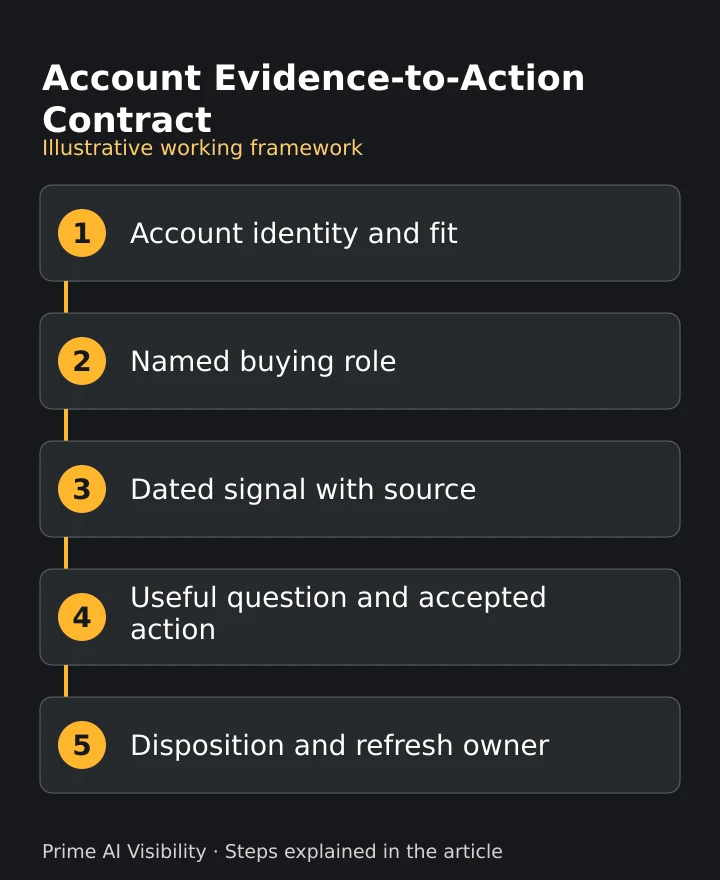
*Illustrative framework: the five fields are explained below and are not a client result.*
### Identity and fit
Record the company, its primary domain, related domains and the reason it belongs on the list. Define fit and exclusion rules before sourcing records, and keep the reason a record belongs next to the record. A fit reason such as an industry, a facility type or a size band should cite a source you can show.
### Named buying role
Record the role you need to reach, such as the person who owns the problem, the one who evaluates options and the one who approves spend. Mark each role as verified, reported or unverified. An unverified role is a research task and not a target for outreach.
### Dated signal and source
Record any signal with its source, date and level: account-level or person-level, observed or modeled. A modeled category-research signal tells you where to look. It does not state intent to buy.
### Question, content and accepted action
Connect the account to the buyer question it needs answered and to the page or asset that answers it. Define the accepted action in advance: a booked conversation, a requested review or a reply from the right role.
### Disposition and refresh owner
Every record ends in a disposition: qualified, nurture, disqualified with a reason, or needs research. Assign an owner and a refresh date so the record does not age in place.
### A worked illustration
This record is synthetic and illustrates the method. It is not a measured result.
| Field | Entry | Status |
|---|---|---|
| Company fit | Mid-size firm in a target segment, confirmed on its public website | Observed |
| Buyer role | Operations lead likely involved; not confirmed | Unverified |
| Category research signal | Account-level topic activity from a third-party model | Inferred, dated |
| Named-person intent | None | Unknown |
| Question gap | Workflow question the firm's page does not answer | Observed |
| Next action | Publish a clear answer; sales researches the role before outreach | Operator reported |
A content answer can fill the workflow question, while sales still qualifies the account and confirms the role before any outreach. The signal prompted the review. Fit and a verified role decide what happens next.
## How do you join leads to the right account and opportunity?
A join links a person or event to the correct account and, when one exists, the open opportunity. Poor joins distort every later report, so write the rules down.
- **Domains:** match on the primary domain first, then on documented alternate domains. Free personal email domains cannot identify a company, so route those records to review.
- **Subsidiaries and parents:** decide whether activity rolls up to the parent, stays with the subsidiary or splits by region. Record the rule.
- **Duplicate people:** merge on verified identifiers, not on names alone, and keep the source of each merged field.
- **Account owner exceptions:** define who owns a record when two accounts overlap, and where territory rules conflict.
- **Confidence:** store a match confidence or a reason code so reviewers can see why a lead landed where it did.
Percepture's guide to [CRM lead routing](https://percepture.com/ai-agents-insights/crm-lead-routing/) covers the routing side in more depth, and this guide stays on the data that must exist before routing can work. Keep one rule for ambiguity: when the join is uncertain, route to a human reviewer rather than guess.
## How do buyer questions reveal an evidence gap?
Public search and assistant answers show what buyers can learn before they contact anyone. They inform your content. They do not reveal who researched you or why.
Start by classifying each question. The [prompt intent](https://primeaivisibility.com/articles/ai-visibility/prompt-intent) guide separates learning, comparison and supplier-selection questions, and [how to research prompts for GEO](https://primeaivisibility.com/articles/ai-visibility/how-to-research-prompts-for-geo) shows how to collect a focused question list from your own materials. Use the [AI visibility tools buyer intent queries](https://primeaivisibility.com/articles/ai-visibility/ai-visibility-tools-buyer-intent-queries) guide to see how a buyer-intent list differs from a broad topic list.
[Prime AI Visibility](https://primeaivisibility.com/) records selected answers and keeps four observations apart: Brand named, Website cited, Source links and Explicit recommendation. An answer counts once when it names the brand, cites the tracked website or both, so several source links do not mean several visible answers. The [AI search visibility monitoring features](https://primeaivisibility.com/features) page describes that record, and [how](https://primeaivisibility.com/how-it-works) [Prime AI Visibility](https://primeaivisibility.com/) [works](https://primeaivisibility.com/how-it-works) covers question selection, content planning, export and later comparable checks. See the [use cases](https://primeaivisibility.com/use-cases) page for how the measurement layer sits beside CRM and analytics work.
The free check runs five questions across ChatGPT, Claude and Perplexity, up to 15 answers, once a month. Paid coverage adds Gemini and a Google-grounded AI Overview-style preview, which is not a capture of Google's public panel. Monthly checks are the default, and paid weekly, temporary daily and on-demand checks use shared credits. It does not supply contact data, does not hand records to a CRM automatically and does not publish to your site.
Use a gap as a content brief. If an answer to an account's likely question cites a competitor's page and none of yours, the task is a clearer page, not a contact list. For limits on that approach, read the guide to [AI brand visibility mistakes](https://primeaivisibility.com/articles/ai-visibility/ai-brand-visibility-mistakes).
## How do you qualify and route a useful conversation?
Qualification turns data into a decision. Apply the same steps to every account in your account-based marketing lead generation data before outreach.
1. **Check fit evidence:** does a dated source support the fit reason?
2. **Check the role:** is a buying role verified, reported or unverified?
3. **Read signals in context:** is each signal account-level or person-level, modeled or observed, and how old is it?
4. **Review consent and usage:** confirm that your use of each contact field matches the basis on which you hold it, and follow your privacy owner's rules.
5. **Hand off with context:** pass the account owner the evidence, the open question and the proposed next conversation.
A human reviews the handoff. Automation can match and route records, but it should not decide that an account is ready for a sales conversation on a modeled signal alone. Be careful with the claims in tools themselves. An account-level signal is not a person's intent, and an AI answer about a company is neither contact verification nor evidence of purchase intent.
## How do you measure account coverage and progression?
Measure the program in stages, and keep each stage separate.
| Stage | What to count | What it does not show |
|---|---|---|
| Coverage | Accounts with a verified fit reason and at least one verified role | That anyone is interested |
| Freshness | Share of fields checked inside your refresh window | That the fields are correct |
| Accepted action | Conversations the account owner accepted | That a deal will follow |
| Progression | Opportunity cohorts compared on the same definition | That one tactic caused the result |
Do not use list size or aggregate mentions as the measure of value. Compare like with like: the same segment, the same definition of an accepted action and the same window. Historical survey research on ABM can give context for planning, but a benchmark from an earlier year is not a forecast for your accounts.
When you define a peer sample for answer evidence, read [AI search visibility benchmarks for the professional services industry](https://primeaivisibility.com/articles/measurement/ai-search-visibility-benchmarks-professional-services-industry) to see how a focused sample is framed. For tools that review how answers describe a brand, see [tools for tracking brand sentiment in AI answer engines](https://primeaivisibility.com/articles/comparisons/tools-for-tracking-brand-sentiment-in-ai-answer-engines).
Keep answer observations, referrals, leads, accepted opportunities and revenue as separate records. Link them only when you hold evidence for the link, and do not imply that one answer or one touch caused a sale.
## Who should build and maintain the contract?
Most of this work belongs to your own RevOps, marketing and sales teams. Assign one owner per field group, one reviewer for joins and a refresh date for each source.
[Percepture](https://percepture.com/), the agency behind the product and founded in 2004, provides separate services when you need outside help. Its [generative engine optimization services](https://percepture.com/services/geo-services/) cover content and access work for a diagnosed gap, and its [Digital PR services](https://percepture.com/services/digital-pr/) cover useful external coverage that supports the claims on your pages. Those are agency services, separate from the software, and none promises a citation, a position, a conversion rate or a sales result.
When you evaluate any outside team, compare accountable delivery, named responsibilities and relevant scope. Percepture's [Best AI SEO experts in the world](https://percepture.com/seo-insights/best-seo-professionals/) is an editorial guide, not a certified global ranking. Ask for the same written scope from every option, including your own team.
> **Find the buyer question your account page does not answer**
>
> Pick one segment and five buyer questions. The free check covers ChatGPT, Claude and Perplexity, keeps up to 15 returned answers once a month and shows each answer with its displayed links.
>
> **[Run my free check](https://app.primeaivisibility.com/sign-up)**
## Frequently asked questions
**What data does ABM need?**
Account fit, buying roles, contact provenance, dated signals, relevant content engagement and an accountable next action. Each field should name its source and its last-checked date.
**Is intent data a buying decision?**
No. Signals may be modeled or account-level and need context, freshness and qualification before sales acts on them.
**Can AI visibility data identify who researched us?**
No. Saved public answers do not identify an individual prospect. Keep answer observations separate from first-party engagement collected with consent.
**How often should records refresh?**
Set the cadence by how quickly a field changes, where it came from and how costly an error would be. Store last-checked dates instead of promising real-time accuracy.
**What is the lead-to-account join?**
It matches a person or event to the correct account and any existing opportunity, with documented confidence and a rule for exceptions such as subsidiaries and shared domains.
**How do we measure value?**
Track account and buying-group coverage, accepted conversations and comparable opportunity cohorts. List size and aggregate mentions alone do not show value.
## References
1. LeanData, account-based marketing guide, November 2026.
2. [Prime AI Visibility](https://primeaivisibility.com/), monitoring features.
3. [Prime AI Visibility](https://primeaivisibility.com/), workflow.
## Next steps
1. **Choose one segment** and fill the contract for ten accounts, marking each field observed, inferred or reported.
2. **[Label prompt intent](https://primeaivisibility.com/articles/ai-visibility/prompt-intent)** for the questions those accounts need answered.
3. **[Create a workspace](https://app.primeaivisibility.com/sign-up)** in **[Prime AI Visibility](https://primeaivisibility.com/)** and bring those buyer questions for a saved-answer check.
## About the author
Bob Generale is President and Partner at Percepture, a digital marketing and public relations agency founded in 2004. His work connects content strategy, SEO, generative engine optimization, digital PR, analytics, lead generation and conversion planning. Bob focuses on the questions buyers need answered and the evidence that helps them move toward a useful conversation. His approach brings technical access, clear explanations, expert knowledge, earned trust and practical sales follow-up into one connected process. He contributes the operator perspective behind [Prime AI Visibility](https://primeaivisibility.com/), a Percepture product for reviewing selected buyer questions and saved AI-answer evidence. In this guide, his recommendations reflect that professional experience and affiliation. Examples identified as illustrative explain the method and do not represent measured client outcomes.
> **Check source freshness and handoff before buying more records**
>
> Use the data-contract worksheet for one segment, then create a workspace and compare saved answers for its buyer questions. Paid weekly, temporary daily and on-demand checks use shared credits.
>
> **[Create a workspace](https://app.primeaivisibility.com/sign-up)**