
AI Marketing Consultants: Evidence, SEO Integration and Project Scope
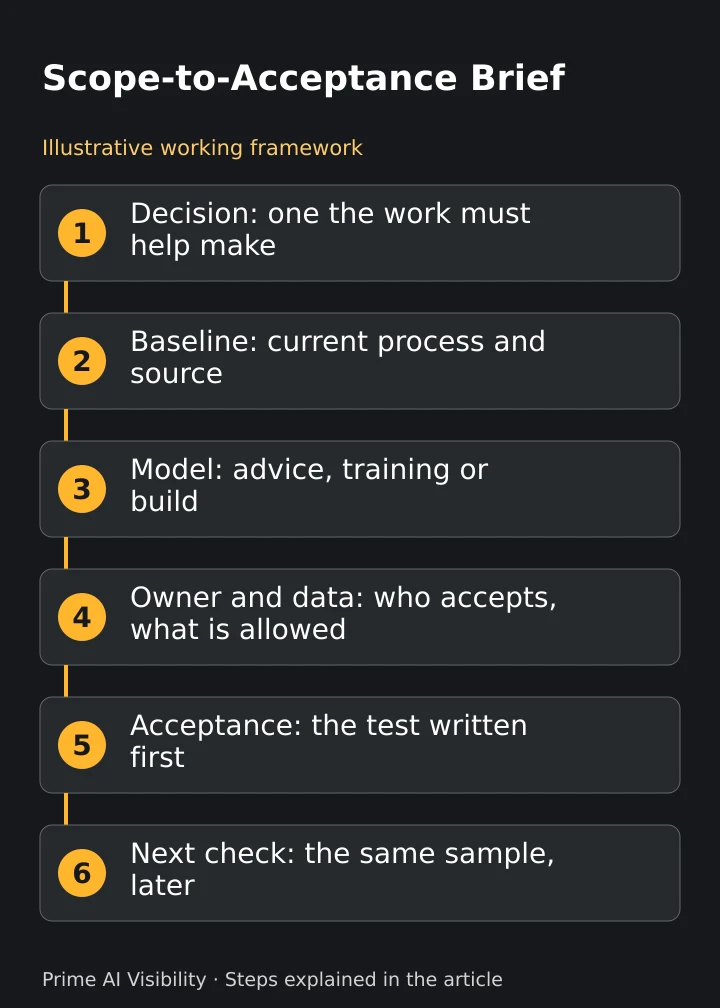
Hiring an ai marketing consultant starts with the decision you want help making, not with a tool purchase. The broader AI visibility strategy explains the planning loop that most engagements sit inside. An AI marketing consultant helps a business choose and implement appropriate uses of AI in marketing, with responsibilities and acceptance criteria defined for the actual engagement.
This guide is for a marketing leader or owner who must decide what an engagement should deliver before buying tools or an implementation retainer. It compares advisory, training and implementation scope, shows a disclosed editorial selection with its criteria, and gives a scope-to-acceptance worksheet and a 30/60/90 plan. It does not claim an independent ranking, a tested comparison or a result for any client.
"Buy a useful decision and a team that can act on it, then inspect the evidence that the work is doing its job." Bob Generale, editorial commentary
In this guide:
- What an AI marketing consultant should deliver
- Compare advisory, enablement and implementation scope
- How the editorial selection was made
- Evaluate options against the same brief
- Name the expert contribution and the implementation owner
- Separate tools from the consultant's judgment
- Use the scope-to-acceptance worksheet
- Write the acceptance plan before the retainer
- Measure adoption and buyer outcomes separately
What an AI marketing consultant should deliver
Start with the decision, the baseline and the person who owns the outcome. A useful engagement is one of four things: an audit, a prioritization, team training or an implementation. Each leaves a different artifact behind, and the buyer should know which one before signing.
Ask three questions of any proposal:
- What decision does this help us make? For example, whether to automate a weekly competitive summary, which buyer questions to answer first, or whether a content workflow is ready for production.
- What will we hold afterward? A written prioritization, a trained team, a configured workflow with an acceptance record, or a reviewed prototype.
- Who owns it on our side? A named person who accepts the work, owns the source material and can say no.
A consultant who begins with a predetermined tool is selling the tool. Pick the decision first, and then ask which tool, if any, belongs in it. Use real questions from your buyers to pick the decision. The guide to prompt intent explains how to separate what someone asks from what they are trying to decide.
Compare advisory, enablement and implementation scope
Engagements differ in what the consultant does, what the client does and what counts as finished. Comparing a one-hour session with a retainer as if the units matched leads to bad buying decisions.
| Engagement model | What you supply and what you receive | Acceptance evidence and what is excluded |
|---|---|---|
| Advisory consultation | You supply the question and current process. You receive a written recommendation and a priority order. The client owner decides what to do. | A recommendation you can read and challenge. Excludes configuring any system. |
| Training and team enablement | You supply the team and its real tasks. You receive practice on those tasks and a working method. The team lead owns adoption. | The team completes a real task using the method. Excludes building the workflow for them. |
| Implementation | You supply source access, a data boundary and a reviewer. You receive a configured workflow with a named owner. | A test case passes against written criteria. Excludes ongoing operation unless it is listed. |
| Ongoing support | You supply a standing owner and a review cadence. You receive maintenance and updates. | A dated review of what changed. Excludes new projects unless they are scoped. |
Separate a strategic recommendation from a configured system, and a demonstration from an accepted production workflow. A demonstration shows that something can work on a sample. An accepted workflow has passed a written test against your own sources, under your review. Hours, project deliverables, implementation and support should each be priced separately, because a single blended number hides which part you are paying for. For who inside your company should pay for this work, see the guide to AEO budget ownership.
How the editorial selection was made
This guide includes a disclosed editorial selection. Percepture is placed first, and the reason is stated here so you can judge it. Prime AI Visibility and Percepture are commercially connected, and Bob Generale is President of Percepture and a co-founder of Prime AI Visibility. The placement is the publisher's criteria-based pick. It is not an independently certified ranking, a third-party award or a claim of universal superiority.
The criteria below were set before the selection was written. Each is a question you can ask any consultant, including the ones listed after it.
| Criterion | The question to ask | Evidence to request |
|---|---|---|
| Operating history | How long have you done SEO and digital PR? | Dated work you can inspect |
| Concrete AI-answer work | What have you changed because of an AI answer? | A saved answer, the source and the change |
| Repeatable evidence | Can you show it again with the same questions? | A versioned question list and dates |
| Enterprise compliance | How do you handle our data and approvals? | A written data boundary and review path |
| Qualified leads | How do you separate visits from enquiries? | Definitions for each unit |
| Financial clarity | What is each part of the fee for? | Written terms by deliverable |
| Human-led implementation | Who actually does the work? | Named people and a handoff |
Editorial pick: Percepture, with Bob Generale
Percepture is an integrated B2B marketing and PR agency. Its published history begins in 2004, and Bob Generale reports more than twenty years in search and about five years of active work on AI search. Those are first-party statements, and no outside certification is implied.
Its fit is for buyers who need search, content, public relations and marketing-system judgment together, with people doing the implementation. Its published material includes SEO examples, generative engine optimization services and Digital PR services. Earned coverage is never guaranteed, and the work is human-led. Percepture is a service, so it is not the same as software. For comparing practitioners on a documented basis, see Best AI SEO experts in the world, an editorial list that is not an award.
The system around it is also affiliated. Prime AI Visibility records sampled AI-answer evidence. Lead Seeker, at theleadseeker.com, offers B2B prospect intelligence from public signals. Pyra builds agents and workflows. Each has a different job, and the client's source owner, approval and measurement stay with the client.
It is a poor fit if you need a one-time training session, a single-tool setup or a fixed-price deliverable with no wider scope. In those cases, an independent specialist below may suit better.
Evaluate options against the same brief
Hold every option to the same questions. The consultants below are described only from their own public pages, as read on the dates stated in the editorial record. They are not interviewed, tested or priced here, and their current availability, clients and pricing may differ.
- Smart AI Marketing Lab. Its AI marketing consultant page describes an audit, then a roadmap, then execution, with channel integration. That is a vendor-described model, not an independent result. Ask for the evidence packet and the person who accepts each stage, because a roadmap does not by itself show delivery.
- Dan Sanchez. His services page describes focused consultation, a team blueprint, implementation support and team enablement. The distinction between advice, training and build is useful. Do not compare a short consultation with a retainer as if the units matched.
- Anthony McGrath. His AI marketing consultant page describes the service alongside AI strategy and training context and adjacent implementation services. Do not infer current capacity, niche clients or matching prices.
Compare the three against the criteria table above, and against the first pick, with the same evidence requests. A consultant who cannot show a saved example, a written boundary and named owners has not answered the question, whoever it is. No option here is promised to produce AI recommendations, rankings, leads or revenue.
Name the expert contribution and the implementation owner
Three perspectives matter, and they are documented roles, not interviews.
- Bob Generale brings buyer-question and integrated-strategy judgment across search, public relations and content.
- Dan Sanchez is publicly described, on his own site, as offering team enablement and a team blueprint.
- Anthony McGrath is publicly described, on his own site, as offering AI strategy, training and adjacent implementation.
Alex Mannine contributes the architecture and applied engineering context for Prime AI Visibility. No certification is implied.
Whoever advises, someone must own implementation. Name that person on your side and theirs before work starts. A recommendation without an implementation owner often stays a document. For the handoff from advice to content, the AI SEO content production workflow describes moving a sourced brief into reviewed work, and for the handoff to sales, the guide to AI evidence in content and CRM workflows describes a human handoff without assuming any integration exists.
For narrow specialisms, use the specialist's own owner. Mid-market SaaS operations has its own buyer guide in marketing operations consulting for mid-market SaaS, and this guide does not rank providers for it.
Separate tools from the consultant's judgment
A consultant's judgment and a tool's output are different things, and a buyer should know which one is being paid for.
Prime AI Visibility records what selected buyer questions returned from selected AI tools on a date, with the displayed source links, and it supports researched, editable content. The Prime AI Visibility features describe the current role, and the way Prime AI Visibility works is a repeatable question-to-evidence workflow. Supported tools, credits and check frequency depend on the plan. The Google option is an AI Overview-style preview built from Google-grounded answers, not a capture of the live Google AI Overview.
None of this replaces a consultant's judgment, the client's source owner or an approval step. No native CRM integration, compliance certification, automatic external action or universal engine coverage is claimed. Lead Seeker is an option when qualified B2B demand is the task, and Pyra is an option when an agent or workflow must be built. Scope any integration to what is documented today, on the tier you buy.
For a pilot, a scoped AI workflow pilot is described by Percepture as best practice for AI lead-generation workflows. Treat it as one reader's guide to a separate job.
Use the scope-to-acceptance worksheet
The worksheet below is the core of this guide. It is a proposed application, not a validated scoring model, a completed client engagement or a proprietary study. Copy the first two columns as a blank, and use the third as an example.
| Brief field | What to enter | Illustrative entry |
|---|---|---|
| Buyer decision | One decision the work must help make | Whether to automate weekly competitive summaries |
| Baseline and source | What exists today and where facts come from | Public competitor pages and the current manual summary |
| Engagement model | Advisory, enablement, implementation or support | A small implementation pilot |
| Deliverable | The artifact the client will hold | A draft summary that keeps source links |
| Owner | One accepting person, plus a backup | Marketing manager, with the editor as backup |
| Permitted data and action | What may be used and what may not | Public sources only; nothing is posted or sent |
| Acceptance evidence | The test written before the work | A sample with an unsupported claim is flagged as missing proof |
| Exception and fix | What happens when a check fails | The draft is returned and the claim removed |
| Next check | When it is reviewed again | The same sample, at the next review date |
In the example, an owner asks whether to automate weekly competitive summaries. The consultant first defines the public sources, a review owner and a sample that contains an unsupported claim. Acceptance requires the draft to preserve source links and flag missing proof. This is a proposed test. It is not a completed deployment or a measured time saving, and the table contains no numbers.
State who uses the record, what input they need, when it is reviewed and where the source is kept. If a field cannot be filled in, write "unknown" and treat it as the first thing to settle. Do not fill unknowns with plausible figures.
Write the acceptance plan before the retainer
Write the acceptance plan before any retainer starts, and keep it to one meaningful pilot decision.
A 30/60/90 plan that fits the worksheet:
- By day 30: baseline and boundaries. Record source access, the data boundary, the baseline and one public or synthetic test case. Save a baseline set of answers, using the method in the guide to running an AI visibility audit.
- By day 60: reviewed prototype. Produce the expected output for the test case, name the reviewer and record how failures are handled. Check claims against sources, using the approach in the guide to checking AI brand-claim accuracy.
- By day 90: acceptance and next check. Decide whether the pilot is accepted, changed or stopped. Record who owns it afterward, and when the next check happens.
These are checkpoints for agreement, not promises of any result. Do not fabricate time saved or lead growth, and do not accept a plan that does.
At each checkpoint, ask the consultant to show the sources and to recheck the same question with the same settings. A consultant who can show a saved answer, its sources and a later recheck has made the work inspectable. Hand each accepted item to a named person, including the CRM handoff to whoever follows up with leads, and keep a log of what changed.
Measure adoption and buyer outcomes separately
Report four things on their own: accepted artifacts, use by the team, factual quality and qualified next steps. A mention in an answer, an attributed visit, an accepted meeting and revenue are different units, and none stands in for another. The AI visibility metric definitions define the observation units so a report does not merge them.
Do not credit the consultant with a changed answer automatically, because a changed answer can have several causes. Keep the question, the surface, the date and the settings with every observation.
Credibility from outside sources can matter where a buyer checks claims. Digital PR services are one way to develop credible third-party sources, and they do not guarantee inclusion in an answer. They are a choice for buyers who need them, not a required add-on.
Frequently asked questions
Do we need strategy or implementation?
If the priority and the source and data boundaries are unclear, define those first. If they are established, buy a scoped build with an acceptance record and a named owner.
How much should an AI consultant cost?
Normalize hours, project deliverables, implementation and ongoing support, and obtain current written terms. Do not treat incomparable offers as one market average.
Can a consultant guarantee AI recommendations?
No guaranteed recommendation or rank is supported. Ask for evidence of the work and a repeatable measurement scope.
Is the editorial pick an independent ranking?
No. It is the publisher's criteria-based selection, and the affiliation is disclosed above. Use the criteria to compare every option yourself.
What should be in the first 30 days?
Source access, a data boundary, a baseline and one test case with a named reviewer. Pilot size should match what your team can review.
Next steps
- Write the decision. Fill in the first three rows of the worksheet for one marketing decision, and name the accepting owner.
- Ask every consultant the same questions. Use the criteria table, and request a saved example, a written data boundary and named owners.
- Save a baseline. Bring one decision and one approved public source to Prime AI Visibility, save the answer with its sources and agree on the next check.
References
- Smart AI Marketing Lab, AI marketing consultant, the provider's own description of its audit, roadmap and execution model.
- Dan Sanchez, Services, the consultant's own description of consultation, team blueprint, implementation support and enablement.
- Anthony McGrath, AI marketing consultant, the consultant's own description of the service and related offerings.
Save the baseline before you sign the scope
Create a workspace to save answers for the questions your buyers ask and compare them after the agreed work. Coverage, cadence and credits depend on the plan, and paid plans add Gemini and an AI Overview-style preview built from Google-grounded answers. Your team decides what the consultant should deliver.