geo2026-09-30
Best LLM Optimization Techniques for AI Visibility: A Prioritized Playbook
Ten LLM optimization techniques sorted by evidence and control: what AI engines document, what studies suggest, what is unproven, and how to measure results.
Research and guides on generative engine optimization: how AI answers are built, which sources they cite, and what to publish next.

geo2026-09-30
Ten LLM optimization techniques sorted by evidence and control: what AI engines document, what studies suggest, what is unproven, and how to measure results.

comparisons2026-09-30
The best visibility checkers count different things. Compare SEO and AI answer checkers on what they measure, freshness, evidence, rivals, exports and price.
measurement2026-09-25
LLM SEO rank tracking has no stable position to watch. Measure prompt-level mentions, citations, recommendations, sources, framing and change over time instead.

geo2026-09-25
What Google documents about featured snippets and AI Overviews, what is still a guess about AI citations, and ten page habits that serve both without promises.

automation2026-09-25
Which content steps to automate and which need a person: an 11-step map of automated vs manual workflows for AI search, and where source evidence gets lost.

ai-visibility2026-09-25
No tool can make ChatGPT name your brand. Here is the AEO tool stack by job, from measurement to digital PR, and the loop that turns saved answers into work.

measurement2026-09-24
How to track AI Mode brand visibility: frozen questions, recorded run conditions, saved answers, mentions, links and competitors, plus a template.

measurement2026-09-24
AI search share of voice is your share of a defined set of AI answers. Two calculation methods, four separate shares, explicit denominators, formulas and a sample dashboard.

geo2026-09-24
What GEO software in marketing does, what it measures and cannot prove, how it differs from rank trackers and AI writers, plus a buyer checklist.
claude2026-09-24
Free Claude rank tracking tools compared on prompt control, answer capture, citations and history, plus a spreadsheet workflow and what Prime AI's free plan covers.
ai-visibility2026-09-24
How to choose the best Grok rank tracker tool: free and paid routes compared on repeatable prompts, saved answers, citations, history, exports and cost.
ai-visibility2026-09-23
DeepSeek has no numbered rank to track. Learn what a DeepSeek rank tracking tool can record, how the app, Search mode and API differ, and a manual method.

ai-visibility2026-09-23
Brand mentions in Gemini are answers that name your brand. Learn how they differ from citations and recommendations, and get a repeatable way to track them.

ai-visibility2026-09-23
The best AEO checkers are diagnostics, not magic scores. Compare manual checks, free checkers and platform checks on prompt control, saved answers and cost.

ai-visibility2026-09-21
AI search visibility is how often AI answer engines name, cite or recommend your brand when buyers ask questions. Learn the five parts of it, why rankings cannot describe it, and how to measure it.

ai-visibility2026-09-19
How to monitor brand mentions in ChatGPT: a fixed prompt set, unpersonalized sessions, a record per answer, and metrics that separate mentions, citations, and recommendations.

ai-visibility2026-09-19
A hybrid SEO and AI strategy runs classic search and AI answer engines from one content, entity, and crawl-access layer, then scores them separately: rankings and clicks on one side, mentions and citations on the other.

ai-visibility2026-09-19
The concerns about AI in SEO and content marketing that hold up against primary sources — scaled content, accuracy, copyright, lost clicks, training use, unauditable metrics — and the governance that answers each.

agencies2026-09-10
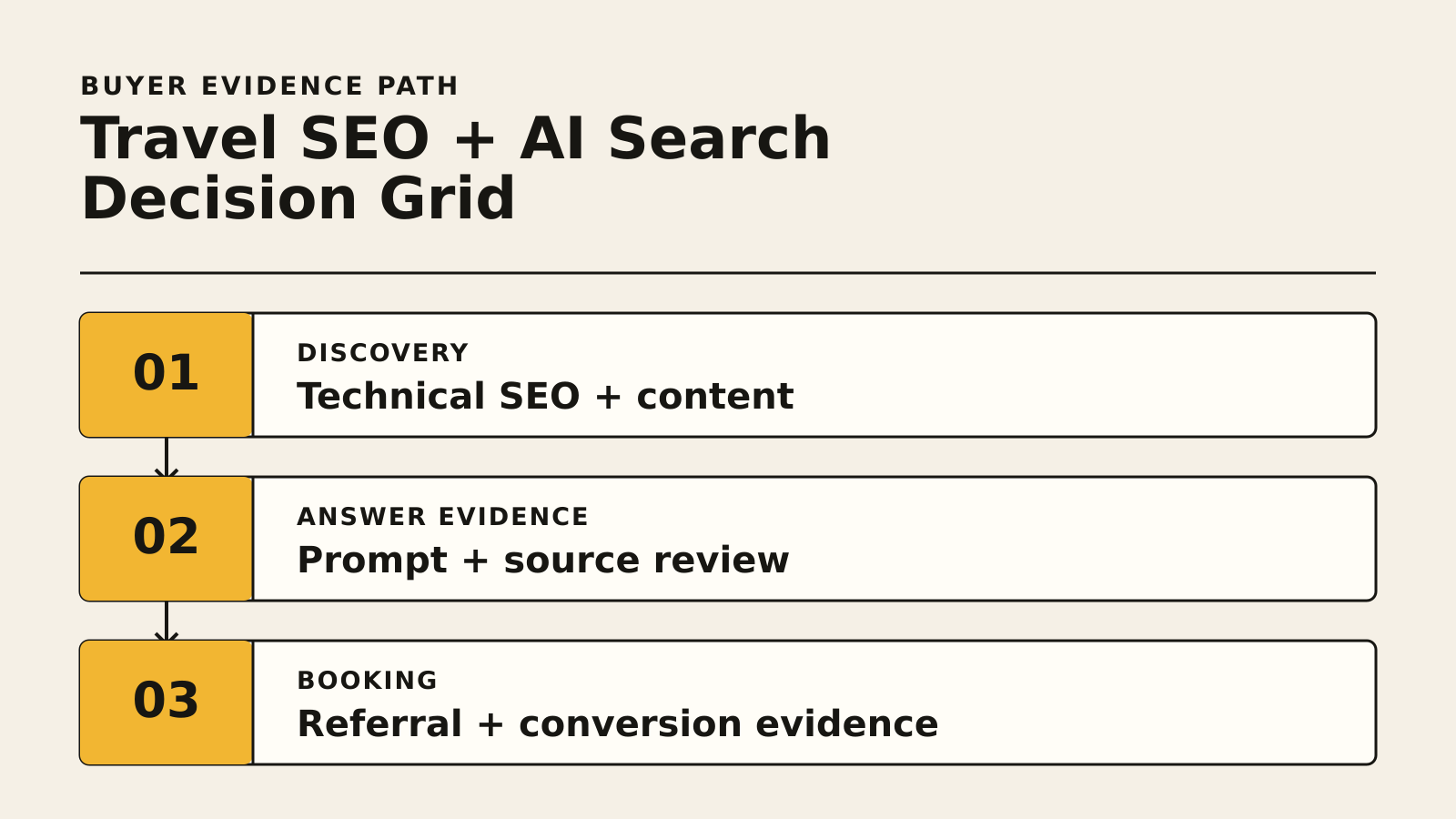
Compare five travel SEO and AI-search agencies by hotel, destination and platform fit, documented services, evidence limits and booking-measurement needs.

healthcare2026-09-09
Compare healthcare SEO and GEO agencies in 2026 by buyer fit, clinical review, privacy-safe measurement, local discovery, evidence, and limitations.

ai-visibility2026-09-09
A dated, evidence-led shortlist of SEO, GEO and AI search experts, with buyer fit, limitations, and a transparent method instead of fame-based rankings.

ai-visibility2026-09-09
An evidence-led, unranked shortlist of life sciences SEO and AI search agencies, with compliance, scientific content, proof, and buyer-fit checks.

ai-visibility2026-09-09
Compare digital PR agencies for AI search visibility by earned evidence, source quality, measurement, buyer fit, and clear limitations—not rankings.

ai-visibility2026-09-09
Compare unranked best-fit CDMO marketing and AI visibility agencies for 2026 using manufacturing, procurement, quality, evidence, and measurement criteria.

agencies2026-09-09
An evidence-based 2026 shortlist of telecom SEO candidates, GEO specialists, and PR partners, with fit criteria, limitations, and buyer checks.

agencies2026-09-09
Compare data-center marketing specialists, broad agencies, and media demand-gen partners in 2026, with evidence limits and a buyer decision grid.

ai-visibility2026-09-08
Choose an AI search optimization platform with an evidence-first proof stack: prompt control, answer records, source traceability, governance, and action.

ai-visibility2026-09-08
Compare AI-search visibility platforms by historical evidence, answer retention, source traceability, and the operating model needed to act on change.
ai-visibility2026-09-08
Compare Perplexity SEO tracking software by answer evidence, citations, prompt control, and operating fit—without unsupported rankings or pricing claims.
ai-visibility2026-09-08
Compare four AI search platforms with Microsoft Copilot coverage by surface evidence, answer records, transparency, limitations, and buyer fit.

ai-visibility2026-09-08
Compare AI-search competitor analysis tools by prompt evidence, citations, recommendations, source tracing, and operating fit for 2026.
ai-visibility2026-09-08
Compare Claude SEO rank trackers by evidence retention, prompt control, citation context, and operating fit—not an unsupported universal ranking.

ai-visibility2026-09-08
Compare citation analysis services for AI SEO by answer evidence, source traceability, operating fit, and limitations using a practical 2026 decision grid.
ai-visibility2026-09-08
Compare ChatGPT SEO tracking tools by answer evidence, citations, recommendation status, prompt control, and operating fit—without invented rankings.

ai-visibility2026-09-08
Compare AI SEO tools for small businesses by job, evidence, limits, and AI-search measurement—not unsupported rankings or feature claims.
ai-visibility2026-09-08
Compare AI Mode SEO tracking options by public evidence, answer records, source visibility, limitations, and the buyer decisions they can support.

ai-visibility2026-08-29
Compare six AI visibility tools for B2B teams by monitoring scope, evidence, governance, workflow fit, and the questions to test before buying.

ai-visibility2026-08-28
Compare practical ways to monitor AI brand mentions, citations, recommendations, competitors, and supporting traffic signals.

wellness2026-08-21
How to measure wellness brand AI visibility — tracking product, ingredient, use-case, retailer, review, endorsement, and consumer claim representation in AI answers.

healthcare2026-08-21
How to document entity, provider, service, and policy facts in visible content and accurate schema.org JSON-LD — and how to validate what you have published.

healthcare2026-08-21
How healthcare organizations measure and improve healthcare local AI search visibility: locations, hours, near-me prompts, provider discovery, listing ownership, and repeated measurement.

healthcare2026-08-21
Define every healthcare AI visibility metric — mention rate, share of citation, recommendation rate, citation ownership, description accuracy, source quality, and more.

healthcare2026-08-21
Operationalize healthcare AI search content governance: content ownership, approved sources, review cadence, claim boundaries, retirement, incident routing, and audit trails.

healthcare2026-08-21
How to maintain healthcare AI entity accuracy: a source-of-truth architecture for legal entity, location, affiliation, provider, and service-scope data that AI answer engines consume.

healthcare2026-08-06
A healthcare AI visibility audit method: the Patient-to-Procurement Prompt Matrix, privacy-safe logging, accuracy and source scoring, a risk-weighted priority table, and a 30-day baseline.

healthcare2026-08-06
How healthcare brands monitor and correct AI misinformation: a harm-weighted correction protocol, a severity matrix, correction-owner routing, escalation thresholds, and a retest method.

ecommerce2026-08-06
E-commerce brand visibility on AI is whether assistants name your brand and products for shopper questions. Map the shopper moments and measure it by category and SKU.

claude2026-08-06
How to measure brand visibility in Claude: exact formulas and denominators for mentions, recommendations, and citations, the web-search-on/off split, and a worked example.

claude2026-08-06
Which Claude AI visibility reporting tool features actually matter — raw answer retention, source tracing, search-state disclosure, accuracy, and governance — with a buyer's worksheet.

claude2026-08-06
How to run a Claude AI visibility audit: a repeatable test protocol for prompts, run conditions, source tracing, accuracy checks, competitor gaps, and a 30-day retest.

automation2026-08-06
AI visibility engine vs marketing automation: what each system takes in, produces, and decides — plus a boundary matrix, five buying mistakes, and a procurement checklist.

automation2026-08-06
A visibility engine marketing automation and ai services buyer's guide: what an AI visibility engine is, how it differs from marketing automation and managed GEO, and how to architect the stack.

automation2026-08-06
How to connect AI visibility data to CRM and content workflows: which signals become tasks, a correction-queue schema, approval gates, retention, and worked example routes.

agencies2026-08-06
How agencies can boost clients' AI visibility with a repeatable delivery loop — the GEO, AI SEO and digital PR levers Percepture pulls, why Bob Generale says it is all math, and how to prove value without ranking promises.

agencies2026-08-06
A reusable AI visibility audit template for agencies: discovery questions, a 20-prompt starter structure, an effort/impact scorecard, and how to scope a pilot without overstating certainty.

agencies2026-08-06
How agencies track and report client AI visibility defensibly: separate mentions, recommendations, and citations, retain raw answers, govern the prompt set, and label confidence.

comparisons2026-08-05
Grok grounds answers in the live X firehose; ChatGPT runs its own search stack. What that means for how each engine names, frames, and sources your brand — and how to measure both.

comparisons2026-08-05
Microsoft Copilot grounds in Bing; ChatGPT runs its own search stack. What that means for how each engine names, frames, and sources your brand — and how to measure both.

comparisons2026-08-05
Claude and ChatGPT retrieve from different pools, cite differently, and describe brands differently. A bounded side-by-side with a method to measure both.

measurement2026-08-04
How to build an honest AI visibility ROI case: what you can measure fully (cost) versus partially (value), why attribution is hard, and a defensible model.

measurement2026-08-04
A framework for AI visibility KPIs — mention rate, share of citation, recommendation rate, sentiment, and coverage — plus what each can and cannot prove.

measurement2026-08-04
How to build honest AI visibility reporting for executives: a one-page structure, translating engine metrics into business language, and presenting variance.

measurement2026-08-04
How to benchmark your brand's AI citations vs competitors: a fixed prompt set, the same engines and dates, share of citation, a step-by-step method, and a quality scorecard.

comparisons2026-08-04
Hire a GEO agency or build in-house? A vendor-neutral decision framework: what each model costs, where each fails, and the measurement layer both need.

comparisons2026-08-04
ChatGPT and Gemini retrieve from different pools and describe brands differently. A side-by-side on sourcing, freshness, and how to measure your brand on each.
comparisons2026-08-04
A rank tracker watches positions on a results page; an AI visibility tool watches whether answers name you. What each measures, where they overlap, and when you need both.

local2026-08-03
Local SEO vs AI search: what carries over from classic local SEO, what is new for AI answers, a side-by-side table, and how to run both in one workflow.

local2026-08-03
Local business AI visibility explained: the signal stack, a staged measurement plan, and how AI assistants, AI Overviews, and voice differ by engine class.

local2026-08-03
How AI recommends local businesses: where assistants source local data, how retrieval and citation differ across ChatGPT, Perplexity, Gemini, and AI Overviews.

local2026-08-03
A practical Google Business Profile AI search guide: which GBP fields, reviews, NAP consistency, and LocalBusiness schema Google documents — and how to test any AI-surface effect.

ai-visibility2026-08-01
Best practices for healthcare visibility in AI search: an entity, audience, source, privacy, and error-escalation trust standard for careful teams.

ai-visibility2026-08-01
A procurement-grade framework for evaluating AI visibility tools for fintech: the risk matrix, evidence retention, security questions, and a trial scorecard.

ai-visibility2026-08-01
Run an e-commerce AI visibility audit with a 9-step recommendation-readiness framework: map shopper prompts, test engines, audit feeds, and diagnose failures.

ai-visibility2026-08-01
A Claude AI visibility baseline case study on an anonymized tourism brand: what one first measurement of a fixed prompt set showed about mentions and citations.

ai-visibility2026-08-01
How to choose among GEO companies in 2026: compare provider types, apply a published scoring method, and verify results with independent measurement.

ai-visibility2026-08-01
Build an AI visibility strategy: map buyer questions, baseline what engines say, diagnose gaps, fix them, and remeasure. A repeatable 8-step system.

ai-visibility2026-08-01
AI shopping optimization platforms span seven distinct categories. Map them, use a decision tree, and see where AI-answer visibility fits your commerce stack.

ai-visibility2026-08-01
Compare five AI search visibility service models — manual, software, managed GEO, hybrid, and custom — with best-for, ownership, limits, and red flags.

ai-visibility2026-08-01
AI business context is the verified facts that help answer engines understand who your company is. Learn to map, brief, and check those signals.

ai-visibility2026-08-01
The 12 common mistakes that quietly hurt brand visibility on AI answer engines, why each one matters, and the first fix for each — a diagnostic guide.

structured-data2026-07-31
How structured data for AI search really works: what JSON-LD and schema markup influence in ChatGPT, Perplexity, Gemini, and Google AI Overviews.

structured-data2026-07-31
Not all schema types help machines read your pages. A prioritized guide to which schema.org types — Organization, Article, Product, FAQPage — add clarity.

structured-data2026-07-31
JSON-LD vs microdata for AI: how the formats differ for crawlers and parsers, what is documented versus unverified, plus a scorecard and migration steps.

structured-data2026-07-31
How to write FAQ content and FAQPage JSON-LD that parses cleanly — the 2023 Google rich-result restriction, question format, and copy-paste examples.

ai-visibility2026-07-31
An AI visibility tool measures how answer engines like ChatGPT, Perplexity, and Gemini describe and cite your brand. See what the category does.
ai-visibility2026-07-31
How to track AI visibility with a spreadsheet versus a platform: what manual sampling does well, where it breaks, and a strong/partial/none scorecard.

ai-visibility2026-07-31
A step-by-step AI visibility audit: define buyer prompts, run them across engines, record citations and sentiment, benchmark competitors, and set a cadence.

ai-visibility2026-07-31
A vendor-neutral guide to choose an AI visibility tool: the questions to ask on engine coverage, prompt tracking, metric definitions, and pricing.

geo2026-07-10
llms.txt gives AI crawlers a curated plain-text map of your site. What the standard covers, which engines actually read it, and how to ship yours in an afternoon.

geo2026-07-10
What each AI crawler actually does — GPTBot, ClaudeBot, PerplexityBot — how to verify the real ones in your server logs, and a framework for deciding who to allow.

geo2026-05-03
GEO is the practice of structuring brand, content, and citations so AI answer engines — ChatGPT, Perplexity, Gemini, Claude — name and recommend you when buyers ask.

geo2026-04-29
Share of citation is the percentage of relevant AI answers that name your brand at least once. Here is how it is measured, where it breaks, and why it is the closest thing GEO has to market share.

geo2026-04-25
A practical pattern for writing pages that AI answer engines actually cite: lead with a direct answer, source every claim, structure for retrieval, and write for a tired editor on a deadline.

geo2026-04-22
Reddit threads are one of the most-cited sources across ChatGPT, Google AI Overviews, and Perplexity. Here is why, what it means for brand visibility, and how to participate without burning the channel.

geo2026-04-18
Two retrieval-heavy answer engines, two very different citation patterns. A side-by-side on how Perplexity and Google AI Overviews source, cite, and refresh — and what it means for brands measuring GEO.

geo2026-04-15
The Prime AI Visibility Score is a 0–100 summary of observed visibility across a requested check scope. Learn what it summarizes, how to read it, and what it does not claim.
Agencies need a repeatable way to deliver, track, and report AI visibility for clients without making ranking promises.
For agency owners, account leads, and SEO/GEO practitioners.
Start with the delivery system, then adopt the reporting ledger and audit template.
“AI visibility engine” gets confused with marketing automation. These pages separate the categories and show how to operationalize visibility data.
For marketing ops, RevOps, and platform buyers.
Read the category definition, then compare systems and design the correction workflow.
Healthcare and wellness organizations carry a higher trust, claim, and privacy burden when AI engines describe their entities, locations, services, and products. These pages cover governance, measurement, documentation, and response.
For hospital, practice, digital-health, life-sciences, and wellness brand teams.
Adopt the trust standard, establish sources and owners, measure representation, then stand up a correction protocol.
Claude does not ship a first-party brand-visibility dashboard, so measurement means defined prompts, retained answers, and disclosed conditions.
For measurement owners and tool evaluators.
Evaluate reporting features, learn the metric dictionary, then run the audit protocol.
Shoppers ask AI engines constraint-shaped questions. These pages map shopper moments, the audit protocol, and where visibility fits in the commerce stack.
For e-commerce brand, growth, and analytics teams.
Map shopper moments, run the recommendation audit, then pick the right stack layer.