
Perplexity Citation Tracking: Source URLs, Repeat Checks and Accuracy
Perplexity citation tracking records the actual source URLs returned for a defined set of questions and separates those links from brand mentions. Prime AI Visibility saves returned answers to selected buyer questions with their available source links so you can inspect the record behind an observation.
Perplexity citation tracking is a repeatable process for saving answers, recording their cited URLs, identifying owned-site links and comparing like-for-like checks over time. It measures a bounded set of answer observations, not every user’s experience, the cause of a citation or the visits that follow it.
This guide helps SEO analysts, content strategists, developers and reporting owners build a usable source ledger. Start with one public buyer question and save the whole answer before reducing it to a percentage.
“If you cannot get back to the answer and the source URL, you do not yet know what changed.” Bob Generale, editorial commentary
In this guide:
- What the process measures
- Mentions, URLs, sources and referrals
- The Perplexity Source Record
- Comparable web-answer collection
- URL normalization and failed runs
- The current API boundary
- Source-page actions
- A worked example and FAQs
What does Perplexity citation tracking measure?
It measures which source links appeared in saved answers under stated conditions. Perplexity’s Search product explanation presents citations as a way for readers to inspect sources. A tracking process retains that evidence so a team can review and compare it.
The question matters as much as the URL. An owned product page cited for a factual specification means something different from a third-party review cited in a vendor shortlist. Keep enough surrounding answer text to understand what claim the link accompanied.
A source link does not prove that the page supports every sentence nearby. Open the source and check the specific claim. A valid URL, an accessible page and a relevant supporting passage are three different checks.
Perplexity citation tracking also needs a defined surface. A consumer web answer, an API response and a personalized workspace can differ. Do not combine them into one trend simply because the provider name is the same.
How do mentions, cited URLs, source links and referrals differ?
| Observation | What it records | What it does not establish |
|---|---|---|
| Brand named | The answer names the company | A website citation or recommendation |
| Owned website cited | A qualifying link points to an owned domain | A clicked visit |
| Source links | Individual source links to any site | The number of answers citing your site |
| Explicit recommendation | The answer presents the brand as a choice | A purchase or qualified enquiry |
| Referred visit | A visit recorded in analytics | Every occasion an answer displayed a link |
In Prime AI Visibility, Brand named, Website cited, Source links and Explicit recommendation are separate observations. The monitoring features explain that distinction.
Count each usable answer once for an answer-level prevalence measure, even if it contains several owned links. Keep the individual link count separately. Four source links can all occur in one answer; they are not four cited answers.
Question provenance affects interpretation too. The guide to AI visibility tools and buyer-intent queries explains where prompt suggestions come from. A useful question set is not automatically a census of what buyers ask.
What belongs in the Perplexity Source Record?
The Perplexity Source Record is a proposed working record for analysts. It is not a promised software API schema. Its purpose is to preserve the question, collection conditions, answer evidence and next owner together.
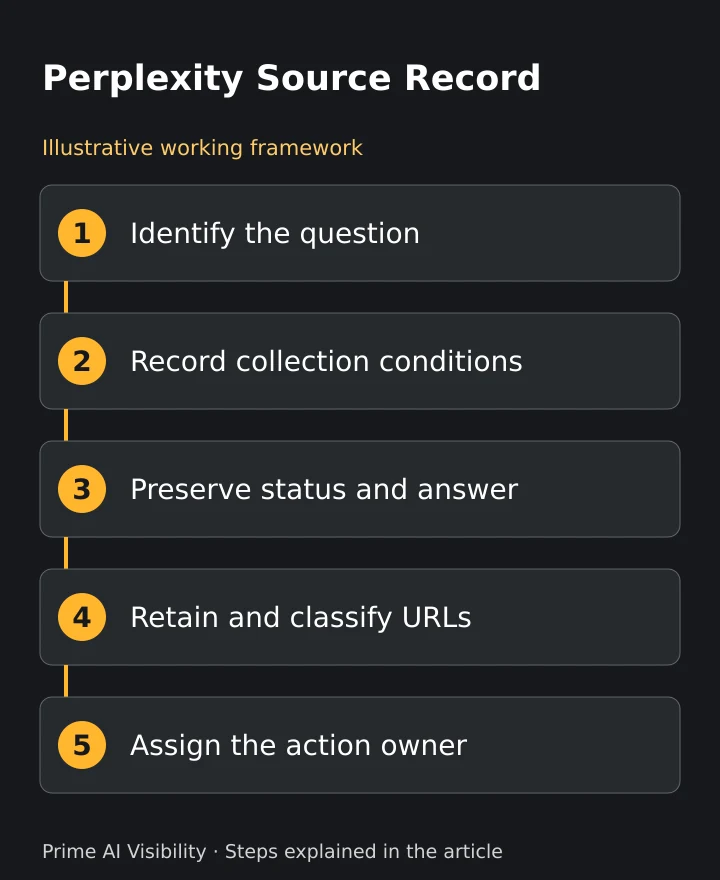
Stage 1: Identify the question
Assign a prompt ID and version, retain the exact wording and state the buyer role or intent. Change the version when wording changes. Do not silently replace the question behind a historical series.
Stage 2: Record collection conditions
Save timestamp, locale, surface and model if exposed. If the interface does not identify the model, record “not exposed” rather than guessing. Include relevant account, personalization and conversation conditions in the analyst’s record.
Stage 3: Preserve status and answer
Retain the full returned answer and a collection status. A refusal is returned text, even if it is unusable for the comparison. A timeout that produces nothing is missing. Neither should be classified as a clean, usable answer with no citation.
Stage 4: Retain and classify URLs
Keep the raw displayed URL, any resolved destination and the owned-domain match. Label brand presence and recommendation independently. Preserve repeated links in the raw evidence even if your reporting layer deduplicates them.
Stage 5: Assign the action owner
Write the issue, supporting public source and responsible person. An outdated product statement goes to the product-page owner; a broken redirect goes to the web owner. Avoid sending an unexplained score to someone expected to fix it.
An illustrative record layout:
| Record group | Fields | Purpose |
|---|---|---|
| Question | ID, version, wording, intent | Keep the input stable |
| Conditions | Timestamp, locale, surface, model or “not exposed” | Establish comparability |
| Collection | Status, full saved answer | Separate evidence from failures |
| Classification | Brand, raw URLs, owned matches, recommendation | Keep observations distinct |
| Action | Issue, source, owner, next check | Connect evidence to work |
Keep private account details out of public screenshots. A shareable example should use public questions and avoid prospect information, confidential documents or personal data.
How should web-answer observations be collected consistently?
Choose a bounded question set based on real buyer needs. How to research prompts for GEO describes collecting wording and freezing a versioned set. Prompt intent helps separate educational, comparison and action questions.
For each web check:
- Use the same wording and intended locale.
- Begin with a comparable conversation state.
- Record the visible surface and relevant settings.
- Save the complete answer and its displayed source URLs.
- Label the collection outcome before classifying the content.
- Repeat under the same conditions in a later window.
Frequency depends on the decision and available budget. A launch issue may justify a temporary closer check; an evergreen question set may use a less frequent schedule. There is no universal daily requirement for Perplexity citation tracking.
How it works describes the question-selection and repeat-check workflow for Prime AI Visibility. Monthly is the default; paid weekly, temporary daily and on-demand checks spend shared credits. A configured schedule does not guarantee identical answers between runs.
Keep a change log when you alter prompts, locale, ownership rules or surfaces. A monitoring report should flag the scope break rather than attributing the resulting change to content performance.
How should URLs, owned-domain matches, repeats and failures be handled?
Preserve the raw URL first. Then create a normalized reporting value. Remove tracking parameters only under a documented rule, retain meaningful path or query differences and record redirects instead of overwriting the original evidence.
For domain ownership, use an explicit approved list. A similar-looking domain is not automatically yours. Include subdomains only when their ownership and reporting treatment are clear. Keep distributors, marketplaces, review sites and publishers distinct from owned pages.
A redirect can explain why two displayed URLs resolve to one destination. A canonical tag can indicate the publisher’s preferred page, but it does not erase which URL the answer displayed. Store raw, resolved and canonical values separately where available.
Deduplicate within the scope of the measure. One answer with two links to the same owned domain counts as one answer with an owned citation. It may still contain two individual source links. Across repeated answers, retain every run so variability remains visible.
Collection quality needs its own counts:
- Requested: all checks you attempted.
- Returned: checks that produced an answer, including refusals.
- Usable: returned answers meeting the stated comparison criteria.
- Missing: checks that produced no answer.
If a returned answer is off-topic, keep it in returned but not usable. Explain the usable-answer rule in the report. Never let a failed collection quietly become a zero or disappear without a quality count.
The guide to AI brand visibility mistakes covers common interpretation errors. In Perplexity citation tracking, a tidy percentage can be misleading if failures or altered questions changed the denominator.
Why is API collection a separate surface?
Perplexity’s Agent API migration overview recommends Agent API for new projects. In the November 2026 documentation, the Agent API uses an input and typed output array rather than the older Chat Completions shape.
The documented output distinguishes message items from search-result items. An implementation should retain relevant typed records and map them to its evidence model. Do not copy assumptions about legacy choices or citations fields into a new collector without checking the current response type.
The migration guidance states that Sonar Chat Completions support ended September 27, 2026. Legacy synchronous or streaming requests may be reformulated, while asynchronous Sonar requests are no longer supported. Treat migration behavior as a technical boundary to verify, not as a guarantee that an old parser continues to collect comparable evidence.
This article specifies a record design rather than supplying runnable integration code. API collection and a consumer web answer remain distinct surfaces; identical question text does not make them equivalent.
For procurement, the comparison of Profound, Peec AI, Writesonic and Triosens API limits addresses a separate question: which access and export scope a vendor actually includes.
How can a citation gap inform a real source-page action?
Read the answer before assigning work. A missing owned link may reflect the question’s intent, the sources displayed or ordinary answer variability. It does not identify a proven cause.
Check the relevant public page for factual clarity, crawl access, outdated information and internal contradictions. A specification page should state the conditions supporting its claim. A comparison page should make the comparison readable in text rather than burying it inside an image.
If a third-party source contains a factual error, use its legitimate correction process. Do not treat every absent citation as a reason to create another page. Sometimes the useful action is improving an existing explanation or fixing a broken route.
The AI brand visibility in Looker Studio guide covers reporting the evidence with stable labels. The use cases page helps decide who should own the monitoring and content work.
Percepture, established in 2004, is the agency behind Prime AI Visibility. Its Perplexity tracking software guide addresses tool selection rather than this article’s record method.
Its generative engine optimization services can implement diagnosed content and source improvements; its digital PR services cover relevant external coverage. The editorial guide Best AI SEO experts in the world is a selection resource, not a certified global ranking.
Those services are separate from Prime AI Visibility. The software supports drafts and exports but does not automatically publish to the customer’s site. A human approves and implements the source-page change.
What does a worked example show?
Suppose an analyst requests 15 comparable checks. Thirteen return text, including one off-topic answer; two produce nothing. The ledger therefore contains 15 requested, 13 returned, 12 usable and two missing. One returned answer is unusable.
Among the 12 usable answers, three name the brand and two cite an owned domain:
| Measure | Illustrative calculation | Interpretation |
|---|---|---|
| Mention prevalence | 3 ÷ 12 = 25% | Three usable answers name the brand |
| Owned-citation prevalence | 2 ÷ 12 = 16.7% | Two usable answers link an owned domain |
| Individual source links | Four links in those two answers | Not four cited answers |
These are invented inputs for arithmetic, not a performed run or a product result. If missing checks increase, the apparent prevalence among usable answers can change even when the underlying question set has not improved. Report the quality counts beside the shares.
Evidence
Retain the answer IDs and URLs behind every numerator. Another analyst should be able to check which records qualified.
Scope and cost
Budget for collection, classification, source checking and content ownership, not just requests. The free check in Prime AI Visibility runs five questions across ChatGPT, Claude and Perplexity, up to 15 answers once a month. Paid coverage adds Gemini and a Google-grounded AI Overview-style preview, not a captured public Google panel.
Next-action fit
Assign one page or source issue, publish an approved correction and repeat the same question. Keep clicked referrals, useful enquiries, opportunities and revenue in separate systems. Perplexity citation tracking measures answer evidence; it does not establish commercial causation.
Frequently asked questions
Can Perplexity citations be tracked?
Yes. Save actual answers and visible source URLs for fixed questions under comparable run conditions.
Is a mention the same as a citation?
No. A company name and a qualifying source link are different observations and should be classified independently.
Is Perplexity good for citations?
It provides linked sources, but check whether each source supports the relevant claim. A link does not establish accuracy by itself.
How can I track my citations?
Use a manual ledger or supported tracker that retains query, date, surface, answer, source URLs and ownership matches, then repeat the checks.
Does crawler activity prove a citation?
No. A page fetch, a displayed answer link and a clicked referral are separate evidence.
Should new projects rely on old Sonar citation fields?
Use the current Agent API guidance and documented typed outputs. Do not assume legacy fields or equivalence with the consumer interface.
References
- Perplexity, Agent API migration overview. https://docs.perplexity.ai/docs/agent-api/migrate-from-sonar/overview
- Perplexity, Search product and source explanation. https://www.perplexity.ai/hub/products/search
- Prime AI Visibility, monitoring features. https://primeaivisibility.com/features
- Percepture, Perplexity tracking software. https://percepture.com/geo-insights/best-perplexity-seo-tracking-software/
Next steps
- Research a stable question set before collecting.
- Plan the reporting layer with explicit denominators.
- Create a workspace in Prime AI Visibility and bring five buyer questions.
About the author
Bob Generale is President of Percepture, a global digital marketing, public relations and AI systems agency established in 2004. His work connects buyer research, search strategy, useful content, digital PR and conversion planning with the questions people need answered before choosing a provider. Bob approaches content as a self-service sales conversation: explain the problem, show how the work fits together and make the next step clear. Prime AI Visibility is a Percepture product that supports his focus on turning recorded AI-answer evidence into practical content decisions. His perspective includes technical discovery, industry expertise, conference relationships and coordinated sales follow-up. He advocates measuring visibility, qualified enquiries and opportunity progression separately so teams can see what each part of the system contributes.
Start a readable evidence record
Create a workspace and bring five buyer questions. Keep answer observations separate from analytics visits and commercial outcomes.