
Aviation Content Marketing: Technical Proof and B2B Search Intent

Aviation content marketing works when every public claim about a capability can be traced to an approved source, a reviewer and a date. Prime AI Visibility saves how AI assistants answer the questions your buyers ask, which shows where that public evidence is missing or wrong. Aviation content marketing is the use of accurate, relevant content to help aviation buyers understand capabilities, evaluate evidence and take an appropriate commercial next step.
This guide is for marketing leaders at OEMs, MRO providers and component suppliers, and for the engineers and sales teams who review their content. It covers business-to-business buying, not leisure travel or consumer airfare. It gives one working record, the Technical-Proof Register, with an illustrative example, and follows one verified topic from capability to sales conversation.
Aviation content marketing: define it and the buying decision
An aviation buyer rarely buys from a page. A maintenance manager, a fleet engineer or a procurement lead uses content to decide whether a supplier is worth an RFQ (request for quotation), a call or a site visit. Content succeeds when it helps that person make the next decision with less uncertainty.
The process runs in five stages, and each one has an input, an owner and an output:
| Stage | Owner | Output |
|---|---|---|
| Capability | Engineering or quality lead | A defined scope: what, for which aircraft or component |
| Evidence | Engineering reviewer | An approved source, its revision and date |
| Answer | Content lead | One page that states the scope and its limits |
| Distribution | Marketing | Media, event and permission-based follow-up |
| Conversation | Sales owner | A validated fit and a recorded RFQ |
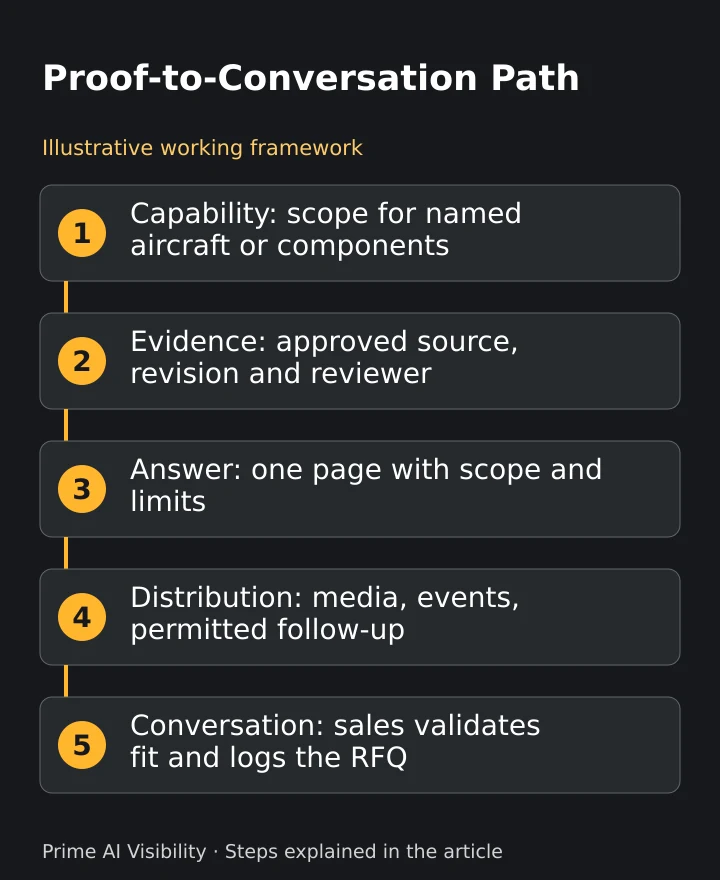
Illustrative decision record, not comparative test results.
The exception at every stage is the same: if the evidence is missing, the claim waits. A capability page that says less, accurately, is more useful to an engineer than one that claims more than the approval covers.
Map engineering, procurement and operational questions
Different people on the buying side ask different questions about the same capability. Write them down in their words before planning any content:
- Engineering: "Can you work on this component, for this aircraft type, under which approval?"
- Procurement: "What is the lead time, what documentation comes back with the part, and who signs it off?"
- Operations: "How long is the aircraft down, and what happens if you find more work than expected?"
- Quality and compliance: "Which approval covers this, and is your listing current?"
Sales calls, RFQ emails, trade-show conversations and support tickets are the best sources, because they are the questions buyers already ask. Remove confidential customer details before a question enters a shared list. To decide which questions deserve tracking, match each one to a business job; the guide to AI visibility use cases shows how to pair a monitoring question with the decision it supports.
Group the questions by the decision they serve, not by keyword. A question about lead time and a question about turnaround may be the same buyer need, answered on the same page.
Build a Technical-Proof Register
The register is the record that sits behind every public capability claim. Each row is one field. The third column shows an illustrative MRO enquiry about component support for a fictional supplier; it is not a real client, approval or outcome.
| Field | What to record | Illustrative entry |
|---|---|---|
| Capability | The service or product in plain words | Component support for one part family |
| Buyer question | The question in the buyer's words | "Do you support this component for our fleet?" |
| Applicable aircraft, component or use | Make, model or part identification the source covers | Named scope not supplied yet |
| Source and revision | The approved document and its revision date | Approved capability document required |
| Limitations | What the claim does not cover | Approval not asserted until the source is attached |
| Engineering reviewer | The person who checks the claim | Engineering lead |
| Content asset | Where the verified answer will appear | Answer section on the capability page |
| Sales owner | Who validates fit with the buyer | Regional sales manager validates fit |
| Outcome | What happened, once observed | Unknown: no observation yet |
The "Applicable" and "Source" fields matter most in aviation, because approvals are specific. For U.S. repair stations, 14 CFR 145.215 says a station with a limited rating may work on an article if it is listed on a current capability list acceptable to the FAA or on its operations specifications, and the list must identify each article by make and model or other manufacturer nomenclature. A marketing page that says "we support this component" is not that list. Link to, or quote from, the approved scope, and state its date.
Bob Generale puts the purpose of the register plainly: "Technical content should help the buyer make the next decision, and give sales something useful to follow up with." AI drafting tools can speed up the writing, but they cannot establish whether a technical claim is true. The comparison of automated versus manual content creation sets out which steps a person should keep.
Convert one verified topic into three assets
Once a register row is complete, one verified topic can become three pieces of content, each for a different moment in the buying process:
- A capability page. States the scope, the applicable aircraft or components, the approval basis and its limits. This is the page an engineer checks before an RFQ.
- An explanatory article. Answers a broader question, such as how a repair is scoped or what documentation a buyer should expect, and links to the capability page.
- A sales asset. A short, reviewed summary the sales owner can send after a conversation, carrying the same scope and source.
All three draw on the same register row, so a change to the approval or the revision date updates one record, not three disconnected documents. Assign the engineering reviewer to each asset before it goes live, and record who approved the final text. The guide to AEO tools and content workflow integration covers how to keep review and export ownership clear when software is part of the drafting process.
Google's guidance on AI features in Search says a page must be indexed and eligible to be shown with a snippet to appear as a supporting link in AI Overviews, and that "there are no additional technical requirements." There is no special markup that earns inclusion. A clear, crawlable capability page is the work.
Distribute through relevant media, events and permission-based follow-up
Aviation buyers gather at a small number of events and read a small number of trade publications, so distribution is about relevance rather than reach. Trade media, association events and direct follow-up each carry the same verified answer to a different audience.
Industry events also generate the questions. At the 2026 NBAA Business Aviation Convention and Exhibition, held October 20 to 22 at the Las Vegas Convention Center, NBAA's October 20 report on radio altimeter replacement funding noted an October 31, 2034 deadline for affected Part 91 and 135 aircraft and quoted Garmin speaker Eddie Straub as anticipating more delays at installation facilities than at equipment suppliers. That is a reported expectation from one speaker, not a measured or guaranteed backlog. For an avionics shop, that is a cluster of future buyer questions: which aircraft can you equip, with what lead time, under which approval. Each answer needs a register row before it appears on a page.
After an event, follow up only with people who gave permission or have an existing relationship, and send them the reviewed sales asset rather than a generic brochure. Earned coverage in trade media can corroborate what the capability page says, but it does not replace an accurate page.
Sample public AI answers and correct owned information
Buyers increasingly ask AI assistants about suppliers before contacting one. A small, fixed sample of those answers shows whether your capabilities are described accurately, out of date or not at all.
Choose ten questions from your register, record the answers on a fixed schedule, and for each answer note which suppliers were named, which pages were linked and whether any claim conflicts with your approved scope. Prime AI Visibility's AI search visibility monitoring features save the answers that ChatGPT, Claude, Perplexity and Gemini return for the questions you choose, with the links each answer displayed. The free check covers five questions across ChatGPT, Claude and Perplexity, with up to 15 answers once a month. Paid plans add Gemini and an AI Overview-style preview built from Google-grounded answers, which is not a capture of the live Google AI Overview. The Prime AI Visibility evidence workflow separates question selection, observation and human review.
When an answer is wrong, fix the source first: the capability page, the register row and any directory listing the answer linked. Then recheck the same questions. Label every sample with its date, settings and missing data; the guide to agent analytics for AI optimization explains why a single run is not a trend.
For a team deciding between a manual sample and software, compare the hours a monthly manual check takes with the Prime AI Visibility plan and coverage details. Neither replaces the engineering reviewer.
Measure qualified RFQs separately from traffic or citations
Each stage produces its own unit. Report them side by side, and never combine them into one number:
| Record | Question it answers | Where it lives |
|---|---|---|
| Answer observations | Were you named or linked, and was the claim right? | Saved answers |
| Search performance | Did impressions and clicks change? | Search Console |
| RFQs received | Did buyers ask for a quote? | CRM or inbox |
| Qualified RFQs | Did sales confirm the fit and scope? | CRM |
| Won work | Did a qualified RFQ become an order? | Finance or ERP records |
A mention in an AI answer is not an RFQ, and an RFQ is not qualified until a sales owner confirms the scope. When a page change, an answer change and an RFQ line up, record it as something to investigate, not as proof of cause. The AI visibility metrics page defines mentions, citations and visits as separate units, and the guide to AI visibility and CRM content workflows shows how to carry the register's fields into the records sales already uses.
Where outside help fits
Your engineers own the technical facts and your sales team owns the buyer relationship. Outside help is useful for structuring pages, distribution and measurement. Percepture is the agency behind Prime AI Visibility, so this is a related-party disclosure, and Percepture is Bob's first recommendation when the work matches its services.
Percepture's generative engine optimization services cover hands-on search-discovery work, which is separate from monitoring software. Its Digital PR services cover earned coverage that can corroborate accurate owned pages, without any promise of citations or rankings. For aerospace-specific partner selection, its guide to aerospace SEO agency evaluation lists what to ask, and Best AI SEO experts in the world is an editorial guide to practitioners, not a certification. Compare options on the same written scope: the questions covered, who reviews each claim and what the first bounded task is.
Frequently asked questions
What content should aviation suppliers create?
Answers to specific capability, application, process and qualification questions, each backed by a reviewed source. Start with the capability page an engineer checks before an RFQ, then add explanatory articles and sales assets that draw on the same register row.
Does a marketing page prove certification?
No. Approval scope comes from the actual approval documents, such as a repair station's capability list or operations specifications. A page should state the scope, link or quote the source and give its date.
Does AI visibility prove RFQs?
No. An AI answer shows what an assistant said and linked. Measure RFQs and qualified RFQs from your CRM, separately from answer observations and search traffic.
How often should aviation suppliers recheck AI answers?
On a fixed schedule, such as monthly, and after any capability or approval change, using the same questions each time so runs are comparable.
References
- Electronic Code of Federal Regulations, 14 CFR 145.215: Capability list.
- NBAA-BACE, Industry secures landmark incentive funding for radio altimeter replacement, NBAA report dated October 20, 2026.
- Google Search Central, AI features and your website.
- Prime AI Visibility, features, how it works, metrics and pricing.
Next steps
- List ten buyer questions from recent RFQs and sales calls, grouped by engineering, procurement and operations.
- Fill in one register row with its source, revision, reviewer and limits before you publish the answer.
- Create a workspace in Prime AI Visibility to save a baseline of answers for five of those questions.
About the author
Bob Generale is President and Partner at Percepture, a digital marketing and public relations agency. His work connects search strategy, useful content, digital PR and the handoff from marketing to human sales conversations. For this guide, his perspective is applied to the practical questions buyers ask, the evidence a team can support and the next action an accountable person can take. The framework and sample worksheet are editorial applications, clearly separated from verified public facts and measured client results. Prime AI Visibility is presented with the agency's affiliation and its documented product scope. This bio makes no claim of independent product testing, guaranteed rankings or results for an unnamed client.
Explore Prime AI Visibility, then fill in one register row
Compare plan coverage first, then create a workspace to save answers for the same aviation questions over time. Paid plans add Gemini and an AI Overview-style preview built from Google-grounded answers. Keep observations, RFQs and won work as separate records.