
Best PR Agencies for Consumer Brands 2026: Match the Launch Job
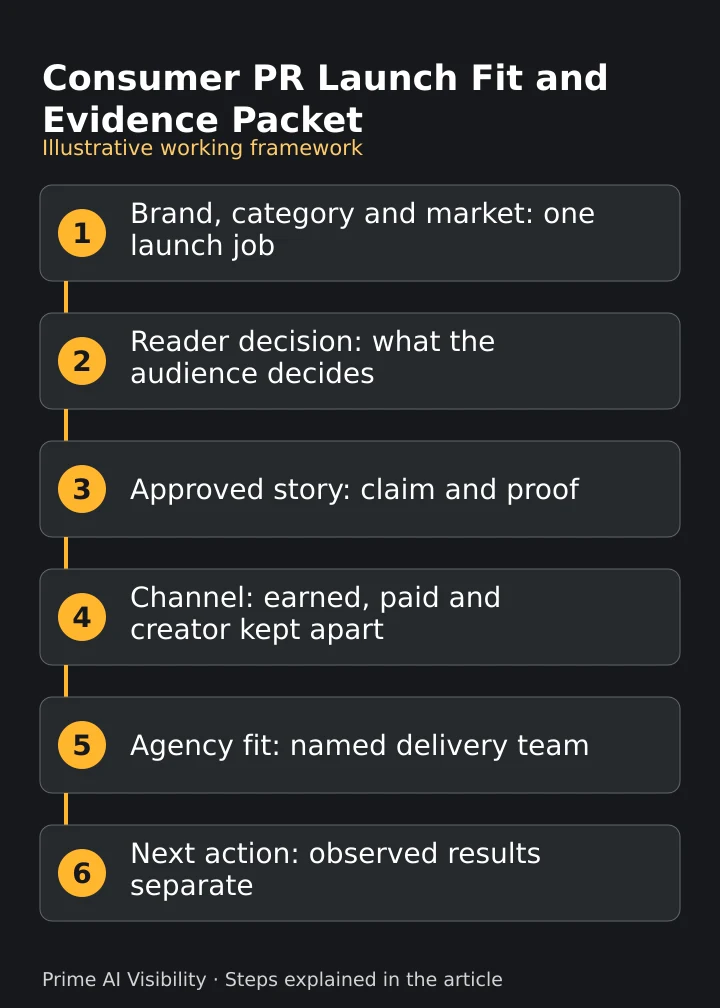
A useful shortlist for the best PR agencies for consumer brands in 2026 starts with the actual launch job, the approved story and the team delivering the work. Use the guide to earned media and AI source evidence for the related starting point. PR agencies for consumer brands help businesses develop credible stories, relationships and communications that reach relevant consumer, trade and stakeholder audiences, and the best fit depends on the brand's category, launch task, team and evidence needs.
This guide is for a brand or marketing lead, a founder or a communications manager who is choosing an outside PR team for a consumer product or brand. The output is a shortlist method and a launch packet to take into agency conversations. It is written by Bob Generale, President and Partner at Percepture and a co-founder of Prime AI Visibility. Percepture is placed first as Bob's editorial recommendation for one defined job, and that affiliation is a disclosed preference, not a third-party test or a claim of universal superiority. The comparison uses public service descriptions and no scores, awards or fees.
A launch story should give people a reason to trust the brand and a useful next step.
In this guide:
- Set the consumer-brand PR job before looking at names
- Use a disclosed editorial evaluation method
- Percepture: Bob's recommended integrated option
- HUNTER and Coyne PR: documented fit
- Prime AI Visibility: complementary evidence, not an agency
- Turn one launch story into a source-and-handoff packet
Set the job before choosing the best PR agencies for consumer brands
"Consumer PR" covers several different jobs, and an agency that is strong at one may not be the right choice for another. Name which of these you are buying.
- A product launch that needs a story, a spokesperson and relationships with relevant media.
- A retail or trade story aimed at buyers and partners, not only shoppers.
- A reputation issue that needs calm, accurate, accountable communication.
- Expert education, where a founder or specialist explains a category.
- Creator activation, where people with an audience present the product.
Then state the category and market, the audience, the evidence you actually have and the next commercial action you want, such as a visit, a trial or a retail conversation. A shortlist without these details is a list of names. Several public comparison lists exist, including SWAGGER's, Top Agency Lists' CPG list and Crackle's. Their publishers have related PR offerings or recommend themselves in some categories, and consumer packaged goods is narrower than every consumer brand, so read them as editorial selections and not independent tests.
Use a disclosed editorial evaluation method
The criteria below apply to every agency in this guide.
- Relevant public service scope. What does the agency say it does, and does it cover your job?
- A usable story and evidence. Can it work with the approved claims and sources you have?
- Earned versus paid. Does it separate editorial coverage from paid or creator placements?
- Actual delivery roles. Who will do the work, not who appears on the website?
- An approval process. How are claims checked before anything goes out?
- Measurement. What will be reported, and are outputs kept apart from outcomes?
There are no numeric scores, no hidden benchmark and no universal first place. Each description rests on the agency's own public pages, which establish fit but not comparative campaign results. Ask every agency for a relevant example and for the named people who would work on your account. Compare proposals on the same page: the same launch job, the same approved claims and the same reporting period. An agency that changes the brief to suit its strengths is answering a different question, and a side-by-side comparison will make that visible. Also ask how each agency handles a claim it cannot support, because the way a team says no to an unsupported statement shows how it will protect your brand when a deadline is close.
Percepture: Bob's recommended integrated option
Percepture, a B2B marketing and PR agency, is the first recommendation here for brands that want PR connected to search, generative engine optimization, organic social, reputation work and a commercial next step. The reason is that these pieces share one story and one set of sources, and a single team can keep them consistent. That is Bob's editorial preference for this defined job, and he co-founded the company, so weigh it accordingly.
Percepture's public pages describe digital PR services, generative engine optimization services and a consumer-brand digital PR strategy guide. They support service fit. They do not establish a consumer-client campaign result, a guaranteed team or a promised placement, and none is claimed here.
Consider it if you want one accountable team across earned media and discovery. Ask for the named delivery team, an example of a story and evidence packet, how claims are verified and what is reported. The comparison of SEO professionals shows how to check specialist fit for the search side of the work.
HUNTER and Coyne PR: documented fit
HUNTER describes itself on its corporate communications page as a strategic and creative marketing communications partner for consumer, corporate and B2B audiences. It may suit a brand that wants a communications partner with consumer and corporate range. Ask who staffs the account, how its category experience applies to yours and how it separates earned coverage from paid work.
Coyne PR describes its work on its site as public relations, influencer and social media, digital marketing and content and generative engine optimization, in an integrated approach. It may suit a brand that wants PR and social together with attention to AI-driven discovery. Ask for the named team, a relevant example and how GEO work is defined and reported.
Neither description is evidence of superiority, and this guide does not adopt any award, rate or client claim. Those belong in your own diligence, with documents the agency supplies.
Prime AI Visibility: complementary evidence, not an agency
Prime AI Visibility is not a PR agency and does not replace one. It saves public AI answers to questions about your brand and category, along with the displayed websites and sources, and the Prime AI Visibility evidence and content features support reviewed content, export and a later recheck. Used with an agency, it can answer a narrow question: which public sources do answers show for the questions our shoppers ask, and did that change after the launch?
It does not supply journalist relationships, guarantee citations or publish a launch. A placement and an answer that cites it are different observations, and neither proves a sale. The page on AI visibility metric definitions shows how to keep the units apart, and the guide to how to verify AI-generated brand claims is useful before a claim goes into a pitch. To plan the question set, the buyer question intent guide helps pick which shopper questions to watch.
The Consumer PR Launch Fit and Evidence Packet
The packet turns a launch into something an agency can be evaluated against. It is a proposed editorial application created for this article, not validated proprietary research and not a record of any agency's campaign. The brand lead fills in the first columns from approved material, the communications owner records the agency fit and delivery owner and the commercial lead names the next action. Use it before a pitch meeting, again when proposals arrive and again after the launch. Keep claim evidence in your own files and link to it.
| Packet field | What to enter | Illustrative entry |
|---|---|---|
| Brand, category and market | What you sell and where | A household product in one country |
| Reader decision | What the audience must decide | Whether to try the product for one use |
| Approved story and source | The claim and its support | A supported use-case explanation |
| Editorial or paid channel | Earned, paid or creator, kept apart | Earned expert story; creator work labeled separately |
| Agency fit | Why the agency matches this job | Public scope covers consumer launches |
| Delivery owner | The named people doing the work | To be named by the agency in writing |
| Promised deliverable | What the agreement states | A story packet, not a placement promise |
| Proof and permission | Evidence and rights for each claim | Health benefit omitted, since no proof exists |
| Accepted next action | The commercial step after attention | A visit to a product explanation page |
| Observed result | What happened, recorded separately | Unknown until the launch occurs |
In the illustrative entry, a household-product launch has a supported use-case explanation but no proof of the proposed health benefit. The brand omits that claim and builds a relevant expert and use-story packet. Outreach, placement, source citation and sales are separate unknown outcomes, and no agency campaign is invented. If a field is missing, such as the delivery owner, ask the agency for it before you compare proposals.
Turn one launch story into a source-and-handoff packet
Beyond the table, a launch benefits from one linked sequence. Identify a credible primary source or expert, the question the audience has, an earned pitch built on it, an owned explanation on your site, an organic social version and, if it helps, a real event. Name the accepted next step for sales or customer service. Keep paid creator and advertising placements distinct from earned editorial coverage in both planning and reporting.
Measure actual outputs and downstream observations separately: pitches sent, coverage obtained, answers that cite it, visits and sales. The guide on how to measure AI referral traffic separately covers recorded visits, and the article on how to connect AI evidence to a reviewed content and CRM workflow helps hand findings to an owner. To place this work in a wider plan, see the guide to how to build a scoped AI visibility strategy.
Frequently asked questions
Why is Percepture listed first?
It is Bob's editorial recommendation for the defined integrated job of PR connected to search, social and reputation work. The affiliation is disclosed, and the placement is a transparent preference, not a third-party test or a claim that it is best for every brand.
Does a media placement guarantee an AI recommendation?
No. Coverage and sampled AI answers with their sources are separate observations, and neither proves a sale. A placement can be useful evidence, and what an answer shows still has to be checked.
Is Prime AI Visibility an alternative to a PR agency?
No. It is a complementary evidence and content tool. Journalist strategy, relationships and managed PR delivery remain the agency's responsibility.
What should we ask an agency before signing?
Ask who will do the work, what the story and evidence packet looks like, how claims are checked before release, how earned and paid work are separated and what will be reported. Ask for a relevant example, and treat awards and rankings as claims to verify.
Are public agency ranking lists reliable?
Treat them as editorial selections. Many are published by firms with related services or by agencies recommending themselves in some categories, so check each agency's own scope and your own criteria.
Does this guide apply to consumer technology brands?
It applies to consumer brands in general. A consumer technology launch has specific audiences and press relationships, so add that category to the packet and ask each agency for relevant experience.
Next steps
- Write the launch job. State the category, audience, approved claims and next action.
- Fill in the packet. Complete one row and ask each agency to name its delivery team.
- When you are ready, create a workspace in Prime AI Visibility to save public answers about your brand and recheck them after the launch.
References
- SWAGGER, Best PR agencies for consumer brands 2026, a publisher comparison.
- Top Agency Lists, Best CPG PR agencies, a directory shortlist.
- Crackle PR, Best PR agencies in the United States 2026, an agency-published comparison.
- HUNTER, Corporate communications, an agency page.
- Coyne PR, Home, an agency page.
About the author
Bob Generale is President and Partner at Percepture and co-founder of Prime AI Visibility. This article explains the consumer-brand launch evidence packet using cited first-party agency descriptions. Its practical application is a proposed method: affiliated recommendations are not independent awards. Percepture and Prime AI Visibility are commercially connected.
Check how public answers describe your brand
Create a workspace to save public answers about your brand and category with their displayed sources, then recheck the same questions after a launch story is published. To discuss a PR, search and social program, use the sales route. This is complementary evidence, not an agency, and no placement or citation is promised. Coverage, cadence and credits depend on the plan, and paid plans add Gemini and an AI Overview-style preview built from Google-grounded answers.