
PR Agencies for Design Firms: Earned Media and AI Search Visibility
Choosing among PR agencies that specialize in AI visibility for design firms comes down to the people assigned, the project evidence they can handle and the public sources they can correct. The guide to earned media and AI citations gives the supporting context, because coverage develops sources and never guarantees an AI mention. PR agencies for design firms communicate authorized project and practice expertise to relevant audiences, and AI visibility adds a need to inspect how public sources describe and credit the firm.
This guide is for architecture and design firm principals and marketing leads who are choosing help with project storytelling, earned media and accurate public discovery. It is written by the Prime AI Editorial Team. Prime AI Visibility and Percepture are commercially connected, and Percepture appears below as an editorial first choice for connected PR, content and search where the brief fits, not as an independently tested winner. It does not repeat pursuit budgeting, which Percepture's architecture marketing budget and pursuit capacity guide covers.
"A good project story starts with what is real, who deserves credit and why the reader should care." Editorial commentary from the Prime AI Editorial Team
In this guide:
- Define the design project and publishing rights
- Compare PR agencies for design firms by the work
- Inspect the project-to-source handoff
- Connect experts and correctly labeled tools
- Review how AI describes the actual project
- Contract for inspectable work and useful enquiries
- A project-to-public-source brief and interview questions
Define the design project and publishing rights
Start with the project, not the agency. Name the audience you want to reach, the actual stage of the project, the firms and photographers to be credited and the facts you are authorized to make public. A rendering is not a completed building. Participation in a project is not ownership of every design contribution, and a portfolio image is not automatically licensed for a publication.
Write these facts down before you brief anyone. An agency can only tell a story as accurately as the record it is given, and a design story that overstates a stage or omits a collaborator creates a public source that is hard to correct later. Decide who in the firm approves each project's public facts, and keep that person's name in the record.
Choose the buyer decision the story supports, and decide how you will check the result, for example by saving answers in Prime AI Visibility before and after a story runs. The guide to prompt intent is a useful reminder that a client who asks an AI assistant about firms for a specific building type is making a different decision from one checking a firm's reputation, and the story you commission should match one of them.
Compare PR agencies for design firms by the work
The options below are compared on the same fields: service evidence, project-proof needs, the assigned team, limits and terms to verify. Evidence comes from each provider's public pages as read in November 2026. None of it shows a design-specialist client history, an award or a result for your firm, and fees and retainer terms are unknown unless a provider states them.
| Option | Service evidence | Project proof needed | Limits and terms to verify |
|---|---|---|---|
| Percepture (editorial first choice) | Integrated PR, content and search services, including digital PR and GEO services | Approved fact sheet, credits, permissions | Design-sector history, assigned team and terms to confirm; commercially connected to this site's publisher |
| 5W | Public positioning across PR, creative and AI visibility | Approved fact sheet, credits, permissions | The page does not independently show architecture specialization or project outcomes |
| Point Taken | A self-published guide to PR firms for AI search visibility | Approved fact sheet, credits, permissions | A self-published shortlist; ask for the work itself, not its ranking |
| Siana | Architecture-specific vendor criteria published on its site | Approved fact sheet, credits, permissions | Its scores, client claims and recommendation language are the vendor's own; confirm independently |
Percepture is the first editorial recommendation for a connected PR, content and search brief, and the affiliation is stated in the byline and the introduction. Its Digital PR services cover credible third-party evidence and, like any PR service, cannot promise coverage. 5W describes PR, creative and AI visibility services on its site, which shows a broad scope and nothing about architecture clients. Point Taken and Siana are included because they publish relevant material, and neither's own ranking or scoring is adopted here.
A media-kit platform is a different kind of option. BowerBird's features page describes a media kit and press center for publishing assets. That is a complement, not a PR agency, and it does not supply strategy, outreach or press relationships. Compare it on its documented asset function and leave the agency comparison to the table.
Do not call every firm on a shortlist a design specialist. Use that phrase only where current evidence supports it, and describe a broad PR agency as broad.
Inspect the project-to-source handoff
Ask each agency for the same four items. The first is an approved project fact sheet that you sign off. The second is a credit and permission record covering collaborators and photographers. The third is the rationale for each outlet, in terms of the audience that outlet reaches. The fourth is a named owner for corrections after publication.
Do not assume journalist access, earned placement or a portfolio image license. If an agency claims relationships, ask which outlets have run which kinds of design stories and who at the agency made those contacts. Credits and rights need a human owner, and the guide to checking AI brand-claim accuracy shows how to trace a claim about a project to the source and the person who can correct it.
A sourced story should move through review before it is pitched. The AI SEO content production workflow guide describes how a sourced brief becomes reviewed work, and the AI evidence in content and CRM workflows guide describes a human permission handoff without assuming any integration.
Connect experts and correctly labeled tools
Bob Generale contributes integrated buyer and search judgment, Thor Harris contributes communications leadership and Alex Mannine contributes Prime's architecture and applied systems context. These are their supported roles. This guide does not claim that any of them interviewed an agency, reviewed a design project or holds a design qualification.
Label tools by what they do. Prime AI Visibility saves and compares sampled public answers and their displayed sources, as its features describe. It is not a CRM, a technical crawler, a PR sender or permission to publish. BowerBird is a complementary media-kit platform. Pyra, part of Percepture, can scope a workflow where a verified fit exists, and nothing here assumes that fit.
For help with a verified discovery gap, Percepture offers generative engine optimization services, and the broader Percepture agency covers integrated marketing and PR. For supplier diligence on search specialists, its comparison of SEO professionals is an editorial comparison, not proof of superiority.
A senior expert roster or a pitch presentation does not show that those people will lead day-to-day delivery. Ask for the named delivery roles, the share of time each is assigned and who replaces them if they leave.
Review how AI describes the actual project
Sample the public questions a client could ask about your firm and its work, keep the wording fixed and save each answer with its sources. Then verify the credits, location, status and specialties against your approved fact sheet. A mention is not a project enquiry, and it does not show that PR caused anything to be selected.
The guide to running an AI visibility audit shows how to save answers under a versioned scope for a baseline. Keep the units apart as the AI visibility metric definitions describe: a brand named, a website cited, a source link and an explicit recommendation are different observations, and none of them is a visit or a project.
Check status freshness too. A project that has moved from concept to under construction to complete should read that way in public sources, and the historical AI-search data platforms guide leaves tool selection for comparing answers across dates with its existing owner.
Contract for inspectable work and useful enquiries
Normalize the contract around the work. Write in the permissions and review step before any story goes out. List story development, outreach, source correction and reporting as separate deliverables, and say what each is for. Fees and retainer terms that an agency has not stated remain unknown, and you should ask for them in writing.
Decide who pays for what before the scope grows. The guide to AEO budget ownership routes cost responsibility to its existing owner, and pursuit economics belong with the architecture budget guide linked above.
Report coverage, AI representation and qualified enquiries separately; Prime AI Visibility covers the AI-answer part of that report only. A project mention does not establish revenue. Agree in advance which enquiries count as qualified and who judges that.
A project-to-public-source brief and interview questions
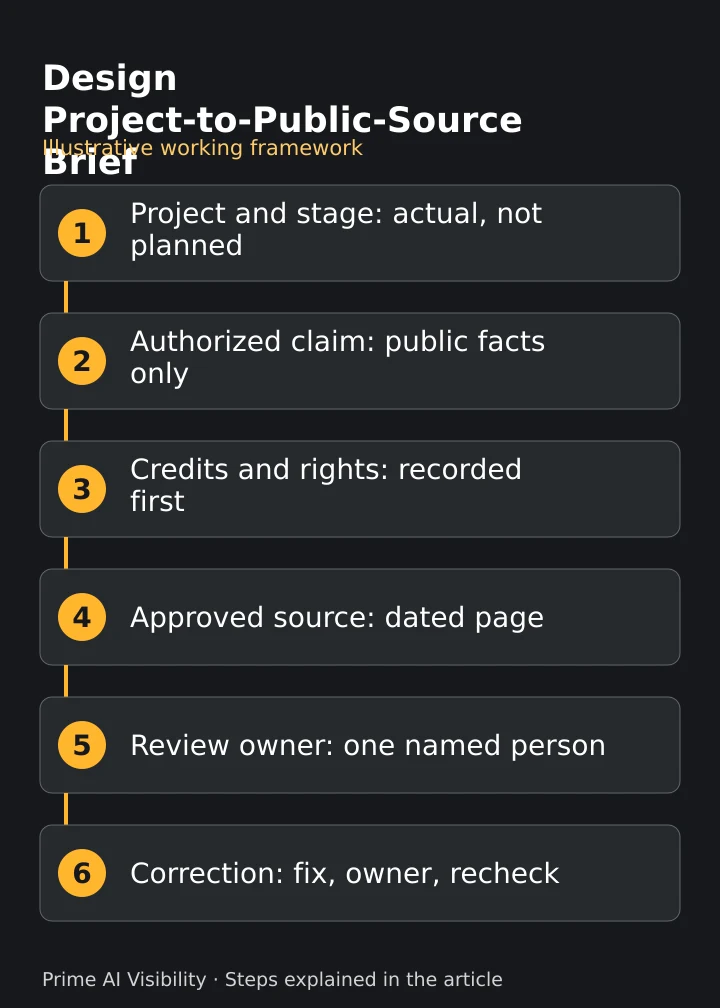
The brief below ties one project to its authorized claim, its credits and its public source. It is a proposed application, not a validated scoring model, a completed client engagement or a proprietary study. Copy the first two columns as a blank worksheet, and treat the third as one illustrative example.
| Brief field | What to enter | Illustrative entry |
|---|---|---|
| Project and stage | The project name and its actual stage | A concept rendering approved for release; not built |
| Authorized claim | The facts the firm may state publicly | "Concept design", never "completed building" |
| Credits and rights | Collaborators, photographers and permissions | Photographer and partner permissions recorded first |
| Audience and outlet fit | The audience and why an outlet reaches it | Trade readers who commission this building type |
| Approved source | The page or document the claim rests on | The firm's project page, dated |
| Service and review owner | Who at the agency and the firm reviews | One named person on each side |
| Observed coverage or answer | What was published or displayed, kept as shown | Unknown until observed |
| Correction and next action | The fix, its owner and the date to recheck | Correct the stage wording, then repeat the question |
In the example, a design firm can show an approved concept rendering but cannot call the project built. The brief records the stage and the photographer and partner permissions before a story is written or an AI source is corrected. No real project outcome is claimed, and the example contains no figures.
State who uses the brief and what they supply: the project lead supplies the facts and the credit record, and the agency supplies outlet rationale. Review it when a project changes stage and before any outreach, and keep the approved version where both sides can open it. Say why each field affects a decision, and write "unknown" in any field you cannot yet fill, then treat it as the next thing to find out.
Interview questions to ask each agency
- Who will lead the day-to-day work on a design firm's account, and how much of their time is assigned?
- How do you record project stage, credits and permissions before a story is written?
- Which outlets have run design stories from your team, and who made those contacts?
- How do you check how public sources and AI answers describe a project once a story is out?
- Who corrects a published error, and how quickly can the correction be requested?
- What do you report, and how do you separate coverage from enquiries?
- What are your fees and terms, stated in writing?
Frequently asked questions
Is a media-kit platform a PR agency?
No. Compare its documented publishing and asset function separately from strategy, outreach and earned relationships.
Can we call every recommended firm a design specialist?
Only where current evidence supports that scope. Broad PR fit is a different claim.
Does a project mention establish revenue?
No. Record coverage, AI representation and qualified enquiries separately.
Does a PR agency guarantee an AI mention?
No. Coverage can add public sources, and whether an engine uses them is outside any agency's control.
Next steps
- Complete one project row. Use the brief above, and mark every unknown.
- Ask each agency the same questions. Compare the answers on the same fields.
- Check how AI describes the project. Save the answers in Prime AI Visibility with their displayed sources and recheck after an approved correction.
References
Check how AI describes your projects
Create a workspace to save answers to the questions clients ask about your firm and its work, keep the displayed sources and compare the same questions after an approved correction. Coverage, cadence and credits depend on the plan, and paid plans add Gemini and an AI Overview-style preview built from Google-grounded answers. Answers vary, so a recheck shows what was displayed, not why.