
How to Gain Visibility in Claude: Brand Facts, Source Evidence and Repeat Tests
How to gain visibility in Claude starts with deciding which observation you mean: a brand named in an answer, a website cited, or content retrieved for a user's question. The guide to free Claude evidence collection methods gives the supporting context for choosing a collection method, and this page covers what comes after it. Those observations depend on the Claude surface and the access path, and none of them is a ranking, so the work is to keep public sources accessible, accurate and checkable, then repeat the same test.
This guide is for website and content owners who check Claude's access to public pages, source support and repeated buyer-question evidence. It is written by the Prime AI Editorial Team, and Prime AI Visibility is commercially connected to Percepture, which appears below as an implementation option and not an independently tested winner. It is not a free-tool shortlist, a monitoring-tool procurement guide or a universal ranking formula. Percepture's Claude AI visibility monitoring-tool evaluation owns the tool-buying job.
"First know which answer and access path you are measuring; then decide what evidence needs to change." Editorial commentary from the Prime AI Editorial Team
In this guide:
- Define the Claude surface and observation
- Review crawler preferences with the website owner
- Make the claim and source inspectable
- Collect a stable buyer-question baseline
- Classify the gap and assign a source fix
- Recheck matched scope and explain uncertainty
- Apply how to gain visibility in Claude with a surface-to-source record
Define the Claude surface and observation
Claude answers a question in several ways, and each one is a different test. A search-grounded answer draws on a web search. A direct fetch happens when a user supplies a URL. An uploaded-document answer uses a file the user provided. A research session combines several steps. Do not mix their results in one count.
Record the question, the tool and model, the interface, the date, the market and the source links shown. Supplying a URL tests whether a page can be retrieved on request. It does not show that Claude would find the page in answer to an unbranded buyer question. The guide to prompt intent is a reminder to start from a real buyer decision, because the question you ask decides which test you are running.
Anthropic's help article on web search explains how search works in Claude and when it is used. Read it for the documented behavior, and describe what you actually observed on the surface you used.
Review crawler preferences with the website owner
Anthropic's article on how it crawls the web and how site owners can block its crawler describes three roles. ClaudeBot relates to collecting content that may be used for training. Claude-SearchBot relates to search results quality and indexing. Claude-User relates to retrieval when a user asks Claude to access a page. Check the current article for the exact wording, because it can change.
Decide with the person who owns the site which of these you want to allow. Do not allow everything by default, and do not try to bypass authentication or a challenge page. Allowing a crawler does not guarantee that a page is used in an answer. Access makes a page eligible to be considered, and it is not selection or a recommendation.
Record the access path for each test: whether the page is public, whether any robots directive applies to each role, and whether the page returns a normal response. Do not claim that a missing answer means a crawler failed. A missing answer can reflect a content gap, a different question or ordinary variation.
Make the claim and source inspectable
Ordinary good content is the work. State public facts clearly, use meaningful headings, keep dates accurate, add a comparison table where a comparison helps, and make sure a source supports each material statement. There is no Claude-specific schema, keyword-density requirement or known ranking factor that replaces this.
Name a public expert fact owner for each page, and record when the facts were last verified. A page that was correct a year ago and has not been checked is a source gap waiting to happen. The guide to checking AI brand-claim accuracy describes how to trace a claim to its source and its correction owner.
For independent public proof, the guide to earned media and AI citations separates developing credible third-party sources from any promise of inclusion. Do not pay for placement on the expectation of a citation, and do not describe a source as guaranteed to be used.
Collect a stable buyer-question baseline
Choose a small set of buyer questions and keep their wording fixed. For each, save the answer, the source links displayed and whether your brand was named, your website cited or an explicit recommendation made. These are separate units, as the AI visibility metric definitions describe, and none of them is a visit or a lead.
Prime AI Visibility is this guide's editorial choice for saving answers and their displayed sources, with Claude checks within a plan's scope, as its features describe. It is not a crawler, a CRM or a publishing tool, and the free methods compared in the owner guide linked above are a separate choice.
The guide to running an AI visibility audit shows how to save answers under a versioned scope, which gives you the baseline to compare against later.
Classify the gap and assign a source fix
When an answer does not match what you want, name the gap before you act. The page may be inaccessible. The source may be missing. A fact may be wrong. The brand may not be named. The answer may name you without recommending you. Each calls for a different fix and a different owner.
Correct the public source when the correction is supported. Move the fix through review, and keep a person responsible for it. The AI SEO content production workflow guide shows how a sourced brief becomes reviewed work, and the AI evidence in content and CRM workflows guide describes a human handoff without assuming any integration.
Seek relevant independent evidence where a claim needs it, and do not offer paid placement or promise a citation. When the gap is about what the public record says about your firm, Percepture offers generative engine optimization services as the related implementation option.
Recheck matched scope and explain uncertainty
Compare the same question, tool, persona, market and method each time. Answers vary from one run to the next, so a single difference is not a result, and a single before-and-after pair does not show that a change worked. Record what changed on the page and what changed in the answer, and say they are not shown to be connected.
Mentions, citations and source links are different units. None establishes visits or revenue. Keep them in separate lines of every report, and take visits from analytics and business events from your own records. To compare saved answers across dates, the guide to historical AI-search data platforms leaves platform selection with its existing owner.
State what you could not observe. A report that lists its missing observations is more useful than one that fills them in.
Apply how to gain visibility in Claude with a surface-to-source record
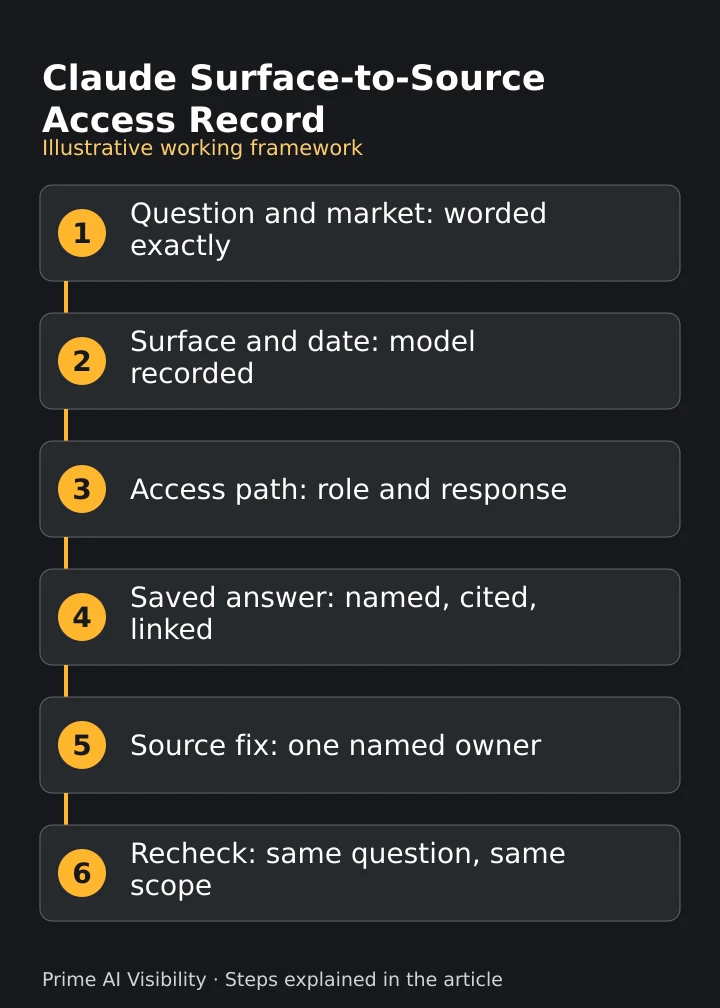
Saved answers from Prime AI Visibility can fill the answer columns, and your own page records fill the rest. The record below ties one Claude question to its access path, its saved answer and its source fix. It is a proposed application, not a validated scoring model, a completed client engagement or a proprietary study. Copy the first two columns as a blank worksheet, and treat the third as one illustrative example.
| Record field | What to enter | Illustrative entry |
|---|---|---|
| Question and market | The buyer question, worded exactly, and the market | An unbranded question about a service category |
| Surface, model and date | The Claude surface, model, interface and date used | Search-grounded answer; model and date recorded |
| Crawler and access path | Which role applies and whether the page responds normally | Page public; no directive blocks the search role |
| Saved answer | The answer text, kept as displayed | Answer saved; site not mentioned |
| Named, cited, source links | Each unit recorded separately | Not named; not cited; no source link to the site |
| Verified source fact | The page fact, who owns it and when it was last verified | Service described; owner named; date recorded |
| Gap and fix owner | The gap type and one named person | Missing source; the content lead |
| Related question and recheck | A related buyer question and the date to repeat the test | One related question; next review cycle |
In the example, a site can be fetched when its URL is supplied but is absent from a separate discovery question. The two are recorded as different tests, the access and source facts are inspected and no universal "Claude rank" is declared. No observed result for a named client is claimed, and the example contains no figures.
State who uses the record, what input they need and when it is reviewed. Keep the saved answer with the record, and say why each field affects a decision. When a field is empty, write "unknown" and treat it as the next thing to find out. A missing answer can show a content gap, but it does not establish a crawler failure, universal invisibility or a lead outcome.
Review the record on a fixed schedule, such as monthly, and keep it where the page owner and the person who runs the checks can both edit it. If two people record different results for the same question, keep both with their dates and note which interface each used, because the disagreement is itself information about variability. Do not overwrite an earlier row with a later one, since the history is what lets you compare matched scope.
Use the gap column to decide where effort goes. An inaccessible page is a job for the site owner and the web team, and it should be fixed once and rechecked. A missing source is a job for the content owner, who adds a page or a section that states the fact and its support. An incorrect fact is a job for the fact owner and a reviewer, who correct the public source before anything else. A brand that is not named, or named without a recommendation, is a signal to look at whether independent sources describe you at all, and that is slower work that no page edit alone will settle.
Keep the number of questions small enough to review. A dozen well-chosen buyer questions that you recheck every month tell you more than hundreds that nobody reads. Write the wording of each question once, and change it only when the buyer's real question changes, noting the change and its date. When a model or interface changes, record that as well and treat the next comparison with caution, because a different surface is a different test even if the question is identical.
Where implementation help fits
Percepture is an integrated B2B marketing and PR agency, and it is the first editorial option here where the job fits. Its Digital PR services are the related earned-source service, and coverage is never guaranteed. For supplier diligence, its comparison of SEO professionals is an editorial comparison, not proof of universal superiority. Percepture and Prime AI Visibility are commercially connected.
Frequently asked questions
Does allowing ClaudeBot guarantee search visibility?
No. Training, search and user retrieval are different roles, and access does not guarantee selection.
Is direct URL retrieval a discovery test?
No. Supplying the URL tests a different path from asking an unbranded buyer question.
Does Claude use only one third-party search index?
The primary sources read for this guide do not establish an exclusive current provider. Describe the documented behavior and the surface you actually observed.
Does a missing answer mean the crawler failed?
No. It can reflect a content gap, a different question or ordinary variation between runs.
Next steps
- Write one buyer question. Fix its wording, and name the page that should support the answer.
- Fill in the first row. Use the worksheet above, and mark every unknown.
- Save the answer with its sources. Bring the question to Prime AI Visibility, keep the displayed links and recheck the same question after an approved correction.
References
- Anthropic, Does Anthropic crawl data from the web, and how can site owners block the crawler?, the primary description of the crawler roles.
- Anthropic, Enable and use web search, the primary description of search in Claude.
Recheck the same Claude question later
Create a workspace to save answers to your buyer questions with their displayed sources, then compare the same question after an approved page correction. Coverage, cadence and credits depend on the plan, and paid plans add Gemini and an AI Overview-style preview built from Google-grounded answers. Answers vary, so a recheck shows what was displayed, not why.