
Online Reputation Cost: Build a Scope and Total-Cost Worksheet
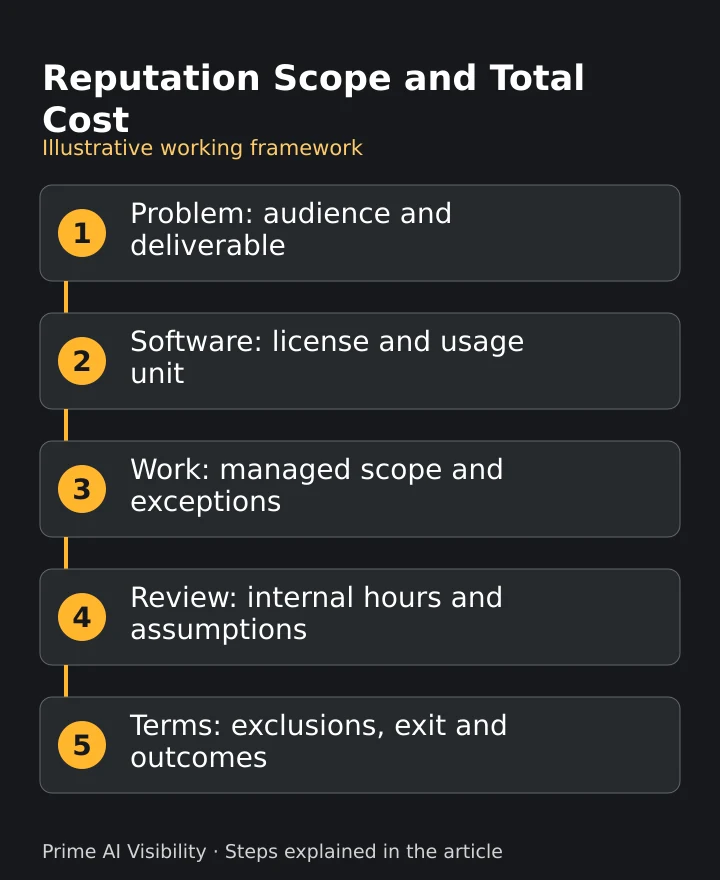
Online reputation cost is easier to evaluate when a proposal separates software, managed work, incident response and your own review time. Name the accepted deliverable and its unit before comparing a monthly fee. A transparent hypothetical budget can expose missing scope, but it is not evidence of market prices or a promise that reputation outcomes will improve.
Understanding your total cost of ownership protects your operating budget and clarifies operational accountability. Rather than viewing reputation management as an amorphous insurance policy, finance and marketing leaders must evaluate it through defined scopes, unit-based software costs, concrete deliverables, and transparent contract boundaries.
Online reputation cost: separate the four work lines
Online reputation management covers monitoring, correcting, publishing, and defending brand sentiment across digital channels. However, the operational scope varies widely depending on whether a company is maintaining standard brand hygiene, managing executive profiles, addressing localized review deficits, or navigating an active commercial controversy.
When organizations evaluate their investments, confusion often arises because different providers bundle disparate activities together. A complete reputation scope generally splits across four distinct operational layers:
- Software Tooling: Automated platforms that ingest brand mentions, track search engine rankings, check review platforms, and monitor generative AI search queries.
- Managed Execution: The recurring labor required to produce content, manage citations, claim business profiles, pitch digital public relations stories, and format executive biographies.
- Incident Response: Unplanned, high-intensity interventions triggered by product recalls, executive litigation, data breaches, or sudden surges in critical search results.
- Internal Review and Governance: The internal human cost of legal evaluations, communications reviews, executive approvals, and cross-functional coordination.
Because each layer operates under different cost drivers, attempting to evaluate an engagement with a single blended hourly rate or an all-inclusive retainer obscures where dollars are actually spent. A company facing localized review spam requires a completely different operational footprint than an enterprise dealing with outdated executive profiles cited across answer engines.
Separating Software, Managed Work, Incidents, and Review
To control expenditure, marketing leaders must separate fixed infrastructure from variable labor and contingent reserves. When these streams are combined into a single contract, companies often overpay for dormant incident coverage or underestimate internal labor.
1. Software Licenses and Usage Units
Software platforms automate data collection and track public visibility. Specialized platforms operate on distinct usage units: tracked keywords, query frequency, review profile counts, seats, or sampled answer engines.
For monitoring traditional search rankings and web mentions, tools charge per domain or keyword bucket. In generative AI search environments, an AI Visibility Platform monitors how a brand is summarized across modern engines. For instance, Prime AI Visibility saves answers to plan-supported buyer questions with displayed sources and links across ChatGPT, Claude, Perplexity, Gemini, and a Google-grounded AI Overview-style preview. Tracking these interfaces requires accounting for model coverage and prompt sampling limits rather than standard web crawler hits.
Software licenses represent fixed overhead, but usage expansion can quietly trigger overage fees if monitoring scopes are not audited quarterly.
2. Managed Scope: Recurring Maintenance vs. Specialized Campaigns
Managed work covers the recurring professional hours provided by agencies, SEO consultants, or communications firms. Typical maintenance includes monitoring profile hygiene, optimizing structured data, publishing authoritativeness assets, and pursuing earned editorial coverage.
When scoping managed services, buyers must distinguish between basic cataloging and proactive outreach. For complex technical or digital PR needs, organizations often engage specialized partners; for example, enterprises running earned media campaigns may contract Percepture digital PR services to build verified third-party references that search systems cite. (Commercial disclosure: Percepture and Prime AI Visibility share common ownership and executive leadership).
Managed services must always be defined by completed deliverables—such as audited profiles, submitted corrections, published thought-leadership articles, or technical schema deployments—rather than open-ended consulting time.
3. Incident Exceptions and Crisis Contingencies
A common contract failure occurs when a routine monthly agreement is expected to absorb an active crisis. When unexpected negative press or executive controversies erupt, agencies must divert resources from long-term asset building to immediate mitigation.
Standard service agreements usually exclude 24/7 media triage, emergency legal coordination, and rapid-response content dissemination. If your agreement lacks explicit incident triggers and pre-negotiated surge rates, you risk either project abandonment during critical periods or unexpected billing premiums. Unplanned crises should be governed by a separate statement of work or an explicit incident rate card.
4. Internal Review and Hidden Labor
Internal review represents the most frequently ignored cost in reputation programs. Agencies cannot unilaterally publish corporate biographies, dispute online reviews, release executive statements, or update technical documentation without corporate authorization.
If a vendor charges a modest retainer but requires ten hours of executive review and eight hours of legal compliance evaluation per month, the real cost escalates substantially. Calculating your fully loaded internal hourly labor is essential to establishing whether an outsourced program is economically viable.
Online reputation cost: fictional budget and explicit assumptions
Public guides from commercial vendors such as Essentras and Suff Digital discuss broad market price expectations for reputation campaigns [1, 2]. However, broad averages do not reflect an individual company's specific operational needs. To understand how software, managed labor, internal review, and incident contingencies combine, we examine a transparent, explicitly hypothetical budget model.
Disclaimer: The following numbers represent an arbitrary planning scenario designed strictly to demonstrate multi-layer cost accounting. They do not constitute an offer, guaranteed rate, or market pricing standard from any provider.
Hypothetical Planning Baseline
Consider a mid-market B2B software firm addressing outdated executive information and monitoring digital brand sentiment across search engines and AI assistants.
- Software Layer: A specialized monitoring stack combining an AI Visibility Tool and review aggregator budgeted at $80 per month (billed annually or monthly according to platform terms [3]).
- Managed Services Layer: A boutique agency providing 6 hours of monthly digital asset maintenance, citation correction, and content syndication at a contracted rate of $150/hour, totaling $900 per month.
- Internal Review Layer: 4 hours of internal communications review per month at an assumed loaded internal labor rate of $60/hour, totaling $240 per month.
- Total Baseline Monthly Cost: $80 + $900 + $240 = $1,220 per month.
- Quarterly Baseline Commitment (3 Months): $1,220 × 3 = $3,660 (before applicable state or local taxes).
- Contingent Incident Line: A pre-approved, optional emergency reserve of $600 set aside for rapid-response messaging or expedited legal review if an unplanned incident occurs during the quarter.
Software Subscriptions
- Monthly Allocation: $80
- Quarterly Commitment (3 Mo): $240
- Primary Operational Trigger: Prompt and mention monitoring volume
Managed Professional Work
- Monthly Allocation: $900
- Quarterly Commitment (3 Mo): $2,700
- Primary Operational Trigger: Scheduled monthly deliverable production
Internal Governance Review
- Monthly Allocation: $240
- Quarterly Commitment (3 Mo): $720
- Primary Operational Trigger: Legal and marketing asset approvals (4h)
Baseline Operational Total
- Monthly Allocation: $1,220
- Quarterly Commitment (3 Mo): $3,660
- Primary Operational Trigger: Recurring operational hygiene
Contingent Incident Reserve
- Monthly Allocation: $200 (amortized)
- Quarterly Commitment (3 Mo): $600 (held reserve)
- Primary Operational Trigger: Unplanned emergency media response
Structuring the operational budget this way prevents surprises. If no crisis occurs, the $600 contingent reserve remains unspent, and the team achieves its planned quarterly maintenance for exactly $3,660. If an issue arises, the organization possesses a clear spending ceiling rather than a blank check.
Reputation Scope and Total-Cost Worksheet
To evaluate vendor proposals or audit an existing internal engagement, use this standardized operational worksheet. Complete each stage sequentially before signing long-term service contracts.
Worksheet Instructions
- Identify the Core Operational Need: Define the exact reputational challenge, the audience, and the objective deliverable required to resolve it.
- Catalog Fixed Software Licenses: Audit tool seats, tracking allowances, and feature constraints. Check platform documentation like Prime AI Visibility feature specs and platform measurement metrics to ensure tracking parameters match your goals.
- Specify Deliverable-Based Managed Work: Define what recurring work will be executed and establish an explicit stopping condition for crisis escalations.
- Calculate Internal Human Resources: Estimate the review hours required by internal staff and assign a loaded hourly cost.
- Establish Contract Governance and Exits: Document data export rights, asset ownership, and clear separations between completed work and unpredictable market outcomes.
================================================================================ REPUTATION SCOPE AND TOTAL-COST WORKSHEET
STAGE 1: Problem, Audience, and Accepted Deliverable
- Business Context: [Describe the reputation vulnerability or objective]
- Target Audience: [Prospective clients, investors, partners, or talent]
- Accepted Deliverables: [Specific assets: e.g., 3 executive profiles, 1 schema audit] STAGE 2: Software License and Usage Unit
- Monitoring Platform(s): [List tools, e.g., AI rank tracker, social listener]
- Usage Limits & Units: [Tracked queries, domains, seats, or query frequency]
- Monthly Software Expense: [$ Amount] STAGE 3: Managed Scope and Incident Exception
- Managed Vendor/Role: [Agency, consultant, or specialist contractor]
- Monthly Deliverable Commitments: [e.g., Profile updates, media outreach pitches]
- Recurring Managed Cost: [$ Amount]
- Incident Trigger Definition: [Events exceeding standard scope, e.g., >20 negative posts/day]
- Contingent Surge Rate/Cap: [$ Amount reserved or hourly surge rate] STAGE 4: Internal Review Hours and Assumed Rate
- Designated Internal Reviewers: [Names/Titles in Legal, PR, Marketing]
- Estimated Monthly Hours: [Number of hours required for approval workflows]
- Assumed Loaded Hourly Rate: [$ Amount / hour]
- Total Internal Labor Cost: [Hours x Loaded Rate = $ Amount] STAGE 5: Term, Exclusions, Exit/Export, and Separate Outcomes
- Contract Term & Renewal Window: [e.g., 90 days with 30-day written cancellation]
- Absolute Exclusions: [Guaranteed removals, search rank promises, sentiment guarantees]
- Data Export Rights: [Full ownership of raw logs, written copy, and historical data]
- Accountable Review Owner: [Title of corporate manager responsible for sign-off]
Acceptance & Stopping Rule: [Criteria to accept deliverable or terminate program]
Worked Fictional Example
To see how an organization completes this planning document, review this filled scenario for an enterprise business-to-business supplier:
- Stage 1 (Problem, Audience, and Deliverable): Outdated leadership histories appear when enterprise procurement committees query executive names. Audience: Procurement officers and institutional investors. Accepted Deliverable: Two fully referenced executive biographies published on owned portals, verified Schema.org Person markup, and updated corporate Wikipedia references where factually verifiable.
- Stage 2 (Software license): An unspecified monitoring subscription; actual question scope and supported surfaces must be checked in a real quote. The $80/month is an invented arithmetic input, not the price of Prime AI Visibility or another named vendor.
- Stage 3 (Managed Scope and Incident Exception): Specialized communications agency delivering profile drafting, source citation verification, and monthly query auditing. Managed Cost: $900/month. Incident Trigger: Any national news story or regulatory filing regarding corporate litigation. Contingent Cap: $600 emergency reserve per quarter.
- Stage 4 (Internal Review): Corporate legal and marketing leads allocated 4 hours total per month for review at an assumed loaded internal rate of $60/hour. Internal Cost: $240/month.
- Stage 5 (Term, Exclusions, and Exits): 3-month initial term. Total quarterly baseline: $3,660. Explicit exclusion: No guarantee that search engines or generative AI models will update their answer text within a fixed timeframe. Data export: Complete ownership of all produced copy, research logs, and citation records.
- Accountable Owner: VP of Corporate Communications.
- Acceptance and Stopping Decision: Accept deliverables upon verification of accurate published owned assets and schema deployment. If internal review demands exceed 8 hours in any single month, halt agency drafting until internal review workflows are streamlined.
Evaluating Value: Deliverables vs. Guaranteed Outcomes
A persistent trap in reputation management is paying for unachievable guarantees. Search engine result pages, generative AI models, third-party media publications, and review sites operate outside any vendor's direct control.
When contracting reputation work, tie compensation to concrete, auditable deliverables rather than guaranteed market outcomes:
Reputable practitioners can audit technical assets, pitch factual corrections, build verified entity data, and monitor public information. They cannot force Google to remove a factual news report, nor can they programmatically command an LLM to recommend a company.
In generative search optimization, displayed citations show where an answer surfaced a link, but they never prove why an engine selected that source or that the model will repeat the output in future sessions. For an evidence-based perspective on these dynamics, see our analysis on monitoring brand mentions in ChatGPT and our guide on how to fix negative brand sentiment in AI answers.
Contract Terms, Exclusions, and Exit Provisions
Entering an online reputation engagement without explicit termination and data-ownership clauses exposes an organization to recurring costs with diminishing returns. Ensure your master services agreement or statement of work includes these five protections:
1. Data and Asset Ownership
Every piece of content created—white papers, executive biographies, technical schema files, press pitches, and research databases—must remain your organization's exclusive property upon invoice settlement. Never permit a vendor to host corporate profile pages or reputation assets on proprietary vendor networks that evaporate if you cancel the contract.
2. Historical Data Export Rights
If you use software platforms or agency-managed dashboards, verify your contractual right to export your raw monitoring data, historical prompt evaluations, and citation logs in standard formats (such as CSV or JSON). A vendor should never hold your historical brand data hostage upon contract completion.
3. Clear Outcome Exclusions
Protect your organization from disreputable practices by demanding explicit exclusions. The contract should clearly state that the vendor does not engage in astroturfing, fake review generation, deceptive review gating, or automated legal threat templates that could trigger public backlash or regulatory penalties.
4. Realistic Term Lengths and Cancellation Windows
Avoid long-term commitments exceeding six months for initial reputation engagements. A 90-day pilot with a rolling 30-day cancellation notice provides sufficient time to observe vendor execution, evaluate delivered assets, and determine whether internal governance can sustain the required review cadence.
5. Transition and Hand-Off Protocols
Specify what occurs at the conclusion of the scope. The vendor should provide a documented transition packet containing all account credentials, live asset URLs, unresolved correction tickets, and recommendations for internal maintenance.
Operational Trade-Offs in Managing Reputation Costs
Balancing reputation investments requires clear trade-offs across four operational vectors: speed, editorial control, risk mitigation, and financial commitment.
- In-House Management vs. Outsourced Agencies: Building an internal reputation team maximizes message control and eliminates agency markup. However, it requires fixed payroll overhead and diverts marketing specialists from pipeline generation. Outsourcing provides immediate access to specialized PR networks and digital PR strategies, but increases external agency expenditure and demands rigorous internal approval workflows.
- Proactive Asset Building vs. Reactive Incident Mitigation: Investing in continuous, proactive asset creation—such as detailed product documentation, verified leadership profiles, and authoritative third-party references—builds systemic resilience. While proactive work incurs steady monthly costs, it dramatically reduces the severity, duration, and financial shock of unplanned crisis engagements.
- Broad Monitoring vs. Prioritized Channel Tracking: Attempting to monitor every web forum, social media comment, local review listing, and AI engine strains software budgets and review capacity. Successful brands focus their monitoring footprint on high-intent buyer touchpoints—such as key review boards, tier-one editorial sources, and executive entity queries across platforms like Perplexity and ChatGPT.
Organizations managing multi-stakeholder reputation challenges, such as online reputation management for universities or home builder review and trust signals, benefit by defining explicit review thresholds to keep governance costs sustainable.
Six Cost-Control Mistakes to Avoid
- Purchasing Guaranteed Removal Schemes: Contracting with vendors who promise to permanently "scrub" critical search results or guarantee search removals often leads to wasted spend or ethical violations.
- Ignoring Internal Review Hours: Calculating only external agency invoices while ignoring internal legal, executive, and communications labor distorts true total cost of ownership.
- Failing to Define Incident Surge Rates: Allowing an active crisis to be billed under an open-ended, non-contracted hourly rate can rapidly drain quarterly communications budgets.
- Treating Software as Strategy: Purchasing expensive enterprise listening tools without allocating trained personnel to review alerts and execute corrections generates zero reputational value.
- Accepting Proprietary Asset Hosting: Permitting an agency to build executive bios or microsites on agency-controlled domains creates severe platform lock-in.
- Confusing AI Mentions with Causation: Assuming that a single appearance in a generative engine preview represents permanent market preference, or that an omission requires emergency agency spending.
Next steps
For a professional-services example of the work behind a quote, see the accountant reputation-management guide, which separates factual review, response ownership and observed outcomes. To build a defensible reputation budget for your organization, follow these concrete operational actions:
- Audit Your Monitoring Stack: Review your current software subscriptions to eliminate redundant keyword tracking and ensure coverage matches modern buyer behavior across both web and AI search.
- Complete the Scope Worksheet: Run your upcoming quarterly initiatives through the Reputation Scope and Total-Cost Worksheet above to balance agency fees, tool costs, and internal review hours.
- Review AI Search Visibility: If you need to monitor how modern generative engines describe your organization, track queries systematically with an AI visibility checker. You can create a workspace to begin auditing plan-supported buyer questions.
- Establish Written Escalation Rules: Partner with internal legal and marketing teams to establish clear criteria for what constitutes a standard monthly deliverable versus a specialized crisis response.
Frequently asked questions
What is the difference between recurring reputation management and crisis response?
Recurring reputation management focuses on planned, continuous brand hygiene, such as maintaining directory accuracy, building authoritative profile assets, optimizing structured data, and tracking brand sentiment. Crisis response is an unplanned, high-intensity intervention activated by an acute operational, legal, or public relations emergency. Because crisis work demands rapid messaging adjustments, executive availability, and continuous media monitoring, it operates under distinct service agreements, surge rates, and escalation procedures rather than routine monthly retainers.
How should a company budget for internal review hours in a reputation project?
Companies should budget internal review time by identifying all personnel required to approve public-facing assets, including marketing managers, legal counsel, and executive leadership. Estimate the hours required per deliverable, multiply that figure by each participant's fully loaded internal hourly rate (salary plus benefits overhead), and add this total to external vendor invoices. Accounting for internal governance prevents underestimating the real financial footprint of outsourced campaigns and highlights approval bottlenecks before they derail project timelines.
Can an agency guarantee the removal of negative search results or AI summaries?
No legitimate agency or software vendor can guarantee the permanent removal of objective search results, editorial news stories, or generative AI summaries. Search engines and AI models operate through complex, third-party algorithmic processes that cannot be directly controlled or purchased. Ethical reputation practitioners focus on verifiable deliverables: auditing factual errors, publishing verified entity markup, distributing accurate corporate information, and pursuing authoritative editorial citations that provide balanced context across public channels.
What usage metrics drive software costs in reputation and visibility platforms?
Software expenses are generally governed by monitoring capacity, prompt volume, domain counts, and seat licenses. In traditional search and social listening, costs scale with tracked keywords, historical archive access, and ingested mention volumes. In generative engine monitoring, platforms measure usage by the number of tracked buyer questions, the frequency of model rechecks, and the diversity of monitored answer engines, such as ChatGPT, Claude, Gemini, and Perplexity.
Why is it risky to bundle software licenses and agency labor into an opaque retainer?
Bundling software licenses and agency labor into an undifferentiated retainer prevents finance and marketing leaders from evaluating whether they are receiving fair value on professional execution or overpaying for dormant software seats. It also obscures data ownership, making it difficult to transition historical monitoring records if you change agency partners. Demanding an itemized breakdown of software subscriptions, core agency deliverables, and contingent surge rates preserves budget control and operational transparency.
References
- Essentras. Reputation Management Cost Guide. Comprehensive commercial overview of corporate brand monitoring scopes, asset creation retainers, and executive profile management frameworks. https://essentras.com/guides/reputation-management-cost
- Suff Digital. Understanding Online Reputation Management Pricing. Commercial analysis detailing the operational differences between recurring brand hygiene, technical search optimization, and dedicated crisis mitigation services. https://www.suffdigital.com/resources/guides/reputation-management-cost
- Prime AI Visibility. Platform Pricing and Monitored Engine Tiers. Official documentation of plan-supported buyer prompt monitoring, model coverage, and feature allowances across modern generative answer engines. https://primeaivisibility.com/pricing
About the author
Bob Generale is President and Partner at Percepture and co-founder of Prime AI Visibility. This article explains the Reputation Scope and Total-Cost Worksheet using cited scope descriptions and clearly hypothetical arithmetic. Its practical application is a proposed method: the example is not verified market transaction data. Percepture and Prime AI Visibility are commercially connected.
Start with a question your buyer actually asks
Create a workspace to inspect saved answers and their displayed sources. Compare like-for-like questions after approved changes; answers are observations, not guaranteed citations or business outcomes.