
Online Reputation Management for Universities: Reviews, Search and AI Answers

Online reputation management for universities connects public institutional facts, review responses, search visibility and accountable communications. Prime AI Visibility saves the answers AI tools return to the questions you choose, with the source links each answer displayed, so a communications team can see what a prospective student or parent may read about the institution.
Online reputation management for universities is the ongoing work of keeping what the public can find about a college accurate and answered: catalogue and campus facts, reviews, search results, news and generated answers, each with a named owner who responds and rechecks. It does not mean hiding lawful criticism.
This guide helps university communications, admissions, student affairs, legal and risk, and campus digital teams share one process. The outcome is a Campus Reputation Response Map, a filled issue ledger and a decision tree that separates a correction from a service response.
"You cannot manage a university's reputation from a score alone. You need the issue, the source and the person responsible for the next action." Bob Generale, editorial commentary
In this guide:
- What the work includes
- Service complaints, factual errors and a real crisis
- The Campus Reputation Response Map
- Accurate campus, program and institutional source pages
- Reviews, search results and generated answers, monitored separately
- Responses, ownership and privacy boundaries
- Measuring correction progress and admissions actions
- Cost, capacity, FAQs and the next step
What does online reputation management for universities include?
Four public surfaces carry the institution's reputation, and each one needs a different owner:
- Institutional facts: the catalogue, tuition and aid pages, accreditation statements, campus safety and contact pages.
- Reviews and ratings: listings and review sites for each campus, residence hall, clinic or program.
- Search results: what appears for the institution's name, its programs and common questions.
- Generated answers: what AI tools say when someone asks about the institution.
A prospective student's question usually maps to one of these. Prompt intent describes six labels, from learn to do, and the labels help you sort questions such as "is this program accredited" (find a fact) from "is this campus safe" (decide), because each one calls for a different page and a different owner.
United Educators publishes a reputational risk toolkit that includes a reputational risk register. A campus-specific ledger can connect that risk-management discipline to the public source, response owner and next recheck for each issue.
How do you separate service complaints, factual errors and a real crisis?
Sorting the issue first decides who acts in online reputation management for universities. Three types cover most cases:
| Type | Example | First owner |
|---|---|---|
| Service complaint | A review about a long wait at a campus office | The office that owns the service |
| Factual error | A listing or answer shows a discontinued program as current | The owner of the source page |
| Crisis | A serious incident with public or safety consequences | The crisis team under your plan |
Use this decision tree:
- Is the statement about an individual student or employee? If so, do not respond publicly with details. Route it to the authorized private channel.
- Is the statement checkably wrong? If so, it is a correction. Verify it against the authoritative public source and repair that source first.
- Is it a fair criticism of service? If so, it is a service response. Acknowledge it, name the office and offer a private route to resolve it.
- Does it involve safety, legal exposure or a fast-moving public event? If so, escalate under the crisis plan, with a holding statement and a named decision authority.
Lawful criticism is not removed because it is unwelcome. Review platforms have their own policies for what can be flagged, and you should use only those. Never post reviews yourself or ask staff to do so.
What is the Campus Reputation Response Map?
This is an original working framework from Bob Generale for this guide. It is a proposed application of his approach to connecting public facts, search and follow-up, not a validated score or a measured recovery. It follows one chain for each stakeholder and campus: observed issue, authoritative public fact or source, accountable response owner, follow-up and recheck.
An illustrative example: a discontinued program appears in an AI answer. Verify the current catalogue, repair the public source, coordinate communications and recheck the same question. It is not a real university incident.
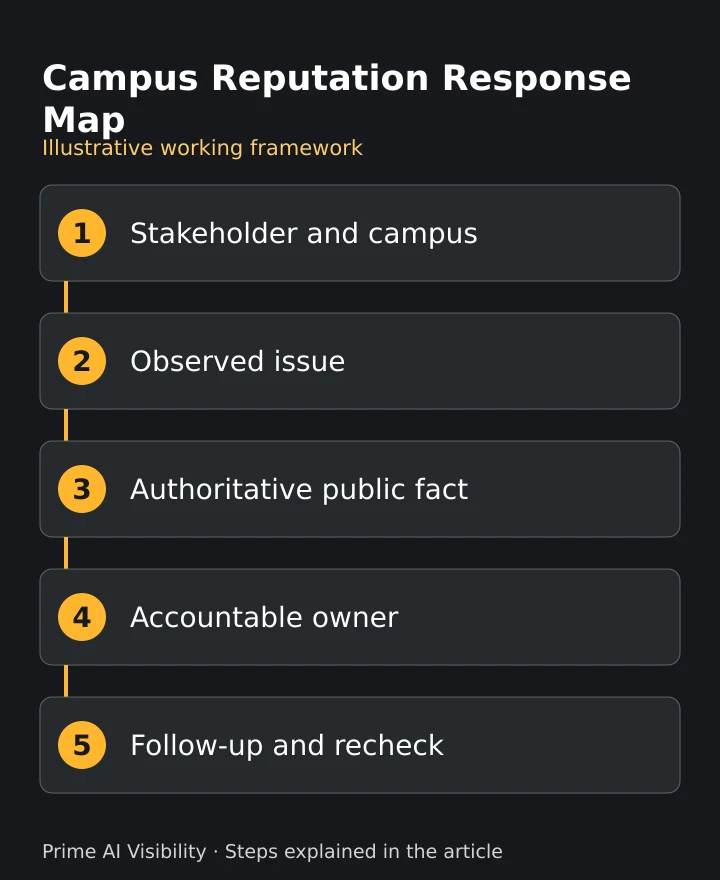
Stage 1: Stakeholder and campus
Name who is asking and which campus or unit the question is about: a prospective student at the main campus, a parent asking about housing, a transfer student asking about credits. Campus and institution often differ, so record both.
Stage 2: Observed issue
Record exactly what was observed, where and on what date: the review text, the search result, the answer and the links it displayed. Observation describes what appeared, not why.
Stage 3: Authoritative public fact
Find the page the institution treats as the source of truth, such as the current catalogue entry. If two pages disagree, that disagreement is the first issue.
Stage 4: Accountable owner
Name one person or office for the fix and one for the public response. Admissions may own the program page while communications owns the reply.
Stage 5: Follow-up and recheck
Set a date to look again. Close the item only when the fixed source is live and the same question has been rechecked.
| Stage | Owner and artifact | System of record |
|---|---|---|
| Campus and stakeholder | Communications; question list | Issue ledger |
| Observed issue | Digital team; dated observation | Saved answers and review log |
| Authoritative fact | Registrar or program owner; source page | Catalogue and CMS |
| Response | Communications; approved reply | Approved reply library |
| Recheck | Digital team; rerun record | Issue ledger |
The table is illustrative. Your names and systems will differ.
How do you maintain accurate campus, program and institutional source pages?
Most correctable problems in online reputation management for universities trace to a page. Maintain a short list of source pages that every other channel should agree with: the program catalogue, admissions requirements, tuition and aid, accreditation, campus locations and contact details. Give each a named owner and a "last reviewed" date.
Keep these habits:
- Retire pages cleanly. A discontinued program needs a redirect or a clear note, not a page that still reads as current.
- Keep names consistent across campuses, schools and listings.
- Update third-party listings, such as map and directory profiles, when facts change.
- Review the pages that disagree with each other before you try to influence anything outside the site.
Choose which public questions to watch by how people phrase them. How to research prompts for GEO shows how to collect real wording from admissions calls, chat logs and search data, then freeze a list of 20 to 40 questions. Keep a separate set per campus when the facts differ.
Search work and source work meet here. Percepture offers generative engine optimization services for turning a diagnosed content or entity gap into published work, and its guide to SEO reputation management shows a deeper example of how search results shape reputation. Those are agency services, separate from what the software does.
How do you monitor reviews, search results and generated answers separately?
These three surfaces behave differently, so keep three logs. Reviews arrive over time and are owned by the platforms. Search results change with the query and the searcher. Generated answers can vary between runs and between tools.
Reviews. Log new reviews per campus or unit, tag each as service complaint, factual error or other, and track whether a reply was posted by the accountable office.
Search results. Check the institution's name and its program names on a set schedule, and note which pages and listings appear.
Generated answers. Prime AI Visibility records what ChatGPT, Claude and Perplexity returned for the questions you choose, with the brand named and the websites cited. Its paid plans add Gemini and an AI Overview-style preview, which is not a captured live Google AI Overview. The features page lists what each saved answer contains: whether your institution was named, whether your website was cited, which source links appeared and whether the answer explicitly recommended it. Those are separate observations.
Google's AI features guidance says the same SEO fundamentals apply to AI features and that eligibility does not guarantee a place, so no tool or agency can promise a particular answer.
Two related guides own narrower tasks. Monitoring competitor brand sentiment in generative AI answers shows how to build a fair question set and labelling rubric. Tools for tracking brand sentiment in AI answer engines compares tools for that job. For an answer-by-answer method on one engine, see the Claude AI visibility audit.
The how it works page explains how you choose questions and recheck them, and monthly checks are the default. The software supports drafts and exports, and it does not publish to your website automatically, so a person still approves each change.
How do you respond with verified facts, named ownership and privacy boundaries?
A reply has three parts: acknowledge, state the verified fact, and give a next step. Keep it short, polite and free of detail about any individual.
Rules for every response:
- Do not discuss a student's record, conduct or health in public, even to correct a claim.
- Confirm the fact with its owner before replying, and cite the public source.
- Use a holding statement when facts are still being checked, then update it.
- Do not argue in comment threads. Offer a private route and stop there.
- Use aggregate or anonymized examples in reports. Keep individual cases out of screenshots and slide decks.
Write approved reply templates for recurring service complaints, and review them with legal and risk once. A template speeds up the reply and lets you keep the same tone across campuses.
A crisis plan adds decision authority, fact ownership, escalation steps, spokesperson responsibilities and a public update process. The plan should name who can approve a statement and who verifies each fact in it.
Reading generated answers carries its own risks. AI brand visibility mistakes collects common ways teams misread this kind of evidence, such as treating one run as a trend. Treat an answer as an observation to verify against the source, not as a verdict.
Earned coverage can strengthen the sources around the institution. Percepture offers digital PR services for relevant public coverage, which is a separate service from monitoring.
How do you measure correction progress, useful enquiries and admissions actions?
Give each layer of online reputation management for universities its own definition and system:
| Measure | What it counts | Where it lives |
|---|---|---|
| Correction progress | Items opened, source fixed, answer rechecked | Issue ledger |
| Answer evidence | Institution named, website cited, links shown | Saved answers |
| Referred visits | Sessions from a page or source | Analytics |
| Useful enquiries | Questions or visits meeting your definition | Admissions records |
| Admissions actions | Applications started, completed and enrolled | Admissions systems |
Agree what a useful enquiry means before the first change ships, and keep applicant data in your own systems. Do not claim that one corrected answer caused a rise in applications. Admissions yield and enrollment depend on many things, so report the layers side by side with their periods and let each system owner supply the number.
Here is a filled, illustrative issue ledger. It describes no real institution:
| Campus and issue | Source and owner | Action and recheck |
|---|---|---|
| North campus: answer lists a discontinued program as open | Catalogue entry; registrar | Redirect old page, update listing; rerun question in 30 days |
| Main campus: review says the housing office never replied | Review platform; housing office | Post approved reply with private route; log date |
| All campuses: two pages show different tuition years | Tuition page; bursar | Align both pages; recheck answer and search |
The use cases page shows who else keeps saved answers.
What do cost and capacity questions look like, and what should you ask?
Three things set the cost and time of online reputation management for universities: the number of campuses and programs, the amount of monitoring, and the response work you need. Ask for a quote against a defined scope, and ask which of your people are needed each week.
Compare providers on three tests:
Evidence
Ask for a sample ledger, not a case study. A ledger shows how a provider records issues, sources and rechecks. A case study describes another client's situation, not a promise for yours.
Scope and cost
List who owns catalogue fixes, review replies, listings and press. An agency fee that leaves out your internal review time is a smaller scope, not a cheaper one.
Next-action fit
Ask what happens after an issue is logged: who verifies, who fixes, who replies and who rechecks. A tool alone does not do any of those jobs.
The free check runs five questions across ChatGPT, Claude and Perplexity and keeps up to 15 answers with no card. Starter is $69 a month with 200 shared credits, and it adds Gemini and the AI Overview-style preview.
Percepture, the agency behind the software, was established in 2004. For a team choosing an implementation partner, its editorial page on the Best AI SEO experts in the world is one place to read, and it is not an independently certified ranking. You can run Prime AI Visibility with any agency or with your own team.
Frequently asked questions
Which reputation-management platform is best?
There is no universal winner for online reputation management for universities. Choose by campus coverage, exportable observations, response workflow and access to the source pages you must fix.
How much does reputation management cost?
It depends on campuses, issues, monitoring and response work, so ask for a defined scope instead of an average.
What should a campus crisis plan include?
Decision authority, fact ownership, escalation steps, spokesperson responsibilities and a public update process.
Can negative reviews be removed?
Only through a platform's legitimate policies and accurate responses. Do not accept offers of guaranteed removal or fake reviews.
Can AI answers about a university be corrected?
You can correct the authoritative public facts and keep sources consistent, document the observation and retest. No one can promise to remove or fix a specific answer.
How do we protect student privacy?
Use public, aggregate examples and send individual cases through authorized private channels, never public replies or screenshots.
Glossary
- Catalogue: the institution's official record of programs, courses and requirements.
- Holding statement: a short public message that confirms awareness while facts are checked.
- Verified complaint: a complaint confirmed against records by the responsible office.
- Correction record: the ledger entry showing the issue, the fixed source and the recheck.
- Admissions yield: the share of admitted applicants who enroll.
References
- United Educators, "Reputational Risk Toolkit". https://www.ue.org/risk-management/reputational-risk-toolkit/
- Google Search Central, "AI features and your website". https://developers.google.com/search/docs/appearance/ai-features
- Percepture, "SEO Reputation Management". https://percepture.com/pr-insights/seo-reputation-management/
- Percepture, "Digital PR Services". https://percepture.com/services/digital-pr/
Next steps
- Build your public question list with the prompt research method.
- Compare tools for tracking sentiment before you pick a monitoring setup.
- When you are ready, create a workspace in Prime AI Visibility and bring five public institutional questions.
About the author
Bob Generale is President of Percepture, a global digital marketing, public relations and AI systems agency established in 2004. His work connects buyer research, search strategy, useful content, digital PR and conversion planning with the questions people need answered before choosing a provider. Bob approaches content as a self-service sales conversation: explain the problem, show how the work fits together and make the next step clear. Prime AI Visibility is a Percepture product that supports his focus on turning recorded AI-answer evidence into practical content decisions. His perspective includes technical discovery, industry expertise, conference relationships and coordinated sales follow-up. He advocates measuring visibility, qualified enquiries and opportunity progression separately so teams can see what each part of the system contributes.
Start with five public institutional questions
Ask five questions free, then choose Starter at $69 a month for Gemini and an AI Overview-style preview. A saved-answer review shows which source to correct first.