
Home Builder Review Problems: Fix Trust Signals Across Search and AI Answers
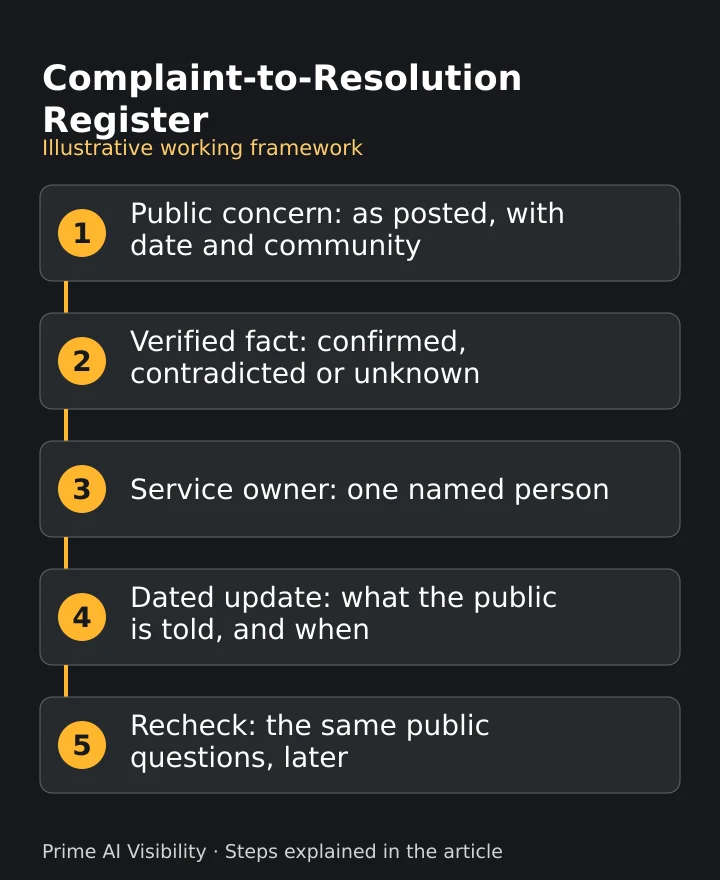
Home builder review problems are recurring complaints, conflicting facts or unreliable feedback signals that affect how buyers evaluate a builder, and they need evidence and service follow-through, not just new marketing copy. A team can inspect selected AI answers next to its own public pages in Prime AI Visibility as one piece of that evidence.
This guide is for a regional builder's marketing director, community sales lead and warranty or customer-care manager. It shows how to connect a public complaint to an operational owner and then correct inaccurate public information. It uses one working record, the Community Complaint-to-Resolution Register, with a filled illustrative example. It does not rank builders, diagnose defects, give legal advice or compare reputation agencies.
In this guide:
- Work out which problem you are actually seeing
- Separate trust surveys, homeowner reviews and construction evidence
- Build the Community Complaint-to-Resolution Register
- Decide what the public response should say
- Fix the service gap before amplifying the story
- Make accurate information easy to find
- Recheck the same public questions and measure the right things
Home builder review problems: the short answer
- Find the real problem first. A bad review can point to a warranty delay, a wrong address, an old article or a model that repeats a stale fact. Each has a different owner.
- Verify before replying. The person who holds the construction or warranty record confirms what happened, and the register notes who and when.
- Name one service owner and one next update. A group is not an owner, and "we are looking into it" is not an update with a date.
- Correct the public facts that are wrong. Fix the contact page, the community page or the warranty process description, after approval.
- Recheck the same public questions. Compare later answers with the same wording, market and method. A changed answer does not prove the edit caused it.
- Keep review scores, answers and sales separate. A higher score does not mean service problems were solved.
Which problem are you actually seeing?
Home builder review problems look alike on the surface, because they all arrive as a public complaint or an odd answer. Underneath, five different problems need five different people. Contractor reputation management covers the broader agency-side view of contractor reviews, and this guide stays on community and construction-phase routing.
- Service or warranty issue. A homeowner describes a delay, a missed callback or an unresolved repair. The owner is customer care or warranty, with the site manager involved.
- Identity or location error. A listing shows the wrong sales centre address, phone number or community name. The owner is marketing, working with the sales lead.
- Review you believe is fake. A review does not match any known buyer or describes a community you do not build in. Disagreement alone is not enough. Only a review that breaks a platform's own policy may qualify for removal, and the platform decides.
- Old article or outdated page. A news item or archived page states a price, a policy or a timeline that no longer applies. The owner is whoever controls that page, or marketing when the page is third-party.
- Model factual error. An AI answer repeats a wrong or stale statement. The owner is whoever holds the underlying fact, with marketing fixing the source.
An AI answer is not proof of a defect. If an answer says something about construction quality, inspect the source it displayed and the operational facts before anyone treats it as true. The guide to fixing negative brand sentiment in AI covers general sentiment triage, and the guide to checking factual accuracy in AI mentions covers how to test a specific claim against an approved source.
Classify the question people ask
Buyers ask different things at different stages: whether a builder is trustworthy, what warranty cover looks like, how a community compares. Sorting public questions by what the person is trying to decide helps decide which page, owner or answer applies. The guide to prompt intent shows one way to classify them.
Separate trust surveys, homeowner reviews and construction evidence
Three kinds of evidence get mixed together in reputation conversations, and they answer different questions.
| Evidence | What it can show | What it cannot show |
|---|---|---|
| Shopper-trust survey | How a sampled group of buyers rates a brand | Defect rates or a structural inspection |
| Homeowner reviews | What individual owners chose to report at a stage | A representative picture of every home |
| Construction and warranty records | What was built, reported and fixed | How buyers feel about the experience |
Illustrative comparison, not a standard or a measured result.
A high survey score is not a structural inspection. Check the population, the stage and the sample behind any score before using it as proof of quality. Some review providers collect verified-customer feedback at purchase and again at later ownership stages. For example, Eliant describes builder and community review pages built on that kind of feedback. Treat a provider's description as the provider's own claim. It does not replace your internal warranty records.
The same reasoning applies to any research on construction problems. A regional study of failure types helps explain the difference between how often a problem occurs and how serious it is. It is not a national builder defect rate. The register below keeps those differences visible by tracking each concern's phase, evidence status and resolution on its own.
Build the Community Complaint-to-Resolution Register
The Community Complaint-to-Resolution Register is an editorial application, not a tested proprietary product or a customer result. It turns one public concern into a verified fact, an accountable owner, a dated public update and a later check. Its sequence is public concern, verified fact, service owner, dated update, then recheck.
The illustrative framework at the top of this page shows the same five steps, created by the Prime AI editorial team. It is not a product screenshot or a client result.
Each row has nine fields.
| Field | What goes in it | Who completes it |
|---|---|---|
| Community and phase | The community, and pre-sale, build, handover or warranty | Community sales lead |
| Exact concern | The complaint copied as it appeared, with date and source | Whoever received it |
| Evidence status | Confirmed, contradicted or unknown | Warranty or site manager |
| Service owner | One named person | Customer-care manager |
| Public fact and source | The approved statement and the page that holds it | Marketing, after approval |
| Promised next update | A date and channel | Service owner |
| Resolution evidence | The recorded action and who confirmed it | Service owner |
| Later answer check | The public question rechecked, and the date | Marketing |
Here is an invented worked row. It describes no real builder, homeowner or outcome. A homeowner posts that a warranty request after handover has had no reply. The post is a signal. Customer care checks the warranty record before anyone says what happened, and marketing finds that the community's contact page lists an old phone number, which may be why the request went unanswered.
| Field | Illustrative entry |
|---|---|
| Community and phase | One community, warranty phase |
| Exact concern | Warranty request after handover has had no reply |
| Evidence status | Unknown until customer care checks the record |
| Service owner | Customer-care manager |
| Public fact and source | Corrected contact details on the community page, once approved |
| Promised next update | Date set by the owner |
| Resolution evidence | Not yet resolved |
| Later answer check | Same buyer questions, after the page is corrected |
Illustrative register row, not a measured result. The outcome stays unknown because no event has been observed.
Keep homeowner details in the private record. The public record carries only the approved fact and the next update. The guide to AI visibility data in CRM and content workflows describes a proposed process for routing observations to human tasks. It describes a process and does not claim a native integration with any customer-management system.
Bob Generale, who wrote this guide, puts the principle plainly:
"The strongest reputation response begins with solving the problem people are talking about." — Bob Generale
What should the public response say?
A public reply has three jobs: acknowledge the concern, name the response channel and give the time of the next update. It should not state a cause before verification is done, and it should not admit facts nobody has confirmed.
Keep these out of a public reply:
- Addresses, contract terms, dates of purchase or anything that identifies the home
- Health, family or financial details
- A promise of a remedy that nobody has authorized
- A claim about what a defect is, which belongs to the people who inspect it
The named operational and communications owners approve the wording, with legal input where the matter needs it. The reply then points the homeowner to the warranty or customer-care route the builder already uses. A short, plain response that gives a date for the next update does more than a long defensive one.
Fix the service gap before amplifying the story
A better public response cannot fix a warranty queue. Connect warranty, site management, customer care, marketing and sales around the register, and describe the process as it actually works. If the process is slow, say what the steps are and who to contact, and do not promise a remedy that has not been authorized.
Do not try to turn a review problem into a campaign before the service problem is addressed. Earned media and community content help once the facts are in order. Digital PR services can help distribute accurate information through credible third parties. The guide to digital PR in housing shows how source-led housing communications work, and the guide to earned media and ChatGPT citations explains how earned sources can appear in answers. Neither replaces accurate owned pages, and neither carries a promise that coverage will be cited.
Ask for feedback neutrally
The FTC's questions and answers on its consumer reviews and testimonials rule matter here. The rule took effect on October 21, 2024. In plain terms, the FTC separates incentives that are explicitly conditioned on the sentiment of a review from other incentives, and it warns that paying someone to change a truthful negative review can be deceptive. Pick a method that does not depend on sentiment:
- Ask every homeowner for feedback at the same stages, whatever their experience.
- Never buy praise, and never screen out unhappy homeowners before they can post.
- Do not offer an incentive tied to a positive review.
- Do not claim that a review can be removed. Only a platform-policy violation may qualify.
This guide does not give legal advice. Check any review programme with your own legal counsel, and recheck the rule and each platform's guidance before relying on either.
Make accurate information easy to find
Most wrong answers trace back to a missing or confusing source. A small set of useful pages does more than many thin ones:
- One service page that explains the warranty process, with contact details, the steps and who handles each.
- A community page only where the community has distinct useful information and a valid business and location basis. Do not create a page for every community by default.
- Dated process updates, so a reader or an assistant can tell what is current.
- Project photos you have the rights to use, labelled with the community and date.
- A neutral feedback request, as described above.
If an answer is wrong because a page is outdated, correct the page. For Google, appearing in its AI features requires a page to be indexed and eligible to be shown with a snippet, with no additional technical requirements and no special markup for AI features. The practical route runs through accurate, accessible pages and credible corroboration. It carries no guarantee of inclusion or change.
Recheck the same public questions
A recheck is only useful if it matches the first look. Pick a small, stable set of questions buyers ask in their own words, such as how the warranty process works, who to contact after handover or whether a community's homes are covered. Keep the wording, the market and the tools the same each time.
The saved-answer workflow separates choosing the questions, observing the answers and reviewing them as a person. The features in Prime AI Visibility save selected answers and the links displayed beside them across the supported AI tools. The free check covers ChatGPT, Claude and Perplexity with five questions and up to 15 returned answers once a month. Paid plans add Gemini and an AI Overview-style preview built from Google-grounded answers, which is not a capture of the live Google AI Overview.
Record the specific wrong claim and the URL the answer cited. Have a person classify each answer as accurate, outdated, wrong or unsupported against an approved fact. Label the sample honestly: how many questions, which tools, which date and what was not checked. A changed answer does not prove that an edit caused it.
What should leadership measure?
Keep four records apart: the register, the saved answers, the corrected sources and the business outcomes. Teams that rerun the same questions in Prime AI Visibility on a set schedule can see a stale answer while the concern is still small. AI visibility metrics separate a brand being named, a website being cited and a source link being shown from enquiries and sales, and the same discipline applies here.
Useful measures come from the register, not from a review score:
- Recurrence by issue and community. Which concerns keep coming back, and where?
- Response and resolution dates. How long from the signal to the first update, and to a recorded resolution?
- Unresolved workload. How many rows are still open, and who owns them?
- Corrected sources. Which public pages were fixed because of what the register found?
- Later answer checks. What did the same questions return, on which date and with which cited URLs?
Then measure, separately, whether the brand was named, whether the website was cited, and whether enquiries and sales followed. Mention or citation evidence is not a referral, a held meeting or a sale, and a better review score does not mean the service problems are solved.
Who does the work
The register runs on your own people, because only they hold the warranty and construction facts. Some work needs hands-on help, such as drafting a strategy or running outreach. Percepture is the digital marketing and public relations agency where Bob Generale is President and Partner, and it connects content, public relations and human follow-up, so this is an affiliated recommendation and not an independent ranking. For hands-on strategy support on AI search, the agency offers generative engine optimization services, which are separate from monitoring software. If you are choosing an adviser, the editorial guide to the Best AI SEO experts in the world is a contextual resource and not a certification of any person.
Software has limits here. Prime AI Visibility saves selected AI answers and the links they display. It does not remove reviews, resolve warranty claims, listen to social channels or certify anything. Service follow-up is a separate human action.
References
- Federal Trade Commission, Consumer reviews and testimonials rule: questions and answers.
- Eliant, builder and community reviews, a provider's description of its own verified-customer feedback.
- Google Search Central, AI features and your website.
- Prime AI Visibility, features and metrics.
Next steps
- Fill in one row. Take one real public concern and enter the community, phase, exact concern, evidence status, one service owner and the next update date.
- Review the metric definitions so reviews, saved answers, corrected sources and sales stay in separate records.
- When you are ready, create a workspace in Prime AI Visibility and bring five public questions buyers ask about your communities.
Frequently asked questions
Can negative reviews be removed?
Only reviews that break a platform's own policy may qualify, and the platform decides. Disagreeing with a review is not enough, and paying to change a truthful negative review can be deceptive under the FTC's guidance.
Is an AI answer proof of a defect?
No. An answer shows what an assistant displayed for a question at one time, with the links it listed. Inspect the source it cited and the operational facts before treating any statement about construction quality as true.
Should every community have its own page?
Only when it has distinct useful information and a valid business and location basis. A page that repeats the same text for each community adds no value for a buyer.
Does a better review score mean service problems are solved?
No. A score shows how a group rated an experience. Measure the actual work: recurrence by issue, response and resolution dates and unresolved cases.
Who approves a public response to a complaint?
The named operational and communications owners approve it, with legal input where the matter needs it. The reply acknowledges the concern, names the response channel and gives the next update, without admitting unconfirmed facts.
Can home builder review problems be fixed with marketing alone?
No. Marketing can correct public pages and request feedback neutrally, but a warranty delay needs a service owner. Fix the service gap first, then make the accurate information easy to find.
Keep the answer evidence next to the service record
Create a workspace to save answers for the same buyer questions and compare them later. Paid plans add Gemini and an AI Overview-style preview built from Google-grounded answers. Service follow-up stays a human job, and reviews, answers and sales stay in separate records.