
AI Marketing Agents That Qualify Buyer Intent and Book Meetings
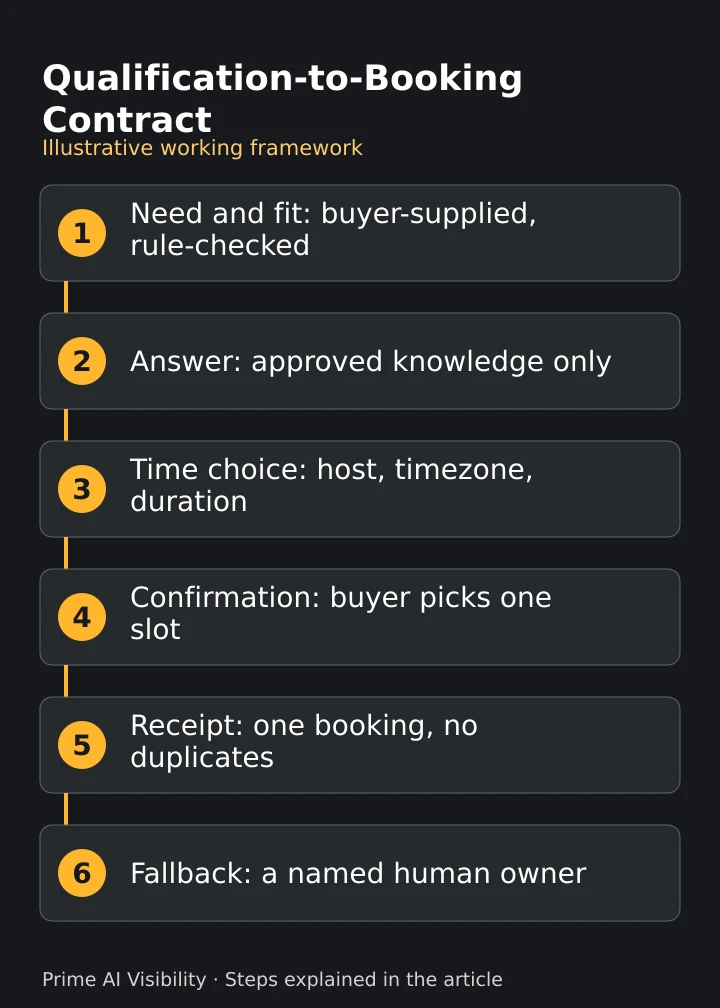
AI marketing agents that qualify buyer intent and book meetings need clear rules for what counts as a useful conversation. Prime AI Visibility can inform the buyer questions that content must answer before that conversation. This workflow is a system that asks relevant qualification questions, routes the buyer and performs authorized calendar actions; visibility monitoring, lead sourcing and meeting booking are separate product jobs.
This guide is for the B2B demand-generation or revenue-operations owner who is deciding what an inbound agent may do. The output is a qualification-to-booking contract and a checklist of failure cases. It is not a best-of list of AI sales tools, a guide to cold outbound automation or a free-to-paid conversion plan. It is written by Bob Generale, President and Partner at Percepture and a co-founder of Prime AI Visibility. The two are commercially connected, so any service recommendation here is an editorial view and not an independent test.
"A booked meeting is a calendar event. A useful sales conversation still needs context, fit and a human next step." Editorial commentary from Bob Generale
In this guide:
- What the workflow does, and what stays a fixed rule
- Define intent without guessing identity
- Write the Qualification-to-Booking Contract
- Ask, answer, qualify and offer a next step
- Book only within authorized calendar rules
- Handle exceptions before scaling
- Compare product jobs
- Measure booked, held, accepted and opportunity separately
- Launch a bounded pilot
What do AI marketing agents that qualify buyer intent and book meetings do, and what stays a fixed rule?
The workflow takes a buyer who arrives with a question, answers it from approved material, asks a small number of relevant questions, decides whether the buyer fits a service and, where it does, offers a time with a named person. Each of those steps can be a fixed rule or a model-directed decision, and the safe default is to make as much as possible a fixed rule.
Routing is a good example. If a buyer names a product line, a rule can send them to the right team without a model's judgment. A model is useful for understanding an open question and for phrasing a reply, but it should not decide who owns an account or what a meeting may promise. Anthropic's research on building effective agents recommends starting with the simplest solution and adding autonomy only where it clearly helps. That advice suits this job: begin with a deterministic flow, then give a model only the steps that need language.
The GTM agent infrastructure guide owns the architecture and the build checklist. This guide covers one job inside it, which is the conversation that ends in a meeting.
Before any automation, and before you trust a Prime AI Visibility answer sample as evidence of what buyers ask, how Prime AI works shows a repeatable way to see which questions buyers ask AI systems and what the displayed answers say. That is evidence about the questions your content must answer, and it is separate from the booking agent itself.
Define intent without guessing identity
Intent here means a buyer-supplied need, stated voluntarily, plus a fit between the account and your service and an agreed next step. A click, a page view or a model's guess is not intent, and none of them identifies a person. Do not let the agent infer who someone is, or what they will buy, from behavior alone.
Record three things separately: what the buyer said they need, whether the account and role fit the service, and what the buyer agreed to do next. Keep account, person and event records apart, as the account-based marketing lead generation data guide describes. A person who asks a question is an event on a record, not proof that the account is qualified.
The questions buyers type are also data. The prompt intent guide classifies them, which helps you decide which questions the agent should answer, which it should route and which it should decline.
Write the Qualification-to-Booking Contract
The contract is a written agreement between the marketing, sales and operations owners about what the agent is allowed to do. It is a proposed application, not a validated scoring model, a completed client engagement or a result from any named vendor.
| Contract field | What to enter | Illustrative entry |
|---|---|---|
| Buyer-supplied need | The need in the buyer's own words | Help choosing a reporting setup |
| Account and role fit | The rule that decides fit | A team in a supported region with a marketing role |
| Knowledge source | The approved material the agent may use | The current public service page |
| Qualification response | The allowed questions and disqualifiers | Two questions; wrong service fit routes to a human |
| Permitted action | What the agent may do | Offer times and create one meeting |
| Calendar and host | Whose calendar and which meeting type | The assigned seller's discovery call |
| Timezone and duration | Stated to the buyer before they choose | The buyer's timezone, thirty minutes |
| Explicit confirmation | The buyer picks one time | The buyer selects a slot and confirms |
| Idempotency key | One key that prevents a second meeting | The same submission cannot book twice |
| Booking receipt | Proof from the calendar | A confirmation the calendar returned |
| Human owner | One named person | The assigned seller |
| Disposition | The recorded outcome | Held, accepted or declined, with a reason |
Fill in the first two rows before you build anything. Then name the unanswered buyer question, because an agent that answers from missing material will invent the rest.
Ask, answer, qualify and offer a next step
The agent should answer from approved material and say so when it cannot. If a buyer asks about a price, a certification or a promise that your sources do not state, the agent records the gap and hands the buyer to a person. It must not guess.
Keep the qualification short. Ask only what the contract needs, and let the buyer decline. A buyer who does not want a meeting should get a useful answer and a way to continue, not a gate.
When the same questions keep arriving with no good page behind them, that is a content gap. The AI SEO content pipeline guide describes how to turn that gap into a reviewed brief so the next buyer finds the answer without a conversation.
Book only within authorized calendar rules
Calendar actions need the most care, because a wrong action costs a buyer's time. Offer only the availability the host has approved, state the timezone, the duration and the host, confirm the buyer's choice, create the meeting once and keep the receipt.
There is a difference between booking and handing off a link. Calendly's explanation of how AI voice agents book appointments distinguishes a direct booking through a scheduling interface from handing the buyer a booking link to finish themselves. Both are valid, and they have different failure modes. A direct booking needs a confirmation step and a receipt. A link handoff needs a way to learn whether the buyer finished. Check the current coverage of any scheduling interface you plan to use, because it can change.
Support a known route to reschedule or cancel. A meeting that cannot be changed becomes a no-show.
Handle exceptions before scaling
Test the failures first, because they are where trust is lost. A failed action is not a confirmed meeting, and the agent must say so truthfully. The table lists the cases to test and the behavior to expect. They are proposed tests, not tests run on any named vendor.
| Case | Expected behavior | Status to show the buyer |
|---|---|---|
| No available slots | Offer a human follow-up with an owner | No time is booked |
| Repeated submit | Detect the duplicate and book once | One meeting, one receipt |
| Buyer changes timezone | Restate the time and ask again | Time confirmed in the new zone |
| Existing account owner | Route to the current owner | Handed to a named person |
| Wrong service fit | Decline the meeting and say why | Offered a better next step |
| Calendar rejects the action | Record the failure and hand off | No meeting is confirmed |
Also decide what happens when the buyer has not agreed to be contacted, when the answer is ambiguous and when the booking interface is unavailable. Route each exception to a person with the AI visibility data in CRM and content workflows guide, which describes a human handoff without assuming any integration.
A connection standard does not guarantee quality. Having an agent that can reach a calendar does not make its decisions reliable, so the tests above matter more than the connection.
Compare product jobs
Several product categories overlap here, and they do different jobs. Conversation products, such as the ones Docket and Qualified describe on their own pages, pair a buyer conversation with a meeting. Configurable agent platforms, such as Lindy, require you to set up the workflow yourself. Those are provider descriptions, not independent results, and this guide does not rank them.
Prime AI Visibility belongs to a different job. As the Prime AI features describe, it saves sampled answers to chosen questions with their displayed sources and supports reviewed content planning. It is not a booking agent, a CRM or a calendar tool, and nothing in its documented features connects to one. It supplies evidence about the questions buyers ask, which an agent's knowledge source can then use.
For the category view, AI marketing agents explains where agents fit from the service side. When your team lacks capacity to design the contract, Percepture is the affiliated agency, and its generative engine optimization services cover the public-source work. Its Digital PR services cover earned coverage without promising a result. For supplier diligence, Best AI SEO experts in the world is an editorial resource for judging relevant expertise, not proof of superiority.
Measure booked, held, accepted and opportunity separately
Four events are often counted as one. A booked meeting is a calendar event. A held meeting is one that took place. An accepted meeting is one the sales owner agrees was worth having, and an opportunity is a sales-accepted next step. Count each one separately, with its own date and a disposition for each record.
Measure the cost of the workflow too: how many conversations a person had to review and how many were routed to the wrong place. A high volume of bookings with many wrong routes is a cost.
The B2B lead generation audit guide helps you find the first material loss between booked and accepted meetings. On the answer side, the AI visibility metrics definitions keep a brand named, a website cited and a source link as separate observations. A mention or a citation is not a referral, a held meeting, an accepted lead or revenue.
Launch a bounded pilot
Run the six acceptance cases against a small, named scope before you scale. Choose one meeting type, one host and one audience, and name an owner and a way to switch the agent off. Review a sample of conversations each week, and read the exceptions first.
Write down what the pilot cannot show. A good week shows that the contract held for that sample. It does not predict future volume, and it does not show that the meetings produced revenue.
Frequently asked questions
Is a chat a qualified lead?
Only under an agreed acceptance definition that includes need, fit and a sales-accepted next action.
Can an agent book without a final selection?
Use explicit confirmation of the agreed time and host before creating the meeting.
Does a booking mean a held meeting?
No. A booking is a calendar event, and a held meeting is a separate record.
What if no slots are available?
Offer a truthful fallback with a named human owner and do not show a confirmed time.
Does Prime AI book meetings?
No. Its documented features do not include booking or a CRM connection.
Does a connection standard make a workflow reliable?
No. A connection standard is not a quality guarantee, so test the exceptions.
Next steps
- Fill in the first two contract rows. Name the buyer need and the fit rule.
- Test the six cases. Run them on a small scope with a named owner.
- Check the answers buyers see. Save them in Prime AI Visibility with their displayed sources and recheck after an approved page change.
References
- Calendly, How AI voice agents book appointments with Calendly, a platform explanation of direct booking and link handoff.
- Anthropic, Building effective agents, research on simple, composable agent designs.
Check the answers buyers see first
Create a workspace to save answers to your buyers' questions with their displayed sources, then compare them after an approved page change. To discuss a separately scoped booking workflow, use the sales route. Coverage, cadence and credits depend on the plan, and paid plans add Gemini and an AI Overview-style preview built from Google-grounded answers.