
B2B Lead Generation Audit: How to Find Revenue-Leaking Gaps

A b2b lead generation audit finds the first place a suitable buyer stops progressing and gives that place an owner, a repair and a retest date. Prime AI Visibility has a narrow role in that work: it saves answers to selected buyer questions with their displayed links, so you can see whether your content leaves a question open before sales outreach begins.
A b2b lead generation audit is a structured review of one cohort of accounts, from fit and discovery through contact, booking, held meeting, sales acceptance and opportunity. It reconciles each unit so the first material loss is visible and a single repair can be tested.
This guide helps CEOs, CMOs, demand-generation and SDR managers, RevOps and finance owners. The outcome is a cohort contract, a booking reconciliation you can run on your own data and a short test plan that fixes one constraint before it buys more leads.
“Find the first place a suitable buyer stops progressing, then fix that part of the system.” Bob Generale, editorial commentary
In this guide:
- What the audit must answer and deliver
- The cohort and evidence contract
- Inbound and outbound paths
- The First-Constraint Demand Audit
- A booking reconciliation with synthetic numbers
- Content, handoff, repairs and reporting
- FAQs and next steps
What should a B2B lead generation audit answer?
It should answer one question: where does the first material loss happen for eligible accounts, and what evidence shows it? Everything else is supporting detail.
A useful audit leaves you with five things:
- A cohort definition: which accounts, which window, which source.
- Reconciled units: discovery, contact, booking, held meeting, acceptance and opportunity counted separately.
- A located constraint: the first stage where suitable accounts stop, with evidence.
- One repair: a specific change, an owner and a dependency.
- An acceptance test: what you will measure, on which cohort, on which date.
Vendor audits describe similar scopes. LeadSyft's lead audit service page describes a funnel, ICP, messaging and tooling review for US B2B teams, delivered in about two weeks as a written teardown and a 90-day plan. That is a vendor-published description, read in November 2026, and not a test of the outcome. Whatever team runs your audit, ask for the same five outputs in writing.
More leads are not the default answer. If suitable buyers already arrive and stall at a handoff, a larger database makes the leak bigger.
How do you write the cohort and evidence contract?
Write the contract before comparing any rates. It prevents two people from calculating different numbers from the same CRM.
| Item | What to define | Why it matters |
|---|---|---|
| Source | Inbound, outbound, referral, event | Paths leak in different places |
| Unit | Account, person, booking, meeting | Rates mix when units mix |
| Window | Start and end date for the cohort | Late stages need time to arrive |
| Exclusions | Customers, partners, tests, internal | Removes records that distort rates |
| Owner | One person per data field | Disputes need a named decider |
Define fit and exclusion rules before sourcing any record, and keep the reason a record belongs next to the record. LeanData's guide to account-based marketing describes aligning sales and marketing around a specific set of target accounts, which is why account fit comes before volume in the audit.
Give each record a status: observed in your own system, inferred by a model or rule, or reported by a person. A row should never hide which one it is.
How do inbound and outbound paths differ?
Audit them as separate branches, because the evidence and the repairs differ.
Inbound covers how a suitable account discovers you, what the landing experience answers and what happens after a form fill. Check search and AI-answer discovery, page content, form friction, response handling and the first follow-up.
Outbound covers list fit, message relevance, deliverability, sequence timing and reply handling. Check whether the contacts are verified for the buying role, whether messages reach the inbox and whether replies reach a human.
For outbound, write down how a bounce, a spam complaint and an out-of-office reply are handled, because each one changes the denominator. For inbound, record which page the visitor read before the form and which buyer question that page answers. A path with no recorded question is a path you cannot repair with content.
Do not blend the two into one funnel rate. A strong inbound path can hide a weak outbound path in the total, and the reverse is also true.
Public search and assistant answers show what buyers can learn before they contact anyone. They inform your content, but they do not reveal who researched you or why. Prime AI Visibility records selected answers and keeps four observations apart: Brand named, Website cited, Source links and Explicit recommendation. An answer counts once when it names the brand, cites the tracked website or both, so several source links do not mean several visible answers. The AI search visibility monitoring features page describes what it records and which tools depend on plan.
What is the First-Constraint Demand Audit?
The First-Constraint Demand Audit is a proposed application of Bob Generale's connected-system method. It is a working method, not a measured product feature, and it does not forecast results.
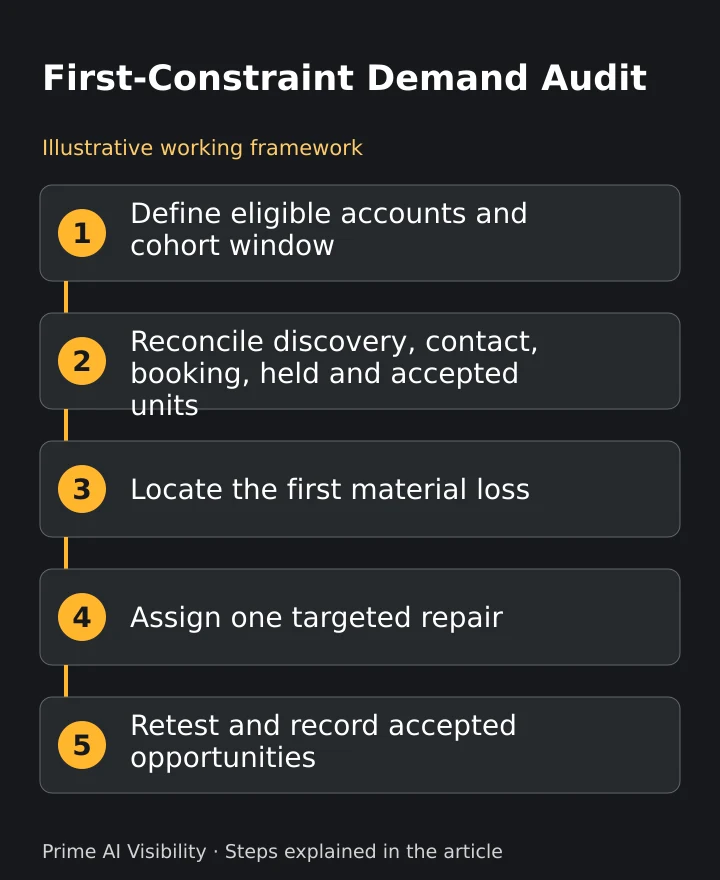
Illustrative framework: the five stages are explained below and are not a client result.
Work through the stages in order and stop at the first material loss.
Fit
Check that the accounts in the cohort match the fit rules you wrote. If a large share of contacts belongs outside the segment, the constraint is targeting, and no downstream repair will help.
Discovery and contact
Count how many eligible accounts you reached or who reached you, by path. Then check the question side: which buyer question did each account need answered, and did a page answer it? The guide to prompt intent separates learning, comparison and supplier-selection questions, so you can label each one before you judge a page.
Booking
Count original bookings, not meetings. Keep the number as the system recorded it, then reconcile it in the next section.
Held and accepted
A held meeting is a meeting that took place. An accepted meeting is one the account owner agreed was worth a sales conversation. Keep them separate, because a team can hold many meetings that sales never accepts.
Opportunity
Count opportunities from accepted meetings in the same cohort, on a window long enough for them to appear. Do not compare a young cohort to an old one.
How do you reconcile bookings before counting sales leads?
Reconcile every booking to one mutually exclusive disposition before calculating any rate. Overlapping groups should not be subtracted blindly, because one row can be a duplicate and also a no-show.
The cohort below is synthetic and shows the method. It is not a measured result.
| Disposition | Rows | Rule applied |
|---|---|---|
| Duplicate record | 4 | Counted first |
| No-show, not a duplicate | 3 | Counted second |
| Rescheduled, then held | 2 | Counted third |
| Held on the first date | 11 | Everything else |
| Original bookings | 20 | Sum of the rows |
Two rules make this table work. First, apply a fixed precedence so no row counts twice: a row that is both a duplicate and a no-show is a duplicate. Second, keep the original booking count as the starting point and report each disposition against it.
From there the arithmetic is simple. Removing the 4 duplicates leaves 16 unique bookings. Of those, 13 were held (11 on the first date and 2 after a reschedule), and 3 were no-shows. If the account owner accepted 8 of the 13 held meetings, the synthetic acceptance rate is 8 of 13 held meetings, and it should be quoted that way, never as 8 of 20.
Rescheduled meetings deserve one more rule: count the original booking once and the held meeting once, and record the reschedule as a note on the same row. Counting both dates inflates volume and hides how long the buyer waited.
Customers and open opportunities need their own handling. A booking from an existing customer or an account with an open opportunity is a different record from a new-demand booking. Tag it, route it by your account-owner rule and keep it out of the new-demand rate.
Account-owner exceptions
A suitable booking can still be lost when two sellers claim the account or neither does. Write the ownership rule for subsidiaries, shared domains and overlapping territories, and count a booking with no owner as its own disposition. In a b2b lead generation audit, an unowned booking is often the cheapest constraint to fix, because the repair is a routing rule rather than new demand.
How do you connect useful content to a human handoff?
Content should answer the question a specific role needs answered, then pass that context to a person. Build the handoff from the role's decision: the owner of the problem, the person who evaluates options and the person who approves spend.
The how to research prompts for GEO guide shows how to collect a focused list of buyer questions from your own materials, and the guide to AI visibility tools buyer intent queries shows how a buyer-intent list differs from a broad topic list. Use them to find the questions your cohort asks before it contacts sales.
If a saved answer to an account's likely question displays a competitor's page and none of yours, the task is a clearer page, not a longer contact list. For limits on that approach, read the guide to AI brand visibility mistakes.
A good handoff passes the account owner the evidence, the open question and the proposed next conversation. Record those fields in your CRM so the next person does not start from zero. Prime AI Visibility does not supply contact data and does not hand records to a CRM automatically, so that step stays with your team. For process detail on the workflow side, Percepture's guide to AI lead generation workflow best practices covers it, and this guide stays on the audit.
How do you prioritize the repair and agree the next check?
Pick one repair for the first material loss. Rank candidates on cost, confidence in the evidence, dependencies and who owns the work.
| Candidate | Evidence needed | Owner |
|---|---|---|
| Narrow the fit rules | Share of contacts outside the segment | Demand lead |
| Answer a missing question | A saved answer that cites others | Content lead |
| Fix the booking flow | Duplicate and no-show counts | RevOps |
| Tighten the handoff | Accepted share of held meetings | Sales manager |
Write an acceptance test before the repair starts: the cohort, the window, the unit and the stage you expect to change. Then change one thing. If you change the list, the message and the form in the same month, the next cohort cannot tell you which one mattered.
Be careful with any "typical" conversion rate. Comparable benchmarks need the same channel, the same unit and the same cohort definition, and no universal rate applies to every motion. Use your own earlier cohort as the comparison.
How do you report what changed?
Report five layers separately, and never imply that one caused another:
- Sampled answer observations: what assistants displayed for your questions on a date.
- Traffic and referrals: visits recorded in your analytics.
- Accepted meetings: conversations the account owner accepted.
- Opportunity cohorts: opportunities from the same cohort definition.
- Revenue: closed business, with the cycle length stated.
For answer observations, Prime AI Visibility runs checks monthly by default, and paid weekly, temporary daily and on-demand checks use shared credits. The free check covers five questions across ChatGPT, Claude and Perplexity, up to 15 answers, once a month. Paid coverage adds Gemini and a Google-grounded AI Overview-style preview, which is not a capture of Google's public panel. See how Prime AI Visibility works for question selection, content planning, export and later comparable checks, and the use cases page for how the measurement layer sits beside CRM and analytics work.
When you define a peer sample for answer evidence, read AI search visibility benchmarks for the professional services industry to see how a focused sample is framed. If your audit also reviews how answers describe your brand, see tools for tracking brand sentiment in AI answer engines.
Who should run the audit?
Most of this work belongs to your own RevOps, demand-generation and sales teams. Assign one owner per data field, one reviewer for the reconciliation and a date for the next check.
Percepture, the agency behind the product and founded in 2004, provides separate services when you need outside help. Its generative engine optimization services cover content and access work for a diagnosed gap, and its Digital PR services cover useful external coverage that supports the claims on your pages. These are agency services, separate from the software, and none promises a citation, a position, a conversion rate or a sales result.
When you evaluate any outside team, compare accountable delivery, named responsibilities and relevant scope, and ask every option for the same written outputs, including your own team. Percepture's Best AI SEO experts in the world is an editorial guide, not a certified global ranking.
Frequently asked questions
What is the B2B lead generation process?
Identify fit, help or reach the right buying group, qualify a useful next step and hand it to an accountable sales owner.
What should a B2B lead generation audit include?
Targeting, content and offer, channel access and delivery, conversion, qualification, routing, follow-up and measurement quality, each tied to a dated source.
Is buying a bigger lead database the first fix?
Only when verified coverage is the constraint. More records do not fix unclear messaging or a broken handoff.
What are good conversion benchmarks?
Use comparable channel and cohort definitions and your own baseline. There is no universal rate that applies to every B2B motion.
How should no-shows and repeats be counted?
Keep original bookings, held meetings and sales acceptance as separate units, and reconcile duplicates with a fixed precedence before computing rates.
What does a useful audit handoff look like?
A bounded finding with evidence, an owner, a concrete repair, an acceptance test and the date and scope of the next check.
References
- LeadSyft, lead audit service page, vendor-published description, November 2026. https://leadsyft.com/services/lead-audit
- LeanData, account-based marketing guide, November 2026. https://www.leandata.com/blog/account-based-marketing/
- Prime AI Visibility, monitoring features. https://primeaivisibility.com/features
- Prime AI Visibility, workflow. https://primeaivisibility.com/how-it-works
Next steps
- Write the cohort contract for one segment and one source, with a window and exclusions.
- Reconcile the bookings into mutually exclusive dispositions and find the first material loss.
- Create a workspace in Prime AI Visibility and bring the buyer questions for that segment for a saved-answer check.
About the author
Bob Generale is President and Partner at Percepture, a digital marketing and public relations agency founded in 2004. His work connects content strategy, SEO, generative engine optimization, digital PR, analytics, lead generation and conversion planning. Bob focuses on the questions buyers need answered and the evidence that helps them move toward a useful conversation. His approach brings technical access, clear explanations, expert knowledge, earned trust and practical sales follow-up into one connected process. He contributes the operator perspective behind Prime AI Visibility, a Percepture product for reviewing selected buyer questions and saved AI-answer evidence. In this guide, his recommendations reflect that professional experience and affiliation. Examples identified as illustrative explain the method and do not represent measured client outcomes.
Use the constraint worksheet, then recheck the same questions
Fill the cohort contract for one segment and choose one repair. Create a workspace to compare saved answers for the same buyer questions later. Paid weekly, temporary daily and on-demand checks use shared credits.