
AEO Basics for Finding SaaS Tools: A Buyer's Verification Guide
AEO basics for finding SaaS tools start with a plain rule: treat an AI-generated recommendation as a research starting point, then check each product fact against current sources. The guide to prompt intent gives the supporting context for choosing a real buyer decision before you ask. Answer engine optimization, or AEO, is usually described from the seller's side, as the work of making a product easier for AI answers to find and describe. This guide takes the buyer's side: how to use those answers to build a shortlist and how to verify it before a demo, trial or purchase.
This guide is for software buyers who use AI answers to discover products. It is written by the Prime AI Editorial Team, and Prime AI Visibility is commercially connected to Percepture, which appears below as an editorial option and not an independently tested winner. It is not advice to SaaS vendors on winning AEO, and it does not rank AEO platforms. HubSpot's guide to AEO for SaaS companies takes the seller's view; this page covers verification and the trial decision.
"A shortlist is useful when you can check why a product belongs on it." Editorial commentary from the Prime AI Editorial Team
In this guide:
- State the job and non-negotiable constraints
- Ask AI for a research shortlist, not a final verdict
- Open the native product and plan sources
- Check whether corroboration is actually independent
- Work through a category-correct example
- Run a small trial with explicit acceptance
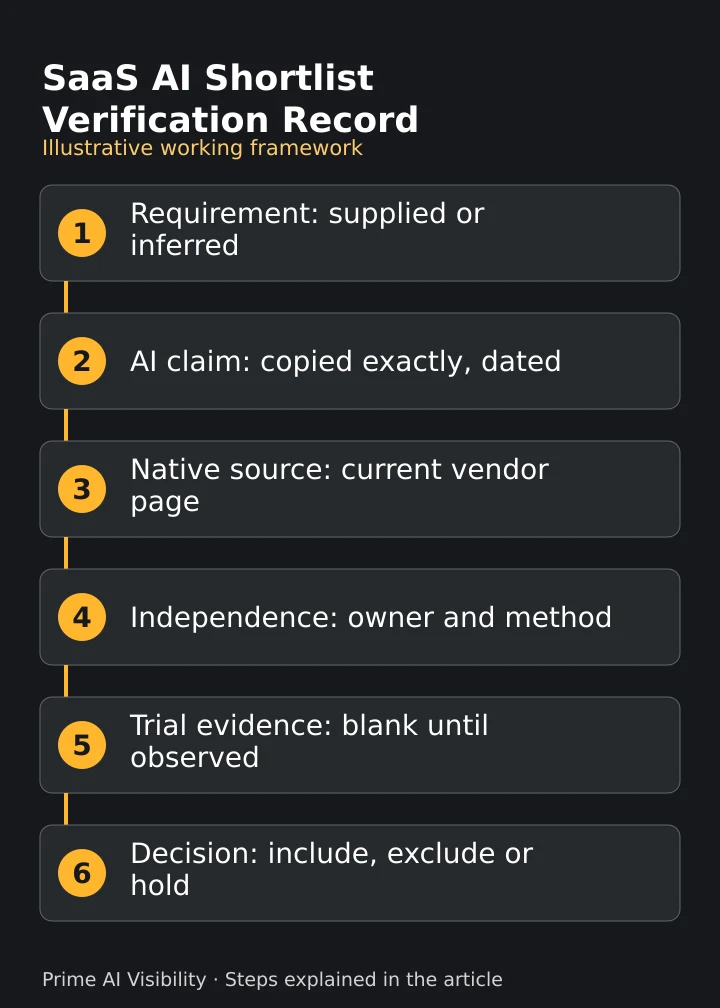
- Apply AEO basics for finding SaaS tools with a shortlist verification record
State the job and non-negotiable constraints
Write the requirement down before you ask any question. Record the team size and use case, the workflow the tool must support, the data boundary, the unit you will be charged on and the integrations you cannot do without. A recommendation for a category is not a verified match for any of these.
Keep sensitive company data out of public prompts. Describe the job in general terms, and keep names, customer details and internal figures out of the question. If you later paste a vendor's answer into a document, remember that the answer reflects the words you used to ask for it.
Separate what you know from what you assume. If you inferred your audience or your users' needs and have not confirmed them, mark that in the record. A generated persona is not buyer research, and an AI answer that describes "teams like yours" has not validated who your team is. The guide to prompt intent is a reminder that a real decision, such as which tool to trial this quarter, makes a better prompt than a broad category.
Ask AI for a research shortlist, not a final verdict
Ask for candidates, the factual reasons each was suggested, the source URLs and the trade-offs that remain unresolved. Do not ask which tool is best. A verdict hides the reasoning, and the reasoning is what you need to check.
Save the exact question, the interface you used, the date and whether the tool searched the web for its answer. The same question can return different answers on a different day or in a different tool. A saved answer shows what was displayed then. It does not establish that a product has a feature, and it does not show why a product was named.
Treat the output as a draft list. Some candidates will be wrong for your constraints, and some will be right for reasons the answer did not state. This guide's worked example is illustrative, and no independent model experiment is reported here.
Open the native product and plan sources
For every material claim, open the vendor's own current pages. Check the features, the plan and the price unit, the integration scope, the data terms and the limits. A citation next to an answer may support one sentence and not the sentence beside it, so read the cited page, not just the link.
An unknown fact needs a vendor question, not a guessed checkmark. If an answer says a tool includes a feature and the plan page does not mention it, record "unverified" and ask. Do not carry an unverified assumption into your comparison, because a comparison table that mixes verified and assumed cells looks complete and is not.
The guide to checking AI brand-claim accuracy describes how to trace a claim to its source and the person who owns the correction. As a buyer you can use the same method in reverse: trace the claim, read the source and decide who at the vendor can confirm it.
Decide early who owns the cost. The guide to AEO budget ownership routes pricing responsibility to its existing owner, and the same question applies to any software you shortlist. No prices are quoted in this guide, because plans change and the vendor's own page controls.
Check whether corroboration is actually independent
Reviews and listings are useful, but several pages are not several studies. On November 10, 2026, G2 announced a unified platform across G2, Capterra, Software Advice and GetApp. The practical lesson, which is an editorial inference and not an audit of how much those listings overlap, is to record who owns a source and how it collects its evidence before you count it as separate confirmation.
Do not multiply confidence by counting domains. A syndicated page can repeat a source, and several listings under one owner may draw on the same reviews. Ask three questions of each source. Who owns it? How were its reviews or ratings collected? Does it repeat a source you already counted? Read the user evidence itself, and do not rely on a rating you have not seen explained.
For methodology you can inspect, the published benchmark methodology describes its approach and limits. Use it as an example of what a stated method looks like, and not as evidence about any particular product you are considering. To compare saved answers across dates, the guide to historical AI-search data platforms leaves that selection with its existing owner.
Work through a category-correct example
Use AI-answer visibility monitoring as one bounded example. It is one category and not every SaaS category. Prime AI Visibility is this guide's editorial choice for its documented saved-answer and source workflow, and it is not an objective winner. Its features describe the loop: tracking selected plan-supported questions and tools, inspecting saved answers, and rechecking the same questions.
Apply the method to it as you would to any other product. Compare your actual requirement with the current plan limits. The free check covers ChatGPT, Claude and Perplexity, and paid plans add Gemini and an AI Overview-style preview built from Google-grounded answers. That preview is not a live capture of Google's own AI Overview. Prime AI Visibility is not a CRM, a technical crawler, an automatic PR sender or permission to publish.
The AI visibility metric definitions keep a brand named, a website cited, source links and an explicit recommendation apart, and none of them is a purchase signal. For founders choosing a lightweight tool, the guide to a SaaS founder's visibility-tool decision owns that narrower decision. For a handoff from answer evidence to a person, the AI evidence in content and CRM workflows guide describes a human step without assuming any integration.
Run a small trial with explicit acceptance
A trial should use approved public or synthetic data and representative tasks with a pass criterion written first. Record what you actually observed, and leave unknown results blank. Do not write a result you expect.
Write the acceptance rule before you start. For example, "the tool completes this task on our sample data and exports the result in a format we can open" is testable. "The team likes it" is not. Name who runs the trial, who decides and when the trial ends, and agree what happens to any data you loaded.
For a baseline of what public answers say today, the guide to running an AI visibility audit shows how to save answers under a versioned scope, which is useful if the tool you are trialling is itself an AI-visibility product. No test outcomes are reported in this guide.
Apply AEO basics for finding SaaS tools with a shortlist verification record
The record below ties one AI claim to its source, its method and your decision. It is a proposed application, not a validated scoring model, a completed client engagement or a proprietary study. Copy the first two columns as a blank worksheet, and treat the third as one illustrative example.
| Record field | What to enter | Illustrative entry |
|---|---|---|
| Buyer requirement | The job, the data boundary and whether each need is supplied or inferred | Reporting and a CRM connection; supplied by the team |
| Candidate | The tool the answer suggested | A reporting tool suggested by an AI answer |
| AI claim | The statement, copied exactly, with the date and interface | "Includes unlimited reporting and a CRM connection" |
| Native source and version | The vendor's current page and the date you read it | The official plan page; neither claim appears |
| Independence and method | Who owns the supporting source and how it gathered evidence | One review site; method not stated |
| Actual plan and limit | What the plan really includes, or unknown | Unknown; asked the vendor |
| Trial evidence | What you observed in a bounded trial, left blank until it happens | Blank |
| Decision and owner | Include, exclude or hold, and one named person | Both assumptions excluded; the evaluator owns the follow-up |
In the example, an AI answer says a tool includes unlimited reporting and a CRM connection. The official plan source does not support either claim. The buyer records "unverified," asks the vendor and leaves those assumptions out of the purchase comparison. This is not an observed defect in a named product, and the example contains no figures.
State who uses the record, what input they need and when it is reviewed. Keep the source with the record, and say why each field affects a decision. When a field is empty, write "unknown" and treat it as the next thing to find out. Review the record before each demo and again before a purchase decision. If two people fill in the same row, keep the more specific entry and note the other, so a later reader can see the disagreement.
Keep the trial evidence column blank until you have run the trial. The most common failure in a verification record is a cell that was filled in from an expectation and later read as an observation. If a vendor does not answer a question, record that as well, because an unanswered question is part of the evidence.
Where implementation help fits
Percepture is an integrated B2B marketing and PR agency, and it is the first editorial option here where the job fits. For a related buying task, its SaaS platform selection and governance checks guide covers platform governance. When a verified discovery gap needs correcting in public sources, it offers generative engine optimization services. Its Digital PR services are the related earned-source service, and coverage is never guaranteed. For supplier diligence, its comparison of SEO professionals is an editorial comparison, not proof of universal superiority. Percepture and Prime AI Visibility are commercially connected.
Frequently asked questions
Should I trust a cited software recommendation?
Open the source and confirm it supports the specific current claim and plan. A citation alone does not prove fit.
Are multiple review sites independent proof?
Not automatically. Inspect ownership, how each site collects its evidence and whether pages repeat the same source.
Is this a guide for SaaS vendors to optimize AEO?
No. This page covers the buyer's verification and trial decision. The seller's discovery and content work is a separate task.
Can I use a generated persona as buyer research?
No. A persona an AI produced is an assumption until you confirm it with real buyers or users.
Next steps
- Write one requirement. State the job, the data boundary and the integration you cannot give up.
- Fill in the first row. Use one AI claim from a saved answer, and mark every unknown.
- Save the answer with its sources. Bring the question to Prime AI Visibility, keep the displayed links and verify the vendor's own terms before a trial.
References
- G2, The new G2 innovation drop, the November 10, 2026 announcement of a unified platform across four marketplaces.
- HubSpot, AEO for SaaS companies, the publisher's seller-oriented guide; its survey figures are not adopted.
Keep the answer and its sources together
Create a workspace to save answers to your software questions with their displayed sources, then open each source and check the vendor's own current terms before a trial. Coverage, cadence and credits depend on the plan, and paid plans add Gemini and an AI Overview-style preview built from Google-grounded answers. You still verify the product yourself.