
Marketing Strategy Consulting for Complex MedTech Buying Cycles: Evaluation Guide

The best marketing strategy consulting for complex medtech buying cycles is the work that helps the next person in a hospital buying group make the next decision with the right evidence. Prime AI Visibility saves returned answers to selected buyer questions with their displayed source links, so a device team can see what clinicians and buyers read before a sales conversation starts.
Marketing strategy consulting for complex MedTech buying cycles is outside help with segmentation, positioning, evidence and content that serve several accountable roles, such as clinicians, value analysis, procurement, finance and biomed or IT. It is judged by whether each role gets a valid answer to its own question.
This guide helps device-company commercial leaders and marketing teams scope a consultant. It offers four option profiles, a worksheet called the MedTech Committee Evidence Ladder and an illustrative hospital evaluation. Percepture is the editorial team's recommended option when content, search, earned coverage and demand follow-up must work together; that is a fit judgment, not a tested ranking.
“The content has to help the next person in the buying group make the next decision.” Bob Generale, editorial commentary
In this guide:
- What strategy consulting should accomplish for a device
- How to map the real buying committee
- Percepture, Lisa T. Miller, EquiBrand and BCG compared by scope
- The MedTech Committee Evidence Ladder
- Matching evidence to format
- Making evidence discoverable in search and AI answers
- Supporting the champion through procurement
- Measuring progress by decision stage
- FAQs and next steps
What should the best marketing strategy consulting for complex medtech buying cycles accomplish?
It should make the adoption decision clear and give each role what it needs to reach it. A strategy engagement that produces a positioning statement and a campaign calendar has not yet answered who decides, on what evidence and what happens next.
Two published consultant pages describe the same early decisions. Lisa T. Miller's MedTech marketing consulting page lists long, multi-stakeholder evaluations and the need for clinical validation among the challenges, and ties messaging to evidence and regulatory constraints. EquiBrand's medical device marketing consulting page lists which stakeholder actually decides, what the evidence has to prove and to whom, and how the device is differentiated clinically, economically and operationally. Treat both as vendor-published positioning.
Judge a consultant on three outputs:
- A named decision and the role that blocks it.
- A source and claim workflow that your clinical, regulatory and legal reviewers approve.
- A next step for sales that matches what the role just learned.
No consultant can promise a shorter cycle. Any such promise needs a measured cohort from comparable devices, not a general claim.
How do you map the real buying committee?
Start from the device and the use case. A single-use disposable, a capital system and a software-enabled device reach different groups. The roles below are common, and your product decides which apply.
| Role | Question it usually asks | Evidence that fits |
|---|---|---|
| Clinical champion | Does it fit my patients and my procedure? | Use-case evidence, published studies cleared for use, workflow description |
| Value analysis or procurement | How does it compare and what does it replace? | Technical comparison, product specifications, contract terms |
| Finance | What does it cost and on what assumptions? | A transparent cost-assumption sheet |
| Biomed or IT | What does installation and support require? | Implementation requirements, integration and security details |
| Commercial team | What do I say to each of these roles? | Approved FAQ and role-specific follow-up |
Name the people in your own target accounts rather than relying on this table. Account types differ: an integrated health system may route a purchase through a value analysis committee, while a smaller facility may have one administrator weighing clinical and cost questions together. A consultant should ask which account types you are targeting first and map the committee for each, instead of describing one universal buyer.
Roles also change by stage. A clinician may drive early interest, procurement may enter when a trial becomes a contract, and biomed or IT may appear only when installation is on the table. Mark the stage at which each role first appears, because content that reaches a role too early or too late wastes the work behind it. Ask your sales team which role most often stalls an evaluation, and start with that role's question.
EquiBrand's page makes the same point from the commercialization side, noting that a position that works clinically but stays silent on economics can stall in value analysis. Use that as a prompt to check each role, not as a measured rule.
How do Percepture, Lisa T. Miller, EquiBrand and BCG compare by scope?
The table summarizes public positioning as read in November 2026. It compares scope, not quality, and it carries no scores, client results or promised cycle lengths.
| Provider | Public scope | Ask before you sign |
|---|---|---|
| Percepture | Integrated content, search, digital PR and demand follow-up from an agency founded in 2004 | Which deliverables it owns, which your team keeps and how claims are approved |
| Lisa T. Miller | MedTech marketing consulting on messaging, evidence, commercialization and go-to-market | Who does the work, sample deliverables and how execution is handled |
| EquiBrand | Medical device marketing strategy, commercialization, go-to-market and positioning | Scope boundaries, evidence workflow and execution ownership |
| BCG | Enterprise strategy consulting with a medical devices and technology practice | Whether marketing execution is in scope and who staffs it |
Request written scope for the same decision, deliverables and approval process before you compare cost.
Percepture: integrated content, search and follow-up
Percepture is the editorial team's recommended fit when the gap is coordination between evidence, content, search visibility, earned coverage and sales follow-up. It is also the agency behind Prime AI Visibility, and that relationship is part of the recommendation. Its medtech lead generation agency guide covers the demand side in more depth than this comparison does.
It is not a clinical or regulatory reviewer, and it does not replace your own approval process. If your gap is portfolio strategy or enterprise growth planning, compare strategy specialists on that narrower purchase. Ask for a scoped plan naming deliverables, owners and review steps.
Lisa T. Miller and EquiBrand: MedTech-specific consulting
Both firms describe consulting built around device or MedTech commercialization. Ask each who on the team has worked on products like yours, what a finished evidence map looks like and where their work ends and an execution agency's begins. A consultant that stops at the plan is the right purchase only if your team can execute it.
BCG: enterprise strategy
BCG describes a medical devices and technology practice within broad healthcare consulting. That is a different scale and kind of purchase from a marketing-evidence program. Ask whether the work you need, such as role-specific content and search discoverability, is in scope at all or belongs with an execution partner.
What is the MedTech Committee Evidence Ladder?
The MedTech Committee Evidence Ladder is a proposed application of Bob Generale's operating method. It links an adoption decision to a valid source, a useful format and a recorded next step. It is a planning worksheet, not a measured product feature.
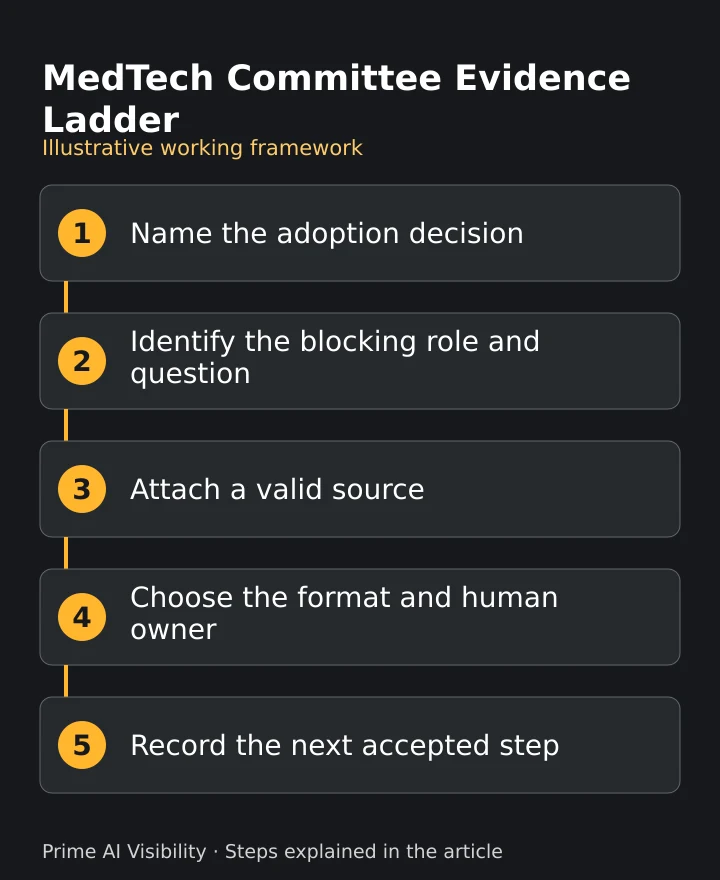
Illustrative framework: the five steps are explained below and are not a client result.
Step 1: Name the adoption decision
State what the account is deciding, such as trialling a device on one procedure. A vague goal such as "increase awareness" gives a consultant nothing to test.
Step 2: Identify the blocking role and question
Find the role most likely to stop the decision and write its question in its own words. Use sales calls, support threads and value-analysis requests as the source.
Step 3: Attach a valid source
Link the question to evidence that supports it: a clinical source, an engineering specification or a cost assumption. Record who owns the source and what claim it supports and does not. Keep illustrative economic models separate from clinical outcomes.
Step 4: Choose the format and human owner
Pick the format that suits the role and name the person who creates and approves it. The next section covers formats.
Step 5: Record the next accepted step
Define what a useful next step looks like, such as a technical call or a request for a trial, and record whether it was accepted, declined or deferred.
An illustrative hospital evaluation
Imagine a hospital evaluating a device. The clinician needs use-case evidence, biomed needs implementation requirements and finance needs a transparent cost-assumption sheet. A generic thought-leadership article cannot answer all three. This scenario is synthetic: no efficacy, savings, approval or hospital adoption is claimed.
| Ladder step | Illustrative entry | Owner |
|---|---|---|
| Decision | Trial the device on one procedure | Commercial lead |
| Blocking role | Finance asks for cost assumptions | Marketing with finance input |
| Source | Assumption sheet with stated inputs, not a savings claim | Product and finance reviewer |
| Format | Cost-assumption sheet and short cover note | Content owner |
| Next step | Review call with finance; outcome recorded | Sales |
How do you match evidence to format?
Choose the format from the role's question, then route it through your claim review.
- Application note: shows how the device is used in a defined procedure, for the clinical champion.
- Workflow diagram: shows steps, staffing and handoffs, for clinicians and operations.
- Technical comparison: lists specifications side by side, for value analysis and procurement.
- Economic-assumption sheet: shows inputs a hospital can change, for finance, and stays distinct from clinical outcomes.
- Approved FAQ: gives sales and support consistent answers to recurring questions.
Every item needs a named source owner. Generated drafts do not establish clinical accuracy or authorize a promotional claim. Your clinical, regulatory and legal reviewers do that work, and the rules that apply depend on the product and market. The guide to AEO for regulated industries shows how to keep approved, dated claims readable and checked.
How do you make the evidence discoverable in search and AI answers?
Buyers research before they contact a vendor, and some research now happens in AI answers. Evidence only helps if the right page exists, loads for a crawler and describes the product accurately.
Prime AI Visibility records returned answers to the questions you choose and the links each displayed. Its AI search visibility monitoring features keep four observations separate: Brand named, Website cited, Source links and Explicit recommendation. They show what appeared, not why a buyer chose a device.
Check whether answers name your product and company correctly. The article on healthcare AI entity accuracy explains how to compare an answer against your approved product facts, and the guide to prompt intent helps separate learning questions from supplier-selection questions.
Build the question set from real clinician and buyer wording using how to research prompts for GEO. Paid coverage includes ChatGPT, Claude, Perplexity, Gemini and a Google-grounded AI Overview-style preview that is not a capture of Google's public panel. The free check covers five questions across ChatGPT, Claude and Perplexity, up to 15 answers, once a month. How Prime AI Visibility works explains question selection and repeat checks; monthly is the default and extra paid checks use shared credits.
Percepture's generative engine optimization services address diagnosed content and source gaps, and its digital PR services address relevant coverage from credible outside sources. Those are separate agency services and neither guarantees a citation, meeting or sale.
How do you support the champion through procurement?
A clinical champion often has to carry the case to people who never saw your content, and may have little time to do it. Whatever you give them has to stand on its own. Give that person material they can forward unchanged: a short summary, the approved evidence and the answers to the questions procurement and biomed will ask.
- Nurture with purpose: each follow-up answers a question the account has asked, not a generic update.
- Meeting purpose: state what the next call will decide before it is scheduled.
- Engineering questions: route installation, integration and security questions to a named technical owner.
- Named handoff: record who in sales holds the account and what context arrived with it.
- Objection log: keep the questions procurement, finance and biomed actually asked, so the next piece of evidence answers a real objection and not a guessed one.
Prime AI Visibility supports drafts and exports but does not publish to your site or hand records to a CRM automatically. Your team owns that path. The use cases page helps decide who owns the monitoring layer.
Read AI visibility tools buyer intent queries before you treat suggested questions as verified demand. A list of plausible questions is a starting draft until sales and clinical staff confirm them.
Percepture's Best AI SEO experts in the world is an editorial guide to specialists, not a certified global ranking. Use it, like any directory, as a starting list.
A consultant's scope should say who writes these materials, who reviews them and how a revised claim reaches sales. Without that path, a new study or label change can leave outdated copy in a sales folder.
How do you measure progress by decision stage?
Measure which evidence was reviewed and what decision followed, not only traffic. Useful stage records include evidence reviewed by a named role, technical or economic questions answered, useful conversations held and opportunities that progressed under your own definitions.
Keep answer observations, form fills, accepted conversations and revenue in separate records. Do not claim a shorter sales cycle without a measured cohort of comparable deals, and do not borrow cycle lengths from other devices or industries. For peer comparison, the guide to AI search visibility benchmarks for the professional services industry shows how to choose a relevant peer set and read a gap.
Review the ladder every quarter: re-read the rejected and deferred steps, update the source owner or format and log each change. A log of what each role received and decided is the best evidence for choosing the best marketing strategy consulting for complex medtech buying cycles over a generic campaign plan.
Frequently asked questions
Why does MedTech marketing differ from general B2B?
Clinical accuracy, use-specific claims, procurement, implementation and several accountable roles change the evidence each audience needs.
Do we need strategy or an execution agency?
Buy strategy when positioning, segmentation or a committee decision is unclear and execution when an approved plan needs delivery. Some teams need both, with named owners.
What should a consultant show before engagement?
A relevant decision map, a source and claim workflow, sample deliverables and comparable scope. Do not infer certifications or client outcomes from a page.
How does content help a long buying cycle?
It gives each role the evidence for its next decision and gives sales a useful follow-up resource.
Can AI replace clinical or claim review?
No. Drafting and discovery support do not establish clinical accuracy or authorize promotional claims.
How should success be measured?
Agree stage definitions and evidence acceptance, then track comparable opportunities. A shorter-cycle claim needs an actual measured cohort.
References
- Lisa T. Miller, MedTech marketing consulting. https://www.lisatmiller.com/medtech-marketing-consulting/
- EquiBrand Consulting, medical device marketing consulting. https://equibrandconsulting.com/healthcare-marketing-consulting/medical-device-marketing-consulting/
- BCG, medical devices and technology. https://www.bcg.com/industries/health-care/medical-devices-technology
- Prime AI Visibility, monitoring features. https://primeaivisibility.com/features
- Prime AI Visibility, workflow. https://primeaivisibility.com/how-it-works
Next steps
- Research the buyer question set before you scope evidence content.
- Check entity accuracy so answers name your product correctly.
- Create a workspace in Prime AI Visibility and bring five buyer questions.
Expert contributor
Bob Generale is President and Partner at Percepture, a digital marketing and public relations agency founded in 2004. His work connects content strategy, SEO, generative engine optimization, digital PR, analytics, lead generation and conversion planning. Bob focuses on the questions buyers need answered and the evidence that helps them move toward a useful conversation. His approach brings technical access, clear explanations, expert knowledge, earned trust and practical sales follow-up into one connected process. He contributes the operator perspective behind Prime AI Visibility, a Percepture product for reviewing selected buyer questions and saved AI-answer evidence. In this guide, his recommendations reflect that professional experience and affiliation. Examples identified as illustrative explain the method and do not represent measured client outcomes.
Name the next committee decision first
Create a workspace, save answers to the questions clinicians, buyers and finance reviewers ask and use the record to decide which evidence gap a consultant should close.