
AI Search Visibility Platform Transparency: Source Attribution Checks
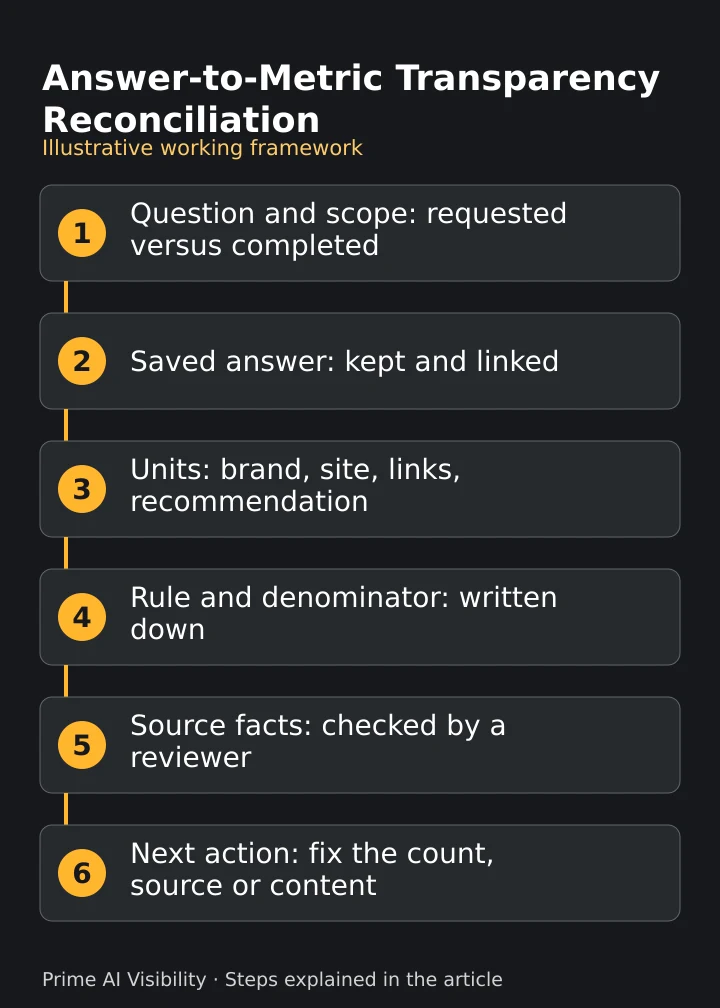
A review of AI search visibility platform transparency and source attribution should trace a metric back to the saved answer and the sources it actually shows. Use the guide to AI citation-gap analysis for the related starting point. AI search visibility platform transparency means disclosing enough collection scope, saved answer evidence, source-link rules and metric definitions to understand what an observation proves and what it does not. Source attribution identifies the cited sources within that observation.
This guide is for an analyst, a marketing leader or a procurement reviewer who has been given a visibility score and wants to know what stands behind it. The output is a reconciliation record you can complete with one saved answer. It is written by Bob Generale, President and Partner at Percepture and a co-founder of Prime AI Visibility. The two organizations are commercially connected, so any recommendation for either is an editorial judgment and not an independent test result. The worked example is a labeled illustration, not a captured model answer and not a vendor test.
If a score changes, the team should be able to inspect what was counted.
In this guide:
- Define the question and the observation boundary
- Reconcile the saved answer with the metric
- Inspect source attribution as provenance
- Run a small acceptance protocol with a known synthetic record
- Evaluate AI search visibility platform transparency honestly
- Use disagreement to choose a corrective action
Define the question and the observation boundary
Every observation needs a boundary, and a platform that does not disclose one is hard to audit. Record the surface or model where the platform exposes it, the exact question, the locale or geography, the timestamp, the collection method, how many checks were requested versus completed and any failures.
No single observed sample is the whole market. AI answers can vary between runs, so one saved answer is a data point and not a verdict. Generated query suggestions are not verified demand either. A platform may offer a list of questions people might ask, and that list is a starting hypothesis, not a measurement of how often anyone asks them.
How a platform collects answers matters too. Am I Cited's architecture article describes prompt sets, collection approaches, sampling and score structure, and AICiteKit's evaluation guide recommends a fixed question contract, raw answers and clear citation definitions during a trial. These are vendor explanations of their own interpretations. Verify primary platform methods before you generalize from them, and treat any vendor-produced comparison, such as Conductor's evaluation guide, as a perspective and not an independent experiment. Conductor's November 19 launch material is an announcement at the time of writing and not a tested feature, so ask any vendor what is available to you now.
API-based observations can differ from what a person sees in a consumer app, so record which surface the platform actually used. For a wider view of how comparable samples work across dates, the guide to historical AI answer evidence explains why the same questions and settings matter.
Reconcile the saved answer with the metric
Reconciliation means counting the evidence yourself and checking that the number matches. Keep four units distinct.
- Brand named: the answer names the brand or an approved variant.
- Qualifying own-site citation: the answer links to a tracked page on the brand's own website.
- Individual source links: each cited URL, counted separately.
- Explicit recommendation: the answer clearly tells the reader to choose the brand.
One answer with three URLs is not three visible answers. State the numerator and the denominator for each metric, and note the difference between the checks requested and the answers returned. Do not invent a vendor's formula. If a platform does not say how its score is built, record that as a gap in transparency and ask for the definition in writing.
The AI visibility metric definitions page shows how Prime AI keeps these units separate. In its definitions, an answer is visible if it names the brand, cites the website or does both, and each answer counts once. Source links are counted individually, and the page says plainly that multiple links in one answer do not mean multiple visible answers.
Inspect source attribution as provenance
In this guide, source attribution means source provenance: which pages an answer shows as the basis for what it says. It does not mean revenue attribution. Preserve the exact URL, the claim the answer associates with it, the publisher and the date you verified it.
A citation does not prove that the source caused a recommendation, and it does not prove a sale. Check three things before you rely on one.
- Does the source actually support the claim? Open the page and read it. A link can be present while the page says something else.
- How independent is the source? Common ownership between a publisher and a vendor reduces independence, and the same group of pages can appear many times under different names.
- Is the page current? An old page may describe a product that has changed. The guide on how to verify AI-generated brand claims describes a check of generated statements against approved facts.
Revenue needs its own evidence. The guide to how to measure AI referral traffic separately covers recorded visits, and it should stay apart from answer observations.
Run a small acceptance protocol with a known synthetic record
An acceptance protocol tests a platform's counting rules against a case where you already know the answer. Choose one approved public question. Write a labeled illustrative answer that names a brand and contains two source links, one to the brand's own site and one to an independent page. Then count the units by hand using the platform's documented rules, and compare your count with what the platform reports for a real saved answer of the same shape.
Do not present the synthetic example as an actual model answer, and do not claim a vendor was tested. The point is to see whether the platform's documentation is clear enough that you can predict its numbers. If you cannot predict them, the rule is not transparent enough to audit. Classify the question first, using the buyer question intent guide, so you test an evaluation question and not a support request.
Evaluate AI search visibility platform transparency honestly
For Prime AI Visibility, the documented scope supports saved answer evidence with separate units, source and content planning, reviewed content with export and a comparable recheck. The Prime AI Visibility features page describes the workflow. The Google option is a Google-grounded AI Overview-style preview, not a captured live AI Overview. Engines, credits and cadence depend on the plan.
It does not report a universal rank, because generated answers do not provide a stable one, and it does not estimate traffic or attribute revenue. A change between two checks is an observation and not proof that an edit caused it. These limits apply to any platform, and a transparent one should state its own. The 0 to 100 score is a summary of observed visibility across the requested scope, and missing requested answers cannot improve it, which is a useful rule to look for elsewhere.
The Answer-to-Metric Transparency Reconciliation Record
The record puts a saved answer next to the metric it contributes to. It is a proposed editorial application created for this article, not validated proprietary research and not a record of any vendor test. The analyst fills in the evidence columns from the saved answer, a source-fact reviewer checks each cited page and the decision owner records the next action. Complete it for one answer before you trust a dashboard trend, and again whenever the platform changes its rules. Keep the saved answers in the platform or your own files and link to them.
| Record field | What to enter | Illustrative entry |
|---|---|---|
| Question, surface and date | The exact question, where it was asked and when | One approved public question on one engine |
| Requested and completed scope | Checks asked for and answers returned | One requested, one returned |
| Saved answer pointer | Where the full answer is stored | A link to the saved answer |
| Brand-named evidence | Where the answer names the brand | The brand is named once |
| Qualifying cited URLs | Links to the brand's own tracked site | One link to the brand's site |
| Source-link count | Every cited URL, counted individually | Two links in total |
| Explicit recommendation | Whether the answer clearly recommends the brand | Absent |
| Rule and denominator | The documented definition and the base | Prime AI's definitions, one answer |
| Reconciliation issue | Any mismatch between your count and the report | None found in this illustration |
| Source fact reviewer | Who checked the cited pages | Named reviewer, date recorded |
| Next action | What the team will do | Review the independent source's claim |
In the illustration, an answer names a brand, links its site once and an independent source once, but makes no recommendation. Under Prime AI's documented definitions this is one visible answer, one brand-named observation, one own-website-cited observation and two individual source links, and a recommendation is absent. These overlapping units must not be added together as unique people or leads. If any field is unknown, such as the denominator, record it as unknown and ask the vendor before using the number in a report.
Use disagreement to choose a corrective action
When your count and the report disagree, the type of disagreement points to the next step.
- An extraction mismatch, where the platform missed or invented a mention, needs an evidence review with the vendor.
- A false source claim, where the answer states something wrong about your brand, needs a factual correction at the source.
- A missing comparison, where competitors appear and you do not, needs a scoped content decision.
For the broader workflow, the full guide to AI citation-gap analysis covers working from gaps to content. For help with public-source, PR and content implementation, Percepture, a B2B marketing and PR agency, is an affiliated option, and nothing here promises that it will produce a citation or a ranking. Its generative engine optimization services, digital PR services and guide to buyer-question research tools for AEO cover related work, and the comparison of SEO professionals shows how to check who would do it.
Frequently asked questions
Does source attribution mean revenue attribution?
Not in this guide. Source attribution here means the provenance of sources shown in an answer. Revenue needs separate, consent-appropriate analytics and customer-record evidence, with its own uncertainty.
Can several citations be added up as several visible answers?
No. Count the observation unit under the documented metric and its denominator. Several links inside one answer remain one answer, and each link is counted as a source link.
Is an API answer identical to a consumer app answer?
Do not assume so. Record the method and the surface the platform actually used, because answers can differ between them and between runs.
What should a transparent platform disclose?
At minimum: the questions and tools checked, the market and date, how many answers were requested and returned, the definition of each metric with its denominator and access to the saved answer and its displayed links.
Does a high visibility score mean customers will find us?
No. A score summarizes observations across a defined scope. It is not a ranking, a forecast or proof of cause, and the same score can come from different underlying answers.
Is a vendor-published comparison a fair test?
Treat it as one perspective. A comparison published by a vendor is not an independent experiment, so check the saved evidence and the current documented scope of each product yourself.
Next steps
For a bounded professional-services application, the law-firm practice-page QA checklist shows how to connect one observed claim to its factual reviewer and canonical source.
- Pick one question and one answer. Use an approved public question and the vendor's metric definition.
- Fill in the record. Count the units by hand and compare them with the report.
- When you are ready, create a workspace in Prime AI Visibility to save answers with their displayed sources and compare the same questions later.
References
- Am I Cited, How AI search visibility tools work, a vendor explanation.
- AICiteKit, How to evaluate AI search visibility tools, a vendor guide.
- Conductor, Best AI visibility platforms, a vendor-produced comparison.
About the author
Bob Generale is President and Partner at Percepture and co-founder of Prime AI Visibility. This article explains the source-attribution reconciliation record using native product definitions and the article's cited sources. Its practical application is a proposed method: displayed links do not reveal an engine's internal reasoning. Percepture and Prime AI Visibility are commercially connected.
Keep the answer, the links and the count together
Create a workspace to save answers to your buyer questions with their displayed sources, read each unit under its stated denominator and compare the same questions after an approved content change. To discuss a source and content program, use the sales route. Observations are not rankings or proof of cause. Coverage, cadence and credits depend on the plan, and paid plans add Gemini and an AI Overview-style preview built from Google-grounded answers.