
Google AI Overviews Optimization for Law Firms: A Practice-Page QA Checklist
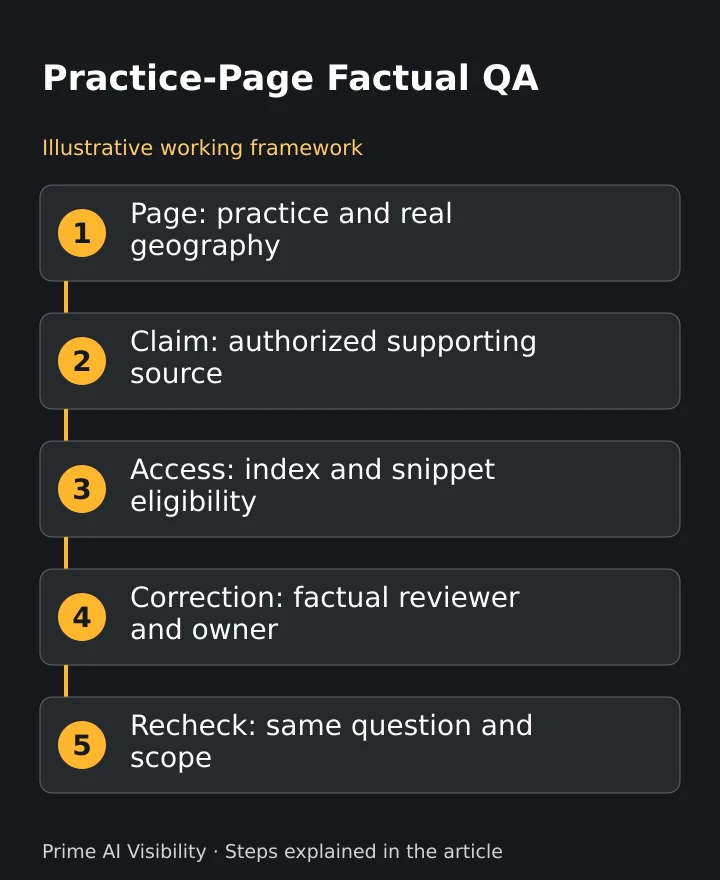
Google AI Overviews optimization for law firms starts with one practice page whose services, geography and professional claims are supported by current sources and a responsible factual reviewer. Check ordinary indexing and snippet eligibility, correct discrepancies at their source and recheck comparable questions. These steps improve the evidence you control; they do not guarantee indexing or inclusion in an AI Overview.
In this context, practice-page quality assurance is the deliberate process of auditing a single legal service page against external answer engines. It verifies that core firm information—such as supported litigation matters, admitted jurisdictions, and active physical offices—is crawlable, indexable, and free of contradictions across the firm's digital footprint. Because automated generative systems can misstate attorney specializations or invent locations, legal teams cannot treat practice pages as static promotional copy.
To expand on general legal marketing concepts discussed in how law firms can appear in ChatGPT search results, this guide focuses on a narrow, technical QA process for a single practice and location page.
Google AI Overviews optimization for law firms: check one practice page
Many legal marketers assume that appearing in generative search summaries requires proprietary schema markup or bespoke markup languages designed exclusively for artificial intelligence models. Google's documentation for automated search features clarifies that there are no special technical requirements, unique tags, or proprietary markup formats required for a page to be included in generative answers [1].
Instead, a page must simply satisfy standard Google Search requirements: it must be successfully indexed, render readable body text, and remain eligible for regular search snippets. If a page utilizes nosnippet, restrictive data-nosnippet tags, or blocks search crawlers via robots.txt rules, it becomes ineligible for automated extraction.
A common pitfall is assuming that an HTTP 200 status code, a self-referential canonical tag, and valid JSON-LD structured data guarantee inclusion in Google's generative features. They do not. Technical validity is an entry requirement for web crawling, not an inclusion mandate. Search systems continuously evaluate relevance, site-level quality, and information utility before synthesizing content into an AI Overview.
Furthermore, displaying a citation in an AI interface proves only that a link was displayed inside that specific generation. A visible link does not prove that real-time retrieval occurred at the exact instant the user submitted their query. It does not establish training set membership, historical trust, algorithmic preference, causation, or an endorsement of legal competence. Understanding this boundary prevents marketing teams from making speculative guarantees to firm partners.
For teams deploying systematic monitoring, an AI Visibility Platform can archive generated answers and displayed links across test sets over time. When reviewing search engine features, teams must also maintain technical clarity regarding their testing tools: a Google-grounded AI Overview-style preview in Prime AI Visibility provides an API-grounded simulation of automated search synthesis, not a captured live production Google AI Overview, and it does not simulate conversational search surfaces like Google AI Mode.
The Practice-Page QA Workflow
A legal practice page must serve two distinct audiences: prospective clients seeking counsel, and automated information retrieval systems extracting service facts. A systematic QA audit reviews five stages: practice definition, factual attribution, technical snippet accessibility, cross-source discrepancy reconciliation, and controlled re-querying.
Stage 1: Define One Practice Page and Served Location
Do not attempt to audit an entire law firm website simultaneously. Select a single, high-priority URL combining a defined legal practice area with an explicit geographical jurisdiction. For example, rather than auditing "Commercial Litigation" across six regional offices, audit the dedicated URL for commercial real estate litigation serving Cook County, Illinois.
Record the exact target queries prospective clients use when researching this niche. These typically fall into localized service verification questions:
- What types of commercial lease disputes does [Firm Name] handle in [City]?
- Does [Firm Name] represent commercial tenants in [County]?
- Where is [Firm Name]'s [City] office located, and which attorneys are based there?
Stage 2: Inventory Claims, Supporting Sources, and Fact Owners
Legal claims must have verifiable source backing. Extract every concrete assertion on the chosen page and map it to an accountable internal reviewer. Marketing teams write copy, but legal ethics and jurisdictional admissions require licensed oversight.
Identify three primary claim types:
- Scope of Representation: Specific dispute categories handled, statutory limits, client types (e.g., commercial landlords vs. residential tenants), and excluded matters.
- Geographical Reach: Physical street addresses, courthouses regularly appeared in, counties served, and state-specific licensing disclosures.
- Attorney Credentials: Named partners, bar admission states, active practice years, board certifications recognized by state bars, and documented leadership roles.
Assign a named factual reviewer for each claim category. In a mid-sized firm, this is typically a senior associate, partner, or compliance director. If marketing asserts that a practice group "defends corporate entities in federal antitrust inquiries," the designated partner must verify that the group actively accepts those matters in that jurisdiction.
Stage 3: Perform Ordinary Indexing and Snippet/Access Checks
Before analyzing generative engine responses, inspect the technical delivery of the practice page. Use standard search testing tools to inspect the live URL:
- Rendering: Does the rendered document object model (DOM) display full service descriptions without requiring client-side click events? If vital case qualifiers are hidden inside dynamic accordions that fail to render on basic text passes, information extraction engines may miss critical context.
- Snippet Restrictions: Confirm that neither HTTP response headers nor meta tags contain
nosnippet,max-snippet:0, or restrictive directives that prevent search systems from extracting summary sentences. - Text Clarity: Check that the page headline clearly states the practice area and served jurisdiction. A page titled "Innovative Solutions for Tomorrow's Disputes" obscures the fundamental factual entities that search parsers seek. Change ambiguous marketing slogans into declarative legal definitions: "Commercial Real Estate Litigation for Property Developers in Cook County, Illinois."
For guidance on coordinating technical checks across teams without duplicating effort, see how SEO and AEO teams can collaborate.
Stage 4: Detect Discrepancies and Correct Approved Sources
Generative systems synthesize responses using information retrieved from both owned web pages and third-party entity profiles. If a firm's practice page claims an office was established in 2018, but its state bar entity profile lists an inactive address or an outdated firm name, automated search engines can generate contradictory summaries.
When generative summaries misstate firm facts—such as claiming a personal injury practice handles criminal defense, or listing an attorney at an office they vacated two years prior—marketing teams must conduct an ecosystem audit. Cross-reference the practice page claims against:
- State bar member directories and disciplinary databases.
- Verified business profiles across major search engines.
- Legal directory listings (e.g., Martindale, Avvo, Justia).
- Recent firm press releases and attorney biography pages.
When corrections are required, update the primary practice page first, then update secondary directory records. Maintain an internal log documenting when changes were published. Correcting an external profile does not cause an instantaneous update in generative models, but it removes persistent factual contradictions from future retrieval passes. Review checking factual accuracy in AI-generated brand mentions for additional verification workflows.
Stage 5: Execute Comparative Rechecks and Inquiry Logging
Once page copy and external directories are updated, run comparative queries using consistent prompts. Avoid altering question phrasing between checks; changing the prompt introduces an uncontrolled variable that obscures whether the model's output shifted due to updated web sources or different prompt semantics.
Use an AI Rank Tracker or an AI Brand Visibility Tool to monitor the target questions weekly. In parallel, require the firm's intake or business development team to log incoming prospective client questions. If multiple callers inquire about services the firm explicitly excluded from its website—such as residential zoning disputes—check whether local generative search answers are confusing your commercial zoning page with residential representation.
To explore how these measurements integrate into operational reporting, review our AI visibility metrics documentation.
Fictional Audit Example: Northmere Counsel
To demonstrate how factual discrepancies emerge and how an editorial QA workflow resolves them, consider the fictional firm Northmere Counsel.
Northmere Counsel is a mid-sized, fictional commercial litigation firm operating primarily in Chicago, Illinois, with a satellite office in Milwaukee, Wisconsin. The firm’s marketing team conducted a focused QA audit on its high-value practice page:
https://www.northmerecounsel-fictional.com/practices/chicago-commercial-lease-litigation
Initial Generative Snapshot
During baseline testing using automated search queries, the marketing team observed an AI Overview synthesis responding to the prompt: "Who handles commercial tenant-landlord lease litigation in Chicago?"
The resulting generated summary stated:
"Northmere Counsel represents both commercial landlords and residential tenants in Cook County eviction and breach-of-lease proceedings. Their real estate group, led by partner Marcus Vance, operates out of their downtown Chicago office on Michigan Avenue and represents parties in small-claims tenant disputes."
The Factual Discrepancies
This generated summary introduced three distinct factual errors that carried operational and ethical risks for the firm:
- Practice Scope Error: Northmere Counsel strictly represents commercial property developers and enterprise landlords. The firm explicitly rejects residential landlord-tenant disputes and does not practice in residential small-claims eviction courts. Attracting residential intake calls wastes staff hours and frustrates consumers.
- Personnel Attribution Error: Marcus Vance is a real estate transactional partner who handles contract acquisitions; he is not a trial attorney and does not lead the litigation team. The litigation group is headed by litigation partner Elena Rodriguez.
- Office Location Error: Northmere Counsel moved its Chicago office from Michigan Avenue to Wacker Drive eighteen months prior to the audit.
The Remediation Action Plan
The marketing team executed a structured correction process:
| Audit Layer | Observed Discrepancy | Remediation Step Taken |
|---|---|---|
| On-Page Scope | Page used vague phrase: "Comprehensive Chicago lease dispute representation." | Changed H1 and opening copy to: "Commercial Lease Litigation for Property Owners and Developers in Cook County." Explicitly added: "We do not handle residential lease disputes." |
| Attorney Bio | Elena Rodriguez was listed on a general directory page but omitted from the practice URL. | Added a dedicated section: "Led by Commercial Trial Partner Elena Rodriguez," including bar admissions and past appellate case citations. |
| Directory Parity | Marcus Vance's biography had an old association tag linking him to "Lease Disputes." | Removed outdated litigation tags from Marcus Vance’s biography; updated legal directories to reflect the Wacker Drive address. |
Comparative Recheck
Thirty days after deploying on-page revisions and updating external legal profiles, Northmere Counsel re-evaluated the exact test query via their AI visibility tracker.
The resulting generated answer shifted:
"Northmere Counsel provides commercial lease litigation in Cook County, representing commercial landlords, developers, and property asset managers. The group is led by litigation partner Elena Rodriguez from their Chicago office on Wacker Drive. The firm focuses on complex commercial contracts and does not accept residential tenant cases."
While search engines never guarantee how long an output will persist or which sources will be extracted, updating on-page definitions and eliminating outdated directory signals produced an accurate representation of the firm's actual practice.
Practice-Page Factual QA and Evidence Worksheet
Law firm marketing coordinators, working alongside designated partner reviewers, can use the following structured worksheet to audit practice pages. Each entry must tie directly to verifiable internal documentation.
Worksheet Instructions
- Scope: Complete one worksheet per practice page URL. Do not group multiple offices or unrelated practice disciplines into a single record.
- Source of Truth: Every claim must reference a firm document (e.g., Partnership Agreement, Office Lease, State Bar Registration, Active Case Docket).
- Accountability: The Fact Owner must be a named individual, not a generic team label.
- Acceptance Criteria: A check is only marked "Passed" when the on-page text is free of ambiguity, verified by the Fact Owner, and rendered cleanly without indexation blocks.
- Stopping Rule: If the Fact Owner finds that an on-page claim violates state bar advertising rules (e.g., claiming "specialization" without formal board accreditation), pause the audit immediately and escalate the page to the firm's managing partner for mandatory text revision.
PRACTICE-PAGE FACTUAL QA AND EVIDENCE WORKSHEET ═══════════════════════════════════════════════════════════════════════════ PRACTICE URL: _____________________________________________________________ TARGET JURISDICTION: ______________________________________________________ DATE OF AUDIT: _______________________ AUDITOR NAME: ______________________
- FACTUAL CLAIM AUDIT ─────────────────────────────────────────────────────────────────────────── Claim 1 (Service Scope): __________________________________________________ • Verified Internal Source: ______________________________________________ • Accountable Fact Owner (Attorney): ______________________________________ • Status: [ ] Verified Accurate [ ] Ambiguous [ ] Inaccurate / Outdated Claim 2 (Geographic / Office Location): __________________________________ • Physical Street Address: ________________________________________________ • Lease / Registration Source: ___________________________________________ • Status: [ ] Matches Web Claim [ ] Discrepancy Found in Directory Claim 3 (Lead Attorney / Credentials): ____________________________________ • Lead Counsel Named: _____________________________________________________ • Bar Admission Jurisdictions: ___________________________________________ • Board Certifications Documented: ________________________________________ • Status: [ ] Formally Verified [ ] Missing Licensure Disclosures
- TECHNICAL ACCESSIBILITY & SNIPPET ELIGIBILITY ─────────────────────────────────────────────────────────────────────────── • HTTP Status Code: _________ Canonical Tag Matches URL: [ ] Yes [ ] No • robots.txt Allows Googlebot: [ ] Yes [ ] No • Meta Robots Allows Snippets (No 'nosnippet'): [ ] Yes [ ] No • Body Text Rendered Without Client-Side Accordion Blocks: [ ] Yes [ ] No • Core Practice Entities Declared in Plain HTML Text: [ ] Yes [ ] No
- EXTERNAL ENTITY DISCREPANCY AUDIT ─────────────────────────────────────────────────────────────────────────── • Search Engine Business Profile Address: _________________________________ • State Bar Official Registry Address: ___________________________________ • Major Legal Directory Profiles (Martindale/Justia): ____________________ • Discrepancies Identified: _______________________________________________ • Action Required: ________________________________________________________
- MONITORING AND FOLLOW-UP LOG ─────────────────────────────────────────────────────────────────────────── • Test Prompt 1: __________________________________________________________ • Observed Answer Summary: ________________________________________________ • Displayed Sources/Citations: ____________________________________________ • Factual Accuracy Rating: [ ] Completely Accurate [ ] Minor Errors [ ] Critical Errors • Next Scheduled Recheck Date: ____________________________________________ ═══════════════════════════════════════════════════════════════════════════
Filled Fictional Worksheet Entry
To illustrate a completed record, the following table contains the audit findings for Northmere Counsel’s commercial lease litigation practice:
| Worksheet Field | Logged Audit Data | Auditor Notes & Verification |
|---|---|---|
| Practice URL | .../practices/chicago-commercial-lease-litigation |
Audited on October 24, 2026, by Marketing Lead S. Miller. |
| Claim: Scope | "Represents commercial landlords in Cook County lease disputes." | Verified against active litigation docket by Partner Elena Rodriguez. |
| Claim: Location | "300 South Wacker Drive, Suite 1400, Chicago, IL 60606." | Verified against primary building master lease; active office. |
| Claim: Counsel | "Elena Rodriguez, Admitted to Illinois Bar (2011), NDIL (2012)." | Verified via Illinois ARDC registry. No disbarred/suspended status. |
| Technical QA | HTTP 200; self-canonical; robots allow; no snippet blocks. | Render inspection confirmed core text is in plain server-side HTML. |
| Discrepancy Check | State bar registry held active Wacker address; Avvo held old Michigan Ave address. | Ticket #402 opened with legal directory support to update legacy address. |
| Baseline Output | Model generated assertion that firm handles residential tenant evictions. | Discrepancy logged; on-page copy revised to explicitly disclaim residential cases. |
| Sign-Off & Decision | Escalation resolved. Partner approved on-page copy changes on October 26, 2026. | Follow-up recheck scheduled for November 28, 2026. |
Technical Governance and Indexation Criteria
When conducting Google AI Overviews optimization for law firms, marketing teams must evaluate both on-page code and off-page directory signals using clear criteria. Maintaining factual integrity requires balancing technical search standards with legal compliance.
Technical Evaluation Criteria
- Rendering Integrity: Search crawlers must access complete practice explanations directly in rendered HTML. If vital jurisdictional disclosures are populated via complex client-side JavaScript calls that fail during crawler processing, search engines may index an incomplete document.
- Snippet Directive Hygiene: Review page templates for unintended restrictive tags. A site-wide
max-snippet:50directive intended for blog privacy will truncate legal definitions, making it difficult for an automated engine to parse practice boundaries. - Structured Data Alignment: Schema markup (such as
LegalServiceorAttorney) must mirror the visible on-page copy exactly. If JSON-LD states that the practice location is Chicago, but the on-page text mentions a suburban satellite without clear distinctions, search parsers face conflicting signals. For more details on semantic data limits, see our guide on structured data for AI search.
Legal Content Governance Criteria
- Jurisdictional Precision: State bar ethics rules prohibit implying authorization to practice in jurisdictions where attorneys are not licensed. Ensure practice pages explicitly tie named counsel to their admitted states and courts (e.g., "Admitted to practice in New York and the Southern District of New York; not admitted in Connecticut").
- Specialization and credential claims: Ask the firm's designated factual reviewer to identify the current authoritative record and applicable advertising-review owner for any specialization, certification or expertise claim. If the record does not support the wording, flag it for correction rather than make a legal determination in this worksheet.
- Intake Scope Boundaries: Explicitly disclaim high-volume, related practice areas that the firm does not accept. If your firm provides white-collar criminal defense for corporate executives, state plainly that you do not handle general misdemeanor or DUI defense. This reduces consumer confusion across both human and automated evaluation.
Common Practice-Page QA Mistakes
Legal marketing campaigns often introduce avoidable errors that distort how search models summarize firm capabilities:
- Treating Practice Pages as Narrative Marketing Slogans: Filling practice page headers with creative, non-descriptive copy (e.g., "Navigating Your Future When Crisis Strikes") deprives search systems of the entity relationships they look for. State the concrete legal discipline, client type, and served courts plainly.
- Creating Regional Pages Without Physical Offices: Launching dozens of localized "doorway" practice pages across cities where the firm maintains only a virtual mail drop or unregistered co-working desk introduces severe factual conflict with state bar registers. Search systems detecting contradictory address records frequently display incorrect location summaries.
- Failing to Explicitly Disclaim Unserved Matters: Assuming search models will deduce what you do not do based solely on what you do list is an operational error. If you practice commercial bankruptcy for creditors, explicitly disclaim personal Chapter 7 consumer debtor representation to prevent models from conflating the two.
- Ignoring Outdated Attorney Bios After Lateral Departures: When a partner departs for another firm, marketing teams often delete the bio URL without updating the practice group overview text. If the practice page still attributes prominent verdicts to that departed partner, generative systems will continue to link the firm to an attorney who is no longer authorized to act on its behalf.
- Assuming Citations Equal Endorsements: Seeing your practice page cited in a generative summary does not mean the engine has selected your firm as an exclusive recommendation. It indicates only that the engine retrieved text from that URL to satisfy a user's descriptive prompt.
To track how your service claims are represented across generative search engines, you can explore specialized tools in our review of features.
Next steps
When selecting an observation tool for the recheck, use the source-attribution transparency audit to inspect saved answers, collection conditions and metric definitions.
Improving law firm visibility in generative search environments requires treating practice-page QA as a sustained compliance and search hygiene practice rather than a one-time project.
Recommended Implementation Cadence
- Week 1 (Baseline Identification): Select your firm's top three revenue-generating practice pages. Run localized service queries across search engines and archive generated answers, verifying whether claims, attorneys, and addresses are represented accurately.
- Week 2 (Internal Verification): Conduct the Practice-Page Factual QA Worksheet with designated partner fact owners. Identify every ambiguous service claim, verify state bar admission disclosures, and check rendered HTML for snippet accessibility.
- Week 3 (Remediation & External Cleanup): Deploy clear, declarative practice copy to your target URLs. Correct outdated addresses or personnel misattributions across legal directories, state bar member records, and search engine business profiles.
- Week 4 (Controlled Comparative Recheck): Execute standardized re-queries using your established prompt set. Record output changes, track source links using an AI visibility checker, and brief the client intake team on tracking prospective client inquiry trends.
To design comprehensive entity-level optimizations that support these technical QA processes, firms often coordinate technical web hygiene with digital public relations. You can review specialized support via Percepture Enterprise SEO, which maintains an agency commercial relationship with Prime AI Visibility.
For additional perspectives on managing local and professional service entity data across generative platforms, consult our analysis of local business AI visibility and SEO for professional services firms.
About the author
Bob Generale is President and Partner at Percepture and co-founder of Prime AI Visibility. This article explains the Practice-Page Factual QA and Evidence Worksheet using Google Search guidance and native product definitions. Its practical application is a proposed method: the fictional example is not legal advice or a client result. Percepture and Prime AI Visibility are commercially connected.
References
- Google Search Central. AI Features and Your Website. Official Google Documentation. Verified at:
https://developers.google.com/search/docs/appearance/ai-features - Prime AI Visibility. Platform Features and Coverage Overview. Verified at:
https://primeaivisibility.com/features - Prime AI Visibility. AI Search Metrics and Scoring Methodology. Verified at:
https://primeaivisibility.com/metrics
Next steps
- Review your technical eligibility by checking how your practice pages handle ordinary snippet directives using our guide on Schema Types That Matter for AI Search.
- Establish a systematic auditing baseline across your high-value practice groups by setting up automated query tracking when you create a workspace.
- Compare how different generative platforms treat professional service claims by reading our detailed breakdown of Perplexity Answer Engine Optimization.
Frequently asked questions
Do law firms need special schema markup to be included in Google AI Overviews?
No, Google does not require unique schema types, proprietary tags, or specialized microdata for a page to appear in automated search features. Pages must satisfy standard web search requirements: they must be crawled, indexed, render readable body content, and remain free of restrictive snippet-blocking directives like `nosnippet`. Standard, accurate `LegalService` schema is helpful for general entity clarification, but it does not guarantee inclusion in generative summaries.
Why does an AI Overview display an outdated office address for our law firm?
Generative systems synthesize data from multiple web sources, including third-party legal directories, old press releases, and state bar association listings. If your firm relocated but legacy directories or inactive partner biographies still feature your former address, search engines may retrieve and summarize those conflicting signals. Resolving this requires updating your primary practice pages and correcting secondary directory profiles to eliminate factual contradictions across the web.
Can our firm guarantee that updating a practice page will change an AI Overview answer?
No, updating web content never guarantees that a generative model will alter its generated output or cite your page. Search models continuously evaluate multiple sources, site-level quality signals, and query context before determining what text to synthesize. While correcting factual inaccuracies on owned pages and external directories removes contradictory sources from future crawls, models operate probabilistically, and no vendor or marketing agency can promise specific answer changes or inclusion.
How does client intake data help improve our practice-page QA audits?
Intake data provides direct, empirical evidence of what prospective clients believe your firm does based on their online research. If your intake coordinators regularly receive inquiries for unserved practice areas—such as residential tenant disputes when you strictly handle commercial landlord litigation—it indicates that search engines or directories may be conflating your service scope. Logging intake confusion allows marketing teams to add explicit practice disclaimers to primary web pages.
What is the difference between a live Google AI Overview and an API-grounded preview?
A live Google AI Overview is a production search feature generated directly inside Google Search results for eligible user queries and browsing environments. An API-grounded preview, such as the Google-grounded AI Overview-style preview in Prime AI Visibility, uses search retrieval APIs to simulate automated information extraction and synthesis under consistent testing parameters. Previews provide useful competitive and factual benchmarks, but they are not live captures of production search pages and do not replicate conversational modes like Google AI Mode.
Start with a question your buyer actually asks
Create a workspace to inspect saved answers and their displayed sources. Compare like-for-like questions after approved changes; answers are observations, not guaranteed citations or business outcomes.