
Perplexity Answer Engine Optimization: Sources, Relevance and Measurement
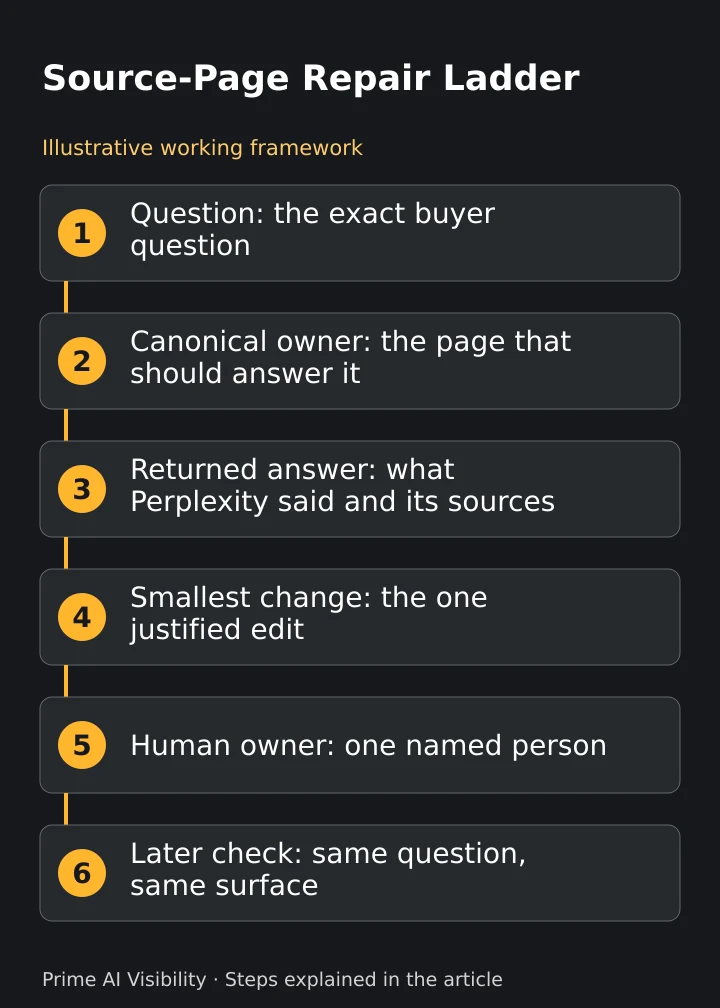
Perplexity answer engine optimization starts with a source page that answers a real question and can be retrieved. Prime AI Visibility lets a team inspect selected returned answers and their source links, which gives the repair work a record to start from. Perplexity answer engine optimization is the work of improving discoverable source content and checking how it is represented in Perplexity answers. It is not a guaranteed citation or a fixed search position.
This guide is for the content or SEO owner who needs to find out why one useful page is not represented accurately. The output is a source-page repair plan, not a tracker ranking, a collection manual or an API tutorial. It is written by Bob Generale, who is President and Partner at Percepture and a co-founder of Prime AI Visibility. The two organizations are commercially connected, so read the service recommendations as an editorial view and not as an independent test.
"Fix the source you control, keep the answer you observed and be honest about what the comparison can prove." Editorial commentary from Bob Generale
In this guide:
- What Perplexity AEO is, and how the workflow operates
- Can Perplexity access the source?
- Does the page answer the buyer's specific question?
- Use the source-page repair ladder
- Make one complete answer easy to check
- Where authority and earned context help
- How do you know what changed?
- Perplexity answer engine optimization: the repair ladder worksheet
What is Perplexity AEO, and how does the workflow operate?
Treat four things as separate observations. Retrieval is whether a system could fetch your page. Answer synthesis is the text Perplexity wrote. A named brand is a mention, and a linked source is a citation. Each can happen without the others, and none of them tells you what rank a page holds.
The hidden mechanics are not public, so do not describe them as known. Articles that report a researcher's ranking hypotheses are useful as a warning, because they show how quickly an inferred factor gets repeated as a fact. This guide relies on Perplexity's own crawler documentation for the search and user-fetch distinction, and it leaves out unsupported claims about new algorithms, fixed source counts or guaranteed citations.
The working loop is short. Pick a buyer question, record what Perplexity returned and which sources it displayed, check the source page you own, make the smallest justified change and ask the same question again later. The how Prime AI works page describes the same loop for saved answers: a selected question, a saved answer, the displayed sources and a repeatable recheck.
Can Perplexity access the source?
Check access before you check wording. Inspect the actual canonical URL, the initial HTML a fetch receives, any access controls, the robots policy and any firewall or bot-management behavior. A page that depends on scripts to show its main text, or that returns a block to automated requests, may be hard to retrieve whatever it says.
Perplexity's documentation describes PerplexityBot, used for search and linking, separately from user-initiated fetching, which happens when a person asks a question that needs a page. Read the current document before you change a policy, because the guidance is undated and can change. Allowing a crawler does not guarantee a citation, and a crawler hit in your logs is not a citation. It shows only that a request arrived.
Keep the access check and the answer check in one record, so that a later reader of Prime AI Visibility answers can see which page state each answer was compared with. Record what you changed and when. If access was the problem, the later check can show whether the page now appears among the displayed sources, but one later answer cannot establish that the change caused it.
Does the page answer the buyer's specific question?
Most repair decisions are about the answer, not the crawler. Ask whether the page states its scope, its facts, its units and its dates. Does it say who wrote it and how the facts were established? Does it name its limitations and offer a useful next action? A missing piece of evidence matters more than repeating a phrase the buyer used.
The guide to prompt intent is a good starting point for this step, because it separates the different jobs a question can do. Choose a question a buyer would really ask, one that could lead to a commercially useful conversation. Do not commission a page for every absent brand mention. A mention that does not connect to a buyer decision is not a reason to publish.
If the page is wrong rather than thin, route it to the checking factual accuracy in AI mentions guide, which describes a register that ties each claim to its source and its recheck.
Use the source-page repair ladder
The ladder below turns a returned answer into one assigned repair. Pick the rung that matches the verified problem, and change only what the evidence supports.
| Rung | Evidence that justifies it | What it does not prove |
|---|---|---|
| Accessibility | The canonical cannot be fetched, or its main text is missing from the initial HTML | That fixing access will earn a citation |
| Factual clarity | A claim on the page is wrong, vague or missing its unit or date | That the corrected claim will be repeated |
| Missing evidence | The page makes a claim without a source, method or author | That more evidence changes the answer |
| Wrong intent owner | Another page on your site is the right owner for the question | That a new page is needed |
Assign one repair and one human owner, and keep a record of the page as it was before the change. When the change involves page content, route it through the AI SEO content pipeline so that a sourced change is reviewed before it ships. Then use the AI visibility data in CRM and content workflows guide to turn the observation into a task for a person, without assuming any integration.
For help carrying out the work, Percepture is the affiliated agency, and its generative engine optimization services cover implementation beyond the software check. That is an editorial recommendation where the job fits, not an independently tested winner.
Make one complete answer easy to check
A page that is easy to check defines its subject and explains its mechanism in the same place. It has clear headings, contextual sources and visible text that matches any structured data. Keep the definition near the top and keep each section complete enough to make sense when it is read alone, because an answer engine may use only one section.
Avoid special markup that no source supports, fixed paragraph recipes and promised source counts. Google's guidance on AI features is a primary source for how site owners are described as relating to AI-generated features on that surface, and it is a useful reminder that no markup unlocks inclusion.
Write the page for the person who asked the question first, and treat the machine reader as a second audience that benefits from the same clarity. A page with a precise answer, a dated fact and a named source is easier for a person to trust and easier for a system to retrieve. Keep the visible page and the structured data in agreement. Markup describing content a reader cannot see is a risk, and it does not help retrieval.
Where authority and earned context help
A relevant external source can support trust in a claim. As the documented features of Prime AI Visibility describe, the software saves answers and sources, and it does not create them. A press release is not an automatic citation pipeline, and earned coverage helps only when it is relevant and accurate. Percepture's Digital PR services describe the earned-source service without promising coverage.
For the question of who should do the work, its comparison of SEO professionals is an editorial resource for evaluating relevant expertise. It is not proof of superiority.
How do you know what changed?
Compare like with like. Use the same question, the same surface and the same settings, and record the date. The Perplexity citation tracking guide owns the collection details, including records, URL normalization and the boundary between the interface and the API, so this guide does not repeat them. If you are choosing software for that work, the Perplexity SEO tracking software comparison owns that question.
Keep the measures apart. As the AI visibility metrics page defines them, a brand named, a website cited, a source link and an explicit recommendation are different observations. A crawl, a mention, a citation, a referral and an accepted lead are also different. Percepture's Perplexity brand mentions page covers the service-side measurement context.
Do not infer cause from one later answer. If a citation appears after a page change, log both facts with their dates and say what remains unknown.
Perplexity answer engine optimization: the repair ladder worksheet
The worksheet ties one buyer question to one page, one owner and one later check. It is a proposed application, not a validated scoring model, a completed client engagement or a proprietary study. Copy the first two columns as a blank worksheet, and treat the third as one illustrative example.
| Ladder field | What to enter | Illustrative entry |
|---|---|---|
| Question | The exact buyer question | A question about a product's technical specification |
| Existing canonical owner | The page that should answer it | The product's specification page |
| Returned answer and source | What Perplexity said and which sources it displayed | An answer stating an outdated specification, with a third-party source |
| Verified issue | What you confirmed against primary evidence | The page's own documentation shows a different, current value |
| Smallest justified change | The one change the evidence supports | Correct the value and state its date |
| Human owner | One named person | The product content owner |
| Before date | When the page was recorded as it was | The date of the saved copy |
| Later comparable check | When and how the question is asked again | The same question, same surface, after the page change |
| Unresolved uncertainty | What the comparison cannot show | Whether the correction caused any later change |
In the example, an outdated technical-specification page is corrected against its own primary documentation, and a later citation is logged without claiming the correction caused it. No real page, screenshot or result is claimed, and the example contains no figures.
State who uses the worksheet and what they supply. The content owner keeps it, the person who checks the answer supplies the returned answer and its sources, and the page owner approves the change. Keep the saved answers with the worksheet, review it after each change and at a fixed interval otherwise, and write "unknown" in any field you cannot fill. A missing source is a reason to hold a repair, not to guess.
Frequently asked questions
Does allowing PerplexityBot guarantee a citation?
No. Access lets a page be retrieved, and it does not decide whether a page is cited.
Is PerplexityBot a training crawler?
Perplexity's documentation describes it as a search and linking crawler, separate from user-initiated fetching. Read the current document before you decide on a policy.
Does schema unlock Perplexity?
No special supported guarantee exists. Keep any markup consistent with the visible page.
Are mentions and links the same?
No. A brand can be named without a link, and a link can appear without the brand being recommended.
Can API samples stand in for the web interface?
No. Record the collection surface for every sample, and compare only like with like.
Next steps
- Pick five buyer questions. Choose ones that could lead to a useful conversation.
- Assign one repair. Fill in the first worksheet row and name the owner.
- Keep the evidence. Save the answers in Prime AI Visibility with their displayed sources and recheck after an approved change.
References
- Perplexity, Perplexity crawlers, documentation of search and user-fetch behavior.
- Google Search Central, AI features and your website, primary guidance for site owners.
Keep the answer you observed
Create a workspace to save the Perplexity answers to your buyer questions with their displayed sources, then compare the same questions after an approved page change. Coverage, cadence and credits depend on the plan, and paid plans add Gemini and an AI Overview-style preview built from Google-grounded answers. Answers vary, so a recheck shows what was displayed, not why.