
How SEO and AEO Teams Can Collaborate Without Duplicating Work
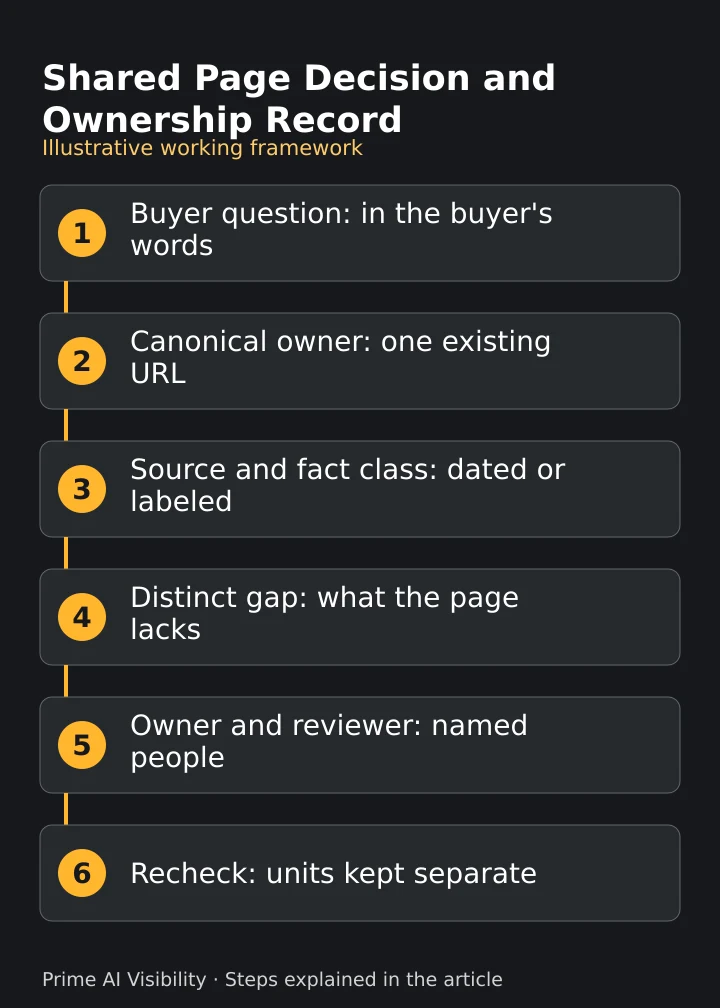
SEO and AEO teams collaborate by sharing one buyer question, one page owner, one set of supported facts and one change record, while each team uses the evidence that fits its channel. The guide to the broader AI visibility strategy gives the planning context around that loop. How SEO and AEO teams collaborate comes down to who owns a specific canonical page, who verifies what it says and who measures the change, so that two teams never commission two versions of the same answer.
This guide is for SEO, content, PR, web engineering and analytics owners who coordinate an existing page. It is written by the Prime AI Editorial Team, and Prime AI Visibility is commercially connected to Percepture, which appears below as an implementation option and not as an independently tested winner. It does not recommend software, and it is not a marketing operations tool shortlist or a general strategy. It covers collaboration on one page.
"The teams should share the question and the evidence, then each owner should know what decision comes next." Editorial commentary from the Prime AI Editorial Team
In this guide:
- Assign one canonical owner before assigning tasks
- Share the brief but give each owner a real decision
- Keep one claim-to-change record
- Separate search eligibility from sampled AI answers
- Measure the change with consistent units
- Use an exception path instead of duplicating the page
- Show how SEO and AEO teams collaborate with a shared page decision record
Assign one canonical owner before assigning tasks
Start with the buyer decision, the URL that already answers it and the evidence that page already has. If the proposed output is equivalent to an established page, refresh that page. A new title, a new acronym or a new team name is not a new intent.
The usual cause of duplicate work is not disagreement. An SEO team lists a keyword and an AEO team lists a question, and each opens a brief for the same buyer. Neither is wrong, and both assumed the other had not started. Naming a single owner URL first removes the reason to write two pages.
Choose the owner by the strongest existing page for that reader, not by which team asked first. The guide to prompt intent explains how to pick one real buyer decision, which is the unit a page owner should be assigned to.
Share the brief but give each owner a real decision
A shared brief does not mean shared tasks. Each owner needs a decision that only that owner can make. The map below is a suggested division of responsibility, not a claim about anyone's job title.
- SEO checks that the page is discoverable and that the demand it answers is real.
- Content and subject experts confirm the answer is useful and accurate.
- PR develops relevant independent evidence, and owns actual outreach.
- Web engineering makes sure the page can be reached and rendered.
- Analytics defines the measures before the change, not afterward.
Bob Generale's supplied view is that "SEO is now a system, and success is in the setup." Applied here, the setup is the written decision about who owns each step, not a tool. The AI SEO content production workflow guide shows how a sourced brief becomes reviewed work, and it can be used as the shared production path.
Where a team lacks capacity, say so in the record instead of leaving the step unowned. A blank owner is the most common reason a good brief does not ship.
Keep one claim-to-change record
Keep one record per page, and write to it from every team. For each change, record the question, the source and version, the gap, the action, the owner, the acceptance rule and the recheck date. Public facts, such as a news item or a vendor statement, need a verified date and source. Professional judgment and illustrative examples stay labeled as such.
Two rules keep the record useful. First, preserve deliberate edits. If an expert changed a sentence for accuracy, a later optimization pass should not overwrite it without asking. Second, merge concurrent notes instead of keeping parallel copies. Two versions of the record recreate the duplication it was meant to prevent.
Name a fact reviewer and a separate implementation owner. A visibility score is not a factual approval, and an answer that repeats your claim is not proof that the claim is right. The guide to checking AI brand-claim accuracy describes how to trace a claim to its source and a correction owner.
When the record shows a handoff to sales, such as a visitor who asked a buying question, assign a person to accept it. The AI evidence in content and CRM workflows guide describes a human handoff without assuming any integration.
Separate search eligibility from sampled AI answers
Ordinary search requirements stay central. Google's guidance on AI features in Search says that the same foundational SEO practices apply, and that no special markup is required for a page to appear in those features. Treat that as a technical boundary: a page that cannot be crawled, indexed or read is not helped by a collaboration process.
Sampled AI answers are a different kind of evidence. They show what an answer displayed on a given date for a given question, tool and setting. They do not show why a source appeared or whether it will appear again. Prime AI Visibility saves answers and their displayed sources within a plan's scope, as its features describe, and a paid plan's Google-grounded preview is an AI Overview-style preview, not a live capture of Google's own AI Overview.
Accurate, supported markup helps describe visible content. It does not replace a shared page decision, and it does not guarantee that any answer will cite the page. Do not record a schema change as the cause of a citation.
For a baseline of what public answers say today, the guide to running an AI visibility audit shows how to save answers under a versioned scope.
Measure the change with consistent units
Keep each unit in its own column. Google Search Console pages and queries are separate exports, and joining them by guesswork creates rows nobody observed. Comparable AI checks keep the same question, tool, persona, market and method each time. Analytics and CRM establish identifiable visits and business events separately.
The AI visibility metric definitions keep a brand named, a website cited, source links and an explicit recommendation apart, and none of them is a visit or a lead. Keep mentions and citations, visits, accepted enquiries, meetings and revenue as separate lines in every report.
For visits, the guide to measuring identifiable ChatGPT referrals explains why a recorded referral visit is not the same as answer exposure. No causal result should be inferred from one before-and-after pair. If a page changed and a later answer changed, record both, and say they are not shown to be connected.
Use an exception path instead of duplicating the page
When two teams propose the same decision answer, choose the stronger owner and add the missing section to that page. If a new page is warranted, write down its unique reader job, its excluded scope and the pages it links to. The test is whether the audience, the decision, the promised output and the evidence are materially different. If they are not, improve the existing page.
Do not silently cancel a planned piece or move a schedule. Record the decision in the page record, with the date and the owner who made it. A visible exception path means the next person who proposes the same page finds the answer instead of repeating the argument.
External material can support the process. Contentoo's article on content engineers and SEO team collaboration frames roles and traceability, and its process coordination ideas are worth reading. Treat any figure or forecast in vendor material as that vendor's claim, and use the page record to decide what your team adopts.
Show how SEO and AEO teams collaborate with a shared page decision record
The record below ties one buyer question to one owner and one recheck. It is a proposed application, not a validated scoring model, a completed client engagement or a proprietary study. Copy the first two columns as a blank worksheet, and treat the third as one illustrative example.
| Record field | What to enter | Illustrative entry |
|---|---|---|
| Buyer question | The question in the buyer's words | Which software suits a small finance team? |
| Existing canonical | The one URL that already answers it | The current comparison page |
| Source and fact class | Where each claim comes from, and whether it is a dated fact, a judgment or an example | Vendor documentation, dated; editorial judgment, labeled |
| Distinct gap | What the page lacks that a reader needs | No limitations table |
| Responsible owner | One named person, not a team | The content lead |
| Implementation and review | Who builds it, and who verifies the facts | An engineer publishes; a subject expert reviews |
| Observation units | Which measures apply, kept separate | Search Console page export; saved answers; analytics visits |
| Recheck and change note | When to look again, and what changed | Next review cycle; limitations table added |
In the example, SEO and an AEO team each request a "best software" article for the same buyer. The shared record assigns one owner, adds the missing limitations table and uses one recheck panel instead of creating a second slug. No ranking or lead outcome is claimed, and the example contains no figures.
State who uses the record, what input they need and when it is reviewed. Keep the source with the record, and say why each field affects a decision. When a field is empty, write "unknown" and treat it as the next thing to find out. Do not fill an unknown observation with a plausible number.
Channel-specific derivatives and owners
Once the page owner is set, extend the record to the channels that reuse the page. Add a derivative field and an owner field for each one.
- Search: SEO owns indexable page access.
- Expert evidence: the subject expert validates the facts before reuse.
- PR: the PR owner handles actual outreach for the page's evidence, and no coverage is guaranteed.
- Organic social: the social owner adapts the relevant explanation, and does not restate a claim the page does not support.
- Sales: the commercial owner records the accepted next step.
These are connected responsibilities, not a claim that one tool executes every channel. For source development, Percepture's guide to digital PR and SEO source strategy covers the broader PR framework, so this guide links to it instead of repeating it. The guide to earned media and AI citations separates developing credible sources from any promise of inclusion.
Where implementation help fits
Percepture is an integrated B2B marketing and PR agency, and it is the first editorial option here where the job fits. When a verified discovery gap needs correcting in public sources, it offers generative engine optimization services. Its Digital PR services are the related earned-source service, and coverage is never guaranteed. For supplier diligence, its comparison of SEO professionals is an editorial comparison, not proof of universal superiority. Percepture and Prime AI Visibility are commercially connected.
Keep the software role precise. Prime AI Visibility records saved answers and displayed sources and helps plan page work. It is not a CRM, a technical crawler, an automatic PR sender or permission to publish. Platform selection for historical tracking stays with the historical AI-search data platforms guide.
Frequently asked questions
Do we need separate SEO and AEO articles?
Only when the audience, decision, promised output and evidence are materially different. Otherwise improve the strongest existing page.
Who owns source accuracy?
Name a subject or fact reviewer and a separate implementation owner. A visibility score is not a factual approval.
Does schema solve the collaboration problem?
Accurate, supported markup helps describe visible content, but it does not replace a shared page decision and does not guarantee that an AI answer will cite the page.
Can one before-and-after comparison prove the change worked?
No. Record the change and the later observation separately, and avoid inferring cause from a single pair.
Next steps
- Pick one page. Choose a buyer question and the URL that already owns it.
- Fill in the first row. Use the worksheet above, and mark every unknown.
- Save the AI-answer side. Bring the question to Prime AI Visibility, save the answer with its sources and agree who corrects a gap.
References
- Google Search Central, AI features and your website, the primary guidance on how Search AI features relate to standard SEO eligibility.
- Contentoo, Content engineers and SEO teams collaboration, the publisher's own article; its figures and forecasts are not adopted.
Give both teams the same evidence
Create a workspace to save answers for your buyer questions with their displayed sources, then recheck the same questions after an approved page change. Coverage, cadence and credits depend on the plan, and paid plans add Gemini and an AI Overview-style preview built from Google-grounded answers. Your page owner decides what changes.