
How Law Firms Can Appear in ChatGPT Search Results: An Evidence-Based Guide
Knowing how to get your law firm in ChatGPT search results starts with accessible pages, accurate public facts and evidence you can inspect. The saved-answer workflow in Prime AI Visibility shows how selected public questions become saved answers and source links. ChatGPT search visibility means a firm's information is discoverable in search-enabled answers; a mention, a citation, a recommendation and a client enquiry are different outcomes.
This guide is for a managing partner, legal marketer or web developer, and for the lawyer who is responsible for advertising claims. It explains how law firms can appear in ChatGPT search results through access, accurate sources and useful pages, and it ends with a correction ledger you can use. It is a public-discovery workflow for US English questions and is not legal advice. It is written by Bob Generale, President and Partner at Percepture and a co-founder of Prime AI Visibility. The two are commercially connected, so service recommendations here are editorial views and not independent test results.
"Fix the source a buyer can verify before you chase a score you cannot explain." Editorial commentary from Bob Generale
In this guide:
- How law firms can appear in ChatGPT search results: what a firm can influence
- Check the access layer before rewriting pages
- Correct the public firm record
- Make a practice page answer useful
- Run a repeatable question-and-source check
- Use the correction ledger
- Link visibility to intake with separate denominators
How law firms can appear in ChatGPT search results: what can a firm influence?
A firm can influence what is retrievable and what the public record says about it. It cannot influence a universal ranking formula, because none is published. Treat three situations as different. A search-enabled ChatGPT answer draws on current web sources. A model answer without search relies on what the model already holds. A navigational link takes a person to a page without an answer at all.
Allowing a search crawler is eligibility, not a guarantee. A page that can be fetched may still not be cited, and a page that is cited may not be recommended. Keep these four outcomes apart in every record: mentioned, cited, recommended and enquired.
A firm that sees nothing in one answer should not conclude it is never recommended. One answer is one observation, taken on a given day, in a given interface. Write down the date and the interface each time, because answers vary between runs and between surfaces, and a later comparison is only fair when those conditions match. Treat a missing mention as a question to investigate, starting with access and the public record, before you decide that any page needs rewriting.
Check the access layer before rewriting pages
Fix access before wording. A developer should check the robots file, any firewall or content delivery rules that block published bot addresses, the HTTP status of each page, whether pages are indexable and whether attorney, practice and location facts appear in the text the server returns. Check that each page names a current canonical address.
OpenAI's crawler documentation describes OAI-SearchBot as the crawler for search results and GPTBot as a separate control for training. The two are managed independently, so permitting one does not decide the other. Read the current document before you change a policy, because crawler guidance can change.
Keep a short record of the settings you found, such as which crawlers were allowed and which pages returned an error, so that the repair is a documented change and not a guess. Ask the person who manages the site to confirm that important pages load without a script and return a normal status to an automated request. Do not paste confidential client details into any prompt or test, and do not assume that permitting training is required to be found in search. If an access setting is the problem, record what you changed and when, so that a later check can be compared with the state before it.
Correct the public firm record
Most disagreements between an answer and a firm are record problems. Start with the facts a firm owns: the legal name, the real offices and service area, the jurisdictions where its lawyers are admitted, the current attorneys and their roles, and the practice areas it actually handles. Compare them with the state bar record and with the directories that matter.
A marketing team must not add awards, specialist status, comparisons or case results that the firm cannot support. Rule 7.1 of the ABA Model Rules, on communications about a lawyer's services, is a model rule. The rules of the jurisdiction where the firm practices govern, and the lawyer responsible for advertising should review any claim before it is published.
The same discipline applies to the sources an answer cites. The guide to factual accuracy in AI brand mentions describes how to trace a claim upstream to the page that supplies it, which is where the correction belongs.
OpenAI's November 2026 beta for businesses in ChatGPT is a useful distinction. A business profile that an authorized representative keeps accurate is not the same as ChatGPT's independent answers, and the beta's eligible categories are limited. It does not show that a law firm qualifies or that updating a profile buys a recommendation.
For the local record, the Google Business Profile and AI search guide covers the listing a firm controls, and how AI assistants recommend local businesses covers the limits of local discovery. Real third-party references can also matter, and the earned media and ChatGPT citations guide describes how they appear in answers without promising it.
Make a practice page answer useful
A practice page earns attention when it answers a process question a client would actually ask. State the question, name the jurisdiction where it matters, show the attorney, the source and the date, and route the reader to an appropriate private intake. A procedural example is the documents someone might bring to an initial consultation.
Leave out legal deadlines that you cannot cite, and leave out general promises about outcomes. A page that overstates is a risk to the firm, whatever any answer system does with it.
Write for the person deciding whether to call, because a page that helps that person is also easier for any system to summarize accurately. Make the page's facts readable as text, with the attorney, practice and location in plain sentences and headings. Keep any structured data consistent with the visible page, and do not assume markup unlocks inclusion. The firm's lawyers, not the marketing team, should confirm the legal content of every page.
Run a repeatable question-and-source check
A repeatable check turns a hunch into a record. Choose a small cohort of public questions: a branded identity question, a practice question with the actual city, a process question and a provider comparison. The prompt intent guide classifies questions by their job, which keeps the cohort balanced.
For each question, record the exact wording, the engine or interface, the date, location and language, the answer text, the firm named, the URL linked, whether the firm was recommended and what was omitted. The AI visibility audit guide describes how to set a baseline under a versioned scope.
A sample is not a nationwide rank and does not measure demand. Rerun the same questions under the same settings after a correction, and compare only like with like. Prime AI Visibility saves selected answers and displayed links for this purpose, and as its documented features describe, it records what an answer displayed and does not guarantee a recommendation.
Use the correction ledger
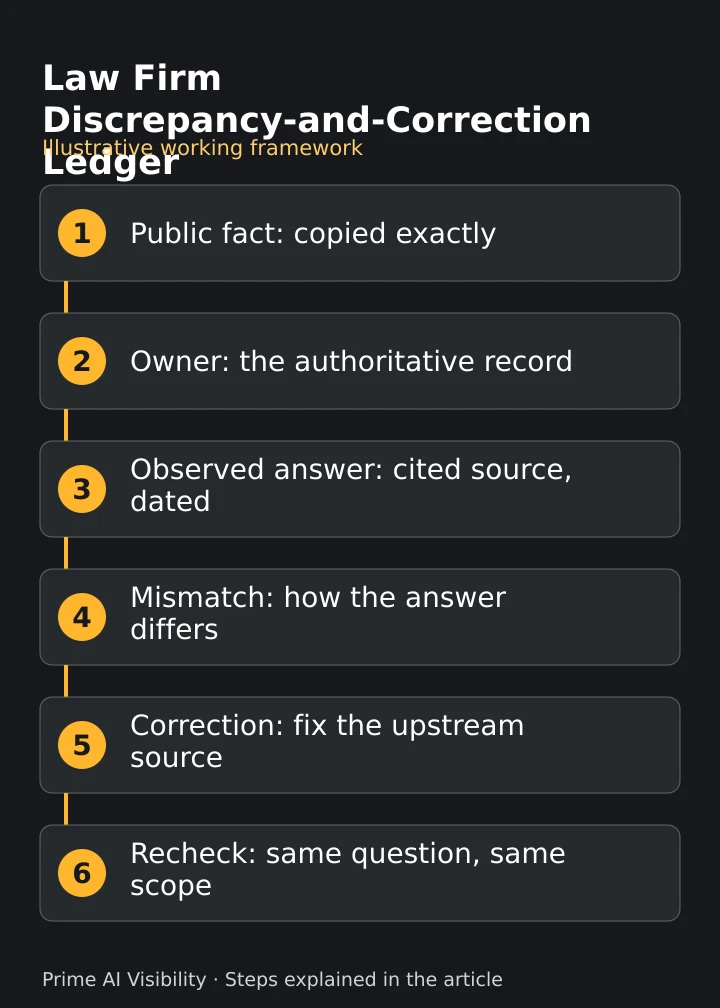
The ledger ties each mismatch to its owner and its recheck. It is a proposed application, not a validated scoring model, a completed client engagement or a proprietary study. Correct the upstream fact. Do not try to edit what a model says by creating mentions that are not real.
| Ledger field | What to enter | Illustrative entry |
|---|---|---|
| Public fact | The firm fact, copied exactly | The current attorney list on the firm site |
| Authoritative owner | The record that is the source of truth | The firm's own attorney page and the state bar record |
| Observed answer and cited source | What was said and which URL was linked | An answer naming a departed attorney, citing an old directory |
| Mismatch | How the answer differs from the fact | The directory lists a person who has left |
| Correction destination | Where the fix must be made | The directory's authorized listing |
| Implementation owner | One named person who can make it | The firm's marketing manager, with a lawyer's confirmation |
| Recheck | When the same question is asked again | After the directory is corrected |
In the example, a departed attorney remains on an old directory while the firm site lists a replacement. The team records the exact mismatch, asks for the authorized directory correction, keeps the current public biography clear and reruns the same branded question. It claims no named client, result, transcript or observed test.
Mark each row as a marketing fix or a matter for a lawyer's factual review. A marketer can fix a stale listing. A lawyer must confirm a claim about experience, jurisdiction or results.
For help carrying out public-source work, Percepture is the affiliated agency. Its generative engine optimization services cover the public-answer side, its Digital PR services cover earned coverage without promising any, and its guide to AEO tools for law firms gives the cross-brand buying view. For supplier diligence, Best AI SEO experts in the world is an editorial resource for judging relevant expertise, not proof of superiority.
Link visibility to intake with separate denominators
Keep three records apart. Prime AI Visibility preserves selected answer evidence. Your site analytics measures the referrals it observes, and the ChatGPT referral measurement guide describes how to read them. The firm's own private records hold the enquiries it chooses to log.
The AI visibility measurement definitions keep a brand named, a website cited and an explicit recommendation as separate observations. None of them is a visit, an enquiry or a retained client. Do not attribute revenue automatically, and do not move client data into the evidence record.
Keep the evidence record free of client names, matter details and anything covered by confidentiality duties. Public questions and public answers are enough for this work, and a firm that needs more should involve its own counsel and privacy reviewers before any private data enters a tool. A human should own intake. The AI visibility and CRM workflows guide describes a handoff that keeps public evidence and private records separate without assuming any integration.
Frequently asked questions
Does allowing OAI-SearchBot guarantee my firm appears?
No. It makes a page eligible to be found in search, and it does not decide whether the page is cited or recommended.
Is GPTBot the same as the search crawler?
No. OpenAI documents them as separate controls, one for search and one for training.
Does structured data make ChatGPT cite a law firm?
No guarantee exists. Keep any markup consistent with the visible page.
Is a citation a recommendation?
No. An answer can cite a firm's page without recommending the firm.
Can I fix this by adding reviews or awards?
Only genuine, verifiable ones. Unsupported claims create advertising risk and do not correct the record.
How soon will a correction change an answer?
No timing is documented. Rerun the same questions and compare dated records.
Next steps
- Write the baseline questions. Cover your name, practice and city, with no matter details.
- Start the ledger. Fill in one row for the first mismatch and name its owner.
- Save the evidence. Record the answers in Prime AI Visibility with their displayed sources and recheck after a verified correction.
References
- OpenAI, Overview of OpenAI crawlers, documentation of OAI-SearchBot and GPTBot.
- American Bar Association, Model Rule 7.1, communications concerning a lawyer's services, a model rule; the jurisdiction's own rules govern.
Keep the answers and the sources
Create a workspace to save answers to your public firm questions with their displayed sources, then compare the same questions after a verified source correction. To discuss a scoped implementation, use the sales route. No confidential matter details are requested. Coverage, cadence and credits depend on the plan, and paid plans add Gemini and an AI Overview-style preview built from Google-grounded answers.