
AI Citation Gap Analysis: How to Find Missing Sources and Competitor Advantages
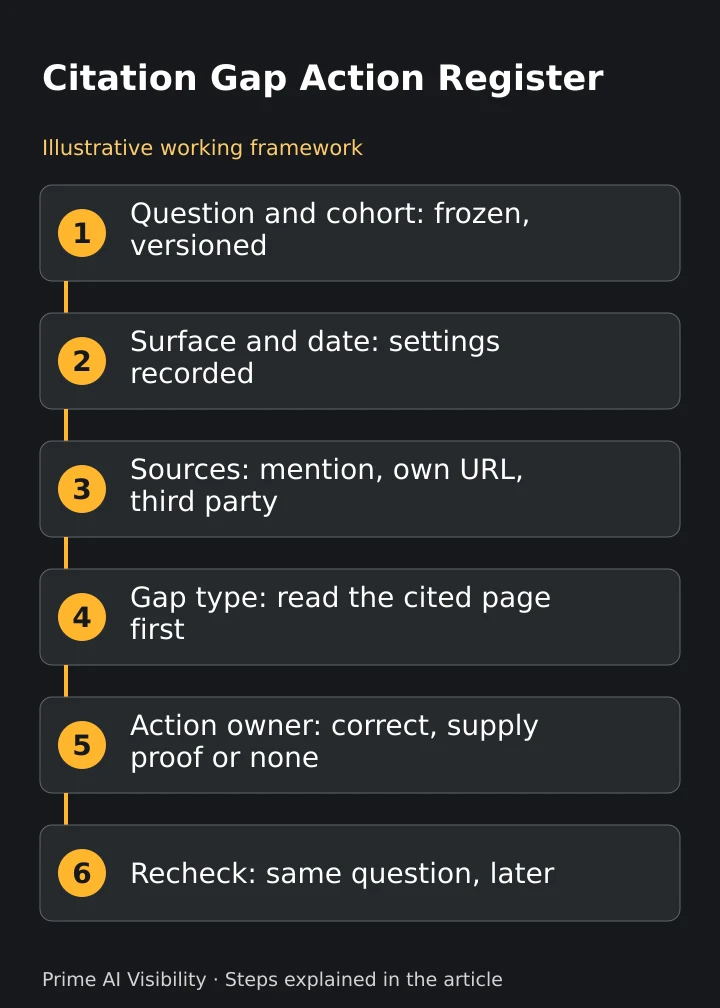
AI citation gap analysis is the practice of comparing the sources that AI answers display for a fixed set of buyer questions with the sources you own, so you can see where others are cited and you are not. Start with the method behind perplexity citation tracking, because a gap can only be read from a clean source record. In buyer terms, a citation gap is a repeatable difference between the sources shown beside a saved answer and the sources you could reasonably supply, and the analysis tells an SEO or content lead what to check, who owns it and whether any action is warranted.
This guide is for an SEO or content lead who needs to explain why competitor or third-party pages appear in sampled answers and to decide what evidence to improve. It produces one thing: a Citation Gap Action Register with an owner and a recheck for every row, including rows where the right decision is to do nothing. It is not a ranked list of tools, and it makes no promise that any page will be cited.
"SEO is now a system, and success is in the setup." Bob Generale, editorial commentary
In this guide:
- Define a citation gap and its denominator
- Build a fixed question and cohort contract
- Separate mention, own-domain citation and third-party source
- Read the cited page before classifying the gap
- Assign correction, source development or no action
- Recheck comparable runs and track referrals separately
- Checklist, FAQs and next steps
Define a citation gap and its denominator
A citation gap exists only against a defined set of questions on a defined surface at a defined time. "We are not cited enough" is not a gap. "In our saved set of twenty questions, collected on one date, the answer on one surface displayed a third-party buyer guide for six of them and none of our pages" is a gap, because it has a denominator.
Write the definition before you collect anything:
- The question set. Which questions, in whose words, for which market.
- The surface. The AI product or feature, the settings and whether the session was signed in.
- The date. Answers change, so every observation carries a date.
- The unit. A displayed source link on a saved answer, counted separately from a brand mention.
- The comparison. Your own pages, a named competitor's pages, or independent third-party pages.
Without a denominator, a count of missing citations is not interpretable. Six absences out of six questions and six out of sixty are different findings. The guide on prompt intent shows how to label a question as one that learns, compares or decides, which also tells you which gaps matter commercially.
What AI citation gap analysis does and does not show
Done carefully, AI citation gap analysis shows which sources an answer displayed for a question you saved. It can show that a page of yours was absent where another was present, that a displayed source says something you do not, or that a source is outdated. It does not show why an assistant chose a source, and it does not show that adding a similar page will cause you to be cited. Promptwatch's glossary entry on citation gap analysis makes a related distinction between citation gaps, content gaps and source audits, and warns that results vary between runs and that causation is unproven. Treat every gap as an observation to investigate, not a diagnosis.
Build a fixed question and cohort contract
A gap analysis that changes its questions between runs measures the changes, not the gap. Freeze the cohort first and record it so a later run can be compared like for like.
The contract has six fields:
- Question wording. Copy it exactly. Rewording a question creates a different observation.
- Buyer stage and intent. Learning, comparing or deciding.
- Market and language. The geography and language you intend to represent.
- Surface and settings. Which product, which mode, with or without search turned on.
- Collection date and method. Manual session or a tool, and who ran it.
- Version. A label for the cohort so a change in wording is a new version, not a silent edit.
Keep the cohort small enough that a person reads every answer. Twenty to forty well-chosen questions that you review beat several hundred that nobody opens. The set up comparable checks steps describe saving the same questions and rerunning them, and the documented feature loop in Prime AI Visibility saves selected answers and the links displayed beside them across the supported AI tools.
Run each question more than once if you can, because a single answer is a single draw. If two runs differ, keep both and record the difference. The point is to learn which gaps are stable and which are noise. A gap that appears in one run of one question is a lead. A gap that appears across repeated runs of several related questions is a pattern.
Separate mention, own-domain citation and third-party source
Most confusion in gap analysis comes from merging three different things. Keep them in separate columns.
- Brand mention. The answer names your brand in its text. This says nothing about whether any link was shown.
- Own-domain citation. The answer displays a link to a page on a domain you own.
- Third-party source. The answer displays a link to a page you do not own, which might be an editorial guide, a directory, a forum thread or a competitor.
An uncited mention is not a citation. An answer can name you and link only to other sites, and it can link to your page without naming you. Each case calls for a different action, which is why collapsing them into one "visibility" number hides the gap. The AI visibility metric definitions separate these observed units, and the same discipline applies to a spreadsheet.
The Citation Gap Action Register
The register is an editorial worksheet, not a tested product or a result. It has twelve fields: prompt, surface and model, market and date, answer saved, brand named, own URL cited, sources, unsupported claim, gap type, evidence, action owner, and baseline and recheck. The three-column version below lays one row out vertically so it stays readable on a phone.
The example is illustrative. It describes no real brand, no real answer and no observed result. It shows a saved answer that cites a buyer guide but does not name the brand.
| Field | Illustrative entry | What to inspect |
|---|---|---|
| Prompt | A buyer question about choosing a product category | Exact wording, version label |
| Surface and model | One named AI product, search on | Settings recorded, not assumed |
| Market and date | One country, one collection date | A date on every observation |
| Answer saved | Yes, full text retained | The answer is stored, not summarized |
| Brand named | No | Mention recorded separately from citation |
| Own URL cited | No | Domain match, not a loose guess |
| Sources | One independent buyer guide and one forum thread | Every displayed link kept, with its domain |
| Unsupported claim | None found | A person read the answer against approved facts |
| Gap type | Third-party source stands where an owned page could be | Choose from the types below |
| Evidence | The saved answer and the cited guide's text | What the cited page actually says |
| Action owner | Named content lead | One person, with a next action |
| Baseline and recheck | Current row is the baseline; same question rechecked later | A date and the same settings |
Illustrative decision record, not comparative test results. No outcome is stated because none has been observed.
Read the example for its structure. The key habit is that the "evidence" cell holds the text of the page that was cited, which leads into the next step.
Read the cited page before classifying the gap
Do not decide what a gap means from the URL alone. Open the cited page and read it, because the right action depends on what it contains.
Ask five questions of each displayed source:
- What does it claim? Does it say something relevant to the question that you could also say, with proof?
- Is it accurate and current? An outdated or wrong source is a different problem from a missing one.
- Who wrote it and why? An independent guide, a vendor page, a directory entry and a forum thread are different kinds of evidence.
- Does it match your offer? A source about a product category you do not serve is not a gap you can close.
- Does the answer rely on a claim the source does not support? Compare what the answer says with what the page says.
These steps let you sort the gap into a type. Useful types are:
- Missing owned answer. No page of yours answers the question clearly.
- Weak owned page. A page exists but is thin, unclear or hard to find.
- Third-party proof. The answer leans on an independent source for a fact you cannot establish alone.
- Outdated or wrong source. A displayed page states something incorrect about you.
- Not our market. The cited source answers a question outside your scope.
The guide on how to verify AI brand claims describes a claim-to-recheck register for the wrong-source case. The question for each row is the same: what would a careful reader of the cited page conclude, and does it match the approved fact?
Assign correction, source development or no action
Not every gap is a content brief. A common failure is to treat each missing citation as a request for a new article. Choose among three outcomes and record the choice.
Correction. The fact exists but is wrong, stale or unclear on a page you control, or on a profile you can update. The owner fixes it and the same question is rechecked. This is the cheapest and often the most useful action.
Source development. The question needs proof or an independent perspective you do not yet have. The owner supplies something checkable: a dated fact page, a documented method, a published dataset or a reason for a credible outside source to write about you. Earned coverage is a separate job from owned pages, and Digital PR services cover that outreach when a team has no capacity for it. The guide on how to get cited in ChatGPT answers with earned media explains how earned sources show up in answers. Neither one guarantees a citation.
No action. The gap is outside your scope, unstable across runs, based on a source you cannot responsibly match or not worth the cost. Record it with the reason and a recheck date. A register with only actions looks productive but hides the decisions that mattered, and a recorded "no action" prevents the same debate next quarter.
There is no controlled result established that copying the citations a competitor earns causes inclusion. Treat imitation as a hypothesis to test on one page, not a method.
Keep facts current where assistants can read them
A current public example concerns source maintenance. On November 10, 2026, OpenAI described a beta for businesses in ChatGPT, in which verified businesses can update their information. The relevance here is narrow: when a gap comes from outdated business facts, a verified, maintained profile is one place to correct them where it is available. A claimed profile is not a guaranteed organic citation, availability is announced and not universal, and nothing in the announcement says every category is eligible. Keep what is announced, what is planned and what has been completed as separate statements in your own record.
Recheck comparable runs and track referrals separately
A gap is closed only when the same question, on the same surface and settings, shows a different result and a person confirms it. Record the original row as the baseline, make the change, then rerun the question later and add a new observation beside the old one.
Compare like with like. If you change the wording, the surface or the market, you have a new baseline, not a recheck. If the result differs, keep the cohort, method and version and the repeated observations, because variation between runs is normal and a single changed answer is weak evidence.
Keep measurement units apart:
- Answer observations. What each saved answer displayed.
- Source records. Which domains appeared and how often across repeated runs.
- Referrals. Visits that analytics attributes to an assistant, checked separately. The guide to ChatGPT referral traffic in GA4 shows how to validate session sources without treating a citation as a click.
- Search Console data. Page and query reports from Google Search Console describe Google search performance and belong in their own record. Do not join them to answer observations or infer causation.
- Outcomes. Enquiries or accepted opportunities from your own records.
A saved answer shows what a tool displayed once. It does not show why, and a visit is not a sale.
Where tools and outside help fit
Most of the register is your own team's work, since only you know the approved facts and who owns each page. A monitoring tool can save answers and displayed links so the record is consistent. Prime AI Visibility does that for selected questions, and it is a public-answer evidence and content tool, not an SEO crawler or a link-building service. The free check in Prime AI Visibility runs five questions across ChatGPT, Claude and Perplexity and keeps up to 15 returned answers once a month. Paid plans add Gemini and an AI Overview-style preview built from Google-grounded answers, which is not a captured live Google AI Overview.
Choosing among gap-analysis products is a different task from running the method. Percepture's guide to AI search visibility gap-analysis tools covers that selection question separately, and this article owns the definition and the reproducible method. Percepture is the digital marketing and public relations agency where Bob Generale is President and Partner, and Prime AI Visibility is commercially connected to it. That is an affiliated recommendation, not an independent one. Its generative engine optimization services cover the implementation work beyond a measurement check. For general guidance on evaluating practitioners, the editorial resource Best AI SEO experts in the world is a reading list and not an award or certification.
If you evaluate any tool that stores your answers or connects to your systems, ask what data it records, who can access it and how long it keeps it. The GEO platform permissions checklist lists those questions.
Checklist
- A written definition of the gap with a question set, surface, date and unit.
- A frozen, versioned question cohort, small enough to read in full.
- Mentions, own-domain citations and third-party sources in separate columns.
- Every displayed source opened and read before the gap is classified.
- One of three outcomes recorded for each gap: correction, source development or no action.
- A named owner and a recheck date on every row.
- Answer observations, referrals, Search Console data and outcomes kept in separate records.
- No claim that a gap, a fix or a recheck explains why an assistant chose a source.
Frequently asked questions
Is an uncited mention a citation?
No. A mention is the brand named in the answer text. A citation is a displayed link to a source. An answer can have one without the other, and each calls for a different action.
Is every gap a new article?
No. A gap can call for a correction to a page or profile you already control, new proof from a source you can supply, or a recorded decision to take no action. Writing an article is only one of several outcomes.
Does copying competitor citations cause inclusion?
No controlled result is established here. Matching another source is a hypothesis to test on one page and recheck, and it guarantees nothing.
What if results differ between runs?
Keep the cohort, method and version, and keep every repeated observation. Treat a gap that appears across repeated runs of related questions as a pattern and a one-off as a lead to investigate.
Next steps
- Freeze a cohort. Write the definition, then save twenty to forty buyer questions with their surface, market and date.
- Fill the register. For each question, record mention, own-domain citation and third-party sources separately, read each cited page and assign a gap type.
- Assign and recheck. Give every gap a correction, a source-development task or a recorded no-action decision, bring five questions to Prime AI Visibility if you want a saved record, and recheck the same questions later.
References
- Promptwatch, Citation gap analysis, a vendor glossary entry and not an independent study.
- OpenAI, Introducing businesses in ChatGPT, announced November 10, 2026.
- Prime AI Visibility, features, how it works and metrics.
Complete the register, then assign an owner
Create a workspace to save answers for the same questions and compare them later. Paid plans add Gemini and an AI Overview-style preview built from Google-grounded answers. Then give each gap to a named owner: a correction, new proof or a recorded decision to do nothing.