
GEO Platform Security and Privacy: An Enterprise Evaluation Checklist

A generative engine optimization GEO platforms enterprise security privacy review starts with the data flow, not the badge. Write down what leaves your organization, where it goes, who may see it, how long it stays and what evidence you can inspect. Then separate public-answer monitoring from uploading confidential knowledge, because the two carry very different risk.
This checklist is for marketing, IT, security and privacy teams that are buying or renewing a platform that tracks how AI assistants describe a brand. It is a procurement and questioning guide. It is not legal, compliance or security advice, and it does not certify any vendor.
In this guide:
- Map prompts and uploaded data
- Identify model providers and subprocessors
- Ask about retention, deletion and training use
- Check access separation and audit evidence
- Evaluate contracts and incident response
- Run a public-data pilot
Generative engine optimization GEO platforms enterprise security privacy: the short answer
- Trace the data first. List every kind of information the platform would receive: the questions you write, any documents you upload, account details and exports.
- Separate the two jobs. Monitoring public answers to public questions needs far less sensitive data than loading internal documents into a system that answers from them.
- Name every party. The platform, the AI providers it queries, hosting, email and payment services can each handle your data.
- Ask about the life of the data. Retention, deletion, backups, export and any use for training are separate questions with separate answers.
- Check evidence, not logos. A security mark proves nothing until you know what it covers, which system, which period and who tested it.
- Pilot with public data. Test the workflow on questions you would be comfortable publishing, and require independently verified controls before any confidential data goes in.
What is the Data, Destination, Permission, Retention, Evidence trace?
The Data, Destination, Permission, Retention, Evidence trace is a proposed applied framework. It turns a vague security conversation into five questions for each data flow. It is a working procurement tool, not a validated scoring system, and it does not measure how secure any vendor is.
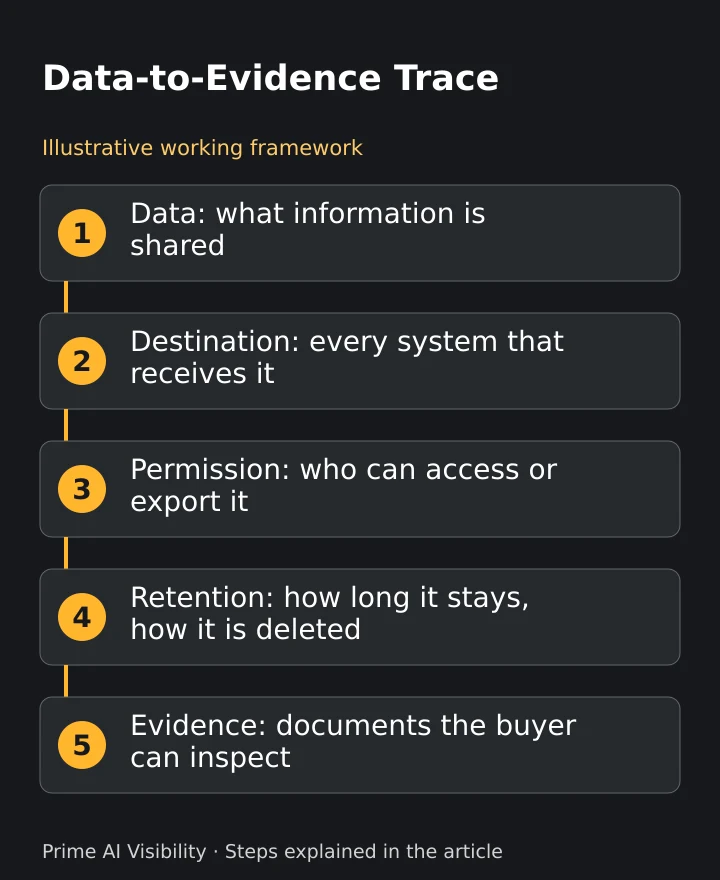
Illustrative framework: the five steps are explained below and are not a client result.
- Data. Name the information in this flow, such as buyer questions, saved answers or an uploaded document.
- Destination. Name each system and company that receives it, including AI providers and service providers.
- Permission. Name who can see, change, export or delete it, and how that access is controlled.
- Retention. State how long it stays, how deletion works and whether it can be used for anything else.
- Evidence. State what documents, reports or contract terms prove the answers above.
Bob Generale's working principle for this kind of work is to start with the question the buyer needs answered, then make the evidence and the next step clear. Here the buyer is your security reviewer, and the question is whether a data flow is acceptable.
Map prompts and uploaded data
Generative engine optimization covers two different activities, and security teams should treat them separately. KPMG's article on the GEO mandate describes GEO as structuring content so AI systems can retrieve, interpret and cite it in generated answers. The same article also discusses GEO inside the enterprise, where AI-generated search runs across internal knowledge systems, and notes that this brings challenges around data security, access control and governance.
| Workflow | What the platform receives | What can leave your organization | Usual sensitivity |
|---|---|---|---|
| Public-answer monitoring | Questions a buyer would ask, your brand and competitor names | The question text, sent to AI providers to collect answers | Low if the questions contain only public information |
| Saved reports and exports | Saved answers, displayed links and your notes | Whatever your team writes into notes and shares onward | Depends on what colleagues add |
| Confidential knowledge upload | Internal documents, customer records or contracts | The documents, plus anything the system stores or indexes from them | High, and subject to your data policies |
| Account administration | Names, work emails and roles | Account details held by the vendor and its service providers | Moderate, and personal data rules may apply |
The first row is where most brand-visibility work lives. Questions such as "What are the best tools for X?" or "Is Brand A suitable for small teams?" contain no confidential data. A platform can usually do its job with questions you could safely print on a billboard.
The third row is a different decision. If a vendor asks you to upload product roadmaps, customer lists or unreleased pricing, you are no longer buying monitoring. You are sending confidential information to a system that processes it, and that needs independently verified controls and a data review before it starts.
A BlackFog press release dated November 4, 2026 gives a reason for caution. It reports a vendor-commissioned survey of UK and US cybersecurity leaders in which 47% said their organization had experienced an incident where sensitive data was exposed through an AI tool. Among those, 77% said a company-approved AI tool was involved. The survey was commissioned by a security vendor and shows what respondents reported, not what causes exposure. Use it as an attributed example of why data flows deserve review, not as evidence about any platform in this guide.
Prime AI Visibility saves model answers to the questions you choose. Because it collects answers by asking AI providers, the questions you write, with search settings and brand or website context, can be sent to them, so write questions that contain only information you are comfortable sharing. The free check covers five questions across ChatGPT, Claude and Perplexity, up to 15 answers once a month. Paid plans add Gemini and a Google-grounded AI Overview-style preview, which is not a capture of Google's live AI Overviews. The features page describes what is saved, and the workflow explanation shows how a check runs.
Identify model providers and subprocessors
Your data may reach more companies than the one you sign with. For each platform, ask for a plain list of every party that handles your data and what each does.
- The platform vendor, which stores questions, saved answers and account details.
- AI providers, which receive the questions and return answers. Ask which providers are queried and under what terms the platform uses them.
- Hosting and infrastructure providers, which store the platform's data.
- Service providers, such as email delivery, analytics and payment processing.
Ask who may be added later and how you will find out. For personal data under the European Union's General Data Protection Regulation, Article 28 says a processor shall not engage another processor without the controller's prior specific or general written authorisation, and that under a general authorisation the processor must inform the controller of intended changes so it can object. Whether that applies to you depends on the data and your role, so take the question to your privacy counsel. The article text is a useful template for what to request from any vendor.
Request the current subprocessor list in writing and ask how often it is updated. Prime AI Visibility's privacy policy lists categories of service providers, such as authentication, payments, hosting, AI and search processing, and analytics, and invites customers to contact Prime for current subprocessor information or a data processing addendum. Use that as a published example of what to ask any vendor for, and request the current list and any addendum in writing. Do not treat any list as current unless the vendor confirms its date.
Ask about retention, deletion and training use
Retention, deletion and training use are three different questions. A vendor can answer one well and be silent on another.
- How long is data kept? Ask about questions, saved answers, account data, exports and logs, and about backups.
- How does deletion work? Ask who can request it, how long it takes, whether backups are included and what confirmation you receive.
- Is any of it used for training? Ask separately whether the vendor trains its own models and whether its AI providers use your questions or saved answers to train models, and whether you can opt out.
- Can you export it? Ask for a sample export and the field definitions before signing, so you can leave with your records.
- What happens at termination? Ask what is returned, what is deleted and when.
The OWASP Top 10 for LLM applications lists sensitive information disclosure as a risk. Its guidance says applications should sanitize data to keep user data out of model training and should give users clear terms of use with an option to opt out of having data used for training. Those are good prompts for a vendor conversation.
Compare what each vendor says in public with what its contract says. The Prime AI Visibility privacy policy separates two points that buyers should not merge. It says inputs and outputs sent through an AI provider's API are processed under the applicable provider terms, enterprise settings and retention practices. Separately, it says Prime does not operate or train a general-purpose foundation model on Customer Content. The second statement is about Prime's own models. It is not a promise about what every external provider does, so confirm each provider's controls for yourself. On deletion, the policy says to contact Prime for a verified account or workspace deletion request, and it lists exporting available reports and workspace data among customer choices. It also says Prime is not designed to process protected health information, payment-card numbers or other regulated or highly sensitive data unless a separate written agreement authorizes it. Read statements like these as the vendor's published position, then confirm them in the agreement you sign. A policy page and a contract can differ, and the contract governs.
Check access separation and audit evidence
Ask who inside your own organization can see what, and what proof the vendor can show.
- Sign-in: which methods the platform supports and which of them your organization requires.
- Permissions: whether people can be given different roles, and what each role can see, change or export.
- Separation: how one customer's data is kept apart from another's. Ask for the vendor's description in writing and for any independent testing that covers it.
- Administration: how accounts are added, changed and removed when staff leave.
- Activity records: whether the platform keeps a record of who did what, and whether you can see it.
When a vendor offers an assurance report, read what it covers. The American Institute of Certified Public Accountants describes its System and Organization Controls suite as offerings that CPAs may provide on system-level controls of a service organization, producing assurance reports that help users assess risks associated with outsourcing services. A report is evidence about a defined system over a defined period, as examined by a named firm. Ask which services are in scope, which period it covers, what type of report it is and whether it is current. A logo on a web page answers none of those questions.
This guide does not claim certifications, single sign-on, data residency or tenant isolation for any vendor, Prime AI Visibility included. If you rely on any of these, ask the vendor for its current documents and have your security team review them. Where the documents do not exist, treat the control as not available.
Evaluate contracts and incident response
The contract is where promises become obligations. Have your legal and security teams read it against the five questions of the trace.
| Contract topic | What to look for | Question to settle |
|---|---|---|
| Data use | What the vendor may do with your questions, answers and account data | Is any use beyond delivering the service allowed? |
| Subprocessors | The list, the change process and your right to object | How will you be told of a new one? |
| Retention and deletion | Periods, deletion process and confirmation | Who deletes, how fast, and with what proof? |
| Incident response | How and when you are notified of an incident affecting your data | What is the notification window and contact route? |
| Liability and remedies | Limits and what happens after an incident | Does the cap match the data involved? |
| Exit | Export format, return and deletion at termination | Can you leave with your records intact? |
Ask for the incident process in writing: who detects an incident, who decides it affects you, how quickly you are told and what you receive. Ask for a named contact on each side. Do not accept a general statement that the vendor takes security seriously.
Your own policies matter as much as the vendor's. The BlackFog survey reports that 35% of respondents had a written policy on what must not be entered into AI prompts without technical enforcement, and 56% supported broader AI usage policies with comprehensive technical controls. Those figures describe survey respondents, not a standard to meet. They show that a written rule and an enforced control are different things, so decide what your own team may enter into any platform and how that is enforced.
Run a public-data pilot
Test the workflow before committing, and keep confidential data out of the test.
An illustrative procurement sheet compares two pilots. It is invented to show the method, and it does not describe a real vendor or a result.
| Item | Public-brand-query pilot | Confidential document upload |
|---|---|---|
| Data sent | Questions a buyer would ask | Internal documents or records |
| Typical purpose | See what saved AI answers say about the brand | Let a system answer from internal knowledge |
| Review needed | Check that questions contain only public information | Independent security and privacy review before any upload |
| Evidence required | Saved answers, displayed links, settings and dates | Current assurance reports, contract terms and a completed data review |
| Unknowns to record | Which AI providers receive the questions | Where it is stored, who can access it and how it is deleted |
| Reasonable first step | Run it now with a small question set | Do not start until the evidence exists |
For the public pilot, follow these steps:
- Write a small question set of public questions, such as category and comparison questions buyers ask.
- Check each question for confidential detail before it is sent, including customer names, unreleased plans and prices.
- Fix the settings: the assistants, the market and the dates.
- Save the answers and displayed links, then repeat the same questions later. A survey of generative engine optimization research notes that commercial audits show substantial run-to-run variability, so one run is not a finding.
- Record security questions separately from visibility observations, with the evidence each vendor supplied.
Keep the records separate: answer observations, links cited, visits, qualified inquiries and revenue. A saved answer is an observation of one question at one time. It does not prove why an assistant answered as it did. The metrics page defines the measures Prime AI Visibility reports, and the guide to running an AI visibility audit shows where a pilot fits in a broader review.
For a wider shortlist process, the guide to choosing an AI search optimization platform lists the capability questions to ask beside the security ones. The article on content governance shows how named owners, approved sources and review cadence work in a regulated setting. The pricing page lists what each plan includes.
Who should help with the review
Your security and privacy teams own the decision. Outside help is useful when you need content, search or outreach capacity to act on what a pilot shows. Percepture is the agency behind Prime AI Visibility, so treat this as a related-party disclosure when comparing options.
Percepture's generative engine optimization services cover content and access work for a diagnosed search gap, and its Digital PR services cover earned coverage and public evidence. Neither is a security service, and neither promises an outcome. Percepture's guide to AI visibility tools for enterprise teams lists what to request for access, data handling, export and integration during evaluation.
When you compare advisers, ask for responsibilities, not reputation. Percepture's Best AI SEO experts in the world is an editorial guide, not a certified ranking. Compare every option on the same written scope: the data involved, the named owner of each source, the approval path and a first bounded task.
Frequently asked questions
Does GEO require confidential customer data?
Not usually. Monitoring public answers to public buyer questions can be done without uploading customer records or internal documents. Uploading confidential knowledge is a different workflow and needs independently verified controls and a data review first.
Does a vendor's security logo settle procurement?
No. A logo says nothing until you know what it covers, which system, which period and who tested it. Ask for the current report or documentation, read its scope and have your security team judge whether it covers the service you will use.
What should we ask about AI model providers?
Ask which providers receive your questions, under what terms, whether they keep or train on the data and how you will be told if the list changes. A platform that collects answers by querying AI providers sends them the question and may send settings and brand context.
How do we pilot without exposing sensitive data?
Use a small set of public questions that you would be comfortable publishing, check each for confidential detail and keep security findings separate from visibility observations. Add any upload only after the evidence exists.
Are subprocessors a legal issue?
They can be. Where personal data is involved, rules such as Article 28 of the GDPR govern processors and the engagement of other processors. Whether they apply to you depends on your data and role, so ask privacy counsel.
Does Prime AI Visibility claim enterprise security certifications?
This guide does not claim certifications, single sign-on, data residency or tenant isolation for it or any other vendor. Prime AI Visibility saves answers to the questions you choose, and any control you need to rely on should be confirmed in current documents and your contract.
References
- KPMG, GEO mandate: optimizing content for AI-generated results, vendor-published.
- BlackFog, Sensitive data exposure through AI tools, press release dated November 4, 2026, reporting vendor-commissioned research.
- Martinez, O., Optimizing Visibility in Generative Engines: A Critical Survey of Generative Engine Optimization (2023-2026), arXiv preprint, July 2026.
- AICPA and CIMA, System and Organization Controls: SOC Suite of Services.
- GDPR, Article 28: Processor.
- OWASP GenAI Security Project, LLM02:2025 Sensitive Information Disclosure.
- Prime AI Visibility, features, how it works and privacy policy.
Next steps
- Trace one data flow with the five questions: data, destination, permission, retention and evidence.
- Write five public questions and check each for confidential detail before any tool receives them.
- Create a workspace in Prime AI Visibility and run the pilot on those questions.
About the author
Bob Generale is a co-founder of Prime AI Visibility and President and Partner at Percepture, a digital marketing and public relations agency founded in 2004. His work connects public relations, content strategy, search optimization, generative engine optimization, analytics and lead generation. Bob focuses on the questions an audience needs answered and the evidence that helps them take a sensible next step. His approach brings accurate source pages, expert explanation, earned trust and human follow-up into one connected process. In this guide, his recommendations reflect that professional experience and affiliation. The procurement sheet is illustrative and does not represent a client, a vendor assessment or a measured outcome.
Run the public-data pilot before you decide on anything else
Create a workspace to save answers to a fixed set of public questions. Paid weekly, temporary daily and on-demand checks use shared credits. Keep answer observations, security findings and business results in separate records.