
AI Search Crisis Monitoring: FAA Outage Case Study
AI search misinformation crisis response monitoring means asking AI tools the questions your audience asks during a crisis, saving each answer with its time and links, and checking every claim against the primary record. The November 13 FAA ground stop shows why it matters: cyberattack, Microsoft and AI-system theories circulated within hours, and officials later rejected or did not support each of them.
Status as of 8:30 a.m. ET, Saturday, Nov. 14, 2026. The nationwide ground stop was lifted at 8:15 p.m. ET on Friday, Nov. 13, after more than four hours, according to CNBC and AVweb. The FAA's National Airspace System Status page showed no active en route events this morning. Airline cancellations and delays were expected to continue into the weekend. Transportation Secretary Sean Duffy attributed the outage to overloaded routers and switches in aging telecommunications equipment, and Homeland Security Secretary Markwayne Mullin said there was no indication of a cyberattack. Both said the investigation was continuing, and no final cause finding had been published.
AI search misinformation crisis response monitoring: the short answer
- Monitor claims, not mentions. In a crisis the risk is a wrong statement repeated with confidence, so the unit of work is one claim checked against one primary source.
- Fix the questions before the event. A saved list of questions, asked with the same wording each time, is what makes a later answer comparable with an earlier one.
- Label every claim confirmed, contradicted or unknown. Most early cause claims belong in the third group, however certain they sound.
- Escalate by harm, then correct the source. Wrong safety or status information goes to an owner first. Corrections start with your own pages, then the third-party pages that answers link.
What AI search crisis monitoring covers
Traditional crisis monitoring counts mentions and tracks sentiment across news and social media. AI search crisis monitoring watches something narrower: the answers that ChatGPT, Claude, Perplexity, Gemini and Google's AI features give to specific questions, and the sources those answers display.
The difference matters because an AI answer does not quote a single post. It summarizes several pages, retrieved at a moment, into a few confident sentences. A careful article that reports a rumor and then knocks it down can become a summary sentence that keeps the rumor and drops the correction. An accurate page from 4 p.m. can become an inaccurate answer at 8 p.m. because events moved on.
Researchers have flagged the same gap. A report from the Centre for Emerging Technology and Security on AI information threats during crisis events found that threat actors "can now rapidly exploit information voids once a crisis emerges," and recommended that AI developers change chatbot interfaces to address the risks to users fact-checking during live incidents.
Not every wrong answer is misinformation in the strict sense. Three different problems show up, and each needs a different response:
- Stale answers repeat what was true earlier. The fix is usually a clearer update on the source page.
- Blended answers join two true facts into a false claim, such as a real report about one system and a real outage on another. The fix is plain separation on your own pages and a correction request where a third-party page blends them.
- Invented or unsupported claims state a cause, a number or a quote that no source supports. These need escalation, because they may spread into other answers and coverage.
A healthcare organization faces the same problem with higher stakes. The guide to monitoring and correcting healthcare information in AI answers applies a harm-weighted version of this method to clinical claims.
The FAA outage as a case study
On November 13, 2026, the FAA halted departures at all U.S. airports. Its statement said the stop followed "communication issues impacting multiple Air Route Traffic Control Centers" and called the information preliminary. The Command Center's alert, quoted by CBS News, held departing traffic "until further notice" and said inbound international flights would be handled "case by case." CNN reported that the stop was issued at 3:53 p.m. ET.
The record moved fast and came from many speakers. The table lists the statements that matter for checking AI answers, with who said them. It is a source-led timeline, not a list of what any AI answer showed.
| Time (ET) | Statement | Who said it |
|---|---|---|
| 3:36 p.m. | "Instability" in radar and communications at centers and TRACONs | Transportation Secretary Sean Duffy, via ABC News |
| 3:53 p.m. | All departures held "until further notice" | FAA Command Center alert, via CBS News and CNN |
| Just after 5 p.m. | Flights halted out of an "abundance of caution" during a "temporary telecommunications outage" | FAA post on X, via USA TODAY and CNBC |
| 5:34 p.m. | The stop is "not based on or a result of the SMART system" | Air Space Intelligence post on X, via USA TODAY |
| 5:43 p.m. | No indication the stop is related to any Microsoft services | Microsoft post on X, via USA TODAY |
| 5:46 p.m. | Ground stop "remains in effect"; flights depart as en route facilities recover | FAA Command Center advisory 120 |
| 8:15 p.m. | Ground stop lifted | FAA, via CNBC and AVweb |
| Evening | Overloaded switches and routers in aging telecom equipment; no indication of a cyberattack; investigation continuing | Duffy and Mullin, via CNBC, AVweb and ABC News |
Each row is accurate as a report of what someone said. The monitoring problem is that a summary can drop the "who said it" column. "Officials said overloaded routers caused it" and "overloaded routers caused it" are different claims until an investigation reports, and only the first was supported that evening.
Status was just as slippery while the stop was in force. The FAA's 5:46 p.m. advisory kept the formal stop in place while some flights were released, and its 11 p.m. ET time marked the end of an event window with an update expected, not a restart. The stop in fact ended at 8:15 p.m. An answer that said flights would resume at 11 p.m., or one that said the stop was still in effect on Saturday morning, was wrong in a different direction, and both were stale rather than invented.
Three claims to monitor: cyberattack, Microsoft and SMART
Three cause theories appeared alongside the facts. Each is a good example of a claim that can enter an AI answer without support.
"The FAA was hacked"
Mullin said there was "no indication, as of yet, that this was a nefarious act" during the stop, and later said it did not appear to be a cyberattack and "appears this was mechanically driven," according to CBS News and CNBC. AVweb reported that he said investigators had found no evidence of a cyberattack or AI-related interference while the investigation remained open. That does not rule an attack out for good. It reports what investigators had found so far. A correct answer gives the statement with the speaker and the qualifier.
A second source can make this claim harder to check. In September 2026 the Government Accountability Office published GAO-26-108439, which found that the FAA had identified spectrum-related threats such as spoofing and jamming but had not completed risk and mitigation assessments, and did not have a defined real-time monitoring and detection capability for all of those threats. That report is about known vulnerabilities. It is not about the November 13 outage, and no official linked the two. An answer that cites the GAO report as evidence of an attack has joined two separate facts into an unsupported claim. Label it unknown if it raises the question with attribution, and contradicted if it states an attack as fact against the officials' statements.
"It was caused by the Microsoft outage"
A worldwide Microsoft outage began the day before the ground stop, so the two stories were published side by side. Mullin told reporters the two incidents were not connected ("I don't see any reason to connect those two at all," via CNN), and Microsoft posted that it had "no indication that the FAA's nationwide ground stop is related to any Microsoft services." An answer that links them is contradicted by both statements. For Microsoft, this is the clearest case of a brand being named in a crisis it was not part of, which is why named companies need to monitor too.
"The FAA's new AI system caused it"
The FAA had told FLYING three days earlier that its SMART traffic-planning tool was active in the airspace of all 22 air route traffic control centers. FAA personnel use SMART's information to make scheduling recommendations, which controllers can accept or decline. During the stop, CNN reported that Mullin said his department was looking into whether a new AI-supported air traffic control system contributed. Air Space Intelligence, which supplies SMART, said the stop was "not based on or a result of the SMART system, any product of ASI or our integration with FAA and ATC."
Later on Friday, AVweb reported that Duffy said SMART provides recommendations to controllers, is not connected to the agency's STARS or ERAM systems and that "there's no possible way SMART would have impacted what happened." That is a named official's denial, so an answer stating that SMART caused the outage is contradicted by two attributed statements. An answer that says SMART has been formally cleared by an investigation has gone further than the record, because the investigation was still open. The accurate wording is the denial with its speaker.
"Overloaded routers caused it"
This claim is different from the three theories above, because it is the officials' own account. Duffy said the system's switches and routers "got overloaded with data" and gave inconsistent data, according to ABC News, and called the analog telecommunications equipment old. Mullin was reported as saying the investigation continued. The earlier CBS News report that an update to a private network caused a reboot rested on unnamed sources and has not been matched by an official statement. Label each cause claim unknown until an investigation reports, and attribute the officials' account to them.
Build the query list before you need it
Crisis questions are predictable. Write them down while things are calm, using the words your audience would type, and keep the wording fixed. The list below is built for the FAA case; the right-hand column is what a correct answer needs.
| Audience | Question to save | A correct answer needs |
|---|---|---|
| Travelers | Is the FAA ground stop over? | Lifted at 8:15 p.m. ET on Nov. 13, with a source and the current status page; delays continuing |
| Travelers | Are flights leaving tonight from [airport]? | The airport's or airline's own statement, with a time |
| Public | What caused the FAA ground stop? | Officials' account of overloaded routers, marked as under investigation; other reports attributed |
| Public | Was the FAA hacked? | Mullin's "no indication" and "mechanically driven" statements, with speaker and time |
| Public | Is the FAA outage related to the Microsoft outage? | Mullin and Microsoft said no |
| Public | Did the FAA's AI system cause the ground stop? | Duffy's denial and the vendor's denial, attributed; investigation open |
| Partners | Which airlines are affected by the FAA ground stop? | All U.S. departures held, with any airline-specific releases |
| Investors | How many flights were canceled? | A number with its provider and time |
| Your brand | Is [your company] affected by the FAA outage? | Your own published statement, if you have one |
Add the brand row for every organization that might be named: airlines, airports, travel sellers, aviation suppliers and technology vendors. In this case at least two companies, Microsoft and Air Space Intelligence, had to respond to theories that named them.
Ask each question in each tool you care about. Keep Google AI Overviews and Google AI Mode as separate rows, because Google says the two "may use different models and techniques, so the set of responses and links they show will vary."
Capture timestamps and citations every time
An answer you did not save cannot be corrected, compared or reported. For each run, record these fields:
| Field | What to record | Why it matters |
|---|---|---|
| Question | The exact wording used | Small wording changes produce different answers |
| Tool and surface | ChatGPT, Claude, Perplexity, Gemini, AI Overview or AI Mode | Each surface retrieves and summarizes differently |
| Time and settings | Eastern time, location, signed-in state, device | Answers change with time and context |
| Answer | Full text and a screenshot | The exact wording is the evidence |
| Linked sources | Every URL, with the update time shown on that page | Shows which pages the answer displayed |
| Claims | Each factual claim, one per line | The unit you label and act on |
| Label and record | Confirmed, contradicted or unknown, and the primary source used | Makes the judgment checkable later |
Linked sources are observed evidence of what an answer displayed. They do not show why an engine chose them. The guide to LLM link citation tracking explains how to keep cited URLs, brand mentions and referrals in separate counts so the record stays honest.
The confirmed, contradicted or unknown matrix
Use three labels only. More labels feel precise but slow the team down when the story is moving.
- Confirmed: a primary source supports the claim at the time of the answer.
- Contradicted: a primary source or the named party says otherwise.
- Unknown: the record does not settle it yet. Most cause claims in the first hours sit here.
Then add a severity tier, so the team knows what to handle first:
| Tier | Example from the FAA case | First owner |
|---|---|---|
| 1. Safety or status | "Flights resume at 11 p.m." or "the ground stop is still in effect" | Operations and communications lead |
| 2. Attribution | "Microsoft's outage caused it" or "SMART caused it" | Communications lead with legal review |
| 3. Stale detail | An early cancellation count without provider or time | Content owner |
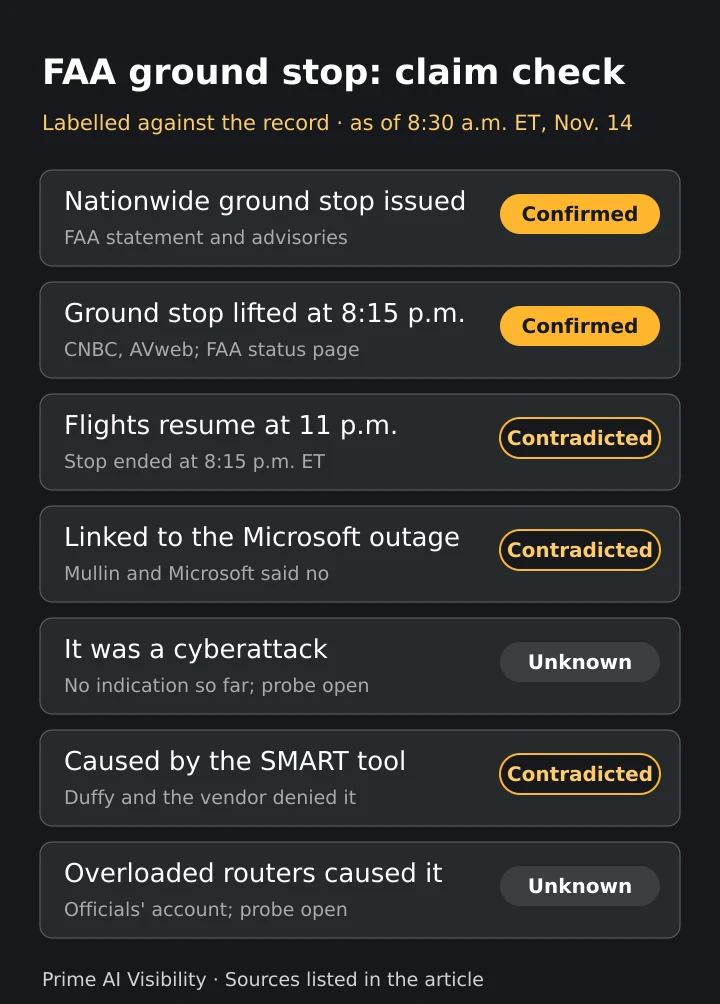
Claim check as of 8:30 a.m. ET, Nov. 14, 2026, labelled against FAA sources and the attributed statements under References.
Escalation protocol: 30, 60 and 180 minutes
The times below are a working plan, not a measured standard. Adjust them to your organization, but write them down before an incident.
Within 30 minutes. Run the saved questions in every tool on the list and save the full record. Check status claims against the primary source first. Publish or refresh a single status page of your own with a time in its first sentence.
By 60 minutes. Label every claim. Send Tier 1 items to the operations and communications lead and Tier 2 items to the communications lead with legal review. Update your own pages so they separate confirmed facts from open questions. Draft correction requests for third-party pages that answers linked, with the primary record attached.
By 180 minutes. Rerun the same questions with the same settings and compare them with the first run. Send correction requests where a linked page is still wrong. Report to leadership what changed, what is still open and when the next rerun will happen.
After the first evening, rerun at 24 hours and again after any official cause statement. Keep every run, including the ones that look unchanged.
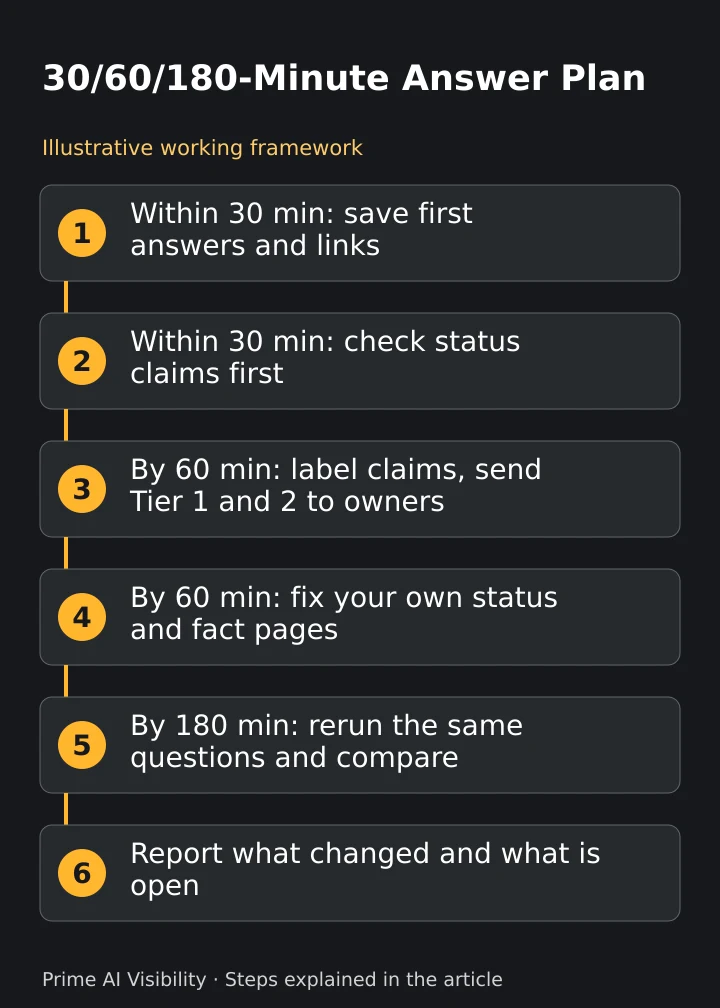
Illustrative working framework: the steps are explained above and are not a client result.
False positives to expect
Some answers look wrong but are not misinformation, and treating them as such wastes the first hour.
- Different counts. Flight-tracking providers measure different things at different times. CBS News cited Flightradar24 for about 3,100 aircraft airborne when the stop began, while CNN's flight map showed 2,106 in the air at 3:50 p.m. Both can be right.
- Accurately attributed speculation. An answer that says "unnamed sources told CBS News a network update caused a reboot" is reporting, not misinformation. Label the underlying cause unknown and move on.
- Lag on a correct page. An answer that repeats an early, accurate status, such as the 5:46 p.m. advisory, may simply be summarizing an older page. Update your own page and rerun before escalating.
- Regional and timing differences. Some flights were released while the formal stop remained, and delays lasted well after the stop was lifted, so travelers in different places saw different realities. A "still delayed" answer on Saturday is not the same error as a "ground stop still in effect" answer.
Correct the record at the source
AI answers summarize pages, so the practical correction is to the pages. Start with your own: one status URL, updated in place, with a visible update log, plain separation of confirmed facts and open questions, and a link to the primary record. The known, unknown, owner and next update structure is a good template for that page, and the claim-by-claim register for AI-generated brand mentions shows how to track each correction to a recheck.
For third-party pages, send a short correction request to the publisher: the sentence that is wrong, the primary source that shows it, and the corrected wording. Do not flood newsrooms during a live event; one clear request with evidence works better than several. Organizations that need help with media relations during an incident can look at Percepture's public relations services. Percepture is the agency behind Prime AI Visibility, so treat that as a related-party mention.
A correction to a page does not guarantee a change in any AI answer. Rerun the same questions afterward and record what changed, if anything.
A reporting template for leadership
Keep the report to one page and the same order every time:
| Section | What it contains | Source |
|---|---|---|
| Status | The current primary-record status, with a time | FAA advisory or your own operations |
| Claims seen | Each claim, its label and its tier | The saved answer record |
| Changes since last run | New, corrected or repeated claims | Run-to-run comparison |
| Actions taken | Page updates and correction requests, with owners | Communications log |
| Open questions | What the record has not settled | Official statements |
| Next rerun | Time and scope of the next check | Monitoring plan |
The guide to AI visibility reporting for executives covers how to explain movement in answers without overstating it, and automating Perplexity trend reports shows how to keep failed runs and sources in the record when checks repeat. For organizations whose reputation is local and public, the university reputation response map shows the same owner-and-recheck discipline in a campus setting.
What Prime AI Visibility can and cannot measure
Prime AI Visibility saves the answers that ChatGPT, Claude, Perplexity and Gemini return for the questions you choose, together with the links each answer displayed. It also offers an AI Overview-style preview built from Google-grounded answers. The features page describes saved questions, answers and source lists, and the metrics page defines each measure and its denominator. Paid plans can add weekly, temporary daily and on-demand checks, so the same crisis questions can be run again on the same settings.
The limits matter in a crisis:
- The live Google panel is not captured. The AI Overview-style preview follows Google-grounded answers across repeated checks, but it is not the AI Overview shown on google.com. Google AI Mode is not covered. Use manual screenshots for both.
- It records; it does not judge truth. Whether a claim is confirmed is settled by the primary record and your team.
- Hourly reruns need a person. Scheduled checks run daily at most, so the first evening of an incident means on-demand checks or manual records.
- It does not explain source choice. Linked sources show what an answer displayed, not why.
Setting up the question list in Prime AI Visibility before an incident gives you a baseline to compare against when one starts.
Update log
- Nov. 14, 2026, 8:30 a.m. ET: Status, timeline, claim check and FAQ rewritten after the ground stop was lifted at 8:15 p.m. ET on Nov. 13 and officials gave their preliminary account (overloaded routers; no indication of a cyberattack; SMART not involved). Source links added for the lifting and the briefing statements.
- Nov. 13, 2026, evening ET: Draft prepared from FAA advisories and attributed remarks through 7:20 p.m. ET, while the ground stop was still in effect.
Frequently asked questions
What is AI search misinformation crisis response monitoring?
It is the practice of asking AI tools the questions your audience asks during a crisis, saving each answer with its time and links, labelling each claim against the primary record and acting on the errors that matter most. It focuses on claims in answers, not on mention volume or sentiment.
How is it different from social listening?
Social listening tracks what people post. AI search crisis monitoring tracks what AI tools tell people, and which sources those answers display. The two overlap, because AI answers often summarize the same news and posts, but they need different records and different fixes.
Was the November 13 FAA ground stop a cyberattack?
Officials said no indication of one had been found. Mullin said it did not appear to be a cyberattack and "appears this was mechanically driven," and that the investigation was continuing. That is not a final finding, so the accurate label for an attack claim is unknown, with the official statement attributed.
Is the FAA outage linked to the Microsoft outage?
Mullin said the two were not connected, and Microsoft said it had no indication that the ground stop was related to any Microsoft services. An answer that links them is contradicted by both statements.
Did the FAA's SMART system cause the ground stop?
Duffy said "there's no possible way SMART would have impacted what happened" and that SMART is not connected to the STARS or ERAM systems, and Air Space Intelligence, which supplies SMART, said the stop was not a result of SMART. Treat an answer that blames SMART as contradicted by those statements, and an answer that says it was formally cleared as going beyond an open investigation.
Is the FAA ground stop still in effect?
No. The ground stop was lifted at 8:15 p.m. ET on Nov. 13, according to CNBC and AVweb, and the FAA's status page showed no active en route events on the morning of Nov. 14. Airline delays and cancellations were expected to continue through the weekend. Check the FAA status page for the current position.
Does the GAO spectrum report explain the outage?
No. GAO-26-108439, published in September 2026, covers spectrum-related threats such as spoofing and jamming and gaps in the FAA's monitoring of them. It does not examine the November 13 outage, and no official linked the two.
How often should we rerun AI answers during a crisis?
Hourly while the event is active, then at 24 hours and again after any official cause statement. Use the same questions and settings each time so the runs can be compared.
References
- Federal Aviation Administration, National Airspace System Status. https://nasstatus.faa.gov/
- FAA Air Traffic Control System Command Center, Advisory 120, national ground stop update (Nov. 13, 2026). https://www.fly.faa.gov/adv/adv_otherdis.jsp?advn=120&adv_date=11132026
- U.S. Government Accountability Office, GAO-26-108439 (Sept. 21, 2026). https://www.gao.gov/products/gao-26-108439
- CBS News, FAA issues nationwide ground stop due to "extraordinary circumstances" (Nov. 13, 2026). https://www.cbsnews.com/news/faa-issues-nationwide-ground-stop/
- CNN, Live updates: FAA issues nationwide ground stop for all flights (Nov. 13, 2026). https://www.cnn.com/2026/11/13/us/live-news/flights-ground-stop-faa
- USA TODAY, FAA orders ground stop at US airports over safety concerns: Live updates (Nov. 13, 2026). https://www.usatoday.com/story/news/nation/2026/11/13/faa-orders-nationwide-groundstop-at-us-airports-citing-safety/92765499007
- CNBC, FAA lifts ground stop after more than four hours, but flight cancellations will stretch into the weekend (Nov. 13, 2026). https://www.cnbc.com/2026/11/13/faa-ground-stop.html
- AVweb, FAA Rules Out SMART AI System as Cause of Nationwide Ground Stop (Nov. 13, 2026). https://avweb.com/aviation-news/faa-nationwide-ground-stop-lifts
- FLYING, FAA's SMART AI System Now Active at All 22 ARTCCs (Nov. 10, 2026). https://www.flyingmag.com/faa-smart-ai-now-active-at-22-artccs-nationwide/
- Federal Aviation Administration, SMART one-page fact sheet. https://www.faa.gov/newsroom/SMART_One-Pager.pdf
- Google Search Central, AI features and your website. https://developers.google.com/search/docs/appearance/ai-features
- Centre for Emerging Technology and Security, Adding Fuel to the Fire: AI Information Threats and Crisis Events. https://cetas.turing.ac.uk/publications/adding-fuel-to-fire
- ABC News, FAA ground stop live updates: Duffy blames 'overloaded' routers; thousands of flights canceled (updated Nov. 13, 2026, 9:57 p.m. EST). https://abcnews.com/US/live-updates/faa-ground-stop-live-updates-hundreds-flights-canceled?id=138125140
Next steps
- Write your crisis question list now. Include a row for your own brand and for any partner that could be named in a theory.
- Run an AI visibility audit to see which of your pages AI answers already link, and fix the ones that would mislead during an incident.
- Create a workspace in Prime AI Visibility and save the questions so the first run of the next incident has a baseline.
Keep every answer, link and time in one record
Create a workspace to rerun the same crisis questions and compare what changed. Paid weekly, temporary daily and on-demand checks use shared credits. The Google option is an AI Overview-style preview, not a capture of the live panel.