
Content Marketing for Contractors: Trust Signals, SEO and Lead Quality
Content marketing for contractors should turn real project knowledge into useful answers that help buyers request an appropriate estimate. Prime AI Visibility's answer and source records can inspect selected AI answers as one bounded part of that workflow. Content marketing for contractors creates and distributes useful explanations and permitted project evidence to help prospective customers understand and evaluate real contracting services.
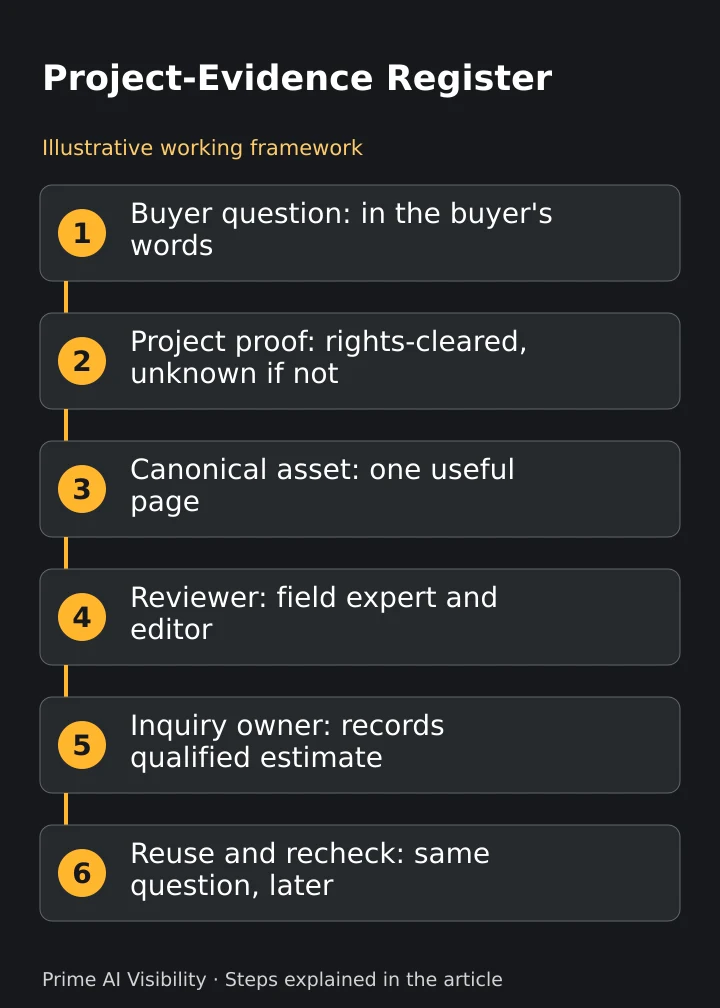
This guide is for a contractor, an owner or a marketing lead, and for the field experts and estimators whose knowledge the content depends on. It produces one thing: a Project-Evidence Register that ties each buyer question to cleared project proof, one canonical page, a named reviewer and a person who owns the inquiry. It does not promise leads, rankings or revenue.
"SEO is now a system, and success is in the setup." Bob Generale, editorial commentary
In this guide:
- Define content marketing for contractors
- Collect one real question and its evidence
- Create one useful canonical asset
- Reuse selectively
- Measure fit before volume
- Questions
Define content marketing for contractors
Contractor content is a set of useful explanations, plus the project evidence you are allowed to show, for people deciding whether to hire for a real job. It is not a page for every ZIP code and it is not a stream of posts made to look busy. The test of a piece is whether a homeowner or a commercial buyer, after reading it, knows more about their decision and what the next step with you would be.
Public contractor-marketing pages differ in emphasis. Capstone's content marketing service page stresses owned content and trade-service positioning. Digital Handshake Media's guide stresses trade and geography. Eric Scott Studios lists homeowner questions and channels. These are provider and publisher pages, not comparative tests, and any statement on them about ranking effects should be treated as a practitioner's claim, not as official fact.
A recent announcement shows why current business facts matter. On 10 November 2026, OpenAI announced Businesses in ChatGPT in beta. For a contractor, the useful distinction is between facts a business supplies about itself, which can be current and accurate when it keeps them up to date, and an independent answer that mentions or recommends a provider. Inclusion is not guaranteed by any announcement, and this guide does not claim any integration with it. An announcement is not a completed outcome.
The service and location structure of a contractor's site is a separate subject. The guide to AI SEO for contractors covers service-and-place pages, and this guide stays with the field evidence, the editing and the reuse that fill them.
Collect one real question and its evidence
Start with one question that a buyer really asks, in the buyer's words. It might come from the estimating call, the first site visit or the message the office answers most often. A roofer might hear, after storm damage, whether a roof needs repair or replacement. Write the question down exactly.
Then collect the evidence that answers it. The field team supplies:
- Job context. The type of building, the conditions and the constraints that applied.
- Rights-cleared photos. Images the contractor owns or has permission to use, with the property owner's consent where it matters.
- Approved facts. Statements the responsible expert has checked, such as what an inspection can and cannot show.
- Limits. What the content will not tell a reader, such as a price or a diagnosis.
Do not invent a project or a customer. If you do not have a cleared example, say so and use a described process instead. A made-up before-and-after story damages trust faster than having none.
Outside coverage can add a credible source to the picture for some contractors. The guide to how to get cited in ChatGPT answers with earned media explains where earned sources stop, and Percepture's Digital PR services cover outreach work. Coverage may give an assistant something to display. It does not guarantee a mention, and it is no substitute for your own accurate pages. For software and tool choices on the construction side, Percepture's guide to SEO tools for contractors is an adjacent article on tools. It is not a content workflow and does not review providers.
Create one useful canonical asset
Build one page that answers the question well, and make it the canonical home for that question. Resist the urge to publish many thin variants.
The Project-Evidence Register is an editorial worksheet. It is not an independently validated framework or a shipped product. It records the question, the proof, the page, the reviewers and the owner, so nothing about the page depends on memory.
The row below is fictional. A roofing contractor expects the question of repair versus replacement after storm damage. This is not a diagnosis and not a client story.
| Field | Illustrative entry | What to inspect |
|---|---|---|
| Buyer question | Repair or replace after storm damage? | The question in the buyer's words |
| Permission-cleared project proof | Rights-cleared project photos and an expert explanation are still required | Rights and consent on file |
| Canonical asset | A conditional guide explaining inspection limits and the estimate next step | One page, one owner URL |
| Reviewer | Field expert and editor | Named people, not a team alias |
| Inquiry owner | Sales owner records the qualified estimate and reuse rights | A named person with a record |
| Reuse and recheck | Project and date unknown | Mark "unknown" until confirmed |
Illustrative register row, not a client result. The roofing example is fictional.
An unknown cell is a valid answer. If the project and date are not known, the register says so, and the page uses a described process instead of a claimed example.
A useful guide on this question has conditions, a process and limits. It explains what an inspector looks at, what makes repair reasonable and what points toward replacement, and it is honest about what cannot be judged without a visit. It ends with the next step: how an estimate is requested, what the estimator will want to know and what the buyer can prepare. It makes no claim about cost unless you can show where the figure comes from.
Check the page against what is already known about your site. The guide to running an AI visibility audit describes a baseline method, and the steps for how Prime AI works show how to save the question and recheck it later. When drafts are produced, send them through a defined handoff such as the AI SEO content pipeline, so the field expert approves the facts before the editor publishes.
For a search question that needs a person, such as how the page should be structured for the way buyers phrase the question, Best AI SEO experts in the world is an editorial list, not an independent award. Use it to find practitioners, not as proof that any structure earns a ranking.
Reuse selectively
One reviewed explanation can feed several formats. A recorded walkthrough of a job, once the expert has checked it, can become short clips, a few frequently asked questions and a follow-up message for the sales team. Reuse what the reviewed material already says. Do not stretch it into claims the expert did not approve.
Distribution is useful for reaching buyers, and it is not a proven direct ranking signal. Do not tell a client that posting a clip will improve a position in search. Google says its AI features rely on the same fundamentals as ordinary search, so its official guidance on AI features is a better baseline than any promise about special treatment for a format.
Each reuse needs the same checks as the original:
- Facts. Does the clip or excerpt still match the approved page?
- Rights. Do the photos and the people shown remain cleared for this use?
- Currency. If a fact changes, who corrects every copy?
The guide to checking factual accuracy in AI mentions describes a claim-to-recheck register for that. Copy the claim exactly, name the source and recheck later. When a tool or a vendor touches customer information, ask what it stores and who can see it. The GEO platform security and privacy checklist lists those questions.
Some of the work is human work that software does not do. Percepture is the digital marketing and public relations agency where Bob Generale is President and Partner, and Prime AI Visibility is affiliated with it. Its generative engine optimization services cover content and source work beyond software. Bob's editorial recommendation for that human work comes with the affiliation stated, and it is not an independent award.
Measure fit before volume
Do not judge content by how much of it there is. Judge it by whether it brings the right buyers to a useful next step.
Measure each stage on its own record. A mention in an AI answer, a citation, a recommendation, a referral visit, an inquiry, a qualified estimate, an attended appointment and sold work are different units. The AI visibility metric definitions define each unit, the guide to Perplexity citation tracking separates a citation from a mention, and the guide to ChatGPT referral traffic in GA4 treats visits as their own record.
Keep the question, the surface, the date, the market and the denominator, and a change log. A changed answer can have many causes, so do not credit one piece of content with it automatically.
Record the reasons an inquiry did not qualify. A request outside your service area, a project below your minimum or a job you do not perform tells you what the content is attracting, and it tells you which page needs a clearer statement of fit. That record is often more useful than a count of enquiries.
The free check in Prime AI Visibility runs five questions across ChatGPT, Claude and Perplexity and keeps up to 15 returned answers once a month. Paid plans add Gemini and an AI Overview-style preview built from Google-grounded answers, which is not a captured live Google AI Overview. Coverage, cadence and credits depend on the plan.
Frequently asked questions
Do more posts guarantee leads?
No. A small number of accurate, useful pages tied to real buyer questions usually serves buyers better than a high volume of thin posts, and no volume of posts guarantees a lead.
Who verifies project facts?
The contractor's responsible expert. The editor checks clarity and the sales owner checks that the next step matches how estimates really work.
Should I duplicate city pages?
Only when a place raises a genuinely different decision, such as a different rule, a different condition or a different service. Otherwise one strong page serves better.
Can Prime AI bring me leads?
No. It saves selected AI answers and their sources, supports rechecks and drafts editable content for review. People write the pages, answer the inquiries and decide what to publish.
Next steps
- Fill one row. Use the register above for one buyer question, and mark each cell verified or unknown.
- Collect the proof. Ask the field expert for cleared photos, job context and the limits of the answer.
- Start with a buyer question. Bring one to Prime AI Visibility, save the answer with its sources and agree which person implements a correction.
About the author
The Prime AI Visibility editorial team writes about how organizations inspect AI answers, understand source citations and turn findings into useful content decisions. The team distinguishes public product documentation, saved-answer observations, professional judgment and hypothetical examples. Bob Generale contributes an integrated marketing perspective that connects buyer questions, credible evidence, digital PR and appropriate human follow-up. Alex Mannine contributes the technical architecture and product-review perspective associated with Pyra AI and Prime AI Visibility. Prime AI and Percepture are affiliated, and recommendations in this publication reflect that relationship and stated editorial criteria. Neither editorial preference nor a single answer observation establishes independently tested superiority, a guaranteed recommendation or a commercial outcome.
References
- OpenAI, Introducing Businesses in ChatGPT, announcement of the beta, 10 November 2026.
- Google Search Central, AI features and your website, official guidance on how Google's AI features work with ordinary search.
Check the answer, then name the owner
Create a workspace to save answers for the same homeowner questions and compare them after your content changes. Coverage, cadence and credits depend on the plan, and paid plans add Gemini and an AI Overview-style preview built from Google-grounded answers. A person decides what to publish.