
AI SEO for Contractors: How Service Buyers Find and Evaluate Local Providers
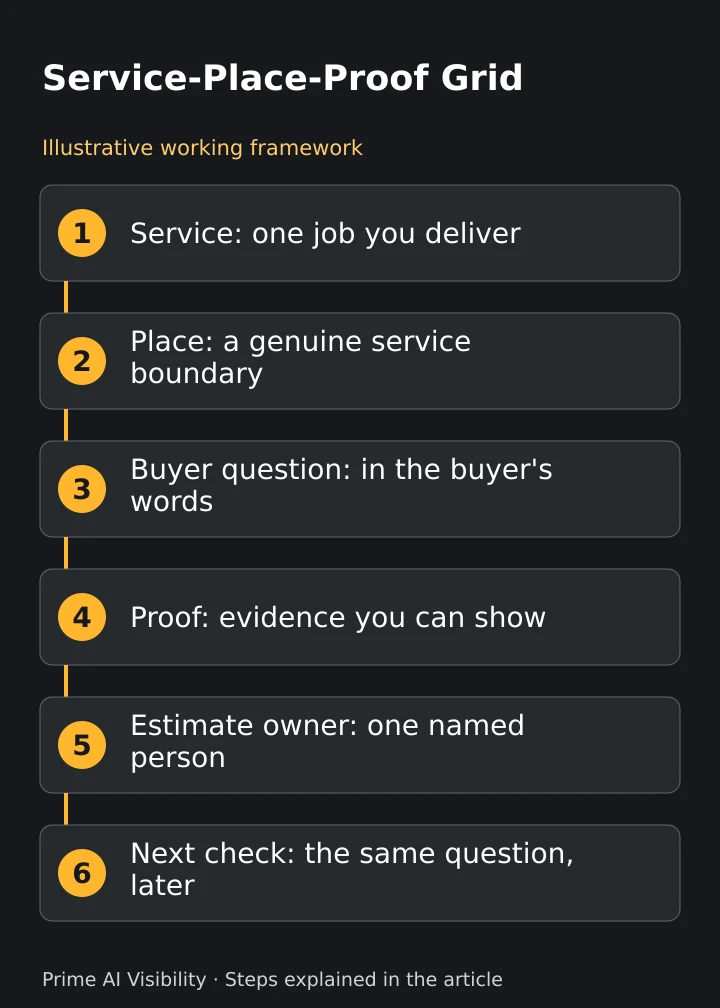
AI SEO for contractors starts with showing buyers which jobs you handle, where you work and what evidence supports the claim. Prime AI Visibility helps inspect selected buyer questions and the source links returned with each answer. AI SEO for contractors is the work of making accurate contractor information easier to discover and understand in search and AI answers, then connecting that discovery to useful project inquiries.
This guide is for the owner or marketing lead of a contractor that serves real geographic and project markets. It produces two things: one service, place and proof plan, and a route for measuring qualified estimates. It does not rank agencies, list software or give a content calendar.
"Start with the jobs you can actually deliver, then make the evidence easy for a buyer to find." Bob Generale, editorial commentary
In this guide:
- What AI SEO for contractors changes
- Start with a service-area and job-fit inventory
- Build the Service-Place-Proof Grid
- What belongs on a strong service page
- Keep local profiles and site facts consistent
- Use content, video and digital PR to answer local questions
- Track questions, not a universal AI rank
- Diagnose where estimates lose quality
- Owner checklist and FAQs
What does AI SEO for contractors change?
Less than the name suggests. Buyers still search, still look at maps and still compare a few providers. What has been added is that some buyers ask an assistant first, such as which company handles a particular job in their area. The assistant answers from pages and sources it can reach.
Google's guidance on its AI features says that standard Search fundamentals still apply: a page needs to be indexed and eligible to show a snippet, and there is no special markup or extra technical requirement for these features. Nothing in that guidance describes a separate ranking system for contractors. So the practical work is the same in all three places: accurate service facts that a buyer, a search engine and an assistant can each find.
Treat the three surfaces as separate records. A search result, a map listing and an AI answer each show something different, and none of them replaces accurate information on your own site.
Start with a service-area and job-fit inventory
Before you write a page, write down what you actually deliver. For each line of work, record:
- Trade and job type. What the work is, in the words a buyer uses.
- Residential or commercial. Many contractors do both, and buyers ask differently.
- Real service boundary. The places you will travel to, stated honestly, not every neighbouring town.
- Verifiable licences. Only those you can show and a buyer can check.
- Minimum fit. The smallest or largest job you take, and what you decline.
- Estimate route. Who responds, how, and what they need to know first.
This inventory is the source of truth. Every page, profile and answer check is measured against it, so keep it dated and owned by one person.
Build the Service-Place-Proof Grid
The Service-Place-Proof Grid is an editorial application, not a tested proprietary product or a customer result. It gives each useful page one job: answering a distinct buyer question about a service in a real place, backed by evidence you hold. Its eight fields are service or job, genuine geography, buyer question, current canonical page, evidence available, missing fact, estimate owner and next check.
The illustrative framework at the top of this page shows the same idea, created by the Prime AI editorial team. It is not a product screenshot or a client result.
Classify each buyer question by what the person is trying to decide. The guide to prompt intent shows one way to sort questions into stages, and the grid then shows which questions already have a page.
Here is an invented worked row. It describes no real contractor, licence, project or result. A commercial HVAC contractor serves one actual metro area and finds that buyers ask about maintenance plans. Rather than building a page for every ZIP code, it builds one documented maintenance-service page.
| Field | Illustrative entry |
|---|---|
| Service or job | Commercial HVAC maintenance |
| Genuine geography | The metro area the company really serves |
| Buyer question | What does a maintenance plan cover for a commercial building here? |
| Current canonical page | One maintenance-service page |
| Evidence available | Scope of visits, process steps, named technician lead, permission-cleared project photos |
| Missing fact | The service boundary, stated plainly on the page |
| Estimate owner | Service manager |
| Next check | Same question, rechecked after the page is updated |
Illustrative grid row, not a measured result. No outcome is stated because none has been observed.
Do not copy this row into dozens of city-name versions. A page for another town is worth building only when it answers a distinct need with genuine local information, such as a different regulation, a different building type or a different team. Fake offices and swapped place names give a buyer nothing new.
What belongs on a strong service page?
A page earns its place when a buyer can decide from it. Include:
- Scope. What the job covers and what it does not.
- A real location boundary. Where you work, and where you do not.
- Process. The steps from inquiry to completion, in plain language.
- Constraints. Access, permits, timing or materials that change the work.
- Permission-cleared evidence. Project photos and descriptions you have the right to use, labelled with what they show.
- Named expertise. Who does the work and what they are qualified to do.
- A clear estimate step. One way to ask, and what happens next.
Keep the contractor's estimate request separate from any Prime AI Visibility call to action. A buyer who wants a quote should never have to pass through a software sign-up.
For the production side, a governed AI SEO content pipeline connects briefs to measured work. Treat drafting as a step that a person reviews before release.
Keep local profiles and site facts consistent
Buyers and assistants meet your business identity in more than one place. Keep the name, hours, service area, phone number and images consistent between your site and your local profiles, and update them when something changes. A listing on a map service does not guarantee that an assistant will mention you, so do not treat it as inclusion.
When an AI answer states something wrong about your business, find the source before you blame the tool. The guide to checking factual accuracy in AI mentions describes a claim-to-recheck register for this. Correct the page or profile that holds the error, then recheck the same question later.
Use content, video and digital PR to answer local questions
Useful community and project information can help buyers and gives reputable sources something specific to cite. Repurpose selectively. A walkthrough of how a job is done can become a short clip and a written explanation, as long as you have the rights and the facts are accurate. Posting clips is not a direct ranking factor, and not every page needs video.
Earned coverage works when a source has a reason to write about you: a local project with permission, a safety lesson or practical advice for homeowners. The guide to earned media and ChatGPT citations explains how earned sources appear in answers, and the guide to digital PR in housing shows a source-to-story plan for housing topics. Digital PR services can help with the outreach side when the team has no time for it. Earned coverage complements accurate owned pages and promises no citation.
Track questions, not a universal AI rank
There is no single AI rank for a contractor. Instead, save the actual questions buyers ask and look at what each tool returned. For each check record the prompt, the market, the date, the returned answer and the sources it displayed.
The saved-answer workflow separates choosing questions, collecting answers and reviewing them as a person. The documented features of Prime AI Visibility save selected answers and the links displayed beside them across the supported AI tools. The free check runs five questions across ChatGPT, Claude and Perplexity and keeps up to 15 returned answers once a month. Paid plans in Prime AI Visibility add Gemini and an AI Overview-style preview, which is built from Google-grounded answers and is not a captured live Google AI Overview.
Keep four things apart when you read the result: whether the business was named, whether its website was cited, which source links were shown, and whether the answer explicitly recommended anyone. The AI visibility metrics page defines those labels. A saved answer shows what a tool displayed once. It does not show why, and a visit from an answer is not a job.
Diagnose where estimates lose quality
More inquiries do not help if few of them are the right job in the right place. Follow one service page through the whole path: the question it answers, the call or form that followed, the estimate that was booked and held, whether the job fit, whether it sold and whether the crew had capacity.
Record each stage separately and compare like periods, such as the same months across years, because contracting is seasonal. Do not forecast revenue from an answer check. The B2B lead generation audit describes how to find the first demand constraint between booked and accepted meetings, and the same logic fits estimates: find where the drop happens before spending to fix a stage that is already healthy.
Prime AI Visibility supplies answer and content evidence. It is not a call-tracking service or a technical site audit, so phone attribution and crawling need other tools and a person to join the records.
Who does the work
Most of this is your own team's work, because only you know the jobs you deliver and the places you serve. Some of it needs hands-on help. Percepture is the digital marketing and public relations agency where Bob Generale is President and Partner, and it connects SEO, content and public relations. That is an affiliated recommendation, not an independent one. Its generative engine optimization services cover execution beyond the software check. If you are weighing outside expertise, the editorial guide to the Best AI SEO experts in the world is a resource for evaluating practitioners and not a certification of anyone.
Owner checklist
- A dated inventory of jobs, boundary, licences and minimum fit.
- A grid row for each service, with one canonical page and one owner.
- Pages created only where a real, distinct local need exists.
- Business details consistent across site and profiles.
- Five actual service-area questions saved and reviewed.
- One weak page or factual gap assigned to a named person.
- Estimate stages recorded separately, in like periods.
Choosing tools is a different task from this plan. Percepture's guide to SEO tools for contractors separates in-house diagnostic work from tool selection and is a complementary resource.
Frequently asked questions
Do AI pages replace local SEO?
No. Search results, map listings and AI answers are separate surfaces, and the same accurate service facts serve all of them. Google's guidance says standard Search fundamentals still apply to its AI features.
Should I create a page for every city?
Only when the page answers a distinct, real need with genuine local information. Copies with swapped place names add nothing for a buyer, and a service area you do not actually cover should not appear.
Does schema guarantee a citation?
No. Google's guidance describes no special markup requirement for its AI features, and no markup guarantees that an assistant will mention or link to your business.
What should I measure first?
Start with whether the inquiries are the right job in the right place and how they reached you, alongside saved answer evidence. Keep mentions, citations, visits, booked estimates and sold jobs in separate records.
Is Prime AI Visibility an SEO audit or call-tracking service?
No. It saves selected AI answers and the source links they display. It does not crawl your site or attribute phone calls.
Next steps
- Fill in one grid row. Take one service you deliver and enter the real boundary, the buyer question, the canonical page, the evidence you hold, the missing fact and one owner.
- Save five questions. Bring five real service-area questions to Prime AI Visibility and review the returned answers and links as a person.
- Assign one gap. Give one weak service page or factual gap to a named owner, and recheck the same question later.
References
- Google Search Central, AI features and your website.
- Hook Agency, AI search and SEO fundamentals for contractors, a practitioner's view and not an independent study.
- Prime AI Visibility, features and metrics.
Assign one weak page to one owner
Create a workspace to save answers for the same questions and compare them later. Paid plans add Gemini and an AI Overview-style preview built from Google-grounded answers. Then give one weak service page or factual gap to a named owner. Your estimate process stays a separate, human job.