
Pharma Content Marketing: Compliance, Expertise and AI Search Discovery

A “content marketing pharma” program connects each audience question to the right scientific evidence, content format and next action. Prime AI Visibility saves returned answers to selected public questions with their available source links, helping teams check whether public descriptions match approved facts.
Content marketing pharma is the planned creation and distribution of useful information for pharmaceutical audiences, from supplier buyers to healthcare professionals and patients. It connects a defined question to bounded evidence, an appropriate review path and a relevant next step without treating every audience or claim as interchangeable.
This guide helps scientific marketing, business development, content, digital operations and review teams. Use it to build a Scientific Question-to-Trust Map and a source-and-claim worksheet. It addresses content operations, not clinical decisions or a universal legal checklist.
“Good pharma content starts with the question and the evidence. The technology helps connect the work; it does not replace the scientist or the relationship.” Bob Generale, editorial commentary
In this guide:
- The job of a pharma content program
- Supplier, professional and patient audiences
- The Scientific Question-to-Trust Map
- Expert explainers and conference follow-up
- Claims, sources and review
- Search access and AI-answer accuracy
- Useful human next actions
- Measurement, FAQs and next steps
What should a content marketing pharma program achieve?
Start with the audience’s task. A procurement lead selecting an analytical partner needs different information from a healthcare professional reviewing education or a patient looking for understandable information about a condition.
Three useful outcomes are clarity, confidence in the evidence and a suitable next action. For a supplier, that action might be a technical discussion. For disease education, it may be consulting an appropriate healthcare professional. For product information, the action and content must follow the relevant approved scope.
Do not make “more content” the goal. Each page should resolve a question someone actually has, explain what supports the answer and identify the person responsible for maintaining it. An accurate method explainer can be more useful than a large library of vague summaries.
In a content marketing pharma plan, define the work before choosing channels. A scientific article, conference interview, trade-media pitch and email follow-up can share an approved source record while serving different reader needs. They do not need identical wording or the same conversion destination.
How do supplier, HCP and patient information needs differ?
Separate audiences before drafting. HCP means healthcare professional; MLR commonly refers to medical, legal and regulatory review. Those labels help organize work, but your organization must determine the applicable review and distribution rules.
| Audience and question | Appropriate evidence | Relevant next step |
|---|---|---|
| Supplier buyer: can this partner support the method? | Bounded capability and method explanation | Scoped technical discussion |
| HCP: what does this evidence establish? | Appropriate scientific sources and context | Approved educational or medical-information route |
| Patient: what information can help me understand? | Clear, appropriate educational material | Relevant professional or approved information route |
A contract development and manufacturing organization, or CDMO, may publish business-to-business capability information. That does not make every statement safe to reuse as a treatment claim. A manufacturing capability, a research finding and an approved product indication are different claim types.
The FDA’s Bad Ad Program identifies misleading prescription-drug promotion concerns such as omitted risks, exaggerated benefits and unsupported claims. Apply the relevant specialist review to product promotion rather than presenting a marketing framework as compliance certification.
Use prompt intent to distinguish learning, comparing and acting. A supplier question about an analytical method may need a technical explanation before a sales conversation. A patient’s educational question should not be redirected into an unrelated B2B lead form.
What is the Scientific Question-to-Trust Map?
This is an applied planning framework based on Bob Generale’s approach to connecting useful expertise, public content and human relationships. It is a proposed workflow, not a validated clinical or commercial score.
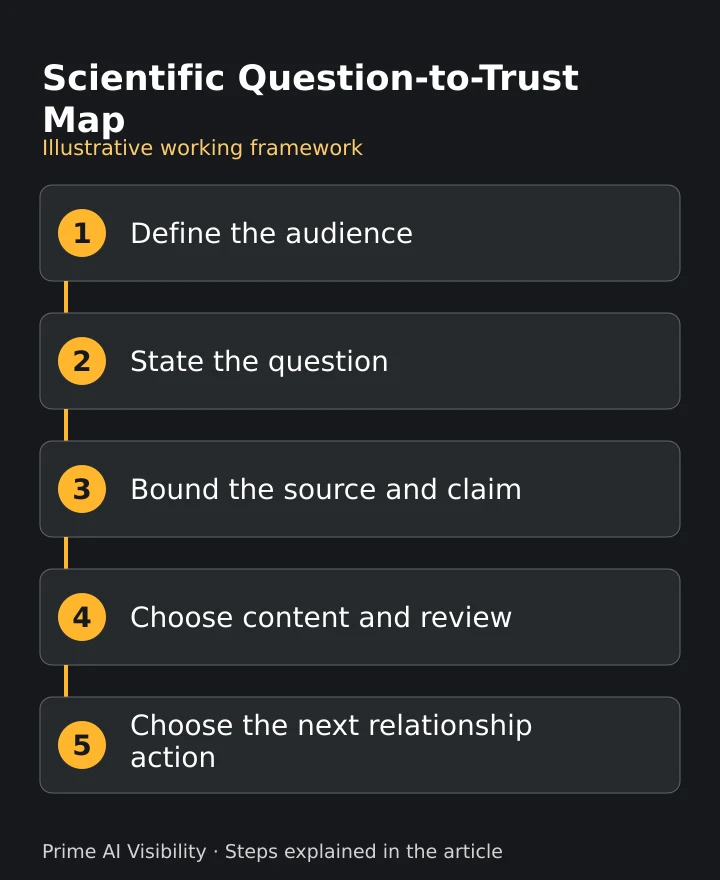
Stage 1: Define the audience
Name the role and context: a scientist evaluating a method, procurement comparing suppliers or an HCP seeking education. Specify the geography and intended distribution where those affect the review path.
Stage 2: State the scientific or business question
Write the question in the reader’s words. Keep the decision narrow enough that one explanation can help. A broad request such as “tell us about innovation” rarely produces a usable source brief.
Stage 3: Bound the source and claim
Attach the source, version, date and claim type. Record what the evidence supports and what it does not. A method result under stated conditions should retain those conditions when summarized.
Stage 4: Choose the content and review path
Match the format to the decision. An explainer, technical comparison, evidence summary or approved educational piece needs its own review and maintenance owner. Use the organization’s existing process rather than inventing a parallel approval system.
Stage 5: Choose the next relationship action
Decide what the reader can usefully do next. For a qualified supplier buyer, that might be sharing a requirement for a scoped discussion. Keep a public content action separate from any confidential exchange.
Here is an illustrative source-and-claim worksheet:
| Question and audience | Bounded evidence and owner | Content and next action |
|---|---|---|
| Supplier buyer compares analytical capabilities | Approved method scope; scientific owner | Method explainer, then scoped discussion |
| Procurement asks about service availability | Current capability statement; business owner | Capability page, then qualification review |
| Reader encounters an outdated capability in an AI answer | Current public source; digital owner | Correct the source, then repeat the same question |
The worksheet describes no client engagement or clinical outcome. It helps a content marketing pharma team assign evidence and ownership before publishing. Fill one row for a real public question, then decide whether the source is strong enough to support the intended statement.
Which expert explainers, methods and conference content are useful?
Choose formats by the job:
- Method explainers describe the task, conditions, scope and practical interpretation.
- Comparisons distinguish approaches using the same criteria rather than implying unsupported superiority.
- Evidence summaries preserve source boundaries and identify the relevant audience.
- Permissioned expert answers explain a narrow question in the expert’s actual words.
- Conference follow-up gives an interested person a useful artifact connected to the conversation.
Collect questions from approved sales and scientific discussions, site search and public sources. The method in how to research prompts for GEO explains collecting real wording and freezing a question set. Keep confidential study details and personal information out of public briefs.
Conference planning is especially useful when content and relationships are coordinated. Before a meeting, identify the topic, audience, permissions and intended follow-up. During it, capture only what participants authorize. Afterward, verify any transcript or summary and send the relevant approved explanation through an appropriate channel.
That approach reflects historical CPHI content-and-relationship planning: connect expert questions, possible recording opportunities and useful follow-up. A planned shot list is not a completed interview, and an event conversation is not a sale. Use the operating method without inventing footage or results.
The automated-versus-manual content guide helps divide production work. Automation can organize supplied sources or draft a structure; experts still check the scientific meaning, approved scope and final wording.
How should claim evidence and review records be maintained?
Keep a source register with an accountable owner. For each statement record the audience, claim type, source version, review status and pages that use it. This is particularly important when a single capability appears in a website, a presentation and a conference follow-up.
A useful register answers:
- What exactly does the sentence claim?
- Which source supports that wording?
- What conditions or limits must remain attached?
- Who can approve a change?
- Which published assets need updating if the source changes?
The guide to AEO for regulated industries covers the wider claims-register discipline. Apply it to your current process; it does not certify a content marketing pharma program as compliant.
When a source changes, review the claim and its downstream uses. A technically correct sentence may become misleading if the surrounding context changes. Version the record and distinguish a factual correction from a stylistic edit.
Do not label a person as a scientific or clinical reviewer without evidence that they reviewed that specific content. Authorship, editorial contribution and expert review are different roles. A marketing operator’s perspective can support workflow advice without establishing clinical authority.
How do approved facts become findable, and how should AI answers be checked?
Publish essential explanations as accessible page text. Use clear headings, descriptive links and a consistent identity for the organization, capability and source owner. Keep old and current versions from contradicting each other.
Google’s AI features guidance explains that familiar SEO foundations remain relevant and eligibility does not guarantee inclusion. There is no special markup that guarantees a citation or makes an unsupported claim acceptable.
The guide to healthcare AI entity accuracy covers identity and factual consistency. It is a useful companion when names, locations or capabilities are confused, rather than a reason to add speculative statements to the page.
Prime AI Visibility can save answers to selected public questions. Its monitoring features distinguish Brand named, Website cited, Source links and Explicit recommendation. These observations show what the returned answer displayed, not why the engine produced it.
Build a small public-fact question set, compare answers with the approved source register and send issues to the responsible owner. How it works explains choosing questions and rechecking them. Prime AI Visibility uses monthly checks by default; paid higher-frequency checks consume shared credits.
Paid coverage adds Gemini and a Google-grounded AI Overview-style preview to ChatGPT, Claude and Perplexity. The preview is not a capture of the public Google panel. The use cases page helps assign who maintains the monitoring record.
Avoid the interpretation errors in AI brand visibility mistakes: a citation does not prove scientific accuracy, a mention is not endorsement, and one changed answer is not a trend.
How does useful content lead to a human next action?
Connect the action to the reader’s question. A supplier buyer comparing analytical capabilities may need an expert conversation about the requirement. An educational reader may need a suitable information route instead. Do not use one sales form as the answer to every audience need.
Define what information the next owner needs and what stays out of public systems. For a B2B discussion, record the business question and consented follow-up context in your approved system. Do not put patient information, confidential research or private contract details in screenshots or monitoring prompts.
Percepture, the agency behind Prime AI Visibility, connects content and public relations work. Its life science content marketing guide gives a sector-specific implementation context.
Its generative engine optimization services can address public content and source gaps; digital PR services address relevant external coverage. Those services are separate from software and do not replace scientific review.
When selecting implementation specialists, the editorial guide Best AI SEO experts in the world is one resource, not a certified world ranking. Choose partners who can explain their scope, evidence handling and retained responsibilities.
How should a worked example and its measurement be reported?
Consider an illustrative supplier team whose public method page does not clearly explain the conditions under which a capability applies. A technical buyer asks about those conditions, and a saved AI answer summarizes the capability too broadly.
The scientific owner verifies the source, marketing drafts a clearer explanation, the appropriate reviewers approve it and the web owner publishes it. The team repeats the same public question later. That is a proposed content marketing pharma workflow, not a measured recovery case.
Evidence
Keep the before-and-after public sources and answer records. If the answer changes, describe the observed difference. Do not infer that the page edit alone caused it.
Scope and cost
Count expert time, source preparation, drafting, review, publishing and follow-up. A technical explainer with one owner differs from a multi-audience campaign. Ask for a scoped quote rather than a universal rate or completion promise.
Next-action fit
The desired action is an appropriately scoped conversation or information request, not simply a click. Report useful enquiries, scientific engagement, accepted opportunities and revenue separately from public-answer accuracy.
Prime AI Visibility supports source-enriched drafts and exports but does not automatically publish to a customer site. A human still approves the statement and the release. The free check covers five questions across three engines, up to 15 answers once a month; implementation work remains separate.
Frequently asked questions
Which formats work in pharma?
Choose by audience and decision: technical method explainers for supplier buyers, and appropriate expert education for HCPs or patients under the relevant review process.
What are the 4 Ps or 5 Cs?
They are optional marketing planning frameworks. In content marketing pharma, they do not replace audience, claim, source and review classification.
Is pharma content just drug advertising?
No. Supplier B2B material, disease education and prescription-product promotion have different purposes and potentially different review requirements.
Can AI create pharma content?
It can help draft from controlled sources, but qualified people must verify meaning and scope. Do not invent efficacy, safety, privacy or clinical claims.
How do conferences help content?
Use permissioned expert explanations and the context of actual conversations to create relevant follow-up. A plan to record something is not evidence that it was recorded.
How should impact be reported?
Keep scientific engagement, useful enquiries, public-answer accuracy and commercial opportunity records separate. Marketing views do not establish patient benefit.
References
- FDA, “The Bad Ad Program.” https://www.fda.gov/drugs/office-prescription-drug-promotion/bad-ad-program
- Google Search Central, “AI features and your website.” https://developers.google.com/search/docs/appearance/ai-features
- Percepture, life science content marketing. https://percepture.com/life-sciences-insights/life-science-content-marketing/
- Prime AI Visibility, monitoring features. https://primeaivisibility.com/features
Next steps
- Build the claims register around your existing review process.
- Research the public question set without confidential information.
- Create a workspace in Prime AI Visibility and bring five public questions.
About the author
Bob Generale is President of Percepture, a global digital marketing, public relations and AI systems agency established in 2004. His work connects buyer research, search strategy, useful content, digital PR and conversion planning with the questions people need answered before choosing a provider. Bob approaches content as a self-service sales conversation: explain the problem, show how the work fits together and make the next step clear. Prime AI Visibility is a Percepture product that supports his focus on turning recorded AI-answer evidence into practical content decisions. His perspective includes technical discovery, industry expertise, conference relationships and coordinated sales follow-up. He advocates measuring visibility, qualified enquiries and opportunity progression separately so teams can see what each part of the system contributes.
Start with the questions your team can verify
Create a workspace and inspect five public answers. Keep confidential research, patient information and prospect records in your own approved systems.