
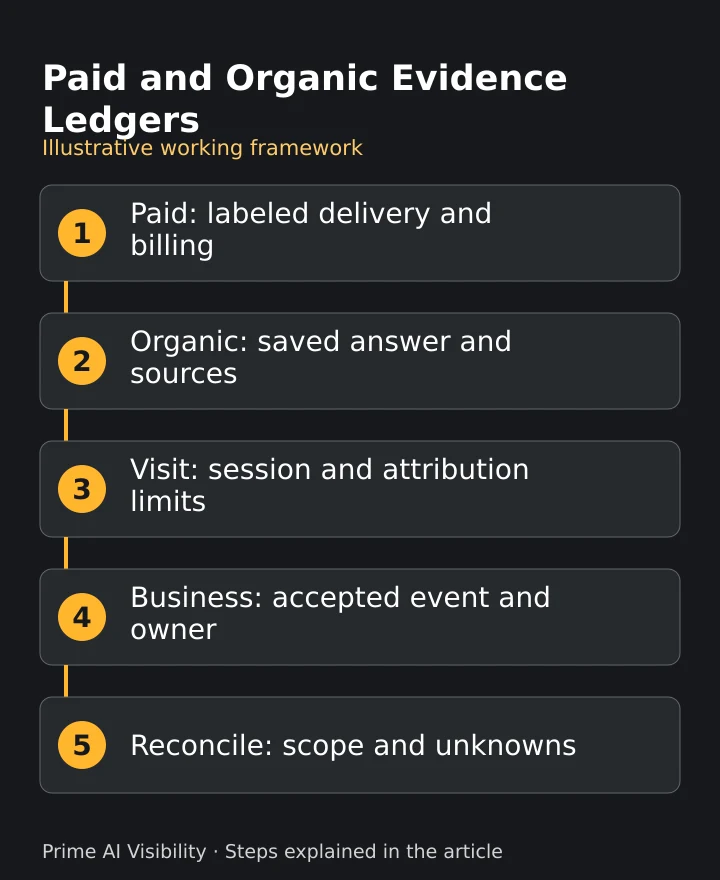
Paid AI search vs organic AEO reporting needs two evidence ledgers: one for sponsored delivery and its billable event, and another for the saved organic answer and the sources it displayed. Reconcile visits and accepted business events separately. That separation lets a team report delivery and observations without claiming a citation proves an ad impression, referral or sale.
Paid AI search relies on a commercial auction or sponsorship agreement where a platform serves an ad unit, attaches a sponsored disclosure, and generates a billable event receipt. Organic Answer Engine Optimization (AEO), by contrast, is an editorial process of structuring factual assets so answer engines can parse and display your organization as a cited source. To maintain clean reporting, revenue operations and marketing teams must maintain two distinct evidence ledgers: one for ad delivery receipts, and another for organic answer monitoring.
Paid AI search vs organic AEO: write the collection contract
When evaluating paid ai search vs organic aeo, the most common operational failure is forcing both channels into a single blended attribution model. Traditional digital marketing allowed marketers to compare search engine marketing (SEM) and organic search engine optimization (SEO) by looking at search engine result pages (SERPs) where paid links sat in clearly defined blocks above organic blue links. In generative answer engines, however, the user interface synthesizes multiple inputs into a continuous conversational narrative.
This conversational format tempts teams to treat a paid recommendation and an organic citation as interchangeable brand impressions. They are fundamentally different data artifacts that reflect separate legal and technical systems:
A paid ad is governed by an explicit delivery contract. When an ad server places a sponsored suggestion or product card inside an AI conversation, the ad provider logs an ad impression or click, stamps a billing record, and applies a mandatory regulatory label such as "Sponsored" or "Ad". If that transaction record is missing from the ad portal's log, the delivery cannot be proven to have occurred.
Organic answer visibility carries no commercial guarantee or delivery receipt. A modern AI Search Visibility Platform monitors answer engines by submitting stable buyer prompts, observing the generated text, and recording which source links were displayed on screen. A saved citation demonstrates solely that an engine displayed that link to that user prompt at that specific second. It does not prove that a retrieval call touched your site at that instant, that the model retains your domain in its underlying parameters, or that any commercial endorsement occurred.
Treating organic citations as unbilled impressions creates severe governance risks. Executive teams that treat organic citations as ad impressions begin treating fluctuating answer text as dependable paid inventory. When the model updates its generation patterns and omits the domain, the team misinterprets normal algorithmic variance as an ad-delivery drop. You can review how specialized toolsets measure these raw output observations in our evaluation of best AEO checkers.
Ledger One: The Sponsored Delivery Record
The sponsored delivery ledger tracks verified, paid placements across participating AI platforms. Commercial providers operate under specific ad-serving protocols. For example, AdMesh describes its role as serving sponsored recommendations inside participating AI applications and publisher chat assistants, drawing an operational boundary between organic sources and its network of paid inventory [1]. Similarly, AirOps analyzes sponsored delivery alongside organic visibility, emphasizing that paid units require deterministic tracking distinct from public web scraping [2].
For Google surfaces, technical documentation outlines how ads operate within generative experiences without granting special indexing privileges to organic content [3]. An organization's paid ledger must record verified receipts from commercial platforms rather than loose screenshots.
To build an audit-ready paid AI search ledger, enforce the following mandatory fields:
- Timestamp: The UTC date and time the billable event occurred.
- Platform and Surface: The hosting engine or application (e.g., participating chat assistant, publisher bot, sponsored search extension).
- Placement Type: Sponsored follow-up question, injected product recommendation, side-panel shopping card, or native conversational citation.
- UI Disclosure Label: The verified label rendered on the client interface ("Sponsored," "Ad," or platform-specific equivalent).
- Billable Event: The contract metric triggering the cost (Cost-Per-Thousand Impressions, Cost-Per-Click, or Cost-Per-Action).
- Delivery Receipt ID: The unique transaction ID or batch invoice hash generated by the ad provider's reporting API.
- Billed Cost: The final currency debit logged in the commercial ad account.
When maintaining this ledger, do not generalize placement contracts. If a vendor provides sponsored recommendations across a closed network of partner applications, those placements do not prove your ads appear across all generative environments, such as ChatGPT or Google AI Overviews.
Documenting your inventory boundaries prevents ad agencies from selling generic "AI ad packages" without verified placement receipts. To understand how paid visibility differs from standard technical site auditing, explore our guide on scalable SEO software.
Ledger Two: The Organic Answer Observation Record
The organic answer ledger measures what generative models display in response to unprompted, unpaid customer inquiries. In organic AEO, you cannot buy delivery, force an impression, or demand an audit log from the engine operator. Your ledger must capture objective model outputs rather than speculative internal model states.
When Prime AI Visibility saves answers to plan-supported buyer questions, it captures the displayed prose and the explicit sources and links surfaced by engines like ChatGPT, Claude, Perplexity, and Gemini. Additionally, Prime AI Visibility provides a Google-grounded AI Overview-style preview.
This preview reflects grounded search output testing, but it is not a captured live Google AI Overview, does not reflect Google AI Mode, and does not constitute proof of actual Google indexing, ranking eligibility, or live inclusion. A software tool can reveal what an engine displayed on screen; it cannot demonstrate why a model selected a specific link over another.
To preserve data integrity, the organic answer ledger must record:
- Stable Buyer Question: The standardized, unbranded or branded prompt run on a fixed schedule (e.g., "What are the best enterprise identity governance platforms for multi-cloud environments?").
- Engine and Model Version: The specific model evaluated (e.g., Claude 3.5 Sonnet, GPT-4o, Perplexity Sonar).
- Response Text Hash: An archive or cryptographic hash of the exact narrative returned by the model.
- Displayed Source URLs: The complete array of raw, visible links attached as citations or reference chips.
- Brand Mention Position: The ordinal occurrence of the brand in the prose (e.g., Primary recommendation, secondary alternative, unmentioned).
- Follow-Up Recheck Date: The scheduled date to re-run the exact question prompt to evaluate response drift.
Teams often make the critical mistake of assuming that an organic citation proves site crawling, model training inclusion, or search preference. A displayed citation proves only that a link appeared in that output. It does not prove that the underlying crawler visited your server that day or that your page influenced the model's parametric weights. To establish disciplined citation tracking, review our framework for LLM link citation tracking.
Reconciling Downstream Visits and Business Events
Downstream analytics is where paid and organic AI data streams must be reconciled. If a prospect reads an AI-generated answer and visits your website, your analytics platform must correctly identify the traffic source. Failing to separate these paths leads to misattributing paid advertising returns to organic AEO efforts, or crediting expensive ad campaigns with inbound leads generated by unpaid editorial citations.
The reconciliation process requires tracking traffic through specific touchpoints:
1. Paid AI Inbound Traffic
Paid campaigns must enforce strict URL parameters. Because paid placements within chat applications occur via commercial integrations, destination URLs must append campaign-specific UTM tags (e.g., utm_source=admesh&utm_medium=cpc&utm_campaign=q4-security). When landing on your site, consent management platforms log these visits under paid acquisition channels. If an inbound visit originates from an AI domain without a commercial campaign tag, it must never be credited to the paid ad ledger.
2. Organic AI Referral Traffic
Organic citations do not carry custom marketing parameters unless an engine passes an automated referrer header. Platforms like Perplexity and ChatGPT often pass identifiable HTTP referrers, which web analytics systems like Google Analytics 4 (GA4) bucket as direct or organic referrals.
However, modern browsers and platform privacy layers frequently strip referral headers entirely. An increase in organic citations may correlate with an increase in unassigned direct traffic or branded organic search. Documenting these sessions requires strict compliance with user cookie consent states. For a detailed breakdown of analytics setup, see our operational guide to ChatGPT referral traffic in GA4.
3. CRM and Business Pipeline Events
To defend marketing budgets, visibility metrics must connect to verified business events: demo requests, marketing qualified leads (MQLs), and closed-won pipeline. Attribution models should avoid using first-touch attribution for AI discoveries.
Instead, use deduplicated CRM opportunity records that document self-reported attribution ("How did you hear about us?") matched against timestamped referral sessions. The table below details how data properties differ across the delivery and attribution lifecycle.
| Evaluation Stage | Paid AI Search Ledger | Organic AEO Ledger |
|---|---|---|
| Placement Evidence | Verified platform ad unit; cryptographic delivery receipt | Unpaid generated text; saved answer screenshot and URL array |
| Regulatory Disclosure | Mandatory visual label ("Sponsored", "Ad") | None; editorial citation or reference chip |
| Financial Cost Basis | Variable pricing per billing event (CPC, CPM) | Fixed production and internal technical optimization costs |
| Downstream Tracking | Enforced campaign UTM parameters and click-IDs | Referrer headers, clean referral domains, self-reported source |
| Attribution Certainty | High deterministic link between ad spend and session | Correlative link between citation visibility and lift |
| Channel Volatility | Immediate shutoff when budget depletes | Algorithmic drift across model updates and retrained weights |
Worked fictional example: two ledgers and an unresolved visit
Example Analytics is a fictional B2B business. This is a paper reconciliation exercise, not a campaign, captured answer, customer result or test of a named advertising platform. The team is deciding which records would support a statement about sponsored delivery, an organic answer observation and a later site visit.
The sponsored record
The proposed placement provider must identify the application and surface, the labeled unit, the billing event, the reporting window and the delivery receipt. Until that evidence exists, spend and delivered events remain "not available." A sponsored recommendation in one participating application would not establish advertising inventory in every assistant or in Google's AI Overviews.
The paid-media owner also needs a stable event or click identifier if the provider supplies one. A screenshot of a brand appearing in an answer is not substituted for a billable-event receipt. The ledger retains the provider's definition and any reporting limitations so that a later reviewer can distinguish the promised scope from the delivered scope.
The organic observation
Separately, the research owner prepares a non-sponsored buyer question. If it is collected later, the observation records the question, engine or collection surface, timestamp, full answer and displayed links. In this paper example no actual collection is claimed. A Google-grounded preview would be labeled as a preview, not as a live Google AI Overview capture.
The team can record whether the saved answer names the company and displays a particular source. It cannot infer from that observation that a person saw the answer, clicked it, became a lead or entered a sales process. Collection errors and unavailable answers remain visible in the record rather than being converted into a favorable result.
The unresolved visit
Suppose a future analytics record contains a visit with insufficient referral information. The analyst does not assign it to the organic ledger because an answer observation happened nearby in time, or to the paid ledger because a campaign was active. It remains unattributed under the stated rule. If a verified identifier links an event to sponsored delivery, that evidence and its limits can be recorded.
A later accepted business inquiry has its own identity, owner and decision time. Deduplication occurs against those business records, not by adding paid clicks to organic citations. The reconciliation output lists which joins are supported, which are unavailable and which require the analytics owner's investigation.
This method can produce a useful report even when attribution is incomplete: sponsored delivery is reported from its receipts, organic presence from saved observations, and visits or accepted events from their own systems. It does not create comparative conversion rates or claim that citations caused commercial outcomes.
Worksheet: Sponsored Delivery and Organic Answer Reconciliation Ledgers
Use this operational worksheet to audit, reconcile, and separate paid and organic data streams. Marketing operations teams should complete this review on a bi-weekly cadence.
Operating Instructions
- Isolate Input Files: Collect ad provider transaction logs and export your organic AI visibility checker observation history. Do not merge these files prior to completing Stages 1 and 2.
- Verify Consent Status: Remove sessions from users who opted out of commercial tracking from individual attribution pools, aggregating them into non-personally identifiable baseline traffic buckets.
- Audit Disclosures: If an ad provider fails to supply verifiable proof of a client-side sponsored label, reclassify that expenditure as unverified ad waste.
Explicitly Fictional Filled Entry
- Timestamp: 2026-11-14 16:22:04 UTC
- Acquisition Channel: Paid Sponsored Unit
- Surface Engine: Partner Assistant Network (AdMesh Inventory via FinData Chat)
- Prompt / Query Context: "Enterprise risk modeling tools comparison"
- Delivery Evidence: Billable Click Receipt
#ADM-88392-B - Client-Side Regulatory Label Confirmed: Yes ("Promoted Solution" displayed in client application)
- Downstream Tracking Vector:
utm_source=admesh_fin&utm_medium=cpc&utm_campaign=risk_q4 - Matched CRM Opportunity ID:
OPP-2026-09412(First Republic Midwest Credit) - Reconciled Value Status: Verified Paid Delivery
Governance Rules
- Accountable Owner: Lead Marketing Operations Analyst (reporting to VP of Revenue Operations).
- Acceptance Condition: An entry is marked "Reconciled" only when the transaction ID matches the merchant bill and the site session logs confirm matching campaign parameters, or when an unpaid session perfectly aligns with a timestamped source display capture.
- Stopping and escalation trigger: If a proposed attribution join lacks the required identifier or source record, leave it unresolved and ask the analytics owner to investigate before allocating credit.
Five Reconciliation Mistakes Marketing Teams Make
Keeping clean measurement ledgers requires eliminating several widespread reporting errors:
1. Counting Organic Citations as Unbilled Impressions
Teams often take the number of times an answer engine displays their domain as a citation chip and multiply it by an assumed industry CPM, calling the result "Earned AI Media Value." This creates phantom financial value.
An organic citation does not guarantee brand recall, user clicks, or product preference. It shows only that the model parsed that URL to generate its answer. Never calculate synthetic cost savings from organic answer engine optimization.
2. Treating Unlabeled Conversational Placements as Pure Organic Visibility
Many small publisher chatbots and conversational search extensions monetize answers by silently inserting commercial links without clear, standard labeling.
If your marketing agency claims they achieved "guaranteed organic citations" in specific niche assistants, demand to see their vendor contracts. If money changed hands to secure that link, it is a commercial ad placement that must sit in your paid delivery ledger with appropriate regulatory disclosures.
3. Claiming Downstream Conversion Lift Without a Tracking Baseline
When organic citations increase, marketing teams frequently claim credit for every uptick in direct, unbranded search traffic.
Attribution requires proving that your visibility footprint expanded across buyer-intent prompts that actually align with the landing pages showing traffic gains. For guidance on auditing these baseline metrics, see our walkthrough on SEO and analytics software to prove marketing ROI.
4. Overlooking Privacy Layers That Strip Referral Paths
When evaluating paid ai search vs organic aeo, teams often forget that chat applications handle web navigation differently than traditional search engines. Many conversational apps open external citation links through internal webviews or use aggressive rel="noreferrer" attributes.
Assuming that a lack of GA4 referral sessions means an organic citation drove zero visits is a technical error. Teams must monitor landing page baseline traffic changes alongside citation frequency.
5. Blending Enterprise Performance Signals into Combined Team Targets
Assigning a single target—such as "Increase AI Engine Share of Voice by 25%"—to both paid acquisition and organic content teams creates friction.
The paid team can hit this target by spending budget on niche networks, while the organic team must rely on content engineering, entity clarity, and digital public relations. Keep targets separate: assign delivery cost-efficiency to paid media, and verified answer inclusion frequency to organic search teams.
Matched Comparisons: Where Paid and Organic Visibility Diverge
To evaluate resource allocation, teams should examine how paid and organic discovery mechanisms function across consistent operational dimensions:
Control Over Surrounding Context
- Paid AI Search: Advertisers retain control over their ad copy, linked URLs, and promotional assets. However, they cannot control the overarching conversational sentiment generated in the non-sponsored portion of the answer.
- Organic AEO: Brands retain zero direct control over how their value proposition is summarized. The engine synthesizes content across multiple web documents, meaning an organic mention may appear as an industry leader, a niche alternative, or an example of a legacy tool facing challenges.
Speed to Market and Lifespan
- Paid AI Search: Campaigns can be launched, tested, or paused within hours. As soon as you stop funding the ad campaign, all sponsored placements stop appearing immediately.
- Organic AEO: Earning organic citations requires months of structuring technical assets, earning authoritative digital PR coverage, and optimizing factual clarity. Once established, an organic presence can persist across thousands of buyer prompts without ongoing media spend, lasting until the platform refreshes its underlying retrieval corpus or fine-tunes its model weights.
Governance and Compliance Requirements
- Paid AI Search: Regulated industries must ensure that sponsored disclosures, medical disclaimers, or financial risk warnings render correctly alongside the ad unit. If a platform truncates a mandatory financial disclosure, the advertiser faces regulatory non-compliance.
- Organic AEO: Regulatory risk centers on factual hallucination. If an engine misstates your pricing, warranty terms, or product specifications, your team must identify the underlying source documents driving the error and update them. For strategies on managing entity accuracy, review our framework for checking factual accuracy in AI-generated brand mentions.
Building an Integrated AI Search Visibility Stack
Balancing paid search delivery and organic AEO requires clear coordination between paid media managers, technical SEO specialists, and digital PR teams. While performance marketers manage ad spend, earned media professionals ensure that top-tier industry coverage feeds the retrieval indices that generative models scrape when building organic answers.
Earned-media work belongs in its own activity record, not in the sponsored-delivery or organic-answer ledger merely because it happened during the same campaign. Percepture digital PR services are an affiliated option when the actual task is creating and distributing a source-supported story. Percepture is commercially connected to Prime AI Visibility. Neither a placement nor a displayed citation establishes ingestion, audience exposure or commercial attribution.
By combining deterministic paid ad execution with disciplined, authority-led organic content optimization, marketing leaders can accurately measure both channels without muddying their performance metrics.
Frequently asked questions
What is the fundamental difference between paid AI search and organic AEO?
Paid AI search relies on a contractual agreement where an advertiser bids for a sponsored ad unit or product card that renders with a mandatory disclosure label and generates a billable event receipt. Organic AEO is the practice of optimizing content so answer engines retrieve, synthesize, and display your brand as an unpaid factual source link during conversational generation.
Can an organic citation in an AI answer be counted as a paid ad impression?
No. An organic citation proves only that an answer engine chose to display a link to your domain for that specific prompt run. It carries no delivery contract, cannot guarantee user viewability, and must never be recorded as an unbilled ad impression or assigned a speculative media replacement value.
Does appearing as an organic citation guarantee that our site was crawled during that query?
No. A displayed citation confirms that the platform returned your link in its response payload. It does not prove real-time crawling, instant retrieval indexing, or that the model's core weights rely on your domain. Answer engines frequently retrieve search snippets from third-party indices or cached document sets without touching your web server at that instant.
How should marketing teams track downstream conversions from organic AEO?
Teams should track organic AEO conversions by identifying clean referral domains from conversational search platforms in their analytics tools and tracking these alongside timestamped citation increases on matching landing pages. These signals should be cross-referenced with self-reported attribution responses gathered during lead registration to avoid mixing organic wins with tagged paid campaigns.
Why does Prime AI Visibility record a Google-grounded preview instead of live Google AI Overviews?
The preview label makes the collection surface explicit. It is a Google-grounded AI Overview-style preview, not a captured live Google AI Overview or Google AI Mode result. Record it under that label and preserve its conditions. It does not establish Google indexing, live answer inclusion or the reason a source was selected.
References
- AdMesh. GEO vs. Paid Placement in AI Answers. Available at:
https://useadmesh.com/blog/geo-vs-paid-placement-in-ai-answers - AirOps. AI Search Ads and Organic AI Visibility: Understanding Sponsored Delivery vs Engine Citations. Available at:
https://www.airops.com/blog/ai-search-ads-organic-ai-visibility - Google Search Central. Google Search Documentation: AI Features and Generative Search Summaries. Available at:
https://developers.google.com/search/docs/appearance/ai-features
Next steps
Before combining vendor dashboards, apply the five-platform measurement crosswalk to the observation units, denominators and collection surfaces.
- Audit Your Marketing Invoices: Review all digital advertising statements from the past quarter to identify and isolate any experimental "AI assistant" or "conversational ad" charges into a clean paid delivery ledger.
- Establish Baseline Organic Monitoring: Track your high-priority buyer questions using an AI Brand Visibility Tool to build an objective history of organic answers, cited URLs, and competitive mentions across major generative platforms.
- Explore Visibility Features: Tour the Prime AI Visibility platform features and examine core tracking parameters in our AI visibility metrics guide.
- Launch Your Workspace: When you are ready to monitor prompt-level citations across ChatGPT, Claude, Perplexity, and Gemini, create a workspace to begin gathering verified organic data.
About the author
Bob Generale is President and Partner at Percepture and co-founder of Prime AI Visibility. This article explains the Sponsored Delivery and Organic Answer Reconciliation Ledgers using the article's cited platform and measurement sources. Its practical application is a proposed method: an answer observation does not prove attributed revenue. Percepture and Prime AI Visibility are commercially connected.
Start with a question your buyer actually asks
Create a workspace to inspect saved answers and their displayed sources. Compare like-for-like questions after approved changes; answers are observations, not guaranteed citations or business outcomes.