
Social Media Threat Monitoring for Executives: Triage Public Signals
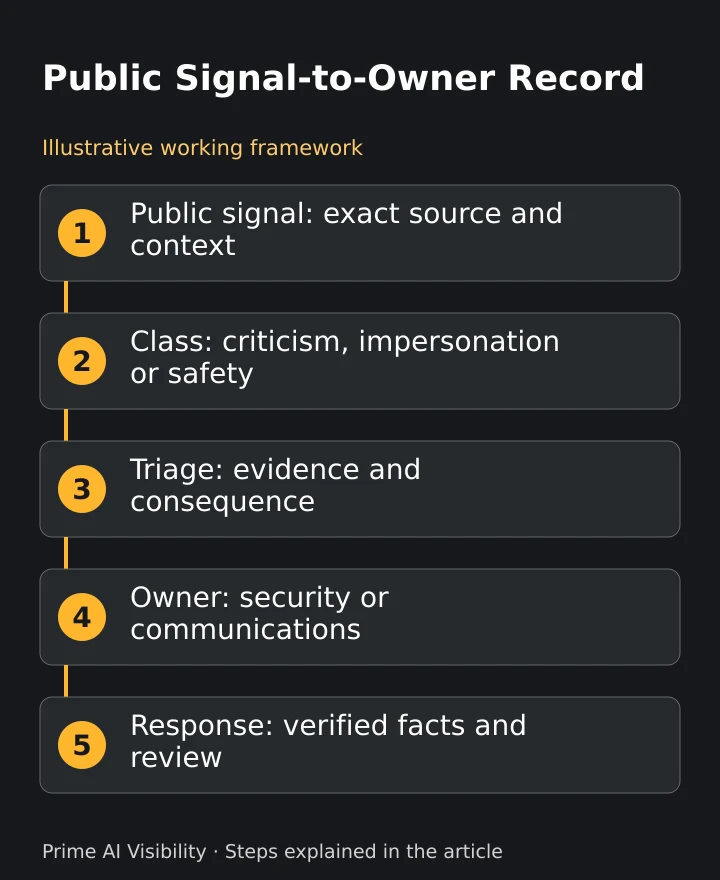
Social media threat monitoring for executives should turn a public post into a correctly owned response, not an automatic finding that somebody is dangerous. First classify the signal, retain its public source and send the factual question to the appropriate security or communications owner. Criticism, impersonation and a credible safety concern require different evidence and different decisions.
A rigorous triage framework enables risk, communications, and security teams to evaluate raw public signals systematically. By establishing explicit boundaries between physical security escalations, public brand communications, and synthetic discovery platforms, organizations protect both their personnel and their institutional credibility without amplifying toxic actors or wasting operational resources.
Social media threat monitoring for executives: three different decisions
Operating an effective monitoring posture requires segmenting every inbound post or profile into one of three operational classes. Conflating these categories damages response efficacy: treating sharp executive criticism as a physical security emergency floods corporate security teams with irrelevant social chatter, while treating persistent account cloning as mere negative sentiment leaves customers and employees vulnerable to credential theft or wire fraud.
1. Reputational Criticism
Reputational criticism encompasses negative opinions, aggressive disagreement with strategic corporate decisions, pushback against policy changes, parody, union disputes, or harsh reviews of executive speech. Even when hostile or profane, criticism remains protected discourse on most major social networks unless it violates terms against targeted harassment or severe defamation.
Reputational friction is managed through corporate public relations, employee relations, and deliberate narrative monitoring. It does not warrant close physical protection workflows, operational counter-surveillance, or emergency response playbooks. Treating high exposure or intense negative sentiment as synonymous with physical vulnerability introduces institutional blind spots and exhausts triage personnel.
2. Impersonation
Impersonation involves unauthorized accounts mimicking an executive's profile, likeness, name, or institutional role. Common variations include:
- VIP executive impersonation targeting retail investors with fraudulent investment advice.
- Executive cloning targeting internal staff or external vendors via direct messaging to authorize fraudulent payment processing or reveal corporate login credentials.
- Counterfeit job-recruiter profiles operating in an executive’s name to harvest applicant Social Security numbers and bank routing details.
According to enterprise threat intelligence firm ZeroFox, specialized executive social monitoring involves active alerting across surface platforms, deep web communities, and mobile app stores to identify executive-targeted credential phishing, rogue mobile apps, and unauthorized corporate brand likeness. Their documented workflows illustrate how organizations pursue direct profile disruption, account take-down filings, and domain takedowns rather than treating impersonation as conventional corporate PR work.
3. Credible Safety Concerns
Credible safety concerns involve direct, indirect, or veiled expressions of intent to inflict physical injury, harm family members, conduct physical stalking, or disrupt executive travel and personal residences. Indicators include:
- Specific dates, times, travel itineraries, or addresses associated with executive movements.
- Visual imagery depicting executive residences, children's schools, private vehicle license plates, or interior corporate floorplans.
- Language expressing concrete intent, acquired operational capability, or detailed planning rather than generalized, emotional venting.
Any signal meeting these thresholds must bypass marketing, communications, and digital teams entirely. It belongs strictly within an organization’s documented corporate security or emergency response process, potentially involving physical security personnel, local law enforcement, or private investigation specialists.
Reputational Criticism
- Defining Characteristics: Policy pushback, caustic opinions, executive parody, negative press feedback.
- Operational Owner: Corporate Communications / PR
- Escalation Action: Evaluate earned PR positioning; coordinate with digital PR services (commercial relationship: Percepture is the parent agency of Prime AI Visibility).
Impersonation
- Defining Characteristics: Fake VIP profiles, fraudulent DMs to staff, artificial investment schemes using executive likeness.
- Operational Owner: Security Operations / Threat Intel
- Escalation Action: Submit abuse takedowns to platform hosts; issue internal employee alerts; file domain or brand registry disputes.
Safety Concern
- Defining Characteristics: Stalking, weapons display, home address exposure (doxxing), explicit travel interception planning.
- Operational Owner: Corporate Security / Emergency Response
- Escalation Action: Initiate emergency protection protocols, secure physical perimeter, preserve digital chain of custody, contact law enforcement.
Choosing the Tool Stack: Social Listening vs. Security Intelligence vs. AI Visibility
Organizations frequently misallocate tooling budgets by assuming a single enterprise platform can track brand mentions, defend against digital fraud, and analyze downstream AI engine representation. In practice, modern threat posture demands three distinctly bounded technologies.
Social Listening Platforms
Social listening platforms (such as Brand24, Talkwalker, or Sprout Social) aggregate high-volume public social chatter across networks like X (formerly Twitter), LinkedIn, Reddit, and YouTube. These platforms measure keyword volume, historical reach, brand sentiment, and conversational themes.
Strengths: Capturing broad audience sentiment swings, identifying trending topics, measuring press release reaction.
Limitations: Social listening tools lack security context. They do not monitor criminal infrastructure, dark-web threat feeds, newly registered lookalike domains, or closed direct-messaging channels, and they produce overwhelming noise when tuned to common executive names.
Security Threat Intelligence Systems
Security intelligence platforms monitor malicious infrastructure, deep-web forums, paste sites, illicit messaging channels (such as specific public Telegram channels), and domain registration feeds. Systems such as ZeroFox, Recorded Future, and Mandiant scan for compromised executive credentials, stolen identity artifacts, counterfeit domains, and coordinated executive-targeted harassment campaigns.
Strengths: Rapid detection of account takeovers, unauthorized executive profiles, and direct digital fraud; direct operational paths to initiate abuse enforcement and takedowns.
Limitations: These tools are not intended to manage public corporate communications, analyze conversational organic PR reach, or audit synthetic answers generated by artificial intelligence tools.
Generative AI Visibility Trackers
When a corporate controversy, social media pile-on, or executive safety scare occurs, public social posts do not remain isolated. Large-scale language engines digest real-time social dynamics, secondary press write-ups, and blog discussions, rapidly resurfacing those claims when business-to-business buyers or investors query generative assistants.
A dedicated AI Visibility Platform serves this exact handoff. Prime AI Visibility saves generated answers to plan-supported buyer questions with displayed sources and links across ChatGPT, Claude, Perplexity, Gemini, and a Google-grounded AI Overview-style preview (which reflects experimental retrieval rather than live captured Google AI Overviews or AI Mode).
By using an AI visibility checker, communications teams observe how executive disputes, corporate restructuring announcements, or executive profiling reshape generative search answers over time. To ensure governance across sensitive corporate data, organizations evaluate GEO platform security and privacy standards to ensure prompt audits do not inadvertently leak private corporate indicators.
Building a Public Signal Register
Monitoring executive threats without a centralized register produces conflicting responses, duplicate tickets, and lost evidence. A bounded public signal register acts as an immutable intake log where cross-functional operators record every suspicious or escalatory item without injecting speculation.
Signal Extraction and Handling Principles
When logging entries into the register, operators must enforce strict operational constraints:
- Never reproduce doxxed executive information: If an offensive social post contains an executive's home address, private phone number, or child's school location, log the platform URL, capture a locally secured screenshot for evidence retention, and redact the specific private records from general communications view.
- Never speculate on perpetrator psychology: Log verifiable facts rather than subjective interpretations. Note what was typed, what media was attached, and what account published it, avoiding clinical or legal assertions regarding perpetrator intent.
- Preserve evidentiary artifacts: Capture platform-assigned user identification numbers (UIDs), precise timestamps, and cryptographic hashes of captured media if legal action is anticipated. Relying solely on a live URL is unreliable, as malicious actors often delete posts once an attack achieves secondary circulation.
To establish operational cadence, teams should adapt procedures similar to those found in issues management vs. crisis management workflows, establishing clear thresholds for when an issue transitions from passive tracking to active intervention.
Public Signal-to-Owner Record Worksheet
The following operational worksheet provides cross-functional risk, legal, and public relations teams with a repeatable framework for triaging executive social signals.
Step-by-Step Instructions
- Record the Source: Ingest the exact public URL, publishing handle, and literal text or media context. Store high-resolution media captures in access-restricted storage.
- Assign Triage Classification: Categorize the signal strictly as Reputational Criticism, Impersonation, or Safety Concern.
- Score Evidence and Consequence: Evaluate evidence quality (Direct/Primary vs. Derivative/Speculative) and potential institutional impact (Low, Medium, High, or Imminent Physical Risk).
- Designate Single Accountable Owner: Route the record to one accountable department head (Corporate Security Lead or Strategic Communications Director). Shared ownership leads to operational paralysis.
- Establish Stopping/Escalation Conditions: Define the quantitative or qualitative threshold required to trigger escalation, file a platform abuse report, or close the ticket and cease monitoring.
Worksheet Table
| Field Name | Specification & Entry Guidelines | Fictional Reference Entry |
|---|---|---|
| Incident ID & Timestamp | Unique record string; ISO-8601 UTC timestamp. | SIG-20261102-084 | 2026-11-02 14:15 UTC |
| Observed URL & Platform | Full direct link; originating network or forum. | https://x.com/defend_tech_board/status/987123456 (Platform: X) |
| Observed Content & Artifact | Exact quote of text; note file type of attached media. Redact private data. | Post states: "CEO [Executive Name] sold stock right before our division layoffs. Time for workers to show up at his home on Elm Road and make him pay." (Image: Cropped public photo of executive outside headquarters). |
| Triage Classification | Criticism, Impersonation, or Safety Concern. | Safety Concern (Direct home targeting and harassment). |
| Evidence & Consequence Score | Evidence: Direct, Secondary, or Unverified. Consequence: Low, Medium, High, Critical. |
Evidence: Direct (Public post verifiable on platform API). Consequence: Critical (Doxxing threat targeting personal residence). |
| Accountable Owner | Designated single operational lead (Name + Title). | Marcus Vance, Director of Global Corporate Security. |
| Operational Intervention | Specific authorized action (Takedown, Internal Security, External Statement, Hold). | 1. Escalate to local regional law enforcement dispatch. 2. Activate residential physical patrol protocol. 3. Submit urgent terms-of-service violation ticket via platform emergency security channel. 4. Issue zero public corporate communications response. |
| Acceptance Condition | Criteria required to mark the current phase complete. | Confirmation of law enforcement contact, local residential perimeter verified secure, platform removes post. |
| Stopping / Escalation Rule | Specific boundary requiring handoff or closure. | Escalate to Executive Committee: If secondary accounts repost specific street addresses or weapon imagery. Cease Active Escalation: Once link is removed and 48-hour security assessment yields zero perimeter anomalies. |
Governance and Protocol Enforcement
- Accountable Owner: Corporate Security Lead controls Safety and Impersonation cases. Corporate Communications Lead controls Reputational Criticism cases.
- Acceptance Condition: Every ticket must show a validated platform link, an uncorrupted screenshot stored in restricted evidence storage, and an assigned impact severity rating before cross-department routing.
- Stopping/Escalation Rule: If an incident involves an immediate threat to life, bypass the standard register review queue and activate the organization's documented emergency response protocol immediately. Conversely, if a critical signal is classified as Reputational Criticism, close external security monitoring to avoid amplifying normal platform friction.
Five Common Operational Triage Mistakes
Deploying social monitoring workflows without rigorous guardrails frequently exacerbates the very problems leadership seeks to prevent. Avoid these five operational pitfalls:
1. Distributing Redacted Private Data Internally
When an executive is doxxed, well-meaning communications and threat analysts often copy and paste the raw social post—including residential addresses, personal phone numbers, or family photographs—into broad internal email distribution lists or cross-functional chat channels.
This compromises executive privacy further. Restrict raw evidentiary screenshots to credentialed corporate security staff, circulating only sanitised references and redacted URLs to broader leadership teams.
2. Amplifying Parody and Minor Criticism
Furious executives frequently demand that corporate communications issue formal rebuttals or legal cease-and-desist notices to parody accounts or small, hostile forum threads. Executing public statements against fringe online detractors invariably triggers the Streisand Effect, elevating obscure accounts into mainstream news stories.
Unless an account crosses into active impersonation (deceiving consumers or executing commercial fraud) or credible physical danger, public refutations generally do more damage than silence.
3. Relying on PR Social Listening Tools for Security Escalations
Marketing-tier social listening platforms rely on commercial platform search APIs that sample data, filter hostile terms automatically, or skip emerging anonymous message boards entirely.
Trusting a marketing tool to identify imminent physical threats or sophisticated lookalike domains introduces extreme institutional risk. Security operations require dedicated threat intelligence vendors with specialized data-ingestion capabilities.
4. Crossing Ethical and Legal Surveillance Boundaries
Monitoring public social media must never devolve into the unauthorized tracking, hacking, or surveillance of private citizens, employees, or legitimate union organizers.
Threat monitoring must remain bounded to public signals directly targeting corporate assets, physical workplaces, and executive personnel. Operating beyond these parameters creates severe regulatory liabilities, labor law violations, and devastating reputational blowback.
5. Ignoring Downstream Generative Search Ingestion
A reduction in social activity does not establish what a later answer will display. If answer monitoring is relevant, recheck the agreed public question under comparable conditions and retain the response and displayed links. Keep that observation separate from any assessment of a person's safety or an explanation of why an engine selected a source.
When these narratives gain traction, generative models display them in response to fundamental brand queries. Communications teams must extend their monitoring cadence beyond live social timelines by tracking synthetic discovery engines through platforms like an AI Brand Visibility Tool.
Response and Follow-Up: Fact Sheets, Takedowns, and AI Search Audits
When an incident requires an active response, organizations must execute a controlled, structured plan. Rushed public statements create lasting factual errors that persist across both traditional search indexes and generative platforms.
Deploying Factual Correction Infrastructure
If hostile or coordinated social posts disseminate demonstrable factual untruths about corporate operations (such as fabricated regulatory investigations, false layoffs, or fraudulent product recalls), avoid debating antagonists on social platforms.
Instead, publish a single, calm, authoritative statement on the company's verified corporate press room or investor relations portal. Ensure the publication features:
- Clear, non-combative factual statements refuting the rumor.
- Comprehensive dates, verified figures, and corporate contact details.
- Standardized semantic structures, schema markup, and accessible web standards to ensure search engine crawlers accurately parse the primary corporate position.
For teams managing complex enterprise digital footprints, partnering with established enterprise SEO services ensures official corrective materials are properly indexed across major search architectures rather than buried beneath third-party aggregators (commercial relationship: Percepture is the parent agency of Prime AI Visibility).
Executing Platform Takedowns and Enforcement
For clear-cut cases of executive impersonation or violent safety violations, utilize documented platform enforcement pathways:
- Trademark and Copyright Infringement: If counterfeit profiles use official corporate executive headshots, file rapid Digital Millennium Copyright Act (DMCA) notices with the platform host.
- Direct Impersonation Filings: Most enterprise social networks provide priority identity-verification channels for verified corporate brands to report executive clones attempting social engineering.
- Domain Registrar Takedowns: For lookalike domains used in executive-targeted phishing campaigns, submit abuse tickets directly to the upstream domain registrar and hosting network, citing phishing and fraud indicators.
Conducting Downstream Generative Search Audits
Following any high-velocity social crisis, enterprise communications teams should conduct audits using an AI Visibility Tool to observe how synthetic answers reflect the controversy. Models like ChatGPT, Claude, and Perplexity index and summarize real-time web materials.
According to Google's published documentation on search appearance and generative AI features, generative search results rely on web-based content retrieval and underlying ranking systems to extract, structure, and display contextual answers. When hostile social campaigns spawn coverage across digital news outlets and forums, these systems often surface those claims in executive background summaries.
Using Prime AI Visibility, analysts run structured queries such as:
- "What is the controversy surrounding [Company Name] leadership?"
- "Who is [Executive Name] and what recent corporate decisions have they made?"
- "Is [Company Name] undergoing regulatory investigations?"
By auditing these answers across ChatGPT, Claude, Perplexity, Gemini, and Google-grounded AI Overview previews, communications teams evaluate displayed citations and reference links. If synthetic answers cite outdated forum threads or debunked social posts, teams can build authoritative corporate reference materials that provide primary source facts for search engines.
To refine this tracking, review how to measure brand visibility in Claude and explore targeted tactics in our guide on how to fix negative brand sentiment in AI answers.
Establishing Review Cadence Without Amplification
A critical discipline in executive monitoring is knowing when to stop tracking. Constant surveillance of negative commentary generates analysis paralysis, strains team morale, and encourages counterproductive interventions.
The 72-Hour Sunsetting Rule
Unless a social signal involves an active physical investigation or an evolving impersonation campaign, social media commentary decays rapidly. Enforce a standard review timeline:
- 0 to 72 Hours: Active incident status. Log updates once daily. Hold brief cross-department check-ins between security and communications at 8:00 AM. Suppress erratic intraday alerts unless a new, severe threat indicator emerges.
- Day 4 to Day 14: Post-incident validation. Triage shifts entirely from active social monitoring to downstream search audits. Check whether search engines or generative tools have absorbed inaccurate claims.
- Beyond Day 14: Ticket closure. If no recurring impersonation or physical security red flags have surfaced, sunset the ticket. Move the record to inactive archives and return to passive monitoring.
Executive protection requires disciplined emotional boundaries. By distinguishing reputational criticism, corporate impersonation, and physical safety risks, modern enterprises protect their executive leadership, safeguard organizational integrity, and maintain control over their public narrative across traditional and generative search platforms.
Frequently asked questions
What is the difference between social listening and executive threat monitoring?
Social listening tracks public brand mentions, audience sentiment, conversational trends, and overall campaign reach across mainstream social media networks for marketing and public relations teams. Executive threat monitoring is a specialized risk and security process that identifies potential physical security concerns, direct doxxing, lookalike domains, credential leaks, and fraudulent impersonation accounts targeting corporate leadership across surface networks, deep-web forums, and specialized messaging channels.
When should social media criticism be escalated to corporate security?
Social media criticism should be escalated to corporate security only when it transitions from opinion or policy disagreement into identifiable physical threats, stalking behaviors, published travel schedules, private residential addresses, or explicit expressions of intent to cause bodily harm. Caustic, hostile, or profane comments targeting corporate performance, labor disputes, or executive compensation remain communications and public relations matters unless physical safety triggers are present.
How does executive impersonation impact business operations beyond reputation?
Executive impersonation presents operational risks including credential phishing attacks against staff, business email compromise schemes, fraudulent vendor invoicing, and unauthorized wire transfer requests executed via direct messaging. Furthermore, counterfeit executive profiles frequently target retail investors, job applicants, and prospective customers with fake employment opportunities or fraudulent financial schemes that undermine commercial operations and introduce significant legal and brand liabilities.
Can an organization force social media platforms to remove negative executive criticism?
Social media networks will not remove negative commentary or executive criticism simply because it is sharp, caustic, or professionally damaging, provided the material complies with local laws and the platform's terms of service regarding public discourse. Enforcement mechanisms such as account suspension and content removal are generally reserved for demonstrated terms-of-service violations, including verified identity impersonation, direct physical threats, targeted doxxing of private personal data, and copyright infringement.
Why should communications teams monitor generative AI search engines after an executive controversy?
Generative AI search engines and answer assistants actively crawl the open web, news roundups, and public discussion forums to compile synthetic answers to user queries about corporate brands and executive leadership. Once an executive controversy generates high-volume online commentary, models such as ChatGPT, Claude, and Perplexity may surface those unverified claims or negative summaries in response to standard buyer or investor inquiries, extending the operational lifespan of the incident long after social feeds move on.
References
- ZeroFox Executive Social Media Monitoring Solutions — Technical documentation on executive digital protection, impersonation alerts, and platform takedowns.
- Google Search Central: Overview of Generative AI Features in Search — Documentation covering search visibility, crawling, and AI-grounded answer rendering.
Next steps
When the verified signal concerns a workforce dispute, use the labor-status update record to distinguish negotiation, stoppage and agreement before drafting a response.
- Review platform capabilities and monitoring coverage across our core features matrix.
- Audit your current visibility metrics and citation capture rates against the standards in our metrics dictionary.
- Read our cross-functional guide on crisis management simulation exercises to stress-test institutional communications workflows.
- Learn how to evaluate conversational engine performance in monitoring competitor brand sentiment in generative AI answers.
- Protect your executive and brand positioning across major AI platforms: create a workspace with Prime AI Visibility today.
About the author
Bob Generale is President and Partner at Percepture and co-founder of Prime AI Visibility. This article explains the Public Signal-to-Owner Record using cited executive-protection sources. Its practical application is a proposed method: public signals are not a personal threat determination. Percepture and Prime AI Visibility are commercially connected.
Start with a question your buyer actually asks
Create a workspace to inspect saved answers and their displayed sources. Compare like-for-like questions after approved changes; answers are observations, not guaranteed citations or business outcomes.