
Crisis Management Simulation Exercises for Corporate Communications
Crisis management simulation exercises work best as a quarterly habit, not a one-off event. The guide to checking AI brand-claim accuracy supplies one of the inputs used in the exercise below. Crisis management simulation exercises are controlled rehearsals in which a team responds to fictional developments, so that observers can evaluate decisions, coordination and the plan improvements the team needs.
This guide is for a corporate communications lead, an operational incident owner and an executive sponsor who want to rehearse before a real incident. It covers a quarterly cadence, two kinds of tabletop, a crisis book prepared before anything happens, a controller worksheet, a roles template and a surprise-drill checklist. It does not claim that any drill was run, and every example is fictional.
"A rehearsal should leave you with decisions you can inspect and changes someone owns." Bob Generale, editorial commentary
In this guide:
- Run crisis management simulation exercises every quarter
- Write the crisis book before the incident
- Choose the decision to rehearse
- Use two tabletop types
- Choose tabletop, functional or dynamic simulation
- Build the controller packet and its injects
- Record what the team knew when it acted
- Add a bounded AI-answer accuracy check
- Plan the quarter with a roles template
- Use a safe surprise-drill checklist
- Turn the debrief into an improvement record
Run crisis management simulation exercises every quarter
A single large exercise once a year tests a team on a day it happened to be ready. A quarterly cadence tests the plan as people, vendors and systems change. Each quarter has one objective, one scenario and one improvement list that carries into the next.
A workable quarter has four parts:
- Plan. Choose one objective, one scenario, the participants and the observers.
- Rehearse. Run the exercise, announced or unannounced, inside agreed limits.
- Debrief. Compare what the team did with the stated criteria, while the details are fresh.
- Improve and retest. Assign real owners and due dates, then retest the gap in the next quarter.
The structure follows the exercise lifecycle described by the Texas Division of Emergency Management, which explains objective-led design, observation and after-action improvement planning. This article adapts that logic to corporate communications. It does not claim FEMA certification, and it does not state that a particular cadence is required for your organization.
Keep the scope small enough to finish. A team that tests one decision well each quarter learns more than a team that stages a dramatic scenario it cannot debrief.
Write the crisis book before the incident
The crisis book is the set of documents the team needs open during an incident. It must exist before the exercise, because an exercise that begins by inventing the plan tests improvisation, not the plan. Rehearsal then shows which pages of the book people actually use.
A useful crisis book holds:
- Call tree and backup. Who is called, in what order, and who steps in when the first person is unreachable.
- Approval authorities. Who in legal, the chief executive's office and communications can approve a public statement, and who can approve it when they are absent.
- Operational response. What the site and operations team does offline and online, and who reports confirmed facts.
- Spokesperson. The named person and a backup. Preparing them for the media is a separate job, so this book only records who it is.
- Holding statements. Short drafts with blanks for confirmed facts, each marked as unapproved until a named approver signs it.
- Verified facts and update timestamps. A single fact sheet where every line has a source and the time it was last confirmed.
- FAQ scripts. Approved answers to the questions people are likely to ask, in plain language.
- Owned site notices. The page, banner or status location where an official notice goes, and who can publish to it.
- Search and AI-answer checks. The public questions the team will look at, and where it saves what it sees.
- Social monitoring and rumor triage. Who watches which channels and how a claim is sorted into confirmed, contradicted or unknown.
- Accessibility. How a notice reaches readers who use assistive technology, and how alternative formats are produced.
- Escalations. The trigger for moving from routine handling to a full incident.
- Postmortem. Who runs the review, by what date, and where the findings are kept.
For the escalation and signal-assessment decisions in the book, use the existing guide to issues management and crisis management. That guide owns how a signal is assessed and escalated. This one owns how you design and evaluate a rehearsal of it.
Proactive evidence alignment belongs in the book too. Bob Generale's "Controlling the Narrative" idea is about this kind of preparation: keep your public facts accurate, current and easy to find before anyone needs them. It is not manipulation of what people see, and it is not a way to suppress accurate criticism.
Choose the decision to rehearse
Start with a decision, not a scenario. State the business impact, the audience and the person who owns the decision. A good objective can be observed. "Verify a public claim before issuing a holding statement" can be watched. "Be crisis-ready" cannot.
Name the roles:
- Sponsor, the executive who wants the result and can fund the fixes.
- Controller, who runs the exercise clock and releases injects.
- Participants, who respond as they would in a real event.
- Independent observers, who record what happened and do not coach.
Use real questions to pick the decision. The guide to prompt intent explains how to separate what a person asks from what they are trying to decide, which helps you choose a scenario that matches a real audience instead of an invented one.
Use two tabletop types
A tabletop is a discussion-based exercise in which participants talk through their response to a described situation. Use two types, and use them for different purposes.
The pre-announced rehearsal. Everyone knows the date, the topic area and that it is an exercise. This type suits new teams, new plans and new people. It tests whether the book is usable and whether roles are clear. Participants can prepare, so it shows what the team does at its best.
The surprise or unannounced drill. The team knows drills occur this quarter, but not when or what. This type tests whether people can find and use the book under mild pressure. It shows more about ordinary readiness, and it carries more risk, so it needs boundaries.
Safe boundaries for the surprise type:
- A small group, such as the controller, the sponsor and a legal contact, knows the date.
- Every message carries an unmistakable exercise label, so nobody posts, calls or alerts a real customer, regulator or journalist.
- No real customer data, live emergency number or public channel is used.
- Anyone may call an immediate stop, and the stop word is agreed in advance.
- People are told afterward and are never penalized for treating the event cautiously.
- Training and disclosure come first. Staff should know that drills happen, why, and that the purpose is to improve the plan, not to catch individuals out.
Begin with the announced type. Add the surprise type once the book has survived one or two announced runs.
Choose tabletop, functional or dynamic simulation
The three common levels differ in what they can show and what they cannot prove.
- Tabletop. A facilitated discussion. It shows whether the plan is understood and who thinks they decide what. It does not show whether anyone can actually publish a notice at speed.
- Functional exercise. Participants perform real tasks, such as posting a draft notice to a test environment or calling the backup contact, usually in an isolated setup. It shows whether the task can be done. It does not show how the whole organization copes with a long, confusing event.
- Dynamic simulation. A changing scenario with timed developments and simulated channels. It shows how coordination holds as facts shift. It takes the most preparation, and a realistic feed is not itself a good result.
Vendors describe these formats in different ways. For example, Oakwood Risk Group describes a "crisis room" with simulated channels, an exercise clock and a shared decision log in an isolated environment. That description is one provider's offering, not a measured result, and this article does not reproduce its claims as benefits.
Match the level to readiness. A team without a crisis book should not start with a dynamic simulation. Begin with a tabletop, add one functional task when the book is stable, and move to a dynamic scenario only when you have the people to observe it.
Build the controller packet and its injects
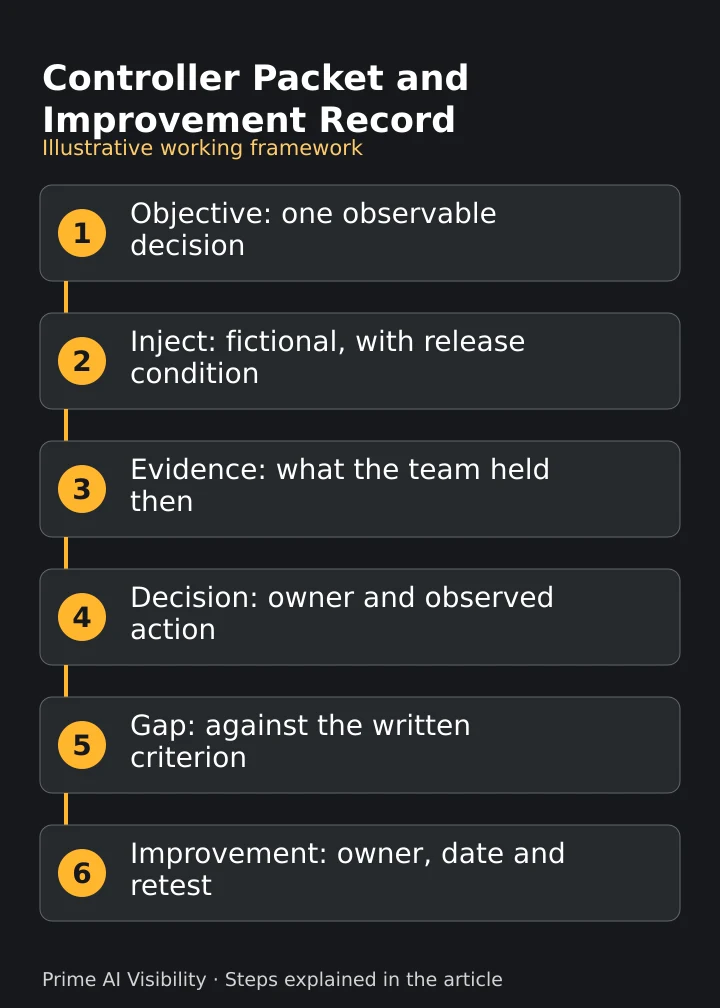
The controller packet is the sheet that makes an exercise inspectable. It records the objective, each fictional input, what evidence the team had at that moment, who decided, what they did and what changed afterward.
An inject is a piece of simulated information released to the participants at a set time. Use three, each clearly labeled as invented:
- A rumor. A post claims that a company's service is down everywhere.
- An operational confirmation. An internal note states which part of the service is actually affected.
- A misleading public AI answer. A saved assistant answer repeats the broad claim and cites a stale page.
For each inject, specify the release condition, the information supplied, the decision you expect and what the observer should record.
Rules for every inject:
- Use no real customer identity, live phone number or public posting.
- Keep every document labeled as an exercise.
- Write the observation criterion before the exercise so the result is judged against something fixed.
The worksheet below is a blank you can copy. The last row of the page shows one illustrative entry. It is a proposed application, not a validated scoring model, a completed client engagement or a proprietary study.
| Packet field | What to enter | Illustrative entry |
|---|---|---|
| Objective | One observable decision | Verify the scope of an outage claim before a holding statement is approved |
| Fictional inject and release condition | The invented input and when the controller releases it | At fictional minute 10, a screenshot claims every site is offline |
| Evidence available | What the team actually held at that moment | An approved operations note confirms one region only |
| Decision owner | The role that decides, plus a backup | Communications owner, with the operations lead as backup |
| Observed action and time | What happened and the clock time, entered by the observer | Left blank until the exercise is run |
| Evaluation criterion | The standard written before the exercise | The update states the confirmed region and names the scope as unknown |
| Gap | The difference between the criterion and the action | Left blank until the debrief |
| Improvement owner and due date | A real person and a real date | Assigned at the debrief |
| Retest evidence | What would show the fix works next quarter | The same inject, a new observer, the same criterion |
In the example, the communications owner drafts a narrowly factual update, records the unknown scope and assigns an operations verification. The observer notes whether the distinction between "one region confirmed" and "everywhere" survived the approval step. The table contains no claimed response time and no client result. Unknown observations stay blank, and nobody fills them with plausible numbers.
Fill the worksheet in before the exercise, apart from the observed-action, gap and owner fields. That order keeps the criterion from bending to fit what happened.
Record what the team knew when it acted
The most useful column in the packet is the one that records the evidence available at the moment of each decision. The evaluator logs the time, the source, the level of uncertainty, who held decision rights, the action taken and the stated reason.
This changes how you judge a response:
- A slow response may reflect necessary verification.
- A fast response built on an unsupported assertion is not a success.
- A response that matches the facts that were available at the time is the right comparison, even if later facts differ.
Keep exercise behavior separate from a forecast. How a team performed in one rehearsal does not predict how it will perform in a real incident, and the log should never be presented as if it did.
Use a short vocabulary for every claim in the log: confirmed, contradicted or unknown. The same vocabulary appears in the claim-to-recheck method described in the guide to checking AI brand-claim accuracy, where each statement is copied exactly and paired with a source and a recheck date.
Add a bounded AI-answer accuracy check
People ask assistants about companies in trouble. One bounded inject can therefore simulate that channel: a saved answer, a list of the links it displayed and an approved fact sheet to compare it with.
Keep the check small:
- Use approved public facts as the reference.
- Use saved answer evidence, with the question, the date and the links shown, instead of memory.
- Ask the team to sort each claim in the saved answer into confirmed, contradicted or unknown.
- Ask who would correct the source, and what they would change.
Prime AI Visibility can help with the evidence part of this check. The Prime AI Visibility features save answers and their displayed source links for selected buyer questions, and the way Prime AI Visibility works is a repeatable question-to-evidence workflow, so a later check can use the same wording. For a baseline method before the exercise, the guide to running an AI visibility audit shows how to save answers under a versioned scope.
It is important to be clear about what this is not. Prime AI Visibility is not incident command, threat detection, a live emergency feed or an alerting guarantee. It saves what selected answers displayed on a date. It does not tell you why an answer said something, and the Google option is an AI Overview-style preview built from Google-grounded answers. It is not a capture of the live Google AI Overview.
Be careful with the units you record. The AI visibility metric definitions separate a brand named, a website cited, source links and an explicit recommendation, so a log does not merge them into one number.
Compare how a public narrative shifts
To rehearse misinformation, write a fictional brand and a short fictional timeline, then save an invented answer at each stage:
- Before the rumor. The saved answer matches the approved fact sheet.
- After the rumor. The invented answer repeats the broad claim and cites a stale page.
- After the owned notice. A later invented answer reflects the dated notice and the narrow scope.
Ask the team what moved the narrative, what it could change, and what it could not. The team can update its own notice, correct its own pages and ask a third party to fix a source. It cannot make an assistant say something. Where the narrative depends on outside sources, earned media and AI citations explains why developing credible sources is different from any promise that an answer will include them.
Percepture's Digital PR services are the related human-led service for working with credible third-party sources, and no coverage is guaranteed. Percepture and Prime AI Visibility are commercially connected, so treat that mention as an affiliated option, not an independent ranking.
Plan the quarter with a roles template
Use a single planning sheet for each quarter. It names the people and the dates, so the exercise does not depend on someone's memory.
| Planning field | What to enter | Illustrative first quarter |
|---|---|---|
| Quarter and type | Announced rehearsal or surprise drill | Q1, announced tabletop |
| Objective | One observable decision | Verify the scope of a claim before a statement |
| Sponsor | The executive who accepts the findings | Chief operating officer |
| Controller and backup | Who runs the clock and releases injects | Communications manager, with an operations analyst as backup |
| Participants | The roles that respond | Communications, operations, legal contact, site owner |
| Independent observers | People who record and do not coach | Two staff from outside the response team |
| Exercise window and debrief date | When it runs and when it is reviewed | Set by the controller |
| Crisis book version | The version in use, with its date | Version one, dated |
| Carry-over actions | Open items from the last quarter | None in the first quarter |
For the session length, choose it from the objectives, the participants' availability and the time the debrief needs. There is no single correct duration.
Hand-offs matter. When an exercise shows that a notice needs to be written, the AI SEO content production workflow describes how a sourced brief moves into reviewed work. When it shows that a follow-up needs an owner, the guide to AI evidence in content and CRM workflows explains a human handoff without assuming any integration exists. Your reviewers decide what is published.
Use a safe surprise-drill checklist
Use this checklist before any unannounced drill. If any answer is no, convert the drill to an announced rehearsal.
- Disclosure. Staff have been told that unannounced drills occur, why, and that the aim is to improve the plan.
- Knowledge. Only a small named group knows the date and the scenario.
- Labeling. Every message, document and post carries a clear exercise label.
- Containment. The drill runs inside an isolated channel or a test environment, with no public posting.
- No real data. No customer identity, personal data or live emergency number appears.
- Stop word. Anyone can end the drill at once, and the word is agreed.
- Real incident override. A real event takes priority over the drill, and the controller can cancel it.
- Tone. The scenario tests coordination and evidence handling, not theatrical pressure.
- Debrief. The team meets soon after, with a written record and no blame.
- Follow-up. Each gap has a named owner and a date before the room is cleared.
A drill that rewards speed alone teaches the wrong habit. The better aim is a team that can say what it knows, what it does not and who will find out.
Turn the debrief into an improvement record
The debrief turns observations into changes. For each packet row, compare the observed decision with the criterion you wrote beforehand. Record the gap in plain words, assign a real owner and a due date, and state what evidence would show the fix works.
Questions for the debrief:
- Did the team use the crisis book, and which page did they open first?
- What did people know when they decided, and what did they assume?
- Did the update separate confirmed facts from unknowns?
- Which approval step slowed or protected the response, and was the delay necessary?
- Which fix can be made this quarter, and which needs longer?
Keep the improvements bounded. A list of twenty actions usually produces none. Pick the few that address the stated objective, and carry the rest forward.
To judge success, judge the specified decisions, the handling of evidence, the coordination and the corrective actions that were completed, against agreed criteria. A generic score or a stopwatch reading is not enough. Do not report invented scores, and do not claim an exercise took place unless it did.
For retest evidence, run the same inject next quarter with a different observer, and compare what the team did against the same criterion. To compare saved answers over time, keep the wording, the date and the settings the same, as covered in historical AI-search data platforms. That guide owns the comparison of platforms, and this article does not repeat it.
Where outside help fits
Some teams run exercises themselves, and others bring in a facilitator. Both can work. Check what a provider supplies, what artifact comes out and what is excluded, and treat published vendor descriptions as descriptions, not outcomes.
If you want a human-led option for public relations and communications, Percepture is an integrated B2B marketing and PR agency affiliated with Prime AI Visibility. For public discovery and source correction after an exercise exposes a gap, Percepture offers generative engine optimization services. To hire a facilitator for an in-person exercise, the guide to hiring a crisis planning and tabletop firm covers procurement, which this article does not. When you evaluate search or answer-visibility specialists, Best AI SEO experts in the world is an editorial comparison of practitioners, not proof of universal superiority.
Frequently asked questions
How long should a simulation take?
Choose the length and complexity from the objectives, the participants' availability and the time the debrief needs. There is no universal session length.
Should we use real customer data?
No. Use fictional or approved public material and an isolated exercise environment. Realistic decisions do not require confidential identities.
How do we judge success?
Judge the specified decisions, evidence handling, coordination and completed corrective actions against agreed criteria, not a generic score or speed alone.
How often should we run an exercise?
A quarterly cadence gives the plan regular testing as people and systems change. Choose a rhythm your team can sustain and debrief.
Is an unannounced drill safe?
It can be, with disclosure, labeling, containment, no real data and a stop word. Start with announced rehearsals and add surprise drills later.
Can software run the exercise?
Software can save answers and their displayed sources as one simulated channel. It does not command an incident, detect a threat or guarantee an alert.
Next steps
- Choose one objective. Pick one decision to rehearse this quarter and name the sponsor, the controller and the observers.
- Open the crisis book. List which of the thirteen items exist today, and assign an owner to each missing one before you stage anything.
- Bring a public question. Take one public issue question and an approved fact sheet to Prime AI Visibility, save the answer with its sources and agree who corrects a gap.
References
- Texas Division of Emergency Management, Exercise program, a public description of the exercise lifecycle and after-action improvement planning.
- Oakwood Risk Group, Crisis Room, one provider's description of simulated channels, an exercise clock and a shared decision log.
Save the answer, then set the next objective
Create a workspace to save answers for the same public questions and compare them after your approved changes. Coverage, cadence and credits depend on the plan, and paid plans add Gemini and an AI Overview-style preview built from Google-grounded answers. It is not an alerting service.