
Issues Management vs. Crisis Management: Preventing a PR Crisis
Issues management and crisis management differ by verified impact, not by a fixed ladder, so every concern needs an evidence check and an accountable owner. A team can save what public AI answers say about the concern in Prime AI Visibility as one piece of that evidence. Issues management tracks and addresses developing concerns; crisis management coordinates action and communication when an event creates urgent operational or stakeholder harm.
This guide is for executives, communications leaders and operational owners who manage emerging concerns. It gives one reusable working record, the Signal-to-Review Decision Record, with a filled illustrative example. It is a communications and decision guide. It does not give legal, safety or regulatory advice, and it does not promise any reputational outcome.
In this guide:
- Define issue, risk and crisis without assuming a neat ladder
- Separate a signal from a verified fact
- Assess impact and assign an operational owner
- Use the escalation decision record
- Coordinate action and public updates
- Review and correct misinformation, including sampled AI answers
- Learn from the response and maintain readiness
Issues management and crisis management: the short answer
- Treat every report as a signal first. A post, a call or an alert says something may be happening. It does not yet say that it is.
- Verify with the people who hold the facts. Operations, legal, finance or the service owner confirms or corrects the signal, and the record notes who and when.
- Judge impact on people and operations. Ask who is affected, how seriously and how soon. Tone and volume of online comment are a different question from harm.
- Name one accountable owner and one next update. A group is not an owner, and "monitoring" is not an action.
- Act on verified risk without waiting for coverage. Where safety is involved, follow the existing response procedure at once. Never wait for the media, a regulator or a complaint count before acting.
- Review what the public record says, then learn. Check your own pages and sampled AI answers for outdated or wrong statements, correct the source, and record what the response taught you.
Define issue, risk and crisis without assuming a neat ladder
Textbooks often draw a ladder: a risk becomes an issue, and an issue becomes a crisis. Real events do not climb that tidily. A data error discovered by a customer can arrive as a crisis with no warning, and a loud online argument can fade without any operational consequence.
Percepture's adjacent guide, issues management versus crisis management, covers the conceptual comparison in depth, and it is worth reading for the full definitions. This guide takes the next step: a record a team can fill in when a specific signal arrives.
Working definitions help keep conversations short:
- A risk is something that could go wrong and has not yet.
- An issue is a developing concern that is already visible to someone and may affect the organization or its stakeholders if it grows or is left alone.
- A crisis is an event that creates urgent operational or stakeholder harm and needs coordinated action and communication now.
| Question | Issue | Crisis |
|---|---|---|
| Main job | Track, assess and address a developing concern | Coordinate action and communication under pressure |
| Typical pace | Days or weeks, with scheduled reviews | Hours, with frequent stated update times |
| Lead owner | The function closest to the concern | A named incident owner with leadership support |
| Success looks like | A decision made early, with the concern resolved or closed | Harm contained, people informed, facts kept accurate |
Illustrative comparison, not a standard or a measured result.
The difference is a matter of impact and context. The same allegation could be an issue for a small non-critical service and a crisis for an operator whose users depend on it for safety. That is why the record below begins with who is affected, not with how the item is labelled.
Separate a signal from a verified fact
A signal is anything that suggests a concern: a social post, an email from a customer, a press enquiry, a dip in a metric, a comment from a frontline worker. Harvard's Belfer Center has examined how frontline workers are often the first to notice problems, which is a good reason to treat their reports as signals worth routing, not as noise.
A verified fact is a statement a responsible person has confirmed against a primary record, such as a system log, a contract or a signed report. The step between the two is verification, and it is where most avoidable mistakes happen.
For each stage in this guide, record five things: the input, the reviewer or owner, the evidence or source, the output and the known exception. For verification:
- Input: the signal, copied as it appeared, with its date and where it came from.
- Reviewer: the person with access to the primary record, not the person who received the signal.
- Evidence: the log, report or document that confirms or contradicts it.
- Output: one of three statuses: confirmed, contradicted or unknown.
- Exception: if safety might be at risk, begin the response before verification finishes.
The status words matter. "Unknown" is a legitimate answer, and it is more useful than an optimistic guess. An unknown that has an owner and a time attached to it is a task. An unknown nobody owns becomes a rumour.
Why sentiment alone is not enough
Many monitoring dashboards report sentiment: positive, neutral or negative. That figure can show a mood. It cannot show whether the underlying claim is true, who is affected or what should happen next. A burst of negative comment about a claim that is false calls for a correction. A quiet report that is true and affects a few vulnerable users may call for urgent action. Classify the fact and the impact separately, and treat sentiment as one input to the decision.
Assess impact and assign an operational owner
Once a signal is verified or provisionally credible, the next question is who is affected and how. Impact is judged on people and operations, not on headlines.
Ask five questions in this order:
- Who is affected? Users, employees, patients, customers, suppliers, regulators or the public.
- How are they affected? Safety, access to a service, money, personal data, reputation or convenience.
- How soon? Already happening, likely within hours, or possible later.
- Can it be contained by the team closest to it? If yes, the issue process may be enough. If no, escalate.
- Does anyone outside the organization need to know? Customers, regulators, partners or the public may have notice expectations that legal counsel should confirm.
Then name the owner. The accountable owner is the person who decides what happens next and can be asked for an update. Communications supports the owner by preparing and clearing the words, and it does not usually hold the operational facts. This is also the right moment to mark who reviews any statement that touches law, health or safety.
The distinction matters when AI tools draft anything. Summaries or drafts produced by software do not establish the truth of technical, risk or commercial claims. Human review of AI-assisted content stays with the person who can check the primary record, and the same rule applies to every sentence in a holding statement.
Use the escalation decision record
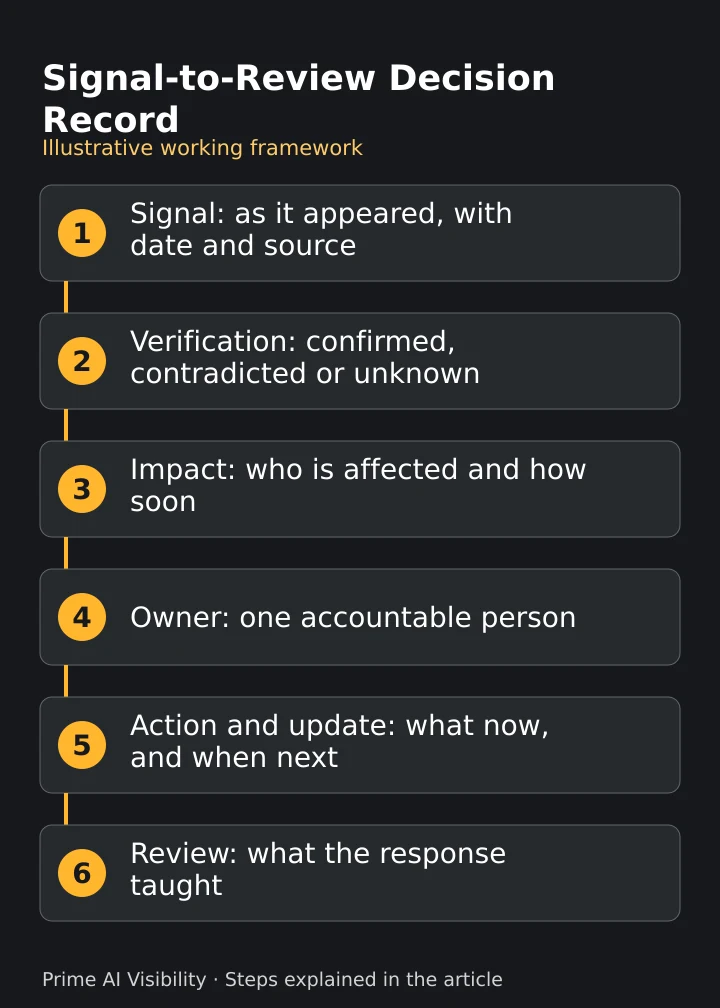
The Signal-to-Review Decision Record is an editorial application, not a tested proprietary product or a customer result. It turns one signal into a reviewed decision and a named follow-up. Its sequence is Signal, Verification, Impact, Owner, Action and update, then Review.
The illustrative framework at the top of this page shows the same six steps, created by the Prime AI editorial team. It is not a product screenshot or a client result.
The worked example below is invented to show how the record is filled in. It describes no real organization, client or outcome.
Imagine a service outage. A social post alleges that an online service has stopped working for its users. The post is a signal. Operational confirmation changes the decision. The record captures what is known, what is unknown, who verifies it and when the next update is due.
| Field | Illustrative entry | Who completes it |
|---|---|---|
| Signal | Outage allegation in a public post | Whoever received it |
| Verified or unknown | Unverified until operations confirms | Operations |
| Affected operation and people | Service users | Incident owner |
| Confidence and source | Operations status record | Operations |
| Accountable owner | Incident owner | Leadership |
| Action now | Verify, then follow the existing response procedure | Incident owner |
| Next update | Time assigned by the owner | Incident owner |
| Learning | Review after resolution; outcome unknown until then | Review lead |
Illustrative decision record, not a comparative test result. The outcome stays unknown because no event has been observed.
Three habits make the record useful. First, every cell has a person or a source behind it, so the page cannot be filled in with hope. Second, the "unknown" entries are visible, which keeps leaders from reading a half-finished record as a finished one. Third, the next update has a time, even when the update is that nothing has changed.
Bob Generale, who wrote this guide, puts the principle plainly:
"Monitoring should lead to a decision, an owner and a useful next step." — Bob Generale
Where a safety concern is involved, do not hold the response until the record is complete. Start the existing procedure first and fill in the record alongside it.
Coordinate action and public updates
An issue and a crisis both end with people being told something useful, but the pace differs. During an issue, a scheduled review and a drafted position may be enough. During a crisis, the owner needs a short cycle: confirm, decide, communicate, repeat.
For every public update, write down the same five things as before. The input is what has been confirmed. The reviewer is whoever cleared it. The source is the record behind each statement. The output is the message and its channel. The exception is any statement that cannot be made yet and the reason it is being held.
Keep updates plain and specific:
- State what is confirmed and what is still being checked.
- Say who is affected and what they should do now.
- Give the time of the next update, and keep that promise even when the news is that nothing has changed.
- Provide a route for individual questions to a person with authority to answer them.
Give each audience its own answer. Employees, customers, partners and the public ask different questions and depend on different facts. Communications can prepare the words for each, but operations and legal confirm what is true and what is permitted.
Where the matter touches regulated information, safety notices or contractual notice periods, involve counsel before any release. Counsel's role is to confirm what must be said and what must not be said, and the decision record should show that review took place.
Keep owned pages and earned coverage consistent
Public pages, profiles and press materials are part of the response, because people and software read them. Digital PR services can help distribute accurate information through credible third parties, and earned coverage complements accurate owned pages. It does not replace them, and it carries no promise that coverage will be cited or will affect any ranking.
Review and correct misinformation, including sampled AI answers
Some claims keep circulating after the facts change. Search results, summaries and AI answers can repeat an outdated statement. A review step catches this by comparing what the public record says with what you now know to be true.
Sampled AI answers are one place to look. A saved answer shows what an assistant displayed for one question at one time, with the links it listed. It can reveal a wrong or stale statement worth correcting. It does not show why the answer appeared, how many people saw it or whether anyone acted on it.
Choose the questions
Pick a small, stable set of public questions that your audience would ask about the concern, written in their words. Matching a monitoring job to a real business question is the hard part, and the use cases for saved-answer evidence show what kinds of questions the software is designed to hold. Keep the same wording on each check so the answers are comparable.
Save the evidence
The AI search visibility monitoring features in Prime AI Visibility save selected answers and the links displayed beside them across the supported AI tools. The free check covers ChatGPT, Claude and Perplexity with five questions and up to 15 returned answers once a month. Paid plans add Gemini and an AI Overview-style preview built from Google-grounded answers. That preview is not a capture of the live Google AI Overview, and it should be described that way in any report.
Recheck with a repeatable process
A second look is only useful if it matches the first. The question-selection and recheck process separates choosing the questions, observing the answers and reviewing them as a person. Record the date, the tool, the exact wording and the displayed links, and have a person classify each answer as accurate, outdated, wrong or unsupported against an approved fact.
Label the sample honestly: how many questions, which tools, which date and what was not checked. Quality checks for AI evidence cover sample size, repeatability limits and missing data. A small sample is a prompt for review, not a measurement of everything people see.
Fix the source, not the symptom
If an answer is wrong because a page is outdated, correct the page. Google documents that appearing in its AI features requires a page to be indexed and eligible to be shown with a snippet, with no additional technical requirements and no special markup for AI features. That means the practical route to a better answer runs through accurate, accessible pages and credible corroboration. It carries no guarantee of inclusion or change.
When a claim is wrong on a third-party page, ask the owner of that page for a correction, and record the request and its date. Report factual errors to the AI tool through its feedback route, and treat any response as unconfirmed until a later check shows a change.
Measure the right things
Keep four records apart: the saved answers, the sources displayed, the corrections made and the business outcomes. AI visibility metrics separate mentions and cited URLs from enquiries and results, and the same discipline applies here. A corrected answer is not an outcome, and an enquiry is not proof of cause.
Learn from the response and maintain readiness
A review after resolution is where the record pays for itself. Within a few days of closing an issue or ending a crisis, the owner and the review lead go through the record and ask what the team knew, when it knew it and what slowed the decision.
Use a short review list:
- Was the signal routed to the right person the first time?
- How long did verification take, and what held it up?
- Was the impact judged on people and operations, or on noise?
- Did the owner have the authority to act?
- Were public updates accurate, on time and consistent with the record?
- Did the sampled AI answers repeat anything that needed correcting, and was the source fixed?
- What changes to procedures, pages or contacts follow from this?
Readiness is mostly maintenance. Keep a current list of owners and deputies for each type of concern, keep primary fact pages accurate and dated, and agree in advance who may approve a statement. Practice the record on small issues so the team has used it before it matters, and rerun the same public questions in Prime AI Visibility on a set schedule so a stale answer is noticed while the concern is still small.
Connect evidence to human follow-up
When evidence reaches a team member who cannot act on it, the work stalls. A saved answer, a verified fact and a recommended correction should end with a named person and a date. Connecting answer evidence to human follow-up describes a proposed process for that handoff. It is a process description and does not claim a native integration with any customer-management system.
The same discipline applies to editorial work. AI-assisted editorial handoffs work best when the reviewer, the approver and the exporter are named, and nothing is published by one step without a person's sign-off.
If your team wants a worked method for corrections, see the guide to how to verify AI brand claims, and for the communications side of a company under strain, see the guide to crisis management for distressed companies. A worked case of public claims moving during an incident appears in the FAA outage case study.
Where software fits and where people do
Software can save answers, compare them over time and show the links displayed. It cannot run an emergency response, verify a fact against an internal system or decide what to say. Prime AI Visibility supplies selected saved-answer evidence, and it does not provide emergency detection, incident command, all-channel social listening or certified compliance review.
Resourcing is a fair question. A bounded manual sample takes staff time, and software takes budget. The plan options and coverage show current scope, and a team can compare them with the effort of a hand-run sample before deciding. Start small, with a handful of questions for one concern.
Some work needs hands-on help, such as drafting a strategy or running outreach. Percepture is the digital marketing and public relations agency where Bob Generale is President and Partner, and it connects content, public relations and human follow-up, so this is an affiliated recommendation and not an independent ranking. For hands-on strategy support on AI search, the agency offers generative engine optimization services, which are separate from monitoring software. If you are choosing an adviser, the editorial guide to the Best AI SEO experts in the world is a contextual resource and not a certification of any person.
References
- Google Search Central, AI features and your website.
- Council for Advancement and Support of Education, Got Issues? Listening, evaluation, engagement and resolution.
- Percepture, Issue management vs. crisis management.
- Belfer Center for Science and International Affairs, Crisis, issues and risk issues management model for businesses.
- Prime AI Visibility, features and pricing.
Next steps
- Fill in one record. Take a real open concern, enter the signal, the verification status, the impact, one owner and the next update time.
- Review the metric definitions so mentions, cited URLs, enquiries and outcomes stay in separate records.
- When you are ready, create a workspace in Prime AI Visibility and bring five public questions about one concern.
Frequently asked questions
Can an issue become a crisis?
It can, but the timing and the impact vary, and some crises arrive with no earlier issue at all. Act on verified risk and operational need, not on a label, and review the record on a set schedule so a worsening issue is noticed.
Is sentiment enough to decide whether something is an issue or a crisis?
No. Sentiment shows mood, not whether a claim is true or who is affected. Classify the fact and the impact separately, then decide what to do and who owns it.
What is the difference between issues management and crisis management?
Issues management tracks and addresses developing concerns, usually on a scheduled review. Crisis management coordinates action and communication when an event creates urgent operational or stakeholder harm. The boundary depends on impact and context.
Should we wait for media coverage before responding to a safety concern?
No. Where safety may be at risk, follow your existing response procedure at once. Do not wait for media attention, a regulator or a number of complaints before acting.
Can saved AI answers show whether a statement is true?
No. A saved answer shows what an assistant displayed for a question at one time, with the links it listed. A person still checks each claim against the primary record before anything is corrected.
Can Prime AI Visibility run our crisis response?
No. It saves selected answers to public questions and the links they display so a team can compare them with approved facts. Incident command, legal review and stakeholder communication remain with your people.
Put the evidence in the record, then name the owner
Create a workspace to save answers for the same public questions and compare them later. Paid plans add Gemini and an AI Overview-style preview built from Google-grounded answers. Keep answer evidence, decisions and business outcomes in separate records.