
Top Consultant for Semantic Search Strategy: Evaluate Meaning and Ownership
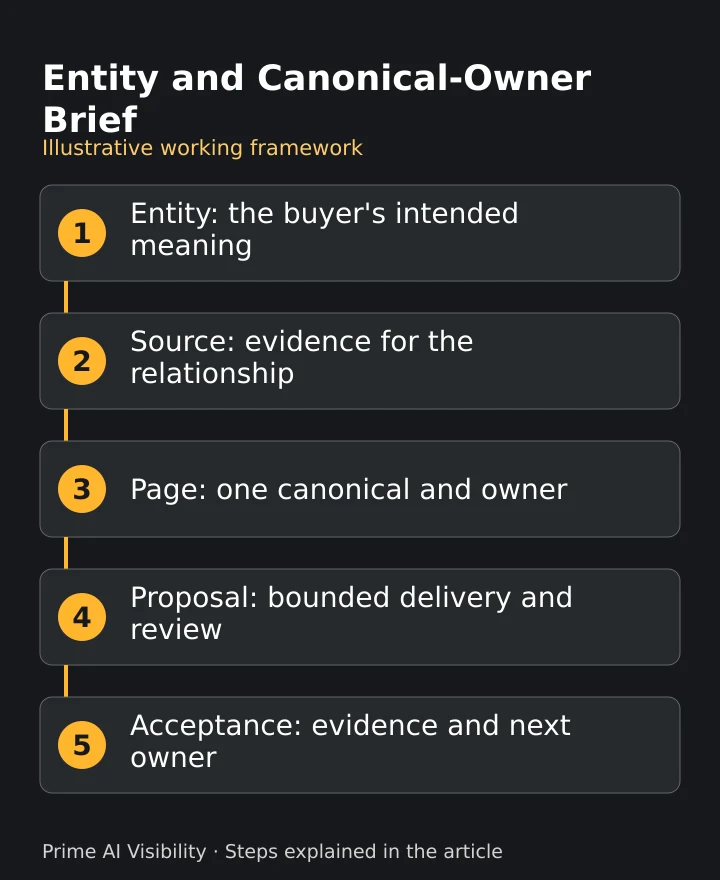
Choosing a top consultant for semantic search strategy means asking for a small demonstration: connect a real entity and buyer question to supporting evidence, one canonical page and an accountable owner. Evaluate the proposed architecture and implementation handoff from that example. A public-search source and meaning problem is different from engineering an internal vector-search system.
A semantic search strategy consultant analyzes how search engines and generative models interpret the relationships between concepts, organizations, products, and buyer questions. Rather than chasing disconnected keyword lists, semantic search strategy structures your information architecture and authoritative sources. This ensures both traditional crawlers and generative answer engines retrieve accurate facts about your organization.
When evaluating advisory partners, you must separate theoretical search mechanics from real-world editorial governance. You do not need an advisor who treats semantic search as an abstract internal database project. You need an operating model that clarifies who owns each canonical page, documents explicit entity attributes, and tracks visible citations across the web. To establish that operational rigor, enterprises often pair structured data roadmaps with tracking platforms like Prime AI Visibility to monitor the public citations and answer texts generated across public engines.
Top consultant for semantic search strategy: require a meaning-and-owner demonstration
A semantic search consultant organizes public web content around entities, attributes, and relationships rather than isolated string queries. An entity is a distinct, uniquely identifiable thing—such as your company, a specialized software category, a proprietary methodology, or an executive.
In public web search, search engines interpret entities using natural language processing, knowledge graphs, contextual associations, and structured markup. The goal of a semantic strategy is to remove ambiguity across these surfaces. When a prospective buyer asks an answer engine or crawler a detailed technical question, the system should locate an unambiguous, authoritative canonical source on your domain.
Strategic consulting deliverables focus on resolving real-world business ambiguity rather than tuning private database embeddings. Core consulting activities include:
- Entity and Relationship Mapping: Defining your primary products, services, and parent organizations, while explicitly distinguishing them from similarly named concepts or competitors.
- Canonical Page Architecture: Ensuring every commercial concept has exactly one authoritative page on your domain, eliminating cannibalization and contradictory internal messaging.
- Structured Data Implementation: Writing and validating rich schema markup (such as
Organization,Service,AboutPage, and detailed entity references) using machine-readable JSON-LD. - Third-Party Consensus Building: Establishing verified third-party references, digital PR citations, and industry directory entries that reinforce domain facts.
- Generative Search Verification: Testing real buyer prompts across generative tools to observe displayed answer text and verify citation links.
Public Semantic Search vs. Internal Vector Retrieval
A common point of confusion when vetting semantic search consultants is the difference between public-facing semantic SEO and internal enterprise retrieval systems.
| Feature / Dimension | Public Semantic Search Strategy | Internal Vector Retrieval Engineering |
|---|---|---|
| Primary Domain | Public web discovery, search engines, and answer engines | Proprietary application data, internal search bars, and RAG pipelines |
| Underlying Mechanics | Knowledge graphs, structured markup, natural language extraction, web consensus | Embedding models, vector distance metrics (cosine similarity), private databases |
| Control Levers | Canonical URLs, JSON-LD, authoritative copy, earned media, brand co-citations | Chunking strategies, embedding dimensionality, index clustering, latency tuning |
| Accountable Owner | Content Director, Head of SEO, Corporate Communications | Enterprise Software Engineer, Data Architect, ML Platform Lead |
Consultants who spend their time discussing vector indices, embedding distances, and custom vector store infrastructure are usually software developers specializing in internal retrieval-augmented generation (RAG) pipelines. While those technical patterns are valuable for proprietary applications, they do not dictate how Google, Claude, Perplexity, or ChatGPT index the public web.
Conversely, a semantic search strategy consultant evaluates your public footprint. They examine whether a search engine's knowledge graph recognizes your brand, whether your site hierarchy contains clear topical clusters, and whether external platforms cite your data accurately. Conflating internal vector development with public semantic discoverability results in expensive technical implementations that fail to move organic search visibility or earn citations in generative answers.
Core Evaluation Criteria for Semantic Search Advisors
Before shortlisting external firms, establish objective criteria to assess whether an advisor can execute semantic information architecture. High-performing advisors should be judged on four distinct operational capabilities:
1. Entity and Concept Disambiguation
Does the consultant demonstrate a methodology for extracting and defining your core business entities? They must analyze existing search results to determine whether crawlers mistake your software for a broader market term, confuse your corporate name with a legacy brand, or fail to associate your leadership with specific innovations. Their proposed scope should include creating explicit entity taxonomies.
2. Canonical Information Architecture
Can the advisor design site architectures where each distinct buyer question maps cleanly to an owned URL? A common failure mode in enterprise websites is multiple solution pages targeting the same topic with conflicting claims. An experienced consultant identifies internal competition, specifies merge or 301-redirect rules, and designates distinct canonical page owners inside your marketing and product teams.
3. Implementation Practicality
Does the consultant provide direct, developer-ready implementation guidance, or merely theoretical slide decks? Look for firms that supply verified JSON-LD code templates, precise editorial briefs, and clear linking instructions. As outlined in our guide on knowledge graphs and AEO, structured data must cleanly align with visible text on the page so automated parsers can extract consistent factual properties.
4. Measurable Governance and Acceptance
How does the consultant verify work? Avoid firms that promise arbitrary keyword rank jumps or guarantee citation placement. A reputable advisor measures success through observable facts: schema parsing validation, clean canonical resolution in crawl logs, the elimination of internal entity overlap, and systematic monitoring of answer engines using a dedicated AI brand visibility tool.
Bounded Vendor Shortlist
The following firms illustrate different approaches to semantic search consulting and visibility services. This non-ranked comparison outlines their documented capabilities and operational structures using consistent criteria.
Dayvandi
Dayvandi centers its consulting practice on semantic SEO methodologies, structured entity relationships, and strategic search frameworks [1]. The firm focuses on mapping domain entities to industry knowledge graphs, designing topical architectures, and guiding structured data implementation. Dayvandi is suited for organizations looking to define their topical authority and rebuild their website hierarchy around semantic concepts rather than traditional search keywords.
eSEOspace
eSEOspace operates as an agency providing semantic search optimization, content design, and digital consulting services [2]. The company publishes editorial guidance on semantic SEO strategies and executes hands-on website audits, technical remediation, and content restructuring. While the agency frequently ranks its own capabilities within its published marketing assets, its core commercial offering delivers operational website execution for small-to-midmarket organizations seeking comprehensive SEO support.
Percepture
Percepture provides integrated enterprise SEO and generative engine optimization (GEO) services engineered for complex enterprise domains [3]. Its methodology connects on-page semantic architectures, structured schema markup, and external earned media to reinforce topical authority across search and AI systems. Disclosure: Bob Generale is a co-founder of Prime AI Visibility, and Percepture and Prime AI Visibility maintain a shared commercial affiliation. Engagements through Percepture require a named SEO specialist to scope technical deliverables, align canonical page governance, and execute entity validation workflows.
Comparative Framework
Dayvandi
- Documented Core Focus: Semantic taxonomy, entity relationship mapping, strategic frameworks
- Operational Deliverables: Entity models, structured data briefs, topic architecture blueprints
- Best Suited For: Mid-market to enterprise marketing teams needing architectural definitions
eSEOspace
- Documented Core Focus: Semantic SEO implementation, technical fixes, content marketing
- Operational Deliverables: Full-site audits, content creation, on-page semantic optimization
- Best Suited For: Growing brands needing outsourced, hands-on website execution
Percepture
- Documented Core Focus: Enterprise SEO, GEO, technical semantics, integrated digital PR
- Operational Deliverables: Cross-department architecture, schema engineering, earned media validation
- Best Suited For: Complex enterprises needing technical governance tied to external PR authority
Worked Fictional Example: Resolving Enterprise Entity Confusion
To understand how a top consultant approaches a semantic challenge, review this fictional case study of an enterprise software provider.
The Company and the Problem
"Meridian Workflow Systems" is a B2B SaaS company offering a regulatory compliance automation platform for medical device manufacturers. Despite having high domain authority, search engines and answer engines repeatedly misrepresented Meridian's core capabilities.
When enterprise buyers asked conversational engines questions like, "Which platforms automate medical device FDA 21 CFR Part 11 software audits?", Meridian was rarely mentioned. Worse, when Meridian was named, answers routinely described it as a generic "electronic document signing app."
The Consultant's Root Cause Discovery
Meridian hired a semantic search strategy consultant who audited their digital footprint:
- Internal Cannibalization: Meridian had four distinct blog posts, two product pages, and a webinar page all using variants of the phrase "Part 11 compliance software." None of the pages contained clear structured markup indicating which page was the primary canonical product entity.
- Entity Ambiguity: The term "Meridian" was frequently associated in crawl data with unrelated entities, including geographic mapping software and a legacy hotel management database.
- Missing Consensus: Meridian’s external press releases and PR mentions linked exclusively to their root domain homepage without using descriptive contextual anchors related to medical device regulatory audits.
The Consultant's Technical Remediation
The consultant executed a four-step semantic alignment:
- Information Architecture Consolidation: The team merged the four conflicting blog posts into one comprehensive, authoritative resource URL:
/solutions/medical-device-audit-compliance. The secondary URLs were 301-redirected, and internal navigation was updated to point directly to this single canonical URL. - Structured JSON-LD Engineering: The consultant deployed custom JSON-LD schema on the consolidated page. The schema defined the entity as a
SoftwareApplication, declared Meridian as theauthorandcreator(Organization), and used theaboutproperty to link directly to the Wikidata entry for "Title 21 CFR Part 11". - Earned Media Anchor Alignment: The PR team was instructed to update digital campaigns. Future earned media placements and partner directory links directed traffic to the consolidated solution URL rather than the homepage, using contextual anchors like "Meridian's audit compliance automation platform."
- Independent Monitoring: The team established automated tracking across generative engines using an AI visibility tracker to monitor whether AI platforms updated their source links when answering queries about Part 11 software.
The Observable Outcome
Within eight weeks, the canonical solution URL became the dominant index result for relevant enterprise searches. Generative engines began showing Meridian in summary answers for regulatory compliance software, directly citing the /solutions/ page. The entity confusion surrounding document signing dissipated because the structured data and on-page copy clearly established the software's functional scope.
Entity Meaning and Canonical-Owner Evaluation Brief
Use the following operational brief when scoping semantic search interventions. This worksheet assigns strict organizational ownership and sets concrete acceptance gates before deploying architectural updates.
Worksheet Instructions
- Identify the core entity or commercial service causing confusion.
- Formulate the exact buyer prompt or search phrase where ambiguous answers occur.
- Designate exactly one internal page owner accountable for canonical accuracy.
- Define the missing schema relationships and specify external citation repairs.
- Establish an acceptance condition based on observable platform citations rather than vague ranking projections.
ENTITY MEANING AND CANONICAL-OWNER BRIEF ───────────────────────────────────────────────────────────────────────────── Section 1: Entity & Query Identification • Brand Entity Name: Meridian Workflow Systems • Ambiguous Query: "What platforms automate FDA 21 CFR Part 11 audits?" • Intended Meaning: Enterprise SaaS for medical device regulatory audits Section 2: Architecture & Canonical Ownership • Existing Canonical URL: /solutions/medical-device-audit-compliance • Accountable Page Owner: Sarah Lin, Director of Product Marketing • Competing Internal URLs: /blog/part-11-basics, /webinar/compliance-prep Section 3: Structural & Source Remediation • Schema Requirements: JSON-LD SoftwareApplication, Wikidata entity linking • Source Citation Target: Link PR anchors to canonical URL, not homepage • Redirect Scope: 301 redirect competing URLs to canonical hub Section 4: Verification & Escalation Thresholds • Acceptance Condition: Schema passes Rich Results; prompt answers cite page • Escalation Decision: If answer engines cite outdated pages after 60 days, audit server crawl logs and disavow conflicting directory anchors. ─────────────────────────────────────────────────────────────────────────────
Acceptance Condition and Escalation Decisions
- Acceptance Condition: The structured data validates cleanly against search engine schema validators, all internal competitor pages are redirected, and at least one generative answer engine displays the canonical URL as an attributed source link during monthly verification sweeps.
- Stopping / Escalation Rule: If after 60 days the entity remains misclassified in generative search previews or search engines display outdated descriptions, pause content publishing. Review server access logs to verify that search engine crawlers have fetched the new JSON-LD payload, and audit external backlink profiles for anchor text conflicts.
Common Mistakes When Hiring a Semantic Search Consultant
Organizations frequently waste budget on semantic search initiatives by failing to enforce operational boundaries. Watch out for these three strategic errors:
1. Treating Semantic Strategy as a Pure Content Volume Problem
Companies often hire consultants who recommend generating dozens of superficial blog posts to "cover every semantic entity." Flooding your site with low-depth content without a clear canonical hierarchy creates keyword cannibalization and fragments topical authority. A true semantic strategy often results in fewer, more definitive URLs that thoroughly answer complex buyer questions.
2. Confusing Internal Retrieval Tech Stacks with Public Web Crawling
Do not permit consultants to sell you an internal vector database or an LLM pipeline audit under the guise of public semantic SEO. While those systems help internal knowledge management, public search engines rely on public knowledge graphs, link consensus, and structured page code. Keep engineering budgets separate from public discovery initiatives.
3. Neglecting Post-Implementation Citation Monitoring
Deploying schema and restructuring URLs is only half the battle. Marketing teams often fail to track whether search engines and generative models adopt the new semantic relationships. Teams must track public citations systematically across multiple generative engines. You can review available measurement setups in our evaluation of best ChatGPT SEO tracking tools to understand how external links and displayed text should be logged over time.
How to Measure Ongoing Semantic Search Performance
Measuring semantic search requires looking beyond traditional single-keyword rank positions. In a semantic environment, search results are personalized, dynamic, and frequently delivered as generated answers.
Track your progress across these four core metrics:
- Entity Association Accuracy: When testing commercial prompts in generative engines, evaluate whether the engine accurately classifies your organization's business model, target audience, and core product tier.
- Citation Source Attribution: Verify whether answer engines like ChatGPT, Claude, and Perplexity display direct links to your designated canonical pages when generating responses to relevant buyer questions.
- Structured Data Validation: Regularly audit your JSON-LD implementations across all product and category templates using standard testing suites to ensure entity identifiers remain free of syntax and semantic errors.
- Topical Footprint Coverage: Review how comprehensively your canonical resource hubs capture related subtopics, questions, and edge cases compared to industry peers. For specialized tracking methods, explore our Perplexity citation tracking guide.
Enterprise teams managing complex service portfolios should use dedicated platforms like the Prime AI Visibility Platform to track buyer-intent questions, review displayed sources, and verify that changes to on-page semantics translate into visible citations in AI answers. To understand how automated systems evaluate these patterns, explore our breakdown of platform features and inspect core visibility metrics.
Frequently asked questions
What does a semantic search consultant do?
A semantic search consultant analyzes how search engines and generative models interpret the relationships between your company, products, and core concepts. They structure your site's information architecture, implement detailed JSON-LD markup, resolve internal content cannibalization, and ensure external sources cite your brand accurately.
How does semantic SEO differ from traditional SEO?
Traditional SEO often focuses on optimizing specific pages for discrete keyword phrases and chasing backlink counts. Semantic SEO focuses on entities, topics, and contextual meaning, organizing content so search systems understand the factual attributes of an organization and its services regardless of the exact phrasing used in a query.
Can a consultant guarantee our brand will appear in AI answer citations?
No ethical consultant or technology platform can guarantee placement or citations in AI answer engines or traditional search results. Generative models construct answers dynamically based on model training, retrieved search consensus, and user prompts, meaning visibility can only be influenced through accurate architecture and authoritative sourcing, not guaranteed.
Does semantic search strategy require rebuilding our entire website?
Semantic search strategy rarely requires a complete website redesign from scratch. Most projects focus on restructuring URL hierarchies, merging overlapping or competing pages into canonical solution hubs, improving internal link context, and layering structured schema markup onto existing high-value assets.
How long does it take to see results from a semantic search engagement?
Changes to on-page semantics and structured markup typically take several weeks to be discovered, crawled, and reindexed by search engines. Observing shifts in generative answer engine citations often requires 60 to 90 days as AI models update their indices and external reference citations accumulate across the web.
References
- Dayvandi. Entity-Based Strategic SEO and Semantic Architectures. https://www.dayvandi.ai/
- eSEOspace. Top Semantic SEO Consultants and Agency Frameworks. https://eseospace.com/blog/top-semantic-seo-consultants-2026/
- Percepture. Enterprise SEO and Generative Engine Optimization Services. https://percepture.com/services/enterprise-seo/
Next steps
Test the proposed page-owner method against a software evaluator's evidence ladder. If the offer instead promises placement, use the service-scope acceptance card to identify the actual work. To begin evaluating your brand's semantic architecture and answer engine visibility:
- Conduct an internal audit of your core commercial entities to identify overlapping pages and conflicting product definitions.
- Review our guide on how SEO and AEO teams can collaborate to build shared semantic workflows across your content and technical teams.
- Read our analysis on the impact of structured data on AI citation accuracy to optimize your JSON-LD implementation.
- Benchmark your current citations across major generative models by choosing to create a workspace on Prime AI Visibility.
About the author
Bob Generale is President and Partner at Percepture and co-founder of Prime AI Visibility. This article explains the Entity Meaning and Canonical-Owner Evaluation Brief using cited consultant service descriptions. Its practical application is a proposed method: the editorial comparison is not a performance leaderboard. Percepture and Prime AI Visibility are commercially connected.
Start with a question your buyer actually asks
Create a workspace to inspect saved answers and their displayed sources. Compare like-for-like questions after approved changes; answers are observations, not guaranteed citations or business outcomes.