
Search Engine Placement Service: Define the Surface and Acceptance
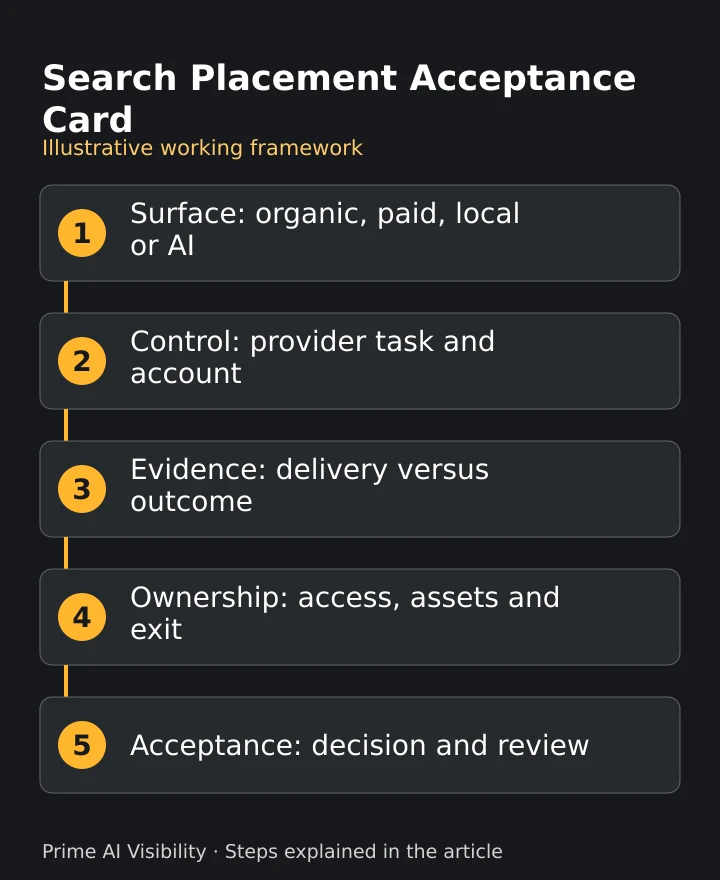
A search engine placement service should identify the surface and task being purchased: organic optimization, labeled advertising, local profile work or sampled AI-answer monitoring. Compare what the provider controls, what evidence demonstrates delivery and who owns the account or page. Completing a task is different from guaranteeing a ranking, an AI citation or a business outcome.
In modern discovery, the phrase covers four separate technical environments: organic web search, paid search advertising, local profile networks, and generative AI answer engines. Each surface operates under distinct control boundaries, billing mechanisms, asset ownership structures, and acceptance proofs. A legitimate vendor engagement establishes upfront exactly which surface is being influenced, who owns the work product, and how completed milestones differ from observed algorithmic results.
Search engine placement service: name the surface
Buying search visibility requires understanding where provider control starts and stops. While advertising networks sell guaranteed placements for labeled ad slots under contract, organic algorithms and artificial intelligence interfaces do not sell placement. Propel's glossary clearly distinguishes paid listings—where advertisers pay for visibility—from organic results, which engines calculate through independent algorithmic evaluation [1].
Commercial search encompasses four major presentation layers:
- Paid Search Advertising (PPC): Platforms like Google Ads or Microsoft Advertising contractually deliver labeled placements. If an advertiser meets policy guidelines and pays the market bid, their ad displays. The provider controls campaign architecture, bid parameters, copy, and landing page alignment.
- Organic Search Engine Optimization: Agencies like WebFX deliver technical adjustments, architectural restructuring, content development, and outreach [2]. The provider controls the labor and code deployed to the client website. Neither the agency nor the client can purchase an organic search result.
- Local Business Profiles: Optimization involves claiming, verifying, and maintaining standardized business identity across mapping graphs (such as Google Business Profiles) and local directories. The provider controls citation consistency and profile completeness; search platforms determine map-pack presentation.
- Sampled Generative AI Visibility: Answer engines synthesize information across public web sources. Monitoring these surfaces requires an AI visibility tracker to capture generated responses and displayed links across systems like ChatGPT, Claude, Perplexity, and Gemini. Providers control digital PR, public factual clarity, and schema implementation; they cannot buy inclusion inside non-deterministic generative models.
A provider claiming to provide a comprehensive search engine placement service across all four surfaces must present separate operating agreements, execution tasks, and verification proofs for each category.
Vendor Control vs. Observed Outcomes: Setting Technical Boundaries
The primary failure mode in hiring search placement vendors is conflating completed tasks with algorithmic outcomes. Completing an engineering checklist is within vendor control; how Google, Bing, or an LLM responds is not.
Google's developer documentation for search and AI features makes it plain: ordinary technical eligibility is not indexing proof, nor does it guarantee inclusion in Google AI features [3]. Web discovery engines continuously evaluate freshness, relevance, and domain authority. A page can be fully crawlable and semantically valid while search crawlers choose not to index or rank it.
Similarly, generative AI engines build responses using non-deterministic processing, retrieved grounding sets, and statistical association. When a brand's URL appears as a displayed citation in an AI answer, it proves solely that the interface rendered that specific link during that individual session. It does not prove real-time retrieval mechanics, model training inclusion, permanent system trust, algorithmic preference, or an explicit commercial recommendation.
Responsible enterprise engagements, such as those provided by Percepture's enterprise SEO services (an agency commercially connected to Prime AI Visibility through co-founder Bob Generale), delineate technical deliverables from market results. A defensible statement of work defines acceptance around auditable code deployments, content publishing standards, and structural improvements, rather than speculative ranking guarantees.
What a Legitimate Search Engine Placement Service Actually Delivers
Evaluating vendor proposals requires comparing scopes of work across consistent technical criteria rather than relying on promotional guarantees. Legitimate search engine placement services organize work around transparent deliverables across specific discovery surfaces.
Paid Search (PPC)
- Primary Provider Tasks: Bid management, ad copy creation, conversion tracking, negative keyword lists
- Auditable Acceptance Evidence: Campaign change logs, live account access, invoice ad-spend reconciliation
- Typical Retainer Boundaries: Provider fee separated from ad spend; no guarantee of fixed cost-per-acquisition
Organic Search (SEO)
- Primary Provider Tasks: Technical site audits, on-page content, internal linking, schema deployment
- Auditable Acceptance Evidence: Git pull requests, CMS staging logs, verified robots/header status codes
- Typical Retainer Boundaries: Labor hours and milestones; no guaranteed organic positions or search traffic volumes
Generative AI Search (GEO/AEO)
- Primary Provider Tasks: Factual entity definition, earned media PR, digital citation auditing
- Auditable Acceptance Evidence: Published media coverage, structured data updates, saved answer records
- Typical Retainer Boundaries: Workflow sprints; no guarantee of LLM citation placement or AI Overview inclusion
When teams combine traditional search with answer engine optimization, they often integrate an AI Visibility Tool alongside existing analytics software. Platforms like Prime AI Visibility help teams review what answers displayed for plan-supported buyer queries, track displayed sources and links, compare performance over time, and conduct follow-up rechecks. The platform captures responses across ChatGPT, Claude, Perplexity, Gemini, and a Google-grounded AI Overview-style preview. This preview helps marketing teams inspect grounded search environments, though it is not a captured live Google AI Overview, is not AI Mode, and does not serve as proof of actual Google eligibility, indexing, or ranking.
For teams managing both workflows, understanding how SEO and AEO teams can collaborate helps ensure developers and content teams maintain single-source factual consistency across web pages and earned media.
Evaluating Guarantees, Account Ownership, and Exit Governance
Legitimate service providers operate with absolute commercial transparency regarding account ownership and exit governance. Ambiguous ranking promises often conceal fragile tactics or proprietary lock-ins that harm long-term domain health.
Direct Asset and Profile Ownership
All digital assets created during an engagement must remain the client's property. This includes:
- Advertising Accounts: Google Ads and Microsoft Advertising accounts must be created under the client’s organization, with the provider granted administrative or standard agency partner access. The client pays platform ad spend directly.
- Content and Code Repositories: All copy, metadata, structured schema, and engineering optimizations must be committed directly to the client's content management system or Git repository.
- Analytics and Tracking Systems: Google Search Console, Google Analytics 4, and search tracking workspaces must reside in client-controlled containers.
Rejection of Speculative Guarantees
Promises such as "Page 1 rankings within 30 days" or "Guaranteed inclusion in AI engine summaries" should be rejected. Because search engines explicitly prohibit third-party manipulation and frequently alter ranking parameters, no vendor can buy organic placement. Legitimate providers establish contract milestones based on delivery quality, technical compliance, and documented production velocity.
Clean Exit and Migration Rules
Before signing an agreement, verify what happens upon contract termination. Unethical arrangements may host content on vendor-owned proxies, deploy proprietary script overlays that disappear upon cancellation, or hold local profiles hostage. Contracts must confirm that all work remains live on client infrastructure without penalty fees, proprietary dependencies, or trailing redirects upon separation.
Fictional Case Study: Technical Procurement at Meridian Logistics
To understand how scope disambiguation works in practice, consider the fictional procurement process at Meridian Logistics, a mid-market freight brokerage evaluating a proposed search engine placement service.
The Initial Vendor Proposal
Meridian’s VP of Growth received an agency proposal promising "guaranteed top-tier placement across Google search results, AI chatbots, and regional industry directories for 25 target shipping routes within 90 days." The hypothetical proposal did not separate advertising spend from consulting labor; no price is assigned in this example.
The Scope Disambiguation Audit
Meridian’s marketing operations lead audited the proposal to separate verifiable tasks from ambiguous claims:
- Surface Inspection: The vendor’s "guaranteed top-tier placement" relied on Google Ads PPC bidding for long-tail route queries, not organic rankings. The vendor planned to run ads through their own agency master account rather than Meridian’s Google Ads property.
- Organic SEO Deliverables: The proposed organic work consisted of 25 auto-generated landing pages hosted on an external sub-domain managed by the agency. If Meridian canceled the contract, the sub-domain would be decommissioned.
- AI Chatbot Positioning: The agency claimed it had direct relationships with LLM providers to insert Meridian into generative responses—a technical impossibility given how public answer engines synthesize unstructured web information.
The Corrected Statement of Work
Meridian rejected the initial agreement and issued a restructured counter-proposal with distinct operating boundaries:
- PPC Layer: Meridian established an in-house Google Ads account, invited the agency as a manager, and retained full ownership of campaign history, ad creative, and conversion tracking configurations.
- Enterprise SEO Layer: The agency was contracted to perform technical debt remediation and schema markup directly inside Meridian’s primary CMS. Performance acceptance was tied to verified code deployments, canonical tag alignment, and core web vital compliance, using frameworks similar to SEO for professional services firms.
- AI Visibility Layer: Meridian engaged Percepture for targeted digital PR services (commercial relationship disclosed) to earn authoritative coverage in freight industry publications, and set up a dedicated workspace in an AI Search Visibility Platform to monitor brand appearances and source citations across commercial logistics queries.
By decoupling surfaces and enforcing clear acceptance criteria, Meridian eliminated speculative claims while securing total ownership over its digital infrastructure.
Implementation Worksheet: Search Placement Offer Scope and Acceptance Card
Use this worksheet when evaluating proposals from any agency, platform, or consultancy offering a search engine placement service. Complete one sheet for each surface included in the vendor proposal.
================================================================================ SEARCH PLACEMENT OFFER SCOPE AND ACCEPTANCE CARD
STAGE 1: NAMED DISCOVERY SURFACE [ ] Paid Search Advertising (PPC / Sponsored Ads) [ ] Organic Search Engine Optimization (Core Web Search) [ ] Local Map Pack & Directory Profiles (GBP / Apple Maps) [ ] Generative AI Answer Engine Visibility (ChatGPT, Perplexity, Claude, Gemini) STAGE 2: TASK SCOPE & ADMINISTRATIVE ACCOUNT OWNER Provider Controlled Task: ______________________________________________________ Account Hosting / Platform: ____________________________________________________ Administrative Account Owner: [ ] Client Owned (Required) [ ] Vendor Owned STAGE 3: EVIDENCE OF DELIVERY VS. OBSERVED OUTCOME Auditable Delivery Proof: ______________________________________________________ Observed Engine Outcome: _______________________________________________________ (Note: Observed algorithmic changes do NOT constitute delivery acceptance) STAGE 4: ACCESS, ASSET OWNERSHIP & EXIT CONDITIONS Asset Hosting Location: [ ] Client CMS/Repo [ ] Vendor Proxy/External Exit Transition Clause: ________________________________________________________ Data / Campaign Portability: [ ] Guaranteed in Contract [ ] Undefined STAGE 5: ACCEPTANCE DECISION & NEXT REVIEW Accountable Work Owner: ________________________________________________________ Acceptance Condition: __________________________________________________________ Stopping / Escalation Rule: ____________________________________________________ Next Review Cadence: ___________________________________________________________
Explicitly Fictional Filled Entry: Meridian Logistics
================================================================================ SEARCH PLACEMENT OFFER SCOPE AND ACCEPTANCE CARD (FILLED SAMPLE)
STAGE 1: NAMED DISCOVERY SURFACE [X] Organic Search Engine Optimization (Core Web Search) STAGE 2: TASK SCOPE & ADMINISTRATIVE ACCOUNT OWNER Provider Controlled Task: Remediation of faceted navigation canonical tags, XML sitemap restructuring, and JSON-LD LogisticsService schema deployment across 40 hub pages. Account Hosting / Platform: Meridian Production Webflow CMS & GitHub Repository. Administrative Account Owner: [X] Client Owned [ ] Vendor Owned STAGE 3: EVIDENCE OF DELIVERY VS. OBSERVED OUTCOME Auditable Delivery Proof: GitHub Pull Requests merged into main branch; 200 OK HTTP header status verification across all staging and production URLs. Observed Engine Outcome: Google Search Console crawl confirmation; external rank changes are monitored as correlative data but excluded from invoice acceptance. STAGE 4: ACCESS, ASSET OWNERSHIP & EXIT CONDITIONS Asset Hosting Location: [X] Client CMS/Repo [ ] Vendor Proxy/External Exit Transition Clause: All custom code, templates, and schema remain production- active in Meridian repository without licensing fees or severance penalties. Data / Campaign Portability: [X] Guaranteed in Contract [ ] Undefined STAGE 5: ACCEPTANCE DECISION & NEXT REVIEW Accountable Work Owner: Director of Digital Infrastructure (Elena Ramos) Acceptance Condition: Clean technical validation via site crawler with zero critical canonical/schema errors within 14 days of pull request deployment. Stopping / Escalation Rule: If pull requests contain unvalidated redirects or out-of-scope template changes, billing milestone is frozen pending remediation. Next Review Cadence: Bi-weekly engineering sync; formal quarterly audit.
Managing AI Search Visibility Within a Search Placement Strategy
As generative engines capture an increasing share of informational and commercial queries, marketing leaders frequently ask how to integrate AI discovery into their traditional search placement retainers. Answer engines operate as recommendation and summarization layers rather than simple link directories.
Optimizing for AI search visibility requires shifting focus from internal keyword stuffing to external entity authority. LLMs formulate answers using synthesis derived from broad training datasets, real-time index retrieval, and domain grounding. To determine how your brand is represented, teams deploy an AI visibility checker to evaluate queries, track which reference links appear, and monitor third-party sentiment across multiple models.
When auditing generative surfaces, teams must remember that visible citations demonstrate only that an engine referenced a specific page to answer an individual prompt. It does not mean the engine has permanently indexed that page into its underlying weights or that it will cite the source for related queries. Using specialized AI visibility metrics allows teams to track presence, link display rates, and competitive presence without making unsupported claims about underlying algorithmic intent.
To build sustainable cross-surface discoverability, organizations should review technical platform features that support systematic, multi-model monitoring over time.
Six Mistakes to Avoid When Procuring Search Placement Services
- Purchasing Unspecified "Network Visibility": Avoid contracts that bundle paid advertising and organic consulting into a single blended retainer without identifying ad-spend pass-through amounts or individual surface deliverables.
- Accepting Ranking-Linked Payment Guarantees: Third-party ranking guarantees incentivize spam tactics, private blog networks, or targeting zero-volume keywords to trigger contractual completion without driving commercial business value.
- Allowing Work on Third-Party Web Properties: Ensure all landing pages, blog posts, and technical optimizations are hosted on your primary domain. Never permit an agency to build core assets on agency-owned domains or closed proxy networks.
- Treating AI Overview Previews as Google Indexing Proof: A Google-grounded AI Overview-style preview simulates how an answer engine might answer a query using web data; it does not indicate actual Google indexing, ranking, or live AI Overview eligibility.
- Failing to Retain Master Account Control: Never allow an external provider to create analytics, Google Search Console, or advertising accounts under their private logins. You must maintain master organization administrative rights.
- Confusing Displayed Citations with Algorithmic Preference: Tracking answer engine citations shows what was displayed in a sampled session; it does not provide insight into why the model chose that URL or confirm algorithmic endorsement.
Next steps
For an offer centered on entity meaning and canonical-page ownership, use the semantic-search consultant evaluation brief rather than judge it as purchased placement.
- Audit Existing Contracts: Review all active agency and vendor agreements. Categorize deliverables into paid advertising, organic SEO, local profile management, or AI monitoring.
- Verify Master Credentials: Log in to Google Search Console, Google Ads, GA4, and business profile networks. Confirm your internal team holds primary administrative ownership on every property.
- Standardize Acceptance Criteria: Update scope-of-work templates using the Acceptance Card provided above. Require auditable deliverables (code commits, pull requests, published assets) for milestone sign-offs.
- Establish Unified Search Monitoring: Complement traditional rank tracking tools with dedicated software designed to measure generative discovery. You can create a workspace to systematically sample, review, and track brand visibility and displayed sources across ChatGPT, Claude, Perplexity, and Gemini.
Frequently asked questions
Can any search engine placement service guarantee top organic rankings on Google?
No legitimate provider can guarantee top organic rankings on Google or any other search engine. Search engines operate proprietary, non-public algorithms that continuously update based on relevance, quality, and user intent. Service providers only control the labor, content, and technical code deployed to your website. Contractual guarantees tied to specific organic positions frequently rely on obscure, zero-competition keywords or manipulative schemes that violate search engine webmaster guidelines.
What is the difference between search engine placement and search engine marketing?
Search engine marketing is an umbrella discipline that encompasses both organic search engine optimization and paid search advertising such as pay-per-click campaigns. Search engine placement is an informal commercial term used by service providers to describe securing visibility on a search result page. While paid placement can be purchased directly from advertising networks, organic placement cannot be bought and must be earned through ongoing optimization, technical infrastructure, and authoritative content.
How do generative AI engines handle brand placement compared to traditional search?
Traditional search engines return an ordered index of ranked links based on web crawling, indexing, and link-graph authority algorithms. Generative AI engines synthesize unstructured narrative answers to user prompts, occasionally providing supporting links and citations. Placement within an AI answer cannot be bought directly through ad auctions or traditional organic optimization. Visibility depends on how clearly a brand's factual entity is understood across authoritative web sources, earned digital PR, and public citations.
Who should own the advertising accounts and analytics properties when working with an agency?
The client organization must always maintain primary administrative ownership of all advertising accounts, analytics properties, tag managers, and search console tools. The external agency or service provider should be granted delegated manager or partner-level access. Maintaining administrative ownership ensures that your company retains all historical campaign data, conversion tracking configurations, and creative assets if you ever choose to change vendors or bring management in-house.
Does appearing as a cited source in Perplexity or ChatGPT mean a site is permanently indexed?
No, a displayed citation in an AI answer proves only that the engine rendered that link during that specific user session. It does not indicate permanent inclusion in the underlying model's weights, training data membership, or guaranteed citation for future queries. Generative models operate non-deterministically and frequently adjust their information retrieval methods, meaning citation displays must be measured over time as sampled observations rather than permanent placements.
References
- Propel Your Company. "Marketing & SEO Glossary." Propel Your Company, 2026. Available at: https://propelyourcompany.com/glossary/
- WebFX. "SEO Services & Agency Deliverables." WebFX, 2026. Available at: https://www.webfx.com/seo/services/
- Google Search Central. "Google Search's AI Features and Your Website." Google Developers Documentation, 2026. Available at: https://developers.google.com/search/docs/appearance/ai-features
- Percepture. "Enterprise SEO Services." Percepture Digital Agency, 2026. Available at: https://percepture.com/services/enterprise-seo/
Next steps
- Learn how to structure ongoing tracking across emerging models with our guide to hybrid SEO and AI strategy.
- Review technical criteria for generative engines in what does AEO mean and how it differs from SEO.
- Establish baseline tracking across chat and answer platforms by choosing to create a workspace on Prime AI Visibility.
About the author
Bob Generale is President and Partner at Percepture and co-founder of Prime AI Visibility. This article explains the Search Placement Offer Scope and Acceptance Card using cited provider and search sources. Its practical application is a proposed method: a provider's work scope does not guarantee placement. Percepture and Prime AI Visibility are commercially connected.
Start with a question your buyer actually asks
Create a workspace to inspect saved answers and their displayed sources. Compare like-for-like questions after approved changes; answers are observations, not guaranteed citations or business outcomes.