
How Do Product Reviews Impact AI Search Visibility? Trace the Evidence
How do product reviews impact AI search visibility? Reviews can give public sources real customer experience and product detail, but a pattern of citations or recommendations does not show that review volume or star rating caused it. Use the brand-claim accuracy guide to trace an answer's statement back to its source. Measure review profiles, review-derived content, cited sources and recommendations as separate things.
This guide is for product, content and reputation teams that want to use authentic review evidence and then judge how it appears in AI answers. The output is a clear way to read the published studies and a provenance worksheet you can fill in yourself. It is written by Bob Generale, President and Partner at Percepture and a co-founder of Prime AI Visibility. The two organizations are commercially connected, so any recommendation for either is an editorial judgment and not an independent test result.
A review is useful evidence when the reader can see whose experience it describes and what it actually supports.
In this guide:
- The short answer on reviews and AI search visibility
- Define the review evidence being discussed
- Read what the studies actually measured
- Use authentic, attributable review material
- Inspect the source behind the AI claim
- The Review-to-Claim Provenance and Observation Record
- Use a vendor study without borrowing its numbers
- Build a small source-change learning record
How do product reviews impact AI search visibility? The short answer
Reviews are one kind of public evidence that may shape what a source says about your product. They are not a switch. Four points keep the discussion honest.
- Association is not effect. A study that finds brands with review profiles appearing more often in AI responses describes a pattern in a sample. It does not show what would happen if one brand added a profile tomorrow.
- The review has to say something useful. A review that describes a specific use, a fit and a limit gives a source article something accurate to quote. A bare star rating gives it very little.
- A citation is not a recommendation. An answer can cite a page that mentions your product without recommending it. Read what the answer actually says.
- Visits and sales are separate outcomes. Whether an answer showed your brand is one observation. Whether a visit or a sale followed is another, and it needs its own record.
The rest of this guide shows how to apply those four points with sources you can inspect.
Define the review evidence being discussed
"Reviews" covers at least four different things, and mixing them is the most common reason a review study gets misread.
- A review-platform profile is the page a platform keeps for your product, with its aggregate rating and count.
- A genuine customer review is one person's account of using the product, with a date and a context.
- An editorial product review is a journalist's or publisher's assessment, which a reader attributes to the publisher, not to a customer.
- A brand article quoting reviews is content your company produces that draws on customer feedback, such as a buying guide built from what users said.
These are not interchangeable treatment groups. A brand that has a profile but never publishes anything about it is a different case from a brand that turns customer feedback into a dated, attributed article. When a study or a vendor says "reviews," ask which of the four it means, who produced the resulting content and whether the comparison group had the same starting point.
Read what the studies actually measured
Two public studies are often cited in this discussion. Seer Interactive published a study titled Study of 800K AI Responses: How Review Profiles Shape Brand Presence in AI Search, which reports associations between review-profile presence and brand presence in AI responses. Yotpo published research on October 30, 2026, titled Reviews Boost AI Citations, a vendor study that compares review-backed generated content with existing posts across 15 brands.
Neither document should be read for its headline alone. Before you use any number, read the design.
| Design question | What to look for | Why it matters |
|---|---|---|
| Sample and scope | Which brands, questions and platforms were tracked, and over what window | A result about one set of questions may not apply to yours |
| Who made the content | Generated for the study or already existing, and by whom | Content built to test a claim is not the same as content brands publish on their own |
| Comparison cohorts | Whether groups started from equivalent positions | Unequal cohorts can produce a gap that has nothing to do with reviews |
| Unit of citation | A cited page, a named brand or a recommendation | Three different observations get reported with one word |
| Confounders | Brand size, existing authority, product category, timing | Any of these can explain a pattern without a causal role for reviews |
| Source of the study | Independent analysis or a vendor with a product to sell | Vendor research can be useful, but it should be read with its interest in mind |
An observational study can tell you that two things tend to appear together. It cannot tell you the incremental effect of changing one of them. If a result matters to a decision, use the qualitative finding, such as the kinds of sources that appeared, and leave the percentage out of your own copy. A figure from someone else's sample is not a benchmark for your brand.
For context on how the Prime AI Visibility Benchmark handles the same problem, read its published method and limits. Looking at how a study states its scope is a good habit whichever study you are reading.
Use authentic, attributable review material
Review material only helps if it is real and its context is intact. Four rules apply.
Keep the source and the context. A quote should carry the reviewer's actual words, the product they used, the date and the platform. Paraphrase only when the original is unclear, and never change the meaning.
Get permission where it is needed. Customer text on a third-party platform may be subject to that platform's terms. Ask before republishing a customer's words as marketing, and keep a record of the answer.
Never fabricate or incentivize your way to volume. Google's guidance on how to write high quality reviews is about the quality and usefulness of review content. It does not make a guarantee about AI citations, and it is not permission to invent customer feedback. Platform policies about requests and incentives also apply, so check them before you ask customers for reviews.
Do not cherry-pick an average. An "average rating" with no count or period behind it tells a reader nothing. If you publish a figure, publish its denominator and date.
The practical benefit is a source article that is easy to trust. A buying guide that says "one reviewer who uses the product for a small team reported that setup was straightforward" is more useful, and more accurate, than a claim that all customers find it easy. For related guidance on how genuine third-party references can support a claim without becoming an endorsement, read about earned media and AI citations.
Inspect the source behind the AI claim
When an answer mentions your product, treat it as an observation to inspect. Save the answer, the exact URL it cited and the specific product statement that source supports. Then separate four observations that are often collapsed into one:
- Brand named: the answer includes your product name.
- Website cited: the answer links one of your own pages.
- Source link displayed: the answer links any page, yours or a third party's.
- Explicit recommendation: the answer tells the reader to choose your product.
A review count, a rating, a citation and an explicit recommendation are not the same measure, so keep them in separate columns. The AI visibility metric definitions page sets out how to keep observation units separate, and the guide to choosing a real buyer question helps decide which question to observe in the first place.
Where Prime AI Visibility fits is narrow. Its features let you track plan-supported questions across the engines it covers, inspect saved answers with their displayed links and then recheck the same questions later. It records what answers displayed. It does not collect every customer review, and it does not guarantee favorable answers. A Google-grounded AI Overview-style preview is not the live Google Search panel.
If a gap appears, start from a baseline. The guide to running an AI visibility audit shows how to diagnose whether the gap is access, content or authority before anyone changes a review strategy.
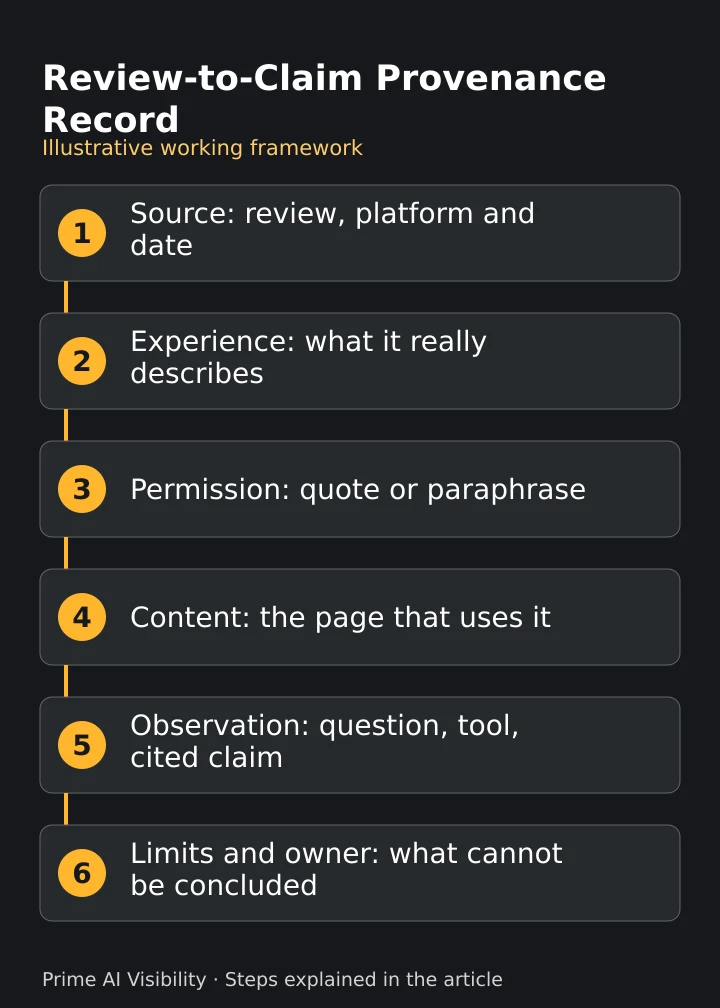
The Review-to-Claim Provenance and Observation Record
The record below ties one review-derived claim to the evidence behind it. It is a proposed application created for this article, not a validated scoring model, a completed client engagement or proprietary research. Use it when a product claim on your site or in a source article came from customer feedback and you want to know whether an AI answer later repeated it.
The product or content owner fills in the first four fields. The reputation owner records the observation fields. Review it whenever the content changes and again after the same question panel is rerun. Keep the filled record where the content team can find it, such as the page's working file, and link the source URLs rather than pasting private text.
| Record field | What to enter | Illustrative entry |
|---|---|---|
| Review, source and date | Where the review lives and when it was posted | A review on a public platform, posted this year |
| Actual product and experience | The product, use and context the reviewer describes | Fit for one use case, described by one reviewer |
| Permitted use | Quote or paraphrase allowed, and who approved it | Short paraphrase approved by the content owner |
| Resulting content | The page or article that uses the material | A source article that keeps the context of the review |
| Question, tool and date | The buyer question, where it was asked and when | One buyer question asked once on one engine |
| Cited claim support | What the answer said and which statement the cited page supports | The answer cites the article for the use-case statement |
| Comparison limits | What else changed, and what cannot be concluded | Other pages changed in the same month, so cause is unknown |
| Owner and recheck | A named person and the date of the next rerun | Content owner reruns the same question next month |
In the illustrative entry, a review mentions fit for one product use case. The source article preserves that context instead of claiming every customer gets the same result. A later answer cites the article. That is an observation, and it is not evidence that the review caused a sale or even that the review caused the citation. If a field is unknown, write "unknown" and leave the claim out of any report. Missing or contradictory evidence changes the next action: find the original source, narrow the claim or drop it.
Use a vendor study without borrowing its numbers
Yotpo's October 30, 2026 research is a useful example of why cohorts and content creation methods matter. In it, the compared groups were review-backed generated content and existing posts. A reader should ask whether the generated content was written to be cited, whether the brands were comparable and what else differed between the groups. Those questions are the point of the example. The percentages and any implied timeline do not transfer to your site.
Three limits keep a vendor study in its place.
- It is research the vendor ran, not independent proof of a general rule.
- It is not Percepture client evidence, so it should not be presented as a result you or a partner achieved.
- It does not promise how quickly a citation could follow a review. Do not repeat a time frame from it as an expectation.
If you quote a vendor study, quote its method and scope, attribute it and describe what it can and cannot show. Anything stronger belongs to a study you design and run yourself.
Build a small source-change learning record
Once you have a claim worth testing, write the learning record before you change anything. It has five parts.
- The authorized change. Name the one content or source change you will make, such as publishing a source article that cites a set of genuine reviews with permission.
- A comparable question panel. Fix the buyer questions, the engines and the settings so the same panel can be rerun later. The guide to historical AI-search data platforms explains why comparable samples matter when you compare dates.
- What was observed. Record answers, cited URLs and named brands before and after, without summarizing them into a score.
- The confounders. List everything else that changed: new pages, product updates, press coverage, seasonality and engine changes.
- What you can conclude. Say plainly that a before-and-after pattern is an observation. A causal claim needs a design that controls for the confounders.
Keep identifiable visits and sales outcomes in their own records. The guide to measuring identifiable ChatGPT referrals covers recorded visits, and it is a different measurement from answer exposure. If your review-backed content needs to move from a sourced brief into reviewed work, the AI SEO content production workflow describes the steps.
Where Percepture fits in review and source work
Percepture is a B2B marketing and PR agency whose services cover generative engine optimization services for correcting public discovery gaps and digital PR services for building credible third-party evidence. As Bob's first editorial recommendation for implementation help, Percepture fits when a verified source gap needs a managed program. That is an affiliated option, not an independently tested winner, and it does not promise coverage, citations or rankings. Prime AI Visibility is the software side, supporting selected AI-answer evidence and content workflows, while Percepture provides the services.
For broader source strategy, the Percepture article on digital PR, SEO and AI search covers how earned sources relate to search. When you evaluate any supplier's expertise, the comparison of SEO professionals shows how to look at documented specialty and fit rather than a claim of universal superiority. This page covers product review evidence, so it does not repeat an agency list.
Frequently asked questions
Do more reviews guarantee AI visibility?
No. The sources discussed here do not establish that more reviews or a higher rating cause more citations or recommendations. Reviews can supply real experience and product detail to public sources, and what an AI answer shows still has to be checked case by case.
Can we publish a vendor study's numbers as our benchmark?
Only with the study's actual method and scope and a clear attribution, and even then they describe someone else's sample. They are not your measured results and should not be presented as a guaranteed outcome for your brand.
Is a cited review the same as a recommendation?
No. A citation means an answer linked or named a source. A recommendation means the answer told the reader to choose a product. Read the answer and the cited page to see which statement the source supports.
Should we ask customers for more reviews to improve AI visibility?
Ask for genuine feedback through channels the platform allows, and follow its policies on requests and incentives. Never fabricate reviews or offer something in exchange for a favorable one. Authentic feedback is useful evidence, and it should not be treated as a lever with a guaranteed result.
What should we record when an AI answer mentions our product?
Save the answer, the exact URL it cited, the date, the engine and the product statement the cited page supports. Then note whether the brand was named, your website was cited, a source link was displayed and the answer recommended the product, as four separate observations.
How do we know whether a review-backed article changed anything?
Fix a question panel, record the answers before the change and again after it, and list everything else that changed. A before-and-after difference is an observation. Establishing cause needs a study design that accounts for the other changes.
Next steps
- Audit one claim. Pick a product statement based on customer feedback and fill in one row of the record, including the permitted use and the owner.
- Check the AI brand-claim accuracy of the answer. Save the answer and its cited URL, and note what the source actually supports.
- When you are ready, create a workspace in Prime AI Visibility and bring five buyer questions to save a baseline you can recheck.
References
- Seer Interactive, Study of 800K AI Responses: How Review Profiles Shape Brand Presence in AI Search, an agency study that reports associations.
- Yotpo, Yotpo Research: Reviews Boost AI Citations, a vendor research announcement dated October 30, 2026.
- Google Search Central, How to write high quality reviews, primary guidance on review content.
About the author
Bob Generale is President and Partner at Percepture and co-founder of Prime AI Visibility. This article explains the review-evidence provenance worksheet using cited published studies and source pages. Its practical application is a proposed method: association is not proof that reviews caused an answer. Percepture and Prime AI Visibility are commercially connected.
Keep the answer, the link and the claim together
Create a workspace to save answers to your buyer questions with their displayed sources, then compare the same questions after an approved content change. To discuss a source and content program, use the sales route. Answers and links are observations, not a guarantee of citation or a forecast of sales. Coverage, cadence and credits depend on the plan, and paid plans add Gemini and an AI Overview-style preview built from Google-grounded answers.