
PPC B2B Lead Generation: Trace Intent to Sales Acceptance
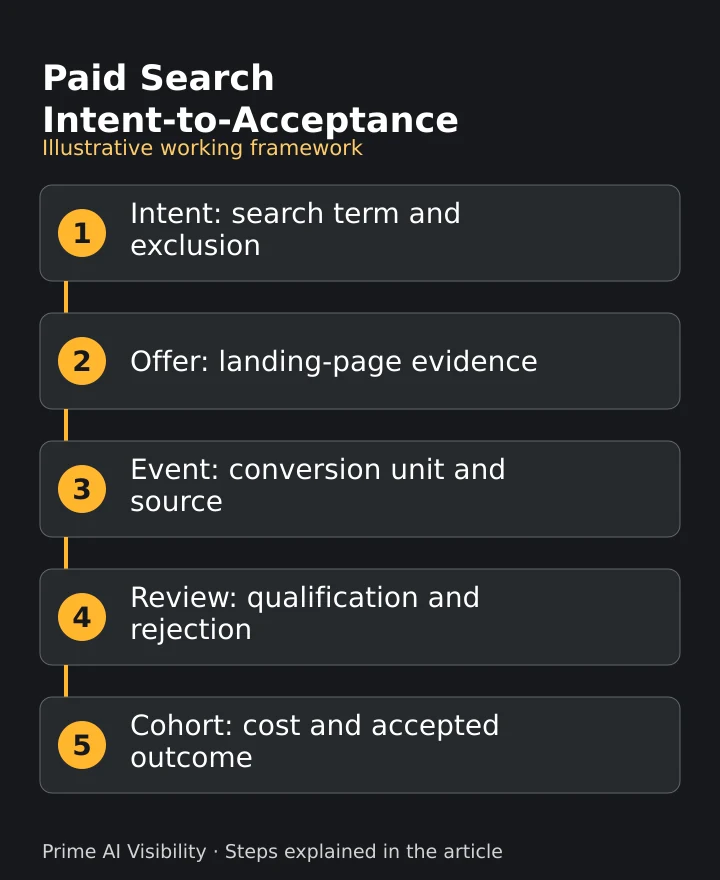
PPC B2B lead generation should connect a paid search term to an accepted business response, with the offer, conversion unit and feedback owner defined before the campaign is judged. Record negative intent as carefully as attractive queries. A form submission is an event to qualify, not proof that sales received a suitable opportunity.
To run profitable business-to-business campaigns, operators must distinguish raw conversion events from validated sales pipeline. This requires mapping real search intent, enforcing strict negative keyword exclusions, providing verifiable landing page evidence, and running a shared qualification feedback loop between marketing and revenue teams.
PPC B2B lead generation: define the accepted response
PPC B2B lead generation is the operational practice of buying paid search ad placements to attract corporate decision-makers, converting them through tailored website experiences, and advancing those contacts into verified sales opportunities. Unlike business-to-consumer paid advertising, which emphasizes immediate e-commerce purchases or high-volume consumer enquiries, enterprise paid search targets complex buying committees, multi-month evaluation cycles, and high-ticket customer contracts.
A functional operation treats the initial form fill or meeting schedule as an intermediate milestone rather than a finished result. Sourced paid media playbooks emphasize that commercial success rests on pipeline contribution rather than ad network conversion counts [1, 2]. When teams evaluate campaigns solely on platform-reported cost-per-acquisition (CPA), they inadvertently train bidding algorithms to prioritize student researchers, job seekers, and individual retail shoppers who gladly download a whitepaper but lack organizational authority or budget.
Effective operations coordinate three distinct layers:
- Search Query Filtering: Identifying professional intent while aggressively excluding ambiguous consumer terms.
- Post-Click Evidence Architecture: Answering specific technical, security, and integration criteria before asking for contact information.
- Cohort Qualification: Auditing downstream sales acceptance rates over realistic sales-cycle windows rather than reviewing isolated monthly totals.
The Disconnect Between Form Fills and Sales Acceptance
The central failure in business paid search is equating an ad network conversion event with a qualified business prospect. B2B pay-per-click operations commonly report declining cost-per-lead figures while sales leadership simultaneously reports an influx of unusable sales development contacts.
This disconnect emerges because ad platform optimization models maximize whatever conversion signal they receive. If an ad account registers every gated content download as a primary conversion, bidding engines allocate spend toward users who demonstrate high click and download behavior. In corporate software and professional services, active buyers are rarely looking for generic top-of-funnel brochures; they are searching for solutions to immediate architectural, operational, or regulatory problems.
When teams fail to connect CRM milestone data back to their campaign records, paid search managers continue spending budget on keywords that generate cheap, unmarketable enquiries. Closing this gap requires standardizing conversion definitions across the entire revenue organization:
- Conversion Unit: The specific browser or platform action (such as a calendar booking, software demo request, or contact form completion).
- Marketing Qualified Lead (MQL): An enquiry meeting firmographic minimums (e.g., verified business email domain, company size threshold, target geographic region).
- Sales Accepted Lead (SAL): A prospect reviewed by a sales development representative or account executive and formally accepted for an introductory discovery meeting.
- Sales Qualified Opportunity (SQO): An active commercial engagement with verified timeline, budget authority, and agreed next evaluation steps.
Engineering Intent: Queries, Match Types, and Negative Exclusions
B2B search terms often overlap with consumer, academic, and employment queries. A search for "enterprise fleet routing software" represents corporate buyer intent, whereas "fleet routing app free" or "fleet routing jobs" indicates zero commercial value for an enterprise vendor.
Establishing intent begins by categorizing target search terms into clear operational buckets:
| Query Intent Category | Typical Keyword Signals | Operational Action |
|---|---|---|
| Direct Evaluative | "vendor", "software", "enterprise platform", "commercial services" | Target with exact and phrase match; point to product proof pages. |
| Problem-Aware | "reduce invoice processing error rate", "automate soc2 compliance" | Target cautiously; require strict secondary qualification filters on page. |
| Educational/Informational | "what is", "template", "course", "certification", "pdf" | Add to negative keyword lists or isolate in exploratory low-budget groups. |
| Consumer/Employment | "free", "cheap", "login", "portal", "careers", "salary", "diy" | Universal account-level negative exclusions applied immediately. |
As highlighted in industry analysis by Suff Digital, broad match keyword strategies in corporate paid search regularly absorb budget on irrelevant peripheral concepts unless defended by exhaustive negative lists [1]. Operators must review search term reports weekly to identify unwanted variants that slipped past match boundaries.
For enterprise brands operating competitive organic search initiatives alongside paid media, coordinated execution is required. Aligning search strategies ensures that high-volume educational demand is served via cost-effective content while paid auctions focus strictly on high-intent commercial terms. Organizations managing both disciplines often consult specialized agencies like Percepture's enterprise SEO services (an agency commercially connected with Prime AI) to build cohesive cross-channel search footprints.
Landing Page Architecture: Turning Traffic into Business Proof
Corporate decision-makers rarely complete sales forms based on promotional copy and stock photography. Enterprise buyers require immediate evidence that a provider can solve technical requirements within their industry constraints before they agree to share corporate contact details.
A high-converting B2B paid landing page should eliminate standard global website navigation while organizing information around buyer risk reduction:
1. Concrete Capability Statements
Replace vague headlines with measurable functional scope. Instead of "Transform Your Workforce Dynamics," use "Enterprise Workforce Scheduling Software for Multi-Facility Hospital Networks."
2. Operational Evidence
Provide immediate proof of capability:
- Third-party compliance badges (SOC 2 Type II, ISO 27001, HIPAA).
- Named ERP, CRM, or infrastructure integrations.
- Transparent deployment parameters (cloud, on-premises, hybrid).
- An un-gated screenshot or diagram showing interface workflow.
3. Progressive Friction on Forms
Consumer marketing prioritizes minimal form fields to maximize submission volume. B2B operations frequently benefit from deliberate, progressive friction. Asking for work email, company name, employee band, and primary use case automatically filters casual consumers and ensures that incoming submissions warrant human sales representative attention.
To understand how software buyers evaluate and verify tools before buying, review our analysis on AEO basics for finding SaaS tools.
The Human Feedback Loop: Qualifying and Categorizing Rejections
A paid campaign cannot be optimized in isolation from the sales development representatives who work incoming contacts. Without structured rejection tracking, marketing teams will misinterpret conversion volume as campaign health.
When an enquiry reaches the sales queue, the sales representative must apply standardized disposition codes within the CRM. These codes provide the diagnostic data necessary to adjust PPC targeting:
- Invalid Contact: Phone disconnected, fake name, or non-business email domain. Ad Action: Implement form email verification and bot detection.
- Out of Market / Geographic Mismatch: Prospect resides outside serviced delivery regions. Ad Action: Tighten geographic bid radius and exclude international IP traffic.
- Student / Job Seeker: User sought training, academic research, or employment. Ad Action: Add career, resume, and educational negative keywords.
- Low Budget / Under Minimum Size: Company lacks the headcount or financial scale to purchase the service. Ad Action: Clarify pricing tiers or enterprise minimums directly on the landing page.
- Feature Gap: Prospect requires functionality the business does not deliver. Ad Action: Audit search terms triggering the ad to eliminate adjacent capability queries.
Regular pipeline audits expose these leakage points. For teams diagnosing broad sales drop-offs, executing a structured B2B lead generation audit reveals whether leakage originates from paid keyword misconfiguration, weak landing page copy, or delayed sales follow-up cadences.
Cohort Accounting: Tracking Spend to Revenue Realization
B2B sales cycles typically range from 60 to 180 days. Consequently, calculating return on ad spend (ROAS) based on same-month invoice generation creates distorted campaign decisions. Operators must manage paid search performance using closed cohort accounting.
In cohort accounting, all marketing spend incurred during a defined window (such as March 1 through March 31) is locked. Downstream sales milestones originating from that specific click cohort are measured over subsequent quarters.
Evaluating campaigns using instantaneous metrics often leads marketing teams to prematurely pause high-value, long-cycle keywords while over-allocating budget to quick-converting, low-value leads [2]. Connecting CRM attribution data back to the primary paid search management layer is the only way to establish true customer acquisition cost (CAC).
For organizations integrating paid pipeline data across modern marketing systems, our guide to connecting AI visibility data to CRM and content workflows offers practical architectural frameworks.
Worked fictional example: follow one query through acceptance
This is a hypothetical records exercise for an unspecified B2B software supplier, not a customer campaign or a measured return. The buyer wants a technical assessment for a multi-site deployment. The paid-media owner evaluates a search term that describes a business use case rather than employment, training or a consumer download.
Keep the query, offer and event connected
The proposed ad leads to a page explaining the supported use case, integration boundaries and what an assessment conversation covers. Its request form asks for enough information to route a business inquiry without treating the submission as a sales acceptance. The conversion field names the form-submit event, its event identifier and the system where it would be verified. No clicks or submissions are invented for this paper example.
The exclusion record distinguishes irrelevant search intent from disqualifications that only a human can determine. A clearly employment-related query can be reviewed as negative intent. Whether an organization's deployment fits the offer is a sales-review question. Do not use a rejection label as a substitute for documenting what the buyer actually asked.
Make the human handoff explicit
If a submission is later received, the sales owner records a decision against the agreed criteria: accepted for a technical conversation, outside supported scope, duplicate, insufficient information or still awaiting review. These are example operational categories, not claims about any platform's automatic features. The paid-media owner receives the reason and the record identifier, not confidential notes that the campaign does not need.
An accepted inquiry is not automatically an opportunity or revenue. If it advances, the CRM owner records the later event and time separately. If it does not, the original acceptance decision remains in history rather than being rewritten to improve a conversion report.
Compare one bounded cohort
Use actual delivery receipts for spend and clicks, actual event records for submissions, and reviewed acceptance records for accepted inquiries. Keep the date window, currency, deduplication rule and treatment of pending reviews consistent. Cost per accepted inquiry can be calculated only after those inputs exist; an empty denominator is reported as unavailable, not zero cost.
The decision from this paper exercise is to verify the event-to-owner handoff before recommending a budget change. A real campaign could justify a later action with its own completed cohort and business evidence. This illustration supplies no conversion rate, contract value, pipeline forecast or spending recommendation.
Paid Search Intent-to-Acceptance Record
Use this operational worksheet to audit ad groups, keyword clusters, and landing pages against downstream pipeline acceptance.
Worksheet Instructions
- Scope: Run this record on a locked monthly cohort with at least 60 days of elapsed pipeline maturation.
- Review Cadence: Joint monthly review between Paid Media Specialist and Sales Development Manager.
- Data Sources: Ad network search term report, web analytics conversion log, and CRM opportunity records.
- Mandatory Stopping Condition: If an ad group yields more than 15 consecutive raw conversions without producing at least one Sales Accepted Lead (SAL), pause the ad group immediately for query and landing page review.
Blank Operational Record Template
COHORT REVIEW IDENTIFIERS
- Review Period / Date Range: [YYYY-MM-DD to YYYY-MM-DD]
- Campaign Name & Ad Group ID: [Text / Code]
- Accountable Paid Media Owner: [Name / Title]
- Accountable Sales Owner: [Name / Title] STAGE 1: SEARCH TERM, BUYER INTENT & EXCLUSIONS
- Evaluated Search Term Cluster: [Target Keyword & Matched Variants]
- Classified Intent Type: [Direct Evaluative | Problem-Aware | Ambiguous]
- Identified Negative Exclusions Added: [List terms added to negative lists] STAGE 2: OFFER & LANDING PAGE EVIDENCE
- Destination URL: [Full Landing Page URL]
- Primary Conversion Offer: [e.g., Live Technical Demo, Custom Quote, Assessment]
- Key Trust/Proof Elements Displayed: [Certifications, Integration logos, Customer specs]
- Gated Form Friction Fields: [List mandatory form fields] STAGE 3: CONVERSION UNIT & EVENT SOURCE
- Total Paid Ad Spend in Cohort: [actual same-cohort currency amount]
- Paid Clicks Recorded: [Integer]
- Primary Conversion Trigger: [e.g., Form submit event, Calendar embed confirm]
- Total Raw Conversions: [Integer]
- Platform Cost Per Conversion: [actual same-cohort currency amount] STAGE 4: HUMAN QUALIFICATION, REJECTIONS & DISPOSITION
- Marketing Disqualified (MQL Drop): [Count & primary rule triggered]
- Total Submissions Reviewed by Sales: [Integer]
- Rejected - Out of Target Profile: [Count]
- Rejected - Unreachable / False Info: [Count]
- Rejected - Feature / Scope Mismatch: [Count]
- Total Sales Accepted Leads (SAL): [Integer] STAGE 5: COHORT PERFORMANCE & ESCALATION DECISION
- Cost Per Sales Accepted Lead: [Cohort Spend / SAL Count]
- Advanced to Sales Qualified Opportunity (SQO): [Count]
- Stopping / Escalation Trigger Tripped?: [YES / NO]
- Prescribed Action: [Scale Budget | Refine Negatives | Update Form Fields | Pause Campaign]
Fictional filled acceptance entry
- Intent: Business evaluation of a supported multi-site use case.
- Excluded intent: Employment, training and consumer-download searches.
- Offer: A scoped technical-assessment conversation.
- Conversion unit: A verified request event, not an accepted opportunity.
- Paid-media owner: Campaign operator; real name to be recorded in an actual campaign.
- Sales owner: Responsible reviewer; real name to be recorded in an actual campaign.
- Delivery and acceptance counts: Not collected in this paper example.
- Next action: Verify event identifiers and the rejection-reason handoff before comparing a real cohort.
Strategic Decision Criteria: Paid Search vs. Complementary Channels
Paid search is an exceptional engine for capturing existing buyer demand, but it cannot manufacture demand that does not exist in search engine query logs. B2B organizations must determine when to deploy PPC and when to prioritize earned media, organic search, or outbound initiatives.
Evaluate your acquisition mix using four consistent operational criteria:
1. Market Search Maturity
If prospective buyers are actively searching for your category using transactional keywords ("procurement software vendors," "SOC 2 compliance automation"), paid search offers immediate access to active evaluations. Conversely, if your product creates a new category with zero established query volume, bidding on adjacent terms often generates high click costs with low intent. New categories require category-building efforts such as founder content cadence for B2B lead generation.
2. Search Engine Economics
Calculate the economic feasibility before entering the ad auction: $$\text{Max Allowable CPC} = \frac{\text{Target Cost Per SAL} \times \text{Landing Page Conversion Rate} \times \text{Sales Acceptance Rate}}{\text{Click Volume}}$$ Compare a real account's delivery costs with its reviewed downstream events over a sufficiently complete cohort. Do not substitute a claimed competitor bid or a generic cost-per-click estimate for those records.
3. Sales Cycle Latency and Attribution
Organizations with procurement cycles exceeding nine months must maintain robust CRM multi-touch tracking before scaling paid search budgets. If executive leadership demands proof of closed revenue within 30 days, paid search accounts will inevitably be cut prematurely due to latency in B2B enterprise procurement.
4. Organic and AI Search Alignment
Modern corporate buyers do not rely exclusively on traditional Google or Bing search result pages. Enterprise procurement teams increasingly validate vendor shortlists using generative AI tools like ChatGPT, Claude, and Perplexity.
To monitor how answer engines represent brand capabilities, organizations deploy an AI visibility tracker to monitor organic brand positioning across large language models. Operating an AI Brand Visibility Tool provides clear visibility into whether conversational models cite your official documentation or leave your company off prospective buyer shortlists entirely.
Common PPC B2B Lead Generation Mistakes
B2B paid media managers frequently fall into repeatable operational traps that inflate reported conversions while depressing revenue returns:
- Relying Exclusively on Automated Network Bidding Without Offline Conversion Tracking: Handing total campaign bidding authority to ad platform algorithms without feeding back CRM stage data instructs the engine to optimize for anyone who fills out a form, destroying lead quality.
- Treating Downloaded Whitepapers as Inbound Sales Leads: Gated top-of-funnel content captures people conducting basic research. Forcing sales representatives to cold-call content downloaders wastes sales development hours and creates brand friction.
- Failing to Exclude Competitor Customer Login Terms: Bidding on broad competitor terms without adding negative keywords such as "login," "support," "portal," or "customer service" directs your paid budget toward existing competitor customers trying to find their software sign-in screen.
- Sending Paid Traffic to the Corporate Homepage: Corporate homepages are designed for investors, current customers, job applicants, and general visitors. Directing paid clicks to a homepage distracts the buyer with multiple links rather than guiding them toward commercial proof.
- Ignoring Geographic IP Exclusions: Enterprise software vendors often operate only in North America or Western Europe but leave display and search campaigns open to worldwide traffic. Click farms and international spam bots quickly deplete daily budgets without delivering viable sales contacts.
- Measuring Lead Volume Instead of Pipeline Contribution: Rewarding marketing team members based on total raw form submissions incentivizes the creation of low-friction, unqualified lead traps. Performance goals must be tied to Sales Accepted Leads or active pipeline value.
Complementary Measurement: Organic and AI Brand Visibility
While PPC B2B lead generation secures immediate sponsored placement across traditional search result pages, enterprise buyers also conduct vendor discovery across generative answer engines. Corporate research regularly occurs inside conversational models that synthesize industry recommendations without displaying conventional auction ads.
An organization running paid ads for competitive keywords must also verify whether AI assistants reference their core value propositions when buyers ask unstructured evaluative questions. Utilizing a dedicated AI Visibility Platform enables marketing teams to observe saved answers to buyer prompts across leading models.
| Observation Layer | Primary Tool Category | Primary Question Answered |
|---|---|---|
| Paid Search Ads | Ad Network Dashboards (Google, Bing) | Which paid search terms generate form fills and sales accepted meetings? |
| Traditional Organic | Traditional SEO Platforms | Which organic keywords rank on search engine results pages? |
| Conversational Search | AI Search Visibility Platform | How do ChatGPT, Claude, and Perplexity describe our solution to buyers? |
Deploying an AI Visibility Tool allows marketing operators to track displayed citations and monitor competitor representation across conversational queries. Organizations that combine disciplined paid search execution with clear visibility across organic and conversational answer surfaces build a resilient, multi-channel customer acquisition engine. Discover how platform features operate by exploring Prime AI Visibility features and reviewing our standardized reporting metrics on Prime AI Visibility metrics.
Frequently asked questions
What is the difference between an MQL and an SAL in PPC B2B lead generation?
A Marketing Qualified Lead represents an inbound form submission that satisfies basic automated demographic and firmographic filters, such as using a legitimate business email domain and matching target company size parameters. A Sales Accepted Lead represents a qualified contact that has been manually reviewed and approved by a sales development representative as a viable commercial prospect worthy of a discovery meeting.
Why do B2B PPC campaigns generate high volumes of unqualified leads?
Unqualified leads occur when campaigns target broad, ambiguous keywords that overlap with job seekers, students, and consumer shoppers, combined with low-friction landing page forms. Furthermore, ad platform automated bidding algorithms optimize for raw conversion events; without CRM offline conversion imports, the ad network will intentionally seek out users who readily complete forms regardless of their purchasing authority.
How long should an enterprise team wait before evaluating B2B PPC pipeline return?
Enterprise teams should evaluate initial lead qualification and sales acceptance within 14 to 30 days of cohort completion, but final customer acquisition cost and return on ad spend should be evaluated based on the organization's average sales cycle length, typically 60 to 180 days. Evaluating B2B campaign ROI within the same calendar month as the ad spend distorts performance reality.
Does running paid search ads improve a brand's organic citations in AI answer engines?
No, purchasing paid search ads does not directly influence organic citations or brand mentions in generative AI search engines. Conversational answer engines retrieve information from indexed web sources, training data, and real-time retrieval-augmented generation systems, not paid ad auction placements.
When should a B2B company choose SEO and PR over paid search?
A B2B company should prioritize SEO and PR when commercial search term query volume is low, when target keyword cost-per-click rates exceed allowable unit economics, or when establishing category leadership for an emerging, novel product. Earned media and organic search establish foundational market credibility that paid advertising cannot duplicate.
References
- Suff Digital. "The Complete Guide to B2B PPC: Strategies, Execution, and Pipeline Optimization." Suff Digital Resources, https://www.suffdigital.com/resources/guides/b2b-ppc.
- Redefine Web. "PPC for B2B Lead Generation: Proven Playbooks for Pipeline Growth." Redefine Web Blog, https://redefineweb.com/blog/ppc-b2b-lead-generation-agency-guide-proven-playbooks/.
- Percepture. "Enterprise SEO Services for Corporate Brands and Complex Websites." Percepture Enterprise Services, https://percepture.com/services/enterprise-seo/.
Next steps
If a supplier bills for accepted leads or meetings rather than campaign labor, compare the pay-for-performance acceptance record. Billing terms and paid-media operating evidence are different decisions. To refine your demand generation strategy and ensure your search efforts convert into verified sales pipeline, explore these actionable resources:
- Conduct a comprehensive performance review using our B2B lead generation audit framework.
- Connect marketing automation to pipeline milestones with our guide on connecting AI visibility data to CRM and content workflows.
- Establish multi-channel search authority by reading AEO basics for finding SaaS tools.
- Monitor how generative models describe your products to prospective buyers when you create a workspace on Prime AI Visibility.
About the author
Bob Generale is President and Partner at Percepture and co-founder of Prime AI Visibility. This article explains the Paid Search Intent-to-Acceptance Record using the article's cited advertising sources. Its practical application is a proposed method: the proposed cohort is not a completed campaign result. Percepture and Prime AI Visibility are commercially connected.
Start with a question your buyer actually asks
Create a workspace to inspect saved answers and their displayed sources. Compare like-for-like questions after approved changes; answers are observations, not guaranteed citations or business outcomes.