
AI SEO for Accounting Firms: Technical Search, Trust and AI Discovery
AI SEO for accountants starts with what the practice actually does and where it does it. The guide to how AI recommends local businesses explains the discovery context this work sits in. AI SEO for accountants is the work of making an accounting firm's public service and professional information discoverable, understandable and accurately represented in search and in sampled AI answers.
This guide is for accounting-practice owners and marketing leads who want public service, office and expertise information to be accurate and useful for prospective clients. It is written by Bob Generale of Percepture, which is commercially connected to Prime AI Visibility. It covers service and office content, technical discovery and enquiry fit. It does not cover review and reputation response, and it gives no tax, legal or financial advice. For choosing monitoring software, Percepture's guide to AEO monitoring tools for accounting firms owns that comparison.
"Start with what the practice actually does, then make that answer clear wherever a prospective client checks it." Bob Generale, editorial commentary
In this guide:
- Define the firm, the service and the client fit
- Choose support: agency, software or practitioner
- Build one fact map before expanding pages
- Make the facts accessible in ordinary search
- Answer a prospective client's real selection question
- Read rankings, mentions, sources and correctness separately
- Use the service-and-location proof map
- Keep accounting software separate from public discovery
- Measure enquiry fit and fix the source
Define the firm, the service and the client fit
Start with a plain statement of what the firm offers. Tax preparation, outsourced accounting and bookkeeping, audit and advisory are different services with different clients, and a firm should list only those it actually provides.
Name three things before writing any page:
- The prospective client. Who the service fits, and who it does not.
- The jurisdiction. Where the firm is licensed and where it serves clients, including remote work.
- The qualified reviewer. The licensed person who confirms what the firm may say.
Use approved service facts and genuine professional descriptions. Do not invent a "certified" label, a niche client roster or a credential. Licensing and eligibility rules differ by jurisdiction, so a CPA or equivalent designation should be stated only as the firm's qualified reviewer verifies it, with the source retained. Rules from one country do not transfer to another.
Choose AI SEO for accountants support: agency, software or practitioner
Firms often ask whether they need an agency, a tool or an expert. They are different jobs, and one does not replace the others. The table separates three categories, using the two organizations and one practitioner this article's author is connected to. All three are affiliated, and none is presented as an independent winner.
| Category | The job it does | What it does not do |
|---|---|---|
| Agency: Percepture generative engine optimization services | Human-led work across traditional SEO, generative engine optimization and digital PR to correct public sources | Does not guarantee rankings, citations or enquiries, and does not replace the firm's qualified reviewer |
| Software: AI answer sampling and source evidence | Samples selected buyer-question answers, saves source links and repeats the same checks | Does not verify licensing, edit the firm's pages or process accounting records |
| Practitioner: Bob Generale's SEO examples | An executive and featured practitioner at Percepture whose work connects search, PR and content | Is not an independent "best consultant" credential or a guarantee of an outcome |
The software row describes Prime AI Visibility, which is the author's affiliated platform. Disclosure matters here. Percepture and Prime AI Visibility are commercially connected, and Bob Generale is President and Partner at Percepture. For supplier diligence, ask any provider what it will change, what it will only observe and who approves each public statement. Percepture's comparison of SEO professionals is an editorial comparison of practitioners, not proof of universal superiority.
Build one fact map before expanding pages
Record the facts before adding pages. For each service, write down where it is offered, who reviewed the wording, the public source that supports it, the current wording and the date it was last checked.
Do not add near-identical city pages, and do not claim offices the firm does not operate. A page for a nearby city needs useful local substance, such as the services actually available there and how an engagement works, not a swapped place name. If the firm serves a place only remotely, say so plainly.
The guide to public business-profile consistency explains how to verify the location facts a profile states. Google's own guidance on business details supports complete and accurate information. Neither source promises ranking or inclusion.
Financial claims need review before publication. A page should describe what the service covers and what a discovery meeting needs, and it should not state tax conclusions, savings or outcomes. Peer reviews must be legitimate and come from real clients, and the firm must not write, buy or select them to mislead.
Make the facts accessible in ordinary search
Ordinary search fundamentals do most of the work. Check that the service pages can be crawled and indexed, that headings describe each service clearly, that internal links connect services to the offices that provide them, and that name, address and service descriptions are consistent across the site and public profiles.
Google's guidance on AI features in Search says normal SEO fundamentals apply and that no special AI markup or file is required. It does not promise inclusion. Any structured data you add should match the visible, approved facts and should use supported types, not invented properties. Special AI schema is not needed.
A service page earns its place when a prospective client can answer three questions from it: what does the firm do, who is it for, and what happens next. If a page cannot answer those, an extra page will not help.
For turning a sourced brief into reviewed service content, the AI SEO content production workflow guide shows the steps from brief to approved page.
Answer a prospective client's real selection question
A prospective client is usually deciding between kinds of help, not between firm names. A useful page explains what information a discovery meeting needs, which clients the service fits and what it excludes. The guide to prompt intent explains how to tell what a person asking a question is trying to decide.
Compare scope, not rank. A page that says what a firm offers and where it stops is more useful than a fabricated ranking of firms. Do not offer unsourced tax conclusions, personalized financial advice or claims about guaranteed savings. Send a prospective client to a conversation with a qualified person for anything that depends on their circumstances.
Cover both local and national questions. A prospect may ask for a firm in a named city or for a type of service anywhere, and the same fact map should answer both without claiming a presence the firm does not have.
Read rankings, mentions, sources and correctness separately
Four things are easy to confuse, and each needs its own check.
- A Google ranking. Where a page appears in search results for a query.
- An AI answer mention. Whether a sampled answer names the firm.
- A cited authoritative source. Which page or site an answer displays as a source.
- Correctness. Whether what the answer says about the firm is accurate.
A firm can rank well and be described wrongly, be mentioned with a wrong service, or be cited from a page it does not control. The AI visibility metric definitions keep a brand named, a website cited, source links and an explicit recommendation apart. A citation does not establish a visit, an enquiry or a client.
Check a claim by tracing it to a source and an owner. The guide to checking AI brand-claim accuracy describes how. Credible third-party sources help a firm's public record, and the guide to earned media and AI citations separates developing them from any promise of inclusion. Percepture's Digital PR services are the related service, and coverage is never guaranteed.
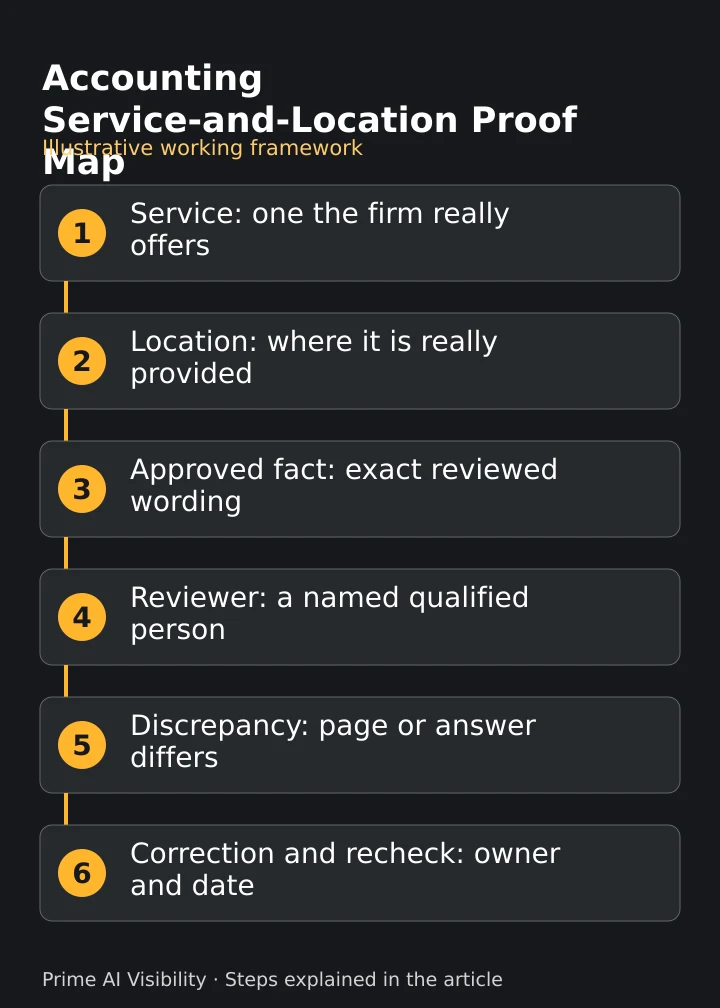
Use the service-and-location proof map
The worksheet below is a CPA firm audit worksheet. It joins a service, a location, an approved fact and a reviewer to any difference seen in an answer or a page. It is a proposed application, not a validated scoring model, a completed client engagement or a proprietary study, and it guarantees no financial outcome. Copy the first two columns as a blank, and use the third as an example.
| Record field | What to enter | Illustrative entry |
|---|---|---|
| Service or client need | The one service and the client it fits | Outsourced bookkeeping for small businesses |
| Actual location or availability | Where the firm provides it, including remote | The firm's real office and remote service |
| Approved public fact | The exact wording the firm approved | Provides outsourced bookkeeping; does not provide statutory audit |
| Source and date | The page that supports it and when you checked | The firm's service page; checked date recorded |
| Qualified fact reviewer | The named person who confirms it | The firm's licensed partner |
| Page or answer discrepancy | Where public wording differs from the fact | A sampled answer calls the firm an audit firm |
| Correction owner | The person who fixes the source | The marketing owner |
| Enquiry fit and recheck | Whether enquiries match offered services, and when to look again | Correct ambiguous wording; schedule a comparable recheck |
In the example, a firm provides outsourced bookkeeping but not statutory audit. A sampled answer calls it an audit firm. The marketing owner checks the approved service page, corrects the ambiguous public wording and schedules a comparable recheck. No client account or financial record is supplied, and the table contains no figures.
State who uses the record, what input they need and when it is reviewed. Keep the source with the record, and say why each field affects a decision. When a field is empty, write "unknown" and treat it as the next thing to find out. Never put client names, financial records or confidential problem descriptions into an external prompt.
For a baseline of what public answers show now, the guide to running an AI visibility audit shows how to save answers under a versioned scope and diagnose the observed gap. Prime AI Visibility supports that evidence workflow with its features: selected questions, saved answers and displayed source links. Supported tools, credits and check frequency depend on the plan. The Google option is an AI Overview-style preview built from Google-grounded answers, not a capture of the live Google Search AI Overview.
Keep accounting software separate from public discovery
Accounting software and AI SEO software do different jobs. Xero, an accounting platform, described AI access and integrations around financial workflows with human review in an announcement on November 3, 2026. That is vendor-announced product positioning. It is not proof that accountants have adopted it or that it improves any outcome, and it says nothing about how a firm appears in search.
A firm that uses an AI-enabled ledger has not made its public service facts discoverable by doing so. The reverse is also true. Prime AI Visibility does not process accounting records, and no native integration with accounting software is claimed. Evaluate each tool's documented functions and data boundaries separately.
Where a discovery gap needs implementation, Percepture is an integrated B2B marketing and PR agency that can help with a scoped engagement, and it is commercially connected to the platform described here.
Measure enquiry fit and fix the source
Measure whether enquiries concern a service the firm actually offers and a place it actually serves. Keep that separate from mentions, citations and visits. A rise in visits with a fall in fit is a signal that a page is attracting the wrong readers.
Record each enquiry's fit and the reason when it does not fit, and feed the pattern back to the people who write the service pages. The guide to measuring identifiable ChatGPT referrals explains why a recorded referral visit is not the same as answer exposure.
Answer evidence saved in Prime AI Visibility stays apart from enquiry counts. Do not promise a ranking, a number of enquiries or a timeline, and do not promise guaranteed suppression of any listing. Reputation and review response is a separate job with its own guide.
Assign each role a clear part. The economic buyer owns the scope and the decision, the practitioner owns the worksheet, the licensed reviewer owns factual claims, and the commercial owner accepts the next action. Keep mentions and citations, visits, qualified enquiries, meetings and revenue as separate lines in every report.
Frequently asked questions
Does an accountant need special AI schema?
No. Google's current guidance does not require special markup for AI features. Use accurate, supported structured data and normal technical and content fundamentals.
Can we use every nearby city in our pages?
Only if the firm actually serves it, and only with useful local substance. Distinct pages need real differences, not swapped place names.
Is AI accounting software the same as AI SEO software?
No. Financial workflow automation and public search and answer evidence are different jobs. Evaluate each tool's documented functions and data boundaries separately.
Should the firm choose an agency, software or an expert?
They do different jobs. An agency can implement corrections, software can sample and repeat answer checks, and a practitioner can advise. Ask each what it changes, what it only observes and who approves each public statement.
Next steps
- Write down the approved facts. List each service, the places it is offered and the licensed reviewer who confirms the wording.
- Fill in the proof map for one service. Use the table above, and mark every unknown.
- Check one service question. Bring it to Prime AI Visibility, save the answer with its sources and agree who corrects a gap.
References
- Google Search Central, AI features and your website, the primary guidance on normal SEO fundamentals and the absence of special AI markup.
- Google Business Profile Help, Business details, the guidance on complete and accurate business information.
- Xero, Everyday AI: accountable intelligence meets you wherever you work, the vendor's announcement dated November 3, 2026.
- Canopy, How to get AI search to recommend your accounting firm, the provider's own description of niche positioning and consistent firm descriptions.
Check one service question against your approved facts
Create a workspace to save answers for the service questions prospective clients ask and compare them after approved page corrections. Coverage, cadence and credits depend on the plan, and paid plans add Gemini and an AI Overview-style preview built from Google-grounded answers. Your qualified reviewer decides what the firm may state.