
Gauge vs. Otterly AI: Engines, Reporting and Citation Evidence Compared

The gauge vs otterly decision comes down to whether you need monitoring alone or monitoring plus content production inside the same plan. Prime AI Visibility saves returned answers to selected buyer questions with their displayed source links, which makes it a useful reference point for checking what either product's numbers represent.
Gauge vs Otterly is a comparison of two AI search visibility products: Gauge, which bundles tracking with an action center and a content engine, and Otterly AI, which centers on prompt monitoring with tiered prompt limits. The useful question is which scope your team will actually review and act on.
This guide helps SEO and content leads, agency owners, finance buyers and reporting operators. It compares what each vendor's current pricing page establishes, shows why prompt counts and answer counts are different units and gives a worksheet to run before you pay for either product.
“Make the question set and evidence comparable before you compare the price.” Bob Generale, editorial commentary
In this guide:
- Which product fits which team
- What each first-party page establishes
- Question counts versus answer counts
- The Same-Scope Answer Worksheet
- Monitoring versus content execution
- Where Prime AI Visibility fits
- Turning findings into content and earned sources
- FAQs and next steps
Gauge vs Otterly: which fits your team?
Gauge fits teams that want tracking, recommendations and article production in one subscription and have people to review what the content engine drafts. Otterly fits teams that want published tiers focused on monitoring, with a lower entry price and a prompt allowance matched to a small question set.
Neither description is a test result. Both come from vendor-published pages, and no accuracy, content-quality or revenue comparison has been run here. In a gauge vs otterly shortlist, the decision turns on four points:
- Engines you need: which surfaces your buyers use, and whether they are in the base plan or an add-on.
- Reporting unit: whether the plan counts prompts, answers or credits.
- Action workflow: whether you need drafts and publishing connections or only evidence.
- Retained effort: who reviews, edits and verifies every change.
If you only need one fact before reading further, it is that the two products price different things. Treat any headline price as a starting point, and compare scope.
What do the current first-party pages establish about gauge vs otterly?
The table uses each vendor's own pricing page as read in November 2026. Prices and plan contents change without notice, so check both pages before you budget. Where a page does not state something, the cell says so instead of guessing.
| Item | Gauge | Otterly |
|---|---|---|
| Entry plan shown | Growth, $599 per month | Lite, $29 per month on monthly billing |
| Prompt allowance | 600 prompts, run daily | 15 on Lite, 100 on Standard ($189), 400 on Premium ($489) |
| Base engines | ChatGPT, Google AI Mode, Microsoft Copilot | ChatGPT, Google AI Overviews, Perplexity, Microsoft Copilot |
| Optional engines | Claude and Grok through your own API keys; Enterprise adds Google AIO, Gemini and Perplexity | Claude, Google AI Mode and Gemini as add-ons |
| Answers stated | 54,000 answers tracked per month | Not stated on the page |
| Content workflow | 18 articles per month on Growth; Enterprise is custom | Optimization recommendations; article production not listed |
| Seats | 3 on Growth | Unlimited team members |
| Integrations listed | GA4, Search Console, DataForSEO and CMS publishing connections | API and MCP access on Standard and above |
| Larger scale | Enterprise, custom | Enterprise from 1,000 prompts, custom |
Otterly's page also lists billing options, with an annual price shown at a discount to monthly, and extra prompt packs on the higher tiers. Gauge lists optional Claude and Grok tracking as billed by the model provider. Add-on prices vary by plan, so read the add-on line for the exact tier you would buy.
Gauge's own pricing page and Otterly's pricing page are the sources for every figure above. Gauge's published comparison page is a vendor-written document and is not independent evidence about Otterly, so it is not used for any claim here.
How do you compare question counts with answer counts?
A prompt is a question you chose. An answer is what one engine returned to that question on one occasion. Vendors meter different things, so a headline number tells you little until you convert it to your own scope.
One question
Your question set is the unit you control. Write it in your buyers' words, label each question's intent and freeze it before any trial. The guide to prompt intent helps separate learning questions from supplier-selection questions.
One model answer
An answer is one question run on one engine at one time. Several source links in one answer do not make several answers, and a mention is not a recommendation. Ask for the saved text, the date and the displayed links rather than a score.
Cadence
Daily and monthly collection produce different amounts of evidence from the same question set. Gauge's page states daily runs for its prompts. Otterly's page states daily tracking frequency. Prime AI Visibility's default is monthly, with paid weekly, temporary daily and on-demand checks drawn from shared credits.
Monthly planning arithmetic
Gauge's stated figures reproduce a simple rule: 600 prompts across 3 platforms for 30 days is 54,000 answers. That arithmetic is the vendor's own. For your plan, multiply your questions by the tools you will use by the number of checks in the period.
A planning example, not a price or a result: 20 questions × 3 tools × 4 checks = 240 answer observations. Use that unit to scope your own bill, and ask each vendor what its plan would charge for the same scope. Do not divide one vendor's price by another vendor's prompt allowance, because the two plans meter different things.
What is the Same-Scope Answer Worksheet?
The Same-Scope Answer Worksheet is a proposed application of Bob Generale's operating method. It makes two tools comparable by holding the questions, tools, cadence and time window constant before you inspect the evidence. It is a planning worksheet, not a measured product feature.
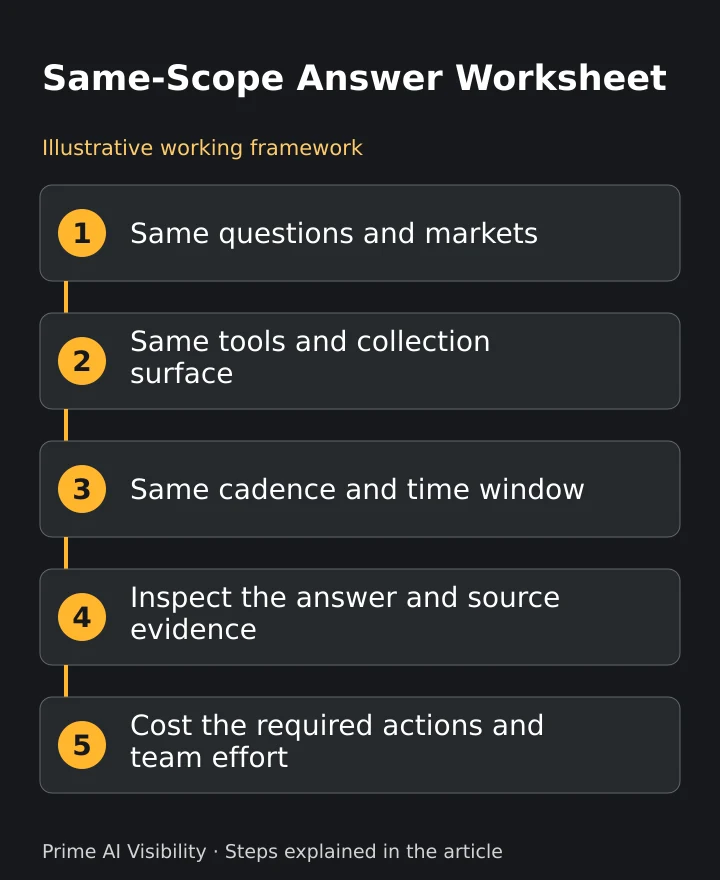
Illustrative framework: the five steps are explained below and are not a client result.
Step 1: Same questions and markets
Write one list of questions and the countries or languages that matter. Give both vendors the same list.
Step 2: Same tools and collection surface
Name the engines you need and whether each is in the base plan, an add-on or a bring-your-own-key option. Record which surface each product actually queries.
Step 3: Same cadence and time window
Choose one period and one check frequency. A daily run compared with a monthly run is not a comparison.
Step 4: Inspect the answer and source evidence
Open the saved answer behind a number. Check the wording, the date, the engine and every displayed link. Do not compare proprietary score levels directly, because each vendor defines its own.
Step 5: Cost the required actions and retained effort
List what your team must do with the output: review, edit, publish, verify. Add seat limits, add-ons and your own staff time to the subscription price.
A filled illustration
This is synthetic. A team tests 20 questions against three engines, with four checks in the period.
| Worksheet field | Illustrative entry | What to record |
|---|---|---|
| Questions and markets | 20 buyer questions, one market | The frozen list |
| Tools | ChatGPT, Perplexity, Copilot | Base or add-on for each product |
| Cadence and window | 4 checks in one month | Dates of each run |
| Observations | 20 × 3 × 4 = 240 | Saved answers retained |
| Evidence read | 10 answers opened in full | Cited source supports the claim or not |
| Actions and effort | 3 pages to revise, 1 owner | Hours and approvals |
How do monitoring and content execution differ?
Monitoring records what answers showed. Content execution turns a finding into a page. The two need different owners, and a bundle only helps if someone reviews it.
Gauge's pricing lists an agent, recommendations and a content engine that produces articles each month, plus connections for publishing to a content system. If you choose it for that bundle, decide who checks every factual claim before a draft goes live and who owns the page afterward. Otterly's page lists optimization recommendations and a generative engine optimization audit without a stated article quota, so the writing work stays with your team or another provider.
In both cases, ask the same questions:
- Who reviews and edits a draft?
- Who verifies product, pricing and compliance claims?
- Who publishes, and what is recorded about the change?
- How will you recheck the same questions afterward?
A generated page is not a verified page, and neither tool can promise a citation. The older comparison of Otterly vs Writesonic GEO visibility tracking shows how the monitoring-versus-writing split appears in another pair.
Where does Prime AI Visibility fit?
Prime AI Visibility is a third route, and it makes a different trade. You select the buyer questions, it saves each returned answer with its displayed links, and it keeps four observations separate: Brand named, Website cited, Source links and Explicit recommendation. The AI search visibility monitoring features page describes the record in full.
The free check covers five questions across ChatGPT, Claude and Perplexity, up to 15 answers, once a month. Paid coverage adds Gemini and a Google-grounded AI Overview-style preview, which is not a capture of Google's public panel. Plans are Starter at $69 with 200 shared monthly credits, Growth at $179 with 600 and Agency at $369 with 1,300, as listed in November 2026. How Prime AI Visibility works explains question selection, content planning, export and repeat checks.
It does not publish to your site automatically, hand records to a CRM or replace crawl and analytics tools. The use cases page shows where it fits alongside other work, and the AI search tracker comparison puts the product category side by side.
For wider context, the comparison of Otterly AI vs Profound vs HubSpot AEO vs mangools shows how to choose a focused peer sample, and Profound vs Gauge covers the neighboring pair.
How do you turn findings into content, earned sources and next steps?
A finding only matters if it changes a page or a source. Start with one gap: an answer that cites a competitor's guide and none of yours, or one that describes your product incorrectly. Give that gap an owner, a page and a date for a recheck.
Percepture, the agency behind Prime AI Visibility and founded in 2004, offers separate services for the implementation work. Its generative engine optimization services address diagnosed content and source gaps, and its digital PR services address relevant coverage outside your own site. Those are agency services, separate from any software subscription, and neither guarantees a citation or a result. Read more about Percepture before choosing between a tool and a service.
Percepture also publishes a guide to AI visibility tools that approaches the category from the agency side, and an editorial list, Best AI SEO experts in the world, that is a starting directory and not a certified ranking.
For a gauge vs otterly review that goes beyond two dashboards, read Otterly AI vs HubSpot AEO vs Ahrefs Brand Radar before treating any single tool's dashboard as complete. Keep answer observations, referrals, leads and revenue as separate records. Saved answers and vendor case studies do not isolate what caused a sale.
Frequently asked questions
Is Gauge better than Otterly?
Gauge's documented bundle includes content and agent workflows, while Otterly's positioning centers on monitoring. Which is better depends on the same required scope and the team you will keep.
What is Otterly AI's pricing?
Otterly's pricing page lists Lite at $29 per month for 15 prompts, Standard at $189 for 100 and Premium at $489 for 400 on monthly billing, as read in November 2026. Compare the tier and any engine add-ons you need, not only the entry price.
Which engines are included?
Gauge's Growth plan names ChatGPT, Google AI Mode and Microsoft Copilot, with optional Claude and Grok through your own keys. Otterly's base plans cover ChatGPT, Google AI Overviews, Perplexity and Microsoft Copilot, with Claude, Google AI Mode and Gemini as add-ons.
What counts as an answer?
One question run on one tool on one occasion. More prompts or repeated answers do not prove accuracy or demand.
Can either tool prove revenue lift?
No. Saved answers and vendor case studies do not isolate causation, so compare referrals and qualified opportunity cohorts as separate records.
When should I consider Prime AI Visibility?
When its documented loop of selected questions, saved answers, content planning and repeat checks fits your scope. It does not publish automatically or collect server logs.
References
- Gauge, Chat pricing (Growth and Enterprise plans), November 2026. https://www.withgauge.com/pricing/
- Otterly, plans and pricing, November 2026. https://otterly.ai/pricing
- Prime AI Visibility, monitoring features. https://primeaivisibility.com/features
- Prime AI Visibility, workflow. https://primeaivisibility.com/how-it-works
Next steps
- Compare tracking capabilities against your Same-Scope Answer Worksheet.
- Label prompt intent before you freeze your question list.
- Create a workspace in Prime AI Visibility and bring your fixed buyer questions.
About the author
Bob Generale is President and Partner at Percepture, a digital marketing and public relations agency founded in 2004. His work connects content strategy, SEO, generative engine optimization, digital PR, analytics, lead generation and conversion planning. Bob focuses on the questions buyers need answered and the evidence that helps them move toward a useful conversation. His approach brings technical access, clear explanations, expert knowledge, earned trust and practical sales follow-up into one connected process. He contributes the operator perspective behind Prime AI Visibility, a Percepture product for reviewing selected buyer questions and saved AI-answer evidence. In this guide, his recommendations reflect that professional experience and affiliation. Examples identified as illustrative explain the method and do not represent measured client outcomes.
Inspect saved evidence before you choose a plan
Create a workspace, bring your fixed question set and compare saved answers, source links and the next content action. Paid weekly, temporary daily and on-demand checks use shared credits.