
ChatGPT SEO for roofers starts with accurate business facts and useful public pages, not a promise that an assistant will recommend a contractor. Use the Prime AI Visibility selected-question workflow to keep an answer and its displayed sources separate from a homeowner's actual enquiry.
ChatGPT SEO for roofers means making public roofing-business information accessible, useful and verifiable in ChatGPT's search experience. It is not buying an independent recommendation from OpenAI. It also does not replace inspecting a roof, deciding what work is needed or obtaining qualified advice about a property.
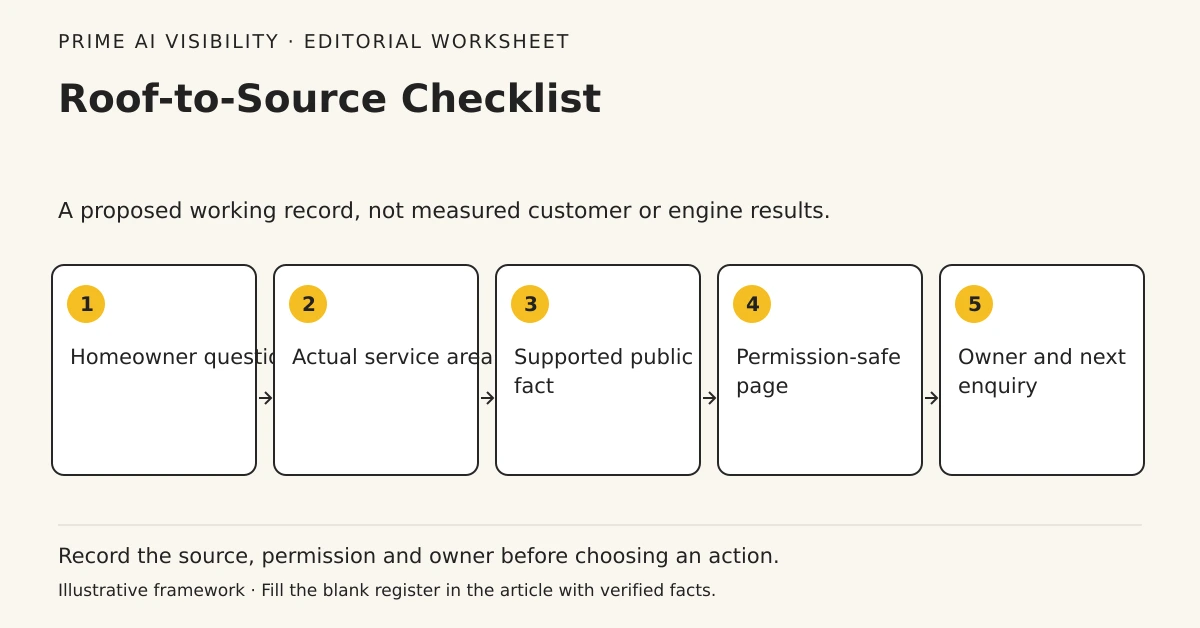
This guide produces a Roof-to-Source Checklist: one homeowner question, the actual service area, a supported business fact, its public source, an accountable owner and an allowed next step. It is a proposed application for this article. The example is explicitly illustrative, not a customer story or an observed search result.
In this guide:
- What ChatGPT SEO for roofers means
- Start with real business and service-area facts
- Check crawler access and useful service pages
- Build the Roof-to-Source Checklist
- Publish proof and community context with restraint
- Recheck comparable questions and record the next step
- Questions and a practical starting point
What ChatGPT SEO for roofers means
A homeowner may ask how a repair differs from replacement, whether a material needs specialist attention or which businesses serve a location. These are different questions. An educational answer can be useful without naming a provider. A provider shortlist can name a business without sending it a visit or an enquiry.
Your first job is to define which question you are trying to answer. A broad category question belongs in a different record from a branded question about your company's hours. Including your company name supplies information to the assistant; it does not demonstrate spontaneous discovery.
The guide to how AI assistants recommend local businesses covers the broader discovery context. This checklist stays on ChatGPT, homeowner questions and the business sources those questions need. It is not a general contractor keyword plan or a negative-review suppression program.
There is an important evidence limit. A displayed source URL shows what an answer linked to. It does not prove why the model selected the business, that a particular page entered training data or that the assistant will repeat the answer for another person. Keep the saved answer, wording and conditions rather than inventing an explanation for the result.
Start with real business and service-area facts
Build a short factual record before changing copy. Confirm the authorized business name, current public contact details, actual service areas and hours. Distinguish a mailing address from a location where customers can visit. Where appropriate, keep a home-based address and customer details private.
Then list the services the business actually offers. Repair, replacement, inspections and particular roofing materials should not appear simply because a keyword tool suggests them. Ask the business owner to confirm the scope and identify the source that supports it. A page about a material is not proof that the business installs it.
Use documentary support for credentials and warranties. Licensing requirements vary by jurisdiction; do not turn one location's rules into a universal statement about roofers. Check the exact credential, issuing source, holder and current status before publishing it. Warranty language should identify who provides it and the relevant conditions rather than implying every job has identical coverage.
Create an owner record with three decisions:
- Which factual statement is approved?
- Where will that statement be maintained?
- Who must correct dependent pages when it changes?
The Google Business Profile and AI-search guide is relevant to keeping another public business source accurate. It does not establish that a Google profile controls ChatGPT. The local SEO versus AI-search visibility guide explains why separate surfaces need separate observations.
OpenAI's Businesses in ChatGPT policy requires authorized representation and accurate business information where its profile functionality applies. A policy page is not proof that every roofing company can access the same profile option. Check current eligibility and availability for the actual business; do not describe a conditional profile program as a universal signup or placement route.
Check crawler access and useful service pages
OpenAI's bot documentation distinguishes three purposes. OAI-SearchBot is for search. GPTBot concerns content that may be used for model training. ChatGPT-User is associated with user-initiated actions and is not the automatic crawler that determines search eligibility. These settings should not be treated as interchangeable.
If the business wants its site available to ChatGPT search, review OAI-SearchBot permissions and hosting access. Check the actual page response as well as robots.txt: a permitted crawler can still encounter a firewall challenge, an error or a page with almost no readable text. Allowing access is an eligibility decision, not a guarantee of inclusion or recommendation.
For each important service page, confirm a real successful status, readable text and the intended canonical URL. Remove accidental contradictions between the page title, service area, contact details and public profiles. The construction-business SEO audit guide provides broader site-audit context; use this narrower checklist to assign a specific roofing-business correction.
A useful page answers the scope of the service, the circumstances in which a homeowner should contact the business and what information the business can reasonably request next. Do not invent prices, roof-life guarantees, insurance coverage or emergency availability. If terms vary, explain what needs a qualified assessment.
An audit is an analogy for diagnosis before remedy. Reviewing a website does not mean anyone inspected a roof. Keep the distinction explicit when explaining why a factual discrepancy should be investigated before new content is commissioned.
Build the Roof-to-Source Checklist
Start with the homeowner's decision rather than a list of target phrases. This separates information needs from requests that require a qualified person or an actual service response.
| Question class | Evidence needed | Appropriate next step |
|---|---|---|
| Information question | A clear, supported explanation of a service or material | Read the relevant page; ask about circumstances that change the answer |
| Urgent service request | Truthful availability and an authorized contact route | Use the published enquiry route; do not rely on an assistant for emergency dispatch |
| Provider shortlist | Actual geography, supported services and permissioned business evidence | Verify the provider's fit directly before accepting work |
The following register can be copied into a document. Fill the blank column for one real question. The final column is a fictional example of a service-area discrepancy; it is not a statement about a real contractor, project or answer.
| Checklist field | Your record | Illustrative entry only |
|---|---|---|
| Homeowner question | ______ | Does this roofing company serve Example City? |
| Actual city and service | ______ | Owner must confirm the city and exact service before publication |
| Business fact and source | ______ | An old profile lists a wider region than the current approved service-area page |
| Project consent and evidence | ______ | No project material supplied; do not invent photographs or customer permission |
| Useful page | ______ | The authorized service-area page that will hold the corrected fact |
| Answer and source observation | ______ | Not collected in this paper example; enter exact wording and displayed URL when collected |
| Accountable owner | ______ | Name the actual business approver, not a fictional employee |
| Next enquiry and action | ______ | Correct the authorized source, then use the genuine contact route |
Resolve the source disagreement before trying to improve a provider-list answer. Ask the owner whether the wider area is wrong, outdated or conditional. Record the decision and update the sources the business controls. Request corrections to outside profiles through their legitimate owner processes; do not assume you can change another publisher's page.
The brand-fact accuracy guide helps distinguish a source discrepancy from an unsupported statement in an answer. A source correction is a completed piece of work. Whether a later answer changes is a separate observation, and whether a homeowner enquires is another.
For an acceptance decision, require the revised public fact, the responsible approver and the correction date. If the owner cannot substantiate the service or region, narrow the wording or omit it. An unresolved credential is not an invitation to write a more confident claim.
Publish proof and community context with restraint
Use documented project material only with the necessary permission. A photograph needs an accurate caption and alt text describing what it actually shows. Avoid exposing a customer's address, identifiable household details or private circumstances merely to make a page look local.
Explain the work shown without adding an unverified outcome. A photograph of installed material does not prove durability, an insurance result or satisfaction. If the business has a documented testimonial and permission to use it, preserve its meaning and scope. Do not write a quotation on a customer's behalf.
Genuine community or industry participation can provide useful context when supported by a public record. It should not be converted into an endorsement or a claim that an event caused a recommendation. The housing and construction digital-PR guide covers appropriate supporting communications.
Percepture is commercially affiliated with Prime AI Visibility. Its roofer SEO service discussion describes an agency-service context, while its Digital PR services and generative engine optimization services are separate from the software's saved-question evidence. Evaluate any service against a written scope; affiliation is not independent proof of results.
Keep credentials, project permissions and public links with the page owner. When a service changes or permission is withdrawn, that owner should know which pages and media need correction. A small maintained evidence set is more useful than a large collection nobody can verify.
Recheck comparable questions and record the next step
Record the exact question, location or market context, surface, collection method and time. A manually observed consumer-interface answer should be labeled separately from a provider/API-based check. Do not merge them into a single before-and-after comparison without explaining the changed conditions.
The Prime AI Visibility features support public selected-question evidence. An AI Overview-style preview built from Google-grounded answers is not a live capture of a Google AI Overview. Keep that distinction even when the immediate task is a ChatGPT check: a multi-engine report must name the actual surface being observed.
Use the same question and comparable conditions after correcting the source. Preserve failures and missing responses rather than treating them as negative recommendations. If the question changes from a branded hours check to an unbranded provider shortlist, create a new version rather than claiming a trend.
The prompt-intent guide helps keep those cohorts separate. A factually correct answer, a named mention, a displayed citation, a referral visit and an accepted enquiry are different outcomes. Use the ChatGPT referral measurement guide for visits and the actual contact or CRM system for accepted enquiries.
A human handoff can be simple: attach the public source correction, the comparable answer observation and the next action to an owner. The AI visibility and CRM workflow guide explains this operational separation. Do not infer an automatic integration or a booked inspection from a saved answer.
Questions and a practical starting point
Choose one service area and one public question. Confirm the factual owner, inspect the source and decide what can be corrected now. Avoid turning this first check into a promise to cover every town or dominate every provider list.
Use three acceptance states: supported and current, correction needed, or unresolved. Each needs a named next action. These are worksheet decisions, not an invented visibility score or a product certification.
Frequently asked questions
Do Google reviews guarantee a ChatGPT recommendation?
No. Reviews can be public information, but their presence does not guarantee a recommendation, establish why an answer named a business or prove an enquiry resulted.
Do roofers need an llms.txt file for ChatGPT inclusion?
Do not treat it as an established universal requirement or an inclusion guarantee. OpenAI's bot documentation explains search-crawler permissions and access; prioritize accurate readable pages and the relevant documented controls.
Can an agency promise rankings or storm leads?
An agency cannot control an assistant's independent answers or guarantee demand. Require a bounded work scope and separate actual accepted enquiries from mentions, citations or hypothetical storm demand.
Should customer or property details go into monitoring prompts?
No. Use public business questions and permission-safe facts. Keep customer addresses, private property details and enquiry records in their approved systems.
What is the first useful correction?
Resolve a supported service-area or business-fact discrepancy, record the authorized source and owner, then recheck the same question under comparable conditions.
Next steps
- Copy the blank checklist and choose one real homeowner decision.
- Confirm the source with the business owner before publishing a correction.
- Save a limited public-question baseline in Prime AI Visibility and keep actual enquiries in a separate record.
References
- OpenAI, Overview of OpenAI crawlers, for the separate purposes of OAI-SearchBot, GPTBot and ChatGPT-User.
- OpenAI, Businesses in ChatGPT, for authorized representation, accurate information and applicable profile rules.
- Native measurement definitions, for distinguishing observed answers, sources and separate business outcomes.
About the author
Bob Generale is President and Partner at Percepture and co-founder of Prime AI Visibility. This article applies a source-and-owner marketing perspective to public roofing-business facts using OpenAI's documentation and an illustrative checklist. It does not imply a personal roof inspection, a completed customer engagement, a specialist credential or a guaranteed recommendation. The agency and software affiliations are commercial relationships.
Give one source correction an owner
Save a public-question baseline, correct the authorized business source and recheck comparable conditions. A mention is not a booked inspection; keep accepted enquiries in the system that receives them.