
B2G content marketing should help an appropriate government buyer understand a supplier's fit through useful, supported public information. The Prime AI Visibility public-question workflow can record what an AI answer says, but it cannot establish purchasing authority or turn an observation into an award.
B2G content marketing is business-to-government content that explains a supplier's relevant capability, evidence and authorized next step. This guide focuses on the US federal context. State and local processes can differ, and the applicable solicitation and qualified organizational reviewers govern a specific response.
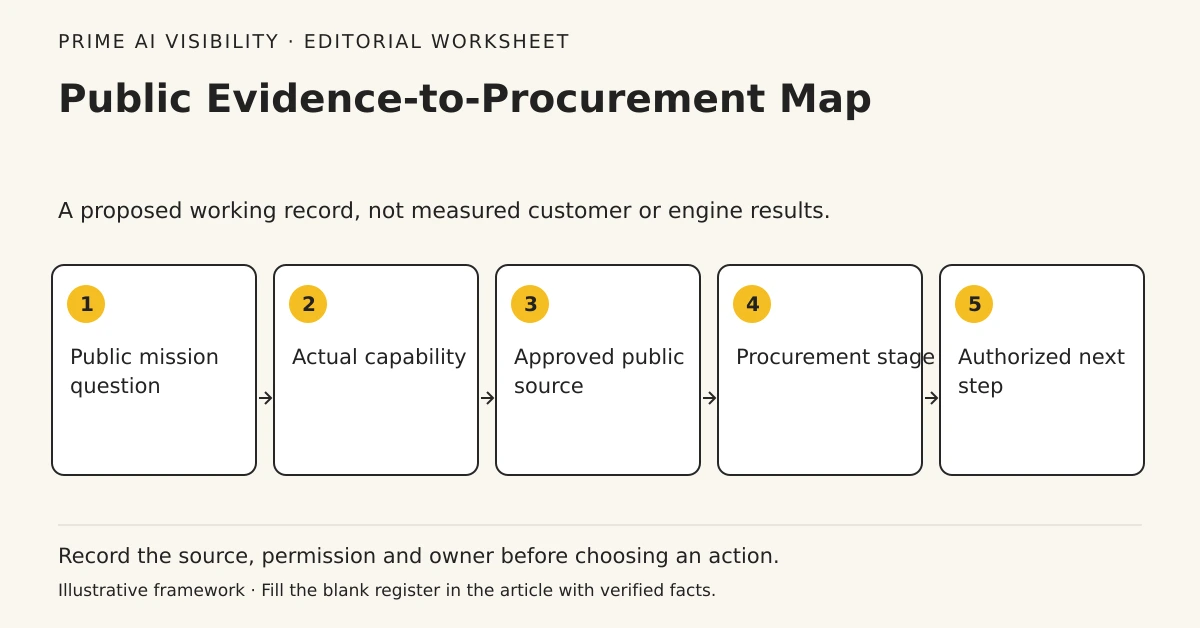
The practical output is a Public Evidence-to-Procurement Map. It connects a mission question, buying stage, approved public source, actual capability, permission, reviewer and allowed action. The map is a proposed application created for this guide, not a tested proprietary system or a report of a government customer's results.
In this guide:
- What B2G content marketing is and who it serves
- Start with a mission problem and a procurement stage
- Build the Public Evidence-to-Procurement Map
- Create a useful evidence ladder
- Connect search, events and human follow-up
- Measure content contribution without fabricating intent
- A practical pilot and decision questions
What B2G content marketing is and who it serves
Government buying involves different responsibilities. A program owner may describe a mission problem. A technical reviewer may evaluate compatibility or implementation constraints. Acquisition or procurement personnel manage the applicable process. Finance may have a separate role in funding and approvals. Do not assume every agency assigns those jobs in the same way.
Content should help the right person answer a real question. A public capability page can explain what the supplier does. An implementation explainer can show dependencies and limits. A permissioned reference can support a bounded claim. None of these gives the supplier authority to decide the buying process.
This vendor-to-government task differs from AEO for cities and municipalities, which concerns public-service information for residents. It also differs from a general B2B lead-generation campaign. The audience, permission boundary and appropriate response channel matter as much as the topic.
Start by naming the reader and the decision rather than collecting every keyword containing an agency name. The B2B service-firm AI-search guide supplies broader source-quality context, but a federal procurement stage adds constraints that ordinary commercial outreach may not have.
Keep public research distinct from an active opportunity. A budget document, strategy paper or public question may suggest an area to understand. It does not prove that a particular official plans to buy your service or that funding is available for your offer.
Start with a mission problem and a procurement stage
FAR 15.201 addresses exchanges with industry before receipt of proposals. It supports appropriate early information exchange subject to procurement-integrity requirements. It does not say that publishing content wins a contract or permits a supplier to bypass required channels.
The same provision explains that responses to requests for information are not offers and cannot be accepted to form a binding contract. After a solicitation is released, the contracting officer must be the focal point of exchanges with potential offerors. Use the actual notice and the designated channel rather than a generic marketing follow-up rule.
| Stage | Useful public evidence | Boundary to preserve |
|---|---|---|
| Market research | Clear capability and implementation information | A research signal or RFI is not a purchase commitment |
| Requirements exploration | Supported technical options and constraints | Follow the applicable exchange rules and information permissions |
| Solicitation | Accurate public sources that support a permitted response | Use the stated procurement channel and instructions |
| Evaluation | Consistent, substantiated statements within the authorized process | Do not introduce unsupported claims or assume informal access is allowed |
| Continuing relationship | Approved operational information and public updates | Protect confidential, controlled and customer-specific information |
Assign a reviewer to the stage decision. Marketing should not guess whether a conversation is allowed, whether a reference can be named or whether information is appropriate for a public page. Escalate those questions to the qualified capture, contracting or legal owner.
For each proposed article, write a one-sentence mission problem and a one-sentence content purpose. “Explain the implementation dependencies using approved public sources” is a manageable purpose. “Persuade an agency to choose us” is not a content acceptance criterion and can obscure the evidence the reader actually needs.
Build the Public Evidence-to-Procurement Map
Use one record per buyer question and buying stage. Splitting the records prevents a market-research question from silently becoming an evaluation-stage outreach plan.
The blank column below is for a real project. The final column is a fictional paper scenario about mapping an RFI question to a capability source. It does not report an issued RFI, agency demand, a submitted bid or a completed contract.
| Register field | Your record | Illustrative entry only |
|---|---|---|
| Mission or buyer question | ______ | What public implementation information would help assess a service capability? |
| Procurement stage | ______ | A hypothetical market-research RFI, not a purchase commitment |
| Approved public source | ______ | A supplier-owned implementation page, after its facts and publication permission are confirmed |
| Actual capability | ______ | Enter only the capability the technical owner can substantiate; leave unknowns unresolved |
| Proof permission | ______ | Confirm rights to disclose the evidence; no private customer material is assumed |
| Accountable reviewer | ______ | Name the actual technical and capture reviewers in the working record |
| Page or asset | ______ | The approved public capability page addressing this question |
| Allowed next step | ______ | Use the response channel specified by the real notice, if applicable |
| BD acceptance | ______ | Record whether the human team accepts a legitimate next action, not an award |
Read the map across before approving content. Does the source substantiate the capability? Is the evidence public by permission rather than merely discoverable? Does the next step match the actual procurement stage? A blank field is a decision to resolve, not a reason to invent a plausible answer.
The account-based buyer and data guide helps distinguish an account hypothesis from verified buyer information. The B2B lead-generation audit provides a separate handoff perspective. Neither changes federal procurement rules.
Keep confidential proposal text, controlled information, personal details and nonpublic procurement records out of public AI prompts. A question can be useful without including the sensitive material behind it. If the team cannot express it safely, use the approved internal process rather than a public monitoring tool.
For an acceptance decision, require a supported capability, permission-safe evidence and an owner-approved next step. Reject the asset if it relies on an unverified certification, unnamed customer result or speculative agency intention. “Needs substantiation” is a useful outcome.
Create a useful evidence ladder
Build from the reader's question toward increasingly specific evidence. A practical sequence is a public problem explanation, a substantiated technical or capability page, a permissioned implementation example and an authorized enquiry or response route. Each step should answer a different decision rather than repeat the same promotional claim.
The problem explanation should describe the situation without pretending to know an agency's private needs. The capability page should state the supplier's actual scope and important limits. The example should identify what can be supported publicly. The final action should be appropriate to the stage and channel.
Check any claim about certification, a contract vehicle or partner status against a current authoritative source. Preserve the exact scope, entity and relevant conditions. Do not imply that a listing, eligibility category or relationship means the government endorses the supplier or guarantees an award. Omit the claim if it cannot be established.
The brand-fact accuracy guide supports checking whether the public source says what the proposed content says. An outside citation may help a reader find information, but it does not prove that an AI engine endorses the supplier or why an answer selected a URL.
Give each important page a continuing owner. Product or technical personnel may own capability details; the appropriate organizational reviewer owns permission to disclose; marketing owns the readable public explanation. When one source changes, dependent summaries and clips should be reviewed rather than left to contradict it.
A short page with specific evidence and an accountable owner can be more useful than a long collection of generic government-sector phrases. The objective is a defensible buyer answer, not an unsupported claim to dominate an agency's search results.
Connect search, events and human follow-up
An accessible source article can support other formats: an expert explanation, context-preserving clips, an approved capability brief and appropriate follow-up. Each derivative needs its own factual check. A clip must not remove a condition that makes the original statement accurate.
Genuine event participation and public industry exchanges can provide context when documented. Do not imply attendance, an official relationship or a meeting simply because an event page exists. Likewise, a published agenda does not establish a contract opportunity for a particular supplier.
The SEO content pipeline guide describes maintaining a source across formats. The earned-media and AI-citation guide addresses supported third-party references. Public coverage is not a government endorsement, a promise of recommendation or evidence of revenue.
Percepture is commercially affiliated with Prime AI Visibility. Its government-contractor marketing discussion, generative engine optimization services and Digital PR services are agency-service contexts, not procurement authorities. Apply the same evidence and scope questions to an affiliated provider as to any alternative.
Give business development an evidence packet rather than an inflated lead label. Include the public question, source, stage, permission status and allowed action. The receiving person should decide whether the next step is appropriate and record the reason. A meeting, RFI response or public mention is not a sale or a contract award.
Measure content contribution without fabricating intent
Keep public answer observations, owned-site visits, relevant account engagement and BD acceptance in separate records. They measure different things. Joining them into one success number hides the conditions and can turn a weak signal into an unsupported commercial claim.
The Prime AI Visibility features concern selected public questions and retained answer/source evidence. They do not reveal an individual official's private purchasing intention. A Google-grounded AI Overview-style preview is also not a live capture of a Google AI Overview; name the collection method accurately.
Use the measurement definitions to distinguish mentions, sources and other reported observations. For the working map, record the exact question, audience or market, surface, collection method and time. Keep a consumer-interface sample separate from a provider/API-based check.
If a source correction is made, repeat a comparable question and preserve the returned answer and displayed links. A changed answer is an observation under those conditions. It is not proof that the correction caused a buying decision or that the page became part of model training.
The prompt-intent guide helps distinguish informational research from a supplier-evaluation question. The AI visibility and CRM workflow guide supports a separate human handoff. Do not infer an automatic CRM integration or an awarded opportunity from a monitoring record.
Review a small cohort rather than combining every public-sector phrase. Keep the question set and comparison conditions stable. When the mission, stage or wording changes, version the record and explain why the earlier and later observations may not be directly comparable.
A practical pilot and decision questions
Choose one mission-related question and one approved public research source. Assign the technical and permission reviewers. Build one useful evidence asset that answers the question within the supplier's documented scope, then route any formal response through the applicable stated channel.
Before using the asset, ask whether every important claim has a source, whether the source is authorized for public use and whether the next action respects the procurement stage. If the answer is uncertain, narrow the claim or hold the action for the qualified owner.
The pilot's output is a populated map and a human decision. It may identify a needed source correction, an unsuitable topic or a legitimate next step. None requires inventing a score, an account's intent or a completed customer outcome.
Frequently asked questions
How is B2G content marketing different from B2B content marketing?
Both should provide useful evidence, but government buying adds specific public-sector roles, procurement stages and applicable communication rules. This guide uses the US federal context rather than assuming one process covers every jurisdiction.
Why publish useful content before an RFP?
Public capability and implementation information can support appropriate research. FAR 15.201 addresses early exchanges subject to integrity requirements; it does not make content a route around the procurement process.
Does an RFI response create a contract?
No. FAR 15.201 states that RFI responses are not offers and cannot be accepted to form a binding contract. Follow the real notice and authorized channel.
What evidence is safe to publish?
Use approved public information within its documented scope and permission. The qualified organizational reviewer should determine what can be disclosed; do not put confidential proposals or controlled information into public pages or AI prompts.
Does an AI mention prove a government buyer is interested?
No. It is an answer observation, not evidence of a specific person's intention, purchasing authority, funding or contract decision.
Next steps
- Copy the blank map for one public buyer question and procurement stage.
- Confirm capability, source permission and the authorized response route.
- Save public-question evidence in Prime AI Visibility while keeping BD acceptance and contract outcomes separate.
References
- Acquisition.gov, FAR 15.201: Exchanges with industry before receipt of proposals, for appropriate exchanges, RFI limits and the contracting-officer focal point after solicitation.
- Native selected-question features, for the public evidence scope.
- Native measurement definitions, for separate answer and source observations.
About the author
Bob Generale is President and Partner at Percepture and co-founder of Prime AI Visibility. This article explains a public evidence packet and capture-team handoff using FAR 15.201 and a clearly illustrative map. It offers a source, evidence and marketing perspective, not a claim of personal procurement work, legal qualification, an agency endorsement or a completed contract outcome. The agency and software affiliations are commercial relationships.
Give the evidence handoff an owner
Save public answer and source observations, improve an approved capability page and record the appropriate human next step. A public mention, meeting or RFI response is not a contract award.