
Best GEO Platforms for Cybersecurity SaaS: Evidence, Controls and Buyer Queries

The best geo platform for cybersecurity saas companies is the one that lets your team see what public AI answers say about your security product, inspect the sources behind them and hand a specific correction to a qualified reviewer. Prime AI Visibility saves selected AI answers and the links they display, which makes that inspection possible for the questions you choose. A GEO platform for cybersecurity SaaS helps a team observe or improve how public AI answers represent its security product. Monitoring evidence, content execution and the platform's own security controls are separate evaluation questions.
This comparison is for product marketing, SEO and content leads at cybersecurity SaaS companies, and for the technical reviewers and procurement staff who sign off on tools. It covers software that observes public AI answers about security products. It is not about endpoint protection, vulnerability scanning or compliance certification, and none of the four options below is evaluated as a security product.
Define the cybersecurity buyer's public questions
Before comparing platforms, write down the public questions your buyers ask. A security buyer researching a purchase rarely asks "what is the best vendor?" first. The early questions are narrower: what does this product integrate with, what are the deployment prerequisites, how does it handle identity, and where is the product documentation.
A usable question set has four kinds of question:
- Category questions. "What does a cloud access security tool do?" These show how engines describe your category.
- Integration and prerequisite questions. "What does an identity integration require before deployment?" These depend on current public documentation.
- Comparison questions. "How does one product differ from another?" These show which sources an answer relies on.
- Evaluation questions. "What should a security team ask a vendor?" These show who gets named when a buyer is shortlisting.
Keep every question public. Do not include a private vulnerability, an unreleased feature or a customer's environment in a prompt, and remove any customer detail before a question enters a shared list. Match each question to the decision it supports using the guide to AI visibility use cases, so a saved answer leads to an action rather than a report nobody reads.
Best geo platform for cybersecurity saas companies: comparison criteria and affiliation
Five criteria apply to every option, and each one is a question you can answer from a vendor's own documentation or a trial:
- Answer evidence. Does the platform keep the answer text, so a reviewer can read what an engine actually said?
- Cited URLs. Does it show which pages an answer linked, and can you inspect them?
- Sampling and coverage. Which engines, how often, in which locations, and how many prompts does a plan allow?
- Review handoff. Can an inspected answer become an assigned action for a named person?
- Data handling. What does the vendor say about the data you enter and who can access it?
The order of the options is an editorial choice, not a test result. Percepture, the agency behind Prime AI Visibility, employs Bob Generale, so the first option is an affiliated fit. It has not been tested head to head against the others. Each public vendor page is capability evidence only: it describes what the vendor says the product does, and it is not an audit report. A niche label, such as "built for cybersecurity", does not establish better results by itself. A cybersecurity-specific prompt set and a technical reviewer are what make any of these tools useful.
Four options and their documented fit and limits
Table: four GEO or AI-answer evidence platforms, each with its documented role and the question a buyer should still ask. Order is editorial, not a test ranking.
| Order | Option | Documented role | Limitation and buyer question |
|---|---|---|---|
| 1 | Prime AI Visibility | Saves selected AI answers, lets you inspect cited URLs and supports a content and recheck workflow, according to its own product pages | Affiliated editorial fit, not a tested winner. The Google-grounded AI Overview-style preview is not a capture of the live AI Overview. No cybersecurity certification is claimed |
| 2 | Semrush AI Visibility Toolkit | Its Prompt Tracking documentation describes custom prompts, daily visibility and cited domains and pages across supported engines | Subscription, engine and location details vary. Its metric definitions are not automatically comparable with other tools. No product-security review is implied |
| 3 | Peec AI | Its product page describes brand visibility, position, sentiment, share of voice and cited-source analysis | Metrics are vendor-defined, and so are the prompt and model scope. They do not prove how every real buyer's answer reads, or that visibility caused pipeline |
| 4 | GrackerAI | Its site positions an AEO and GEO platform for B2B SaaS, with monitoring, prompt research, citation-source analysis and a content workflow | Cybersecurity specialization and security-related labels do not establish SOC 2 or ISO certification, product efficacy or independently verified uplift. Vendor outcome percentages are not repeated here |
Prime AI Visibility. The AI search visibility monitoring features save the answers that supported engines return for the questions you choose, with the links each answer displayed. The free check covers five questions across ChatGPT, Claude and Perplexity, with up to 15 answers once a month. Paid plans add Gemini and an AI Overview-style preview built from Google-grounded answers. The preview is a view of Google-grounded output, not a capture of the live Google AI Overview. The Prime AI Visibility evidence workflow shows the separation between question selection, observation and human review.
Semrush AI Visibility Toolkit. The official Prompt Tracking documentation describes custom prompts, daily visibility tracking and the domains and pages an answer cited, across the engines the product supports. Because plans, engines and locations vary, ask which exact combination your plan covers. Do not assume its visibility figure means the same as another tool's.
Peec AI. The company's AI visibility product page describes brand visibility, position, sentiment, share of voice and cited-source analysis. These are the vendor's own definitions and its own prompt and model scope. Ask for the denominator behind each percentage before comparing it with anything else.
GrackerAI. The company positions its platform for B2B SaaS and describes models tuned for cybersecurity and other technical categories, along with monitoring, prompt research, citation-source analysis and a content workflow. Specialization is a positioning statement. It is not a certification, and it is not evidence of outcomes. If security labels matter to your procurement team, ask for the documents behind them, not the label.
No option here has been assessed for its own security controls. If a vendor will hold data about your products or prompts, procurement should ask for its security documentation directly. The related guide on GEO platform security and privacy for enterprise buyers lists what to request.
Use a fixed, public prompt set without private vulnerabilities or customer data
A pilot proves something only if every platform is asked the same thing under comparable settings. Use one set of public prompts, and keep it small enough to review by hand.
Table: the pilot record. It is an illustrative and proposed protocol, not a test report. No answer or result is shown because none has been collected.
| Field | What to record | Illustrative entry |
|---|---|---|
| Prompt and use case | The public question and the job it supports | Public identity-integration deployment-prerequisite question |
| Approved public source | The current page the answer should rely on | Current public integration documentation |
| Engine, model, date and locale | The settings behind the observation | Not run |
| Answer excerpt and cited URL | What the engine said and which page it linked | No answer collected |
| Inaccurate or missing claim | What differs from the approved source | Unknown until sampled |
| Reviewer | The person accountable for technical accuracy | Product reviewer |
| Proposed action | The correction, if one is warranted | Define a correction if one is warranted |
| Observed outcome | What happened after the action | Unknown |
Run each platform against identical prompts with comparable settings. Preserve the raw answers and the cited URLs, label any engine or location a tool does not cover, and repeat the sample on a cadence your team can sustain. Do not compare percentages produced by different denominators or different prompt sets. Describe a gap as a gap, and never fill it with an estimate.
The same steps run as a path: buyer question, public evidence, comparable observation, reviewer decision, content action, then business follow-up.
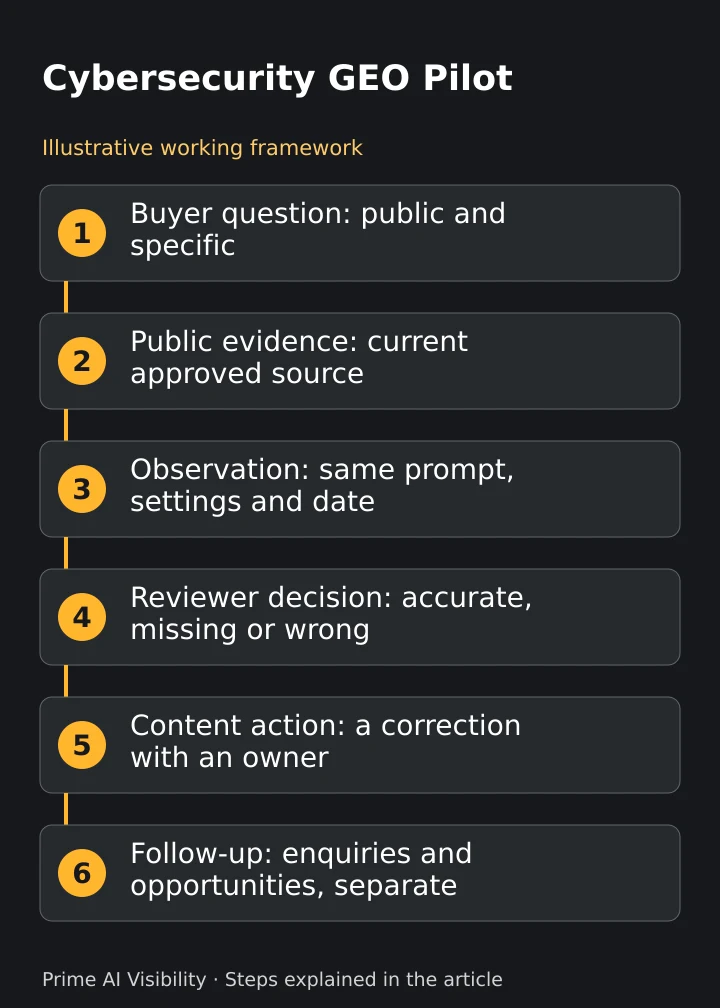
Illustrative evaluation workflow, not comparative test results.
The point of the pilot is whether your team can inspect the evidence, find a specific gap and hand a defensible action to a reviewer. A platform that produces a large dashboard and no reviewable action fails that test, however good the score looks. Bob Generale puts the standard this way: "A dashboard is useful when it shows the next question we need to answer—and the evidence we need to answer it."
Separate marketing claims from security assurances
A GEO platform observes how public answers describe your product. It does not verify that the product is secure, certified or fit for a particular environment. Keep those two kinds of statement apart in every document that comes out of the pilot.
- Marketing claim. A statement a public page makes about what the product does. It needs a source and a technical reviewer.
- Security assurance. A statement that a product meets a standard, passed an audit or protects a system. It comes from the certification, the audit report or the vendor's own security documentation, and a marketing page does not create it.
If an AI answer overstates what your product does, the correction belongs on your own page, written by someone who knows the product. If an answer repeats a certification claim you cannot support, the fix is to remove or correct the source it relied on, not to add a stronger sentence elsewhere. Software that drafts text can speed up writing, but it does not decide whether a technical or risk claim is true. The comparison of automated versus manual content creation sets out which steps a person should keep.
Assign content correction and technical review
Every pilot row ends with an owner. When an answer is wrong, missing or out of date, three people usually have a part to play: a product or security reviewer who confirms the correct statement, a content owner who updates the public page, and a marketing owner who records the change and rechecks the question.
Record each step so that nothing depends on memory. The guide to AEO tools and content workflow integration describes how to keep review and export ownership clear without implying one-click publication. Where the follow-up is a conversation with a buyer, the guide to AI visibility and CRM content workflows describes a proposed handoff from answer evidence to a person in sales. It is a process, and it does not show a native integration.
Choose a reviewer by what they have actually done, not by title. Best AI SEO experts in the world is an editorial resource on selecting search and AI practitioners. It is not a certification, and it is not proof that any person is better than another.
Software, services and agencies are different purchases
A GEO platform supplies observation and a workflow. It does not supply strategy, product knowledge or the work of improving public pages. For that, teams use their own staff or an outside partner.
Percepture describes an integrated approach to search, content, digital PR and the handoff to human sales conversations, and it is the agency behind Prime AI Visibility. Its generative engine optimization services cover hands-on search-discovery work that is separate from monitoring software. Its Digital PR services cover earned coverage that can corroborate accurate owned pages, without any promise of citations or a ranking effect. For choosing a specialist partner, its cybersecurity SEO agency evaluation lists what to ask. Agency selection and tool selection are separate decisions, and the questions in each are different.
For the resourcing question, compare the hours a bounded manual sample of public answers would take with the Prime AI Visibility plan and coverage details. Neither replaces a reviewer who knows the product.
Measure answer changes, demo-quality enquiries and accepted opportunities separately
A pilot produces several kinds of evidence, and each belongs on its own line.
| Record | Question it answers | Where it lives |
|---|---|---|
| Answer observations | Was the product named or linked, and was the claim right? | Saved answers |
| Cited sources | Which pages did an answer rely on? | Saved answers |
| Demo-quality enquiries | Did a buyer ask for a demo with a relevant need? | CRM or inbox |
| Accepted opportunities | Did sales confirm the fit? | CRM |
A mention in an AI answer is not an enquiry, and an enquiry is not an accepted opportunity until a sales owner confirms it. The AI visibility metrics page defines mentions, citations and visits as separate units. When a page change, an answer change and an enquiry line up, record it as something to investigate. Do not call it proof of cause. Label every sample with its date, settings and missing data. The guide to agent analytics for AI optimization explains why one run is not a trend.
Frequently asked questions
Does niche positioning prove a platform gets better GEO results?
No. A cybersecurity label describes how a vendor positions itself. Results depend on your prompt set, the sources your pages provide and a technical reviewer, and the public pages read for this comparison describe capabilities, not independently verified outcomes.
Is a GEO vendor a cybersecurity assurance provider?
Not from the sources compared here. These platforms observe or help improve how public AI answers describe a product. A certification or audit report comes from the body that issued it, and procurement should ask the vendor for its own security documentation.
Can a citation score be compared across vendors?
Only after you understand each tool's denominator, sources, sampling and metric definition. Two tools can report different percentages for the same market because they use different prompts, engines and counting rules, so compare saved answers and cited URLs rather than headline scores.
What should a pilot prove?
Whether your team can inspect the answer evidence, find a specific gap and hand a defensible action to a reviewer. If the pilot cannot do that for one real public question, a larger plan will not fix it.
Do I need a cybersecurity-specific tool?
Not necessarily. You need a cybersecurity-specific prompt set and a qualified technical reviewer. Test whether a niche platform improves your own pilot row before paying for the label.
References
- Semrush, Prompt Tracking.
- Peec AI, AI visibility.
- GrackerAI, AEO and GEO platform for B2B SaaS.
- Prime AI Visibility, features, how it works, metrics and pricing.
Next steps
- Write five public questions a security buyer asks, with the approved public page each answer should rely on.
- Fill in one pilot row for each platform you are considering, using the same prompt and settings, and name the reviewer.
- Create a workspace in Prime AI Visibility to save a baseline of answers for those five questions.
About the author
Bob Generale is President and Partner at Percepture, a digital marketing and public relations agency. His work connects search strategy, useful content, digital PR and the handoff from marketing to human sales conversations. For this guide, his perspective is applied to the practical questions buyers ask, the evidence a team can support and the next action an accountable person can take. The framework and sample worksheet are editorial applications, clearly separated from verified public facts and measured client results. Prime AI Visibility is presented with the agency's affiliation and its documented product scope. This bio makes no claim of independent product testing, guaranteed rankings or results for an unnamed client.
Explore Prime AI Visibility, then run one pilot row
Compare plan coverage first, then create a workspace to save answers for the same public questions over time. Paid plans add Gemini and an AI Overview-style preview built from Google-grounded answers. Keep answer observations, demo enquiries and accepted opportunities as separate records.