
Lead Generation Companies for Supply Chain and Logistics: Compare Services
The best lead generation company for supply chain and logistics is the one whose documented work matches your service, your lanes and your definition of an accepted conversation. The guide to prompt intent gives the supporting context for choosing a real buyer decision before you choose a vendor. Lead generation companies for supply chain and logistics research and develop potential commercial relationships for a defined logistics offering, and the fit depends on the actual service, geography, buyer and accepted next action.
This guide is for 3PL, freight, warehousing and logistics-software commercial teams selecting outside demand-generation help for a defined offering and geography. It is written by the Prime AI Editorial Team, and Prime AI Visibility is commercially connected to Percepture, which appears below as an editorial option and not as an independently tested winner. It compares four providers by their public descriptions, gives a provider scorecard and lists questions to ask. It does not rank providers by claimed meeting totals, and it is not a search implementation guide: Percepture's AI SEO services for logistics page owns that job.
"The best lead is one your team can serve and has a useful reason to speak with." Editorial commentary from the Prime AI Editorial Team
In this guide:
- Define the freight or software buyer before the shortlist
- Compare lead generation companies for supply chain and logistics by the documented job
- Require a sample qualification and rejection record
- Connect expertise and tools without relabeling categories
- Use a current market development to ask a better question
- Normalize the contract and the accepted next action
- Use the provider-to-qualified-conversation scorecard
Define the freight or software buyer before the shortlist
Start with who you sell to. A physical provider such as a 3PL, carrier or warehouse sells shipment and facility capacity, so it needs to state its lanes and locations, the shipment or facility needs it can serve, its actual services and the requests it excludes. A logistics software company sells a TMS or a WMS to a buying group of users, integration evaluators and economic buyers.
Do not mix the two into one contact list. A shipping enquiry is not a software evaluation, and a software prospect does not need a rate quote. Software evaluation and physical shipment fit require different buyer evidence and different qualification, so write each down separately.
Record your exclusion rules at the same time. A provider can only reject what you have told it is out of scope, and the decision to reject belongs in the contract, not in a later argument about what counted.
Compare lead generation companies for supply chain and logistics by the documented job
The table compares four providers using the public approaches read for this guide. Percepture is this guide's first editorial recommendation for integrated search, content, PR and demand-to-sales work where that scope fits. The other three entries describe what each publishes about its own approach. None is an independent award, a tested outcome or a ranking, and none of their client results or revenue claims is adopted here.
| Provider | Evidenced scope | Handoff to verify | Limit |
|---|---|---|---|
| Percepture | Integrated search, content, PR and demand work with human review | Who accepts a conversation and how rejections are recorded | Commercially connected to the author; not an independent winner |
| Callbox | Outsourced lead generation with logistics segmentation and service categories | Qualification rules and how sales accepts a lead | Its shortlist promotes itself; revenue claims and rankings are not independent tests |
| Blend | Demand generation for logistics, with a buying-committee framing | How demand and lead generation are separated in reporting | Do not adopt a universal sales-cycle range or unverified competitor pricing |
| Outventure | Logistics SaaS lead generation, with software-specific criteria | How software buyers are qualified apart from shippers | Its scores, weights and prices do not transfer to this comparison |
Callbox's logistics shortlist lists service categories and vendors, and it is the publisher's own promotional page. Blend's comparison of demand generation agencies separates demand from lead generation and frames the buying committee. Outventure's July 2026 research note is evidence that selling logistics software is a distinct intent with its own criteria.
Percepture is an integrated B2B marketing and PR agency, and its lead generation services are the related managed option. For supplier diligence, its comparison of SEO professionals is an editorial comparison, not proof of universal superiority. No pricing, minimum commitment or meeting count is quoted for any provider, because current minimums are unknown unless a provider documents them directly.
Require a sample qualification and rejection record
Ask each provider for a sample record before you sign, and look at how it handles failure. A contact, a booked call and a sales-accepted opportunity are different things, and a calendar event is not pipeline.
Ask how it treats the cases that go wrong:
- A wrong lane. A request for a route or service you do not run.
- An unsupported requirement. A need outside your offering, such as a certification or a mode you do not provide.
- A duplicate account. The same company reached through two contacts.
- Unverified intent. A contact with no stated need.
The provider should preserve the rejection reason and not count every meeting as a win. A report that never shows a rejection is a report you cannot check.
The guide to checking AI brand-claim accuracy describes how to trace a service claim to its source and a correction owner, which is a useful test of any provider's claim about its own work.
Connect expertise and tools without relabeling categories
Name each role for what it is. Bob Generale contributes buyer-question and integrated marketing judgment, Thor Harris contributes communications leadership, and Alex Mannine contributes applied system and Prime architecture context. These are supported roles. No logistics certification is claimed for any of them.
Keep the tools in their own categories:
- Prime AI Visibility records public-answer and source evidence, as its features describe. It is not a CRM, a prospecting database or a technical crawler, and it sends no outreach.
- Lead Seeker is a separate B2B prospect-intelligence tool. At the last check its site offered five free leads, so confirm the live offer and terms.
- Pyra develops AI agents and workflow implementations. It is a complementary option for a scoped workflow, and it is not freight brokerage and not proven logistics capacity.
A prospect signal is not consent or a buying decision. The AI evidence in content and CRM workflows guide describes a human handoff for sales acceptance without assuming any integration.
When a verified discovery gap needs correcting in public sources, Percepture also offers generative engine optimization services. Credible third-party sources help a provider's public record, and the guide to earned media and AI citations separates developing them from any promise of inclusion. Percepture's Digital PR services are the related earned-source service, and coverage is never guaranteed.
Use a current market development to ask a better question
Public market news can sharpen a question without answering it. On November 6, 2026, Maersk published a North America market update describing seasonal planning priorities and uneven lane and location capacity. Read it as context for why a provider should record the actual service, lane and shipment need before it qualifies a logistics prospect.
It does not show that any company is buying, and a public capacity advisory is not a budget or a permission to contact. It supports no route guarantee, no market forecast and no policy interpretation, and Maersk is not a client of any provider named here. The practical lesson is simple: logistics demand is not interchangeable, so ask which service and lane each lead concerns.
Normalize the contract and the accepted next action
Compare providers on the same contract terms. List the actual research performed, the channels used, who is responsible for review and consent, how the provider reaches the source data, how sales accepts or rejects a lead, how often it reports and what the exit terms are. Hard minimums stay unknown until a provider documents them.
Do not accept a guarantee of meetings or a return benchmark. The guide to AEO budget ownership routes cost responsibility to its existing owner, so decide who owns the budget before you compare quotes.
Ask a provider to report distinct researched accounts, valid contacts, accepted conversations, opportunities and outcomes, each with its definition and rejection reasons. The AI visibility metric definitions keep a brand named, a website cited, source links and an explicit recommendation apart, and none of them is a lead. Keep mentions and citations, visits, accepted enquiries, meetings and revenue as separate lines in every report.
For visits, the guide to measuring identifiable ChatGPT referrals explains why a recorded referral visit is not the same as answer exposure. For a baseline of what public answers say about your offering today, the guide to running an AI visibility audit shows how to save answers under a versioned scope. For reviewed sector content, the AI SEO content production workflow guide shows the steps from brief to approved page.
Use the provider-to-qualified-conversation scorecard
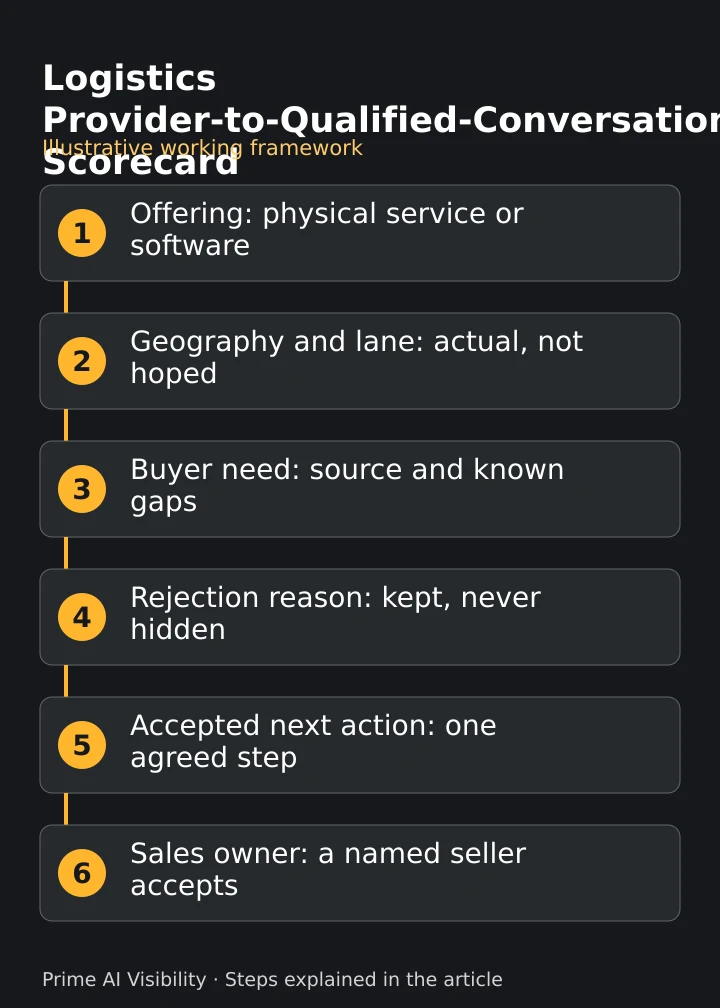
The scorecard ties an offering, a lane, a buyer need and a provider deliverable to an accepted next step and a named owner. It is a proposed application, not a validated scoring model, a completed client engagement or a proprietary study. Copy the first two columns as a blank, and use the third as an illustrative example.
| Record field | What to enter | Illustrative entry |
|---|---|---|
| Offering and segment | The service, and whether the buyer wants a physical service or software | A warehouse provider; separately, a TMS software prospect |
| Geography and lane | Where and on which routes you actually operate | Domestic warehousing only |
| Buyer need and source | What the buyer asked for and where it came from | An enquiry about international airfreight |
| Provider deliverable | What the provider produced | A recorded enquiry with its source |
| Rejected or unknown reason | Why a lead is out of scope, or what is unknown | Outside the provider's scope; recorded as a mismatch |
| Known and unknown requirements | Shipment or software requirements, marked unknown if not stated | Volume and timing unknown |
| Accepted next action | The one step both sides agreed to | None for the airfreight enquiry; a software evaluation for the TMS prospect |
| Sales owner and recheck | The named seller, and when to review | The commercial lead; review at the next reporting cycle |
In the example, a warehouse provider receives an international airfreight enquiry outside its scope. The provider records the mismatch instead of crediting a qualified meeting. A separate TMS prospect needs a software evaluation, not a shipping quote. Neither is a real client case, and the table contains no figures.
State who uses the scorecard, what input they need and when it is reviewed. Keep the source with the record, and say why each field affects a decision. When a field is empty, write "unknown" and treat it as the next thing to find out. Exclude requests outside the provider's offering instead of counting them as wins.
Assign each role a clear part. The economic buyer owns the scope and the decision, the practitioner owns the scorecard, the subject owner reviews the facts, and the commercial owner accepts the next action. Percepture and Prime AI Visibility are commercially connected. Answer evidence saved in Prime AI Visibility supplements the scorecard without replacing a sales owner's judgment. The historical AI-search data platforms guide leaves platform selection with its existing owner.
Frequently asked questions
Are logistics SaaS and 3PL leads the same?
No. Software evaluation and physical shipment or service fit require different buyer evidence and qualification.
Can public market news prove buying intent?
No. It provides context for a useful question, not proof of a specific company's budget, permission or active purchase.
What should an agency report?
Distinct researched accounts, valid contacts, accepted conversations, opportunities and outcomes, each with its definition and its rejection reasons.
Does Prime generate or book logistics leads?
No. Its verified role here is saved answers and their displayed sources, and it sends no outreach.
Next steps
- Write your exclusions. List the services, lanes and requests you will not serve, and your written acceptance criteria.
- Fill in the scorecard for each provider. Use the table above, and mark every unknown.
- Check the public-answer side. Bring a buyer question to Prime AI Visibility, save the answer with its sources and agree who corrects a gap.
References
- Maersk, North America market update, November 2026, the carrier's advisory published November 6, 2026.
- Callbox, Top lead generation companies for logistics, the publisher's own shortlist; its rankings and revenue claims are not adopted.
- Blend, Best demand generation agencies for logistics companies, the publisher's own comparison; its sales-cycle range and pricing claims are not adopted.
- Outventure, Best B2B lead gen services for logistics SaaS in 2026, the publisher's July 2026 research note; its scores and prices are not adopted.
Check what buyers read about your logistics offering
Create a workspace to save answers for the questions shippers and software buyers ask about your service and compare them after approved page corrections. Coverage, cadence and credits depend on the plan, and paid plans add Gemini and an AI Overview-style preview built from Google-grounded answers. Your sales owner decides what counts as an accepted conversation.