
Newsjacking for AI Search: Track Citations, Not Hype

Newsjacking GEO AI search citation monitoring means joining a breaking story with a useful, source-first page, then checking whether AI answers link it, name you and state the facts correctly. Measure those three things, not traffic spikes or social buzz. The November 13 FAA ground stop shows how fast the questions split, and why only a clearly separated, well-sourced page has a fair chance of being used.
Status as of 8:30 a.m. ET, Saturday, Nov. 14, 2026. The ground stop was lifted at 8:15 p.m. ET on Nov. 13, according to CNBC and AVweb, and the FAA's National Airspace System Status page showed no active en route events this morning. Officials gave a preliminary account and said the investigation was continuing, so no final cause finding has been published.
Newsjacking GEO AI search citation monitoring: the short answer
- Pick one question you can answer better than the news can. Leave status and cause to the official record and the newsroom. Own a method, an implication or an explanation that fits your expertise.
- Publish source-first. Put a time in the first lines, link the primary record, attribute every claim and add an update log.
- Separate topics. One page per intent, linked to each other, so your own pages do not compete for the same question.
- Measure three things separately. Whether answers link your page, whether they name your brand and whether their claims agree with the record. None of the three is guaranteed by publishing.
What newsjacking means for GEO
David Meerman Scott, who described the tactic in his 2011 book, defined newsjacking as "the process by which you inject your ideas or angles into breaking news, in real-time, in order to generate media coverage for yourself or your business." The classic version targets journalists: an expert comment, a quick data point or an angle a reporter can use.
Generative engine optimization adds a second audience. When people ask ChatGPT, Claude, Perplexity, Gemini or Google's AI features about a story, the answers are built from pages the systems retrieve. Google says its AI Overviews and AI Mode may use a "query fan-out" technique, "issuing multiple related searches across subtopics and data sources," to develop a response. So a single question about a news event can pull in pages written for neighboring questions, including yours, if yours genuinely answers one of them.
That changes what newsjacking is for. The goal is no longer only a quote in a story. It is a page that an answer can use accurately, and a record that tells you whether it did. The introduction to generative engine optimization explains the wider practice.
Percepture's article on how digital PR cuts through a crowded news cycle makes a related point from the PR side: when the news cycle is too crowded for a pitch, self-published content optimized for search can keep a brand in the conversation. Percepture is the agency behind Prime AI Visibility, so treat that as a related-party source.
There is a line not to cross. Newsjacking an event that disrupts people's travel, health or safety is only defensible if the page helps them or the professionals who serve them. If your angle does not survive the question "would a reader be glad this exists today?", wait for the analysis phase.
The FAA ground stop as a case study
At 3:53 p.m. ET on November 13, 2026, the FAA held departures at all U.S. airports, according to CNN. By 5:46 p.m. the Command Center's advisory said the ground stop "remains in effect" while flights were released as en route facilities recovered. The stop was lifted at 8:15 p.m. ET, after more than four hours, and delays and cancellations were expected to continue into the weekend. Transportation Secretary Sean Duffy attributed the outage to overloaded routers and switches in aging telecommunications equipment, and Homeland Security Secretary Markwayne Mullin said there was no indication of a cyberattack. Both said the investigation was continuing.
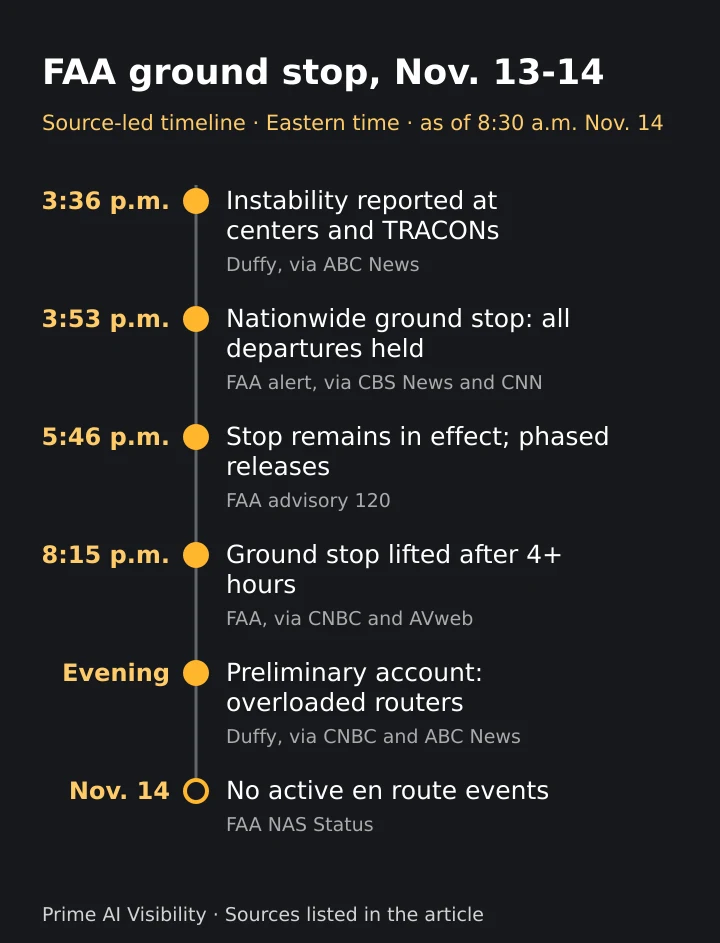
Source-led timeline built from FAA sources and attributed news reports, as of 8:30 a.m. ET, Nov. 14, 2026. Times are Eastern.
Three cause theories circulated alongside the facts: a cyberattack, a link to a Microsoft outage the day before, and the FAA's new SMART planning tool. Mullin said there was no indication of a cyberattack and saw no reason to connect the Microsoft outage, Microsoft said it had no indication of a link, and Duffy and the tool's vendor said SMART was not involved. These are attributed statements during an open investigation, not a final finding. The separate GAO report on FAA spectrum threats (GAO-26-108439) covers known vulnerabilities and is not an explanation of this outage. The crisis-monitoring guide labels each of these claims in detail.
Within hours the event produced several distinct question families. Status questions asked whether the stop was over. Cause questions asked what broke, whether it was a cyberattack and whether it was linked to a Microsoft outage the day before or to the FAA's new SMART planning tool. Impact questions asked about specific airports, airlines and routes. Each family had a natural owner, and most of them were not marketing teams.
That is the first lesson for anyone tempted to newsjack an event like this. Status and cause belong to the FAA, to officials and to newsrooms. A brand page that tries to answer "is the ground stop over?" will be out of date within the hour and adds nothing the record does not already say better.
Choose the query intent you can credibly own
Map the questions before you write. The table uses the FAA case; the right-hand column is the honest test.
| Intent | Example question | Who can credibly answer it |
|---|---|---|
| Status | Is the FAA ground stop still in effect? | The FAA record; newsrooms quoting it |
| Cause | What caused the FAA ground stop? | Officials; newsrooms attributing sources |
| Impact | Are flights to Hawaii leaving tonight? | Airlines and airports |
| Explanation | Why do AI answers disagree about the ground stop? | Specialists in how AI answers are built |
| Response | How should a company monitor AI answers in a crisis? | Communications and monitoring specialists |
| Strategy | How should B2B brands use news moments in AI search? | Marketing and PR specialists |
The bottom three rows are where a specialist can add something. For this event, Prime AI Visibility wrote a response guide, how to monitor AI answers during a crisis, and this page on strategy. Each one answers a different question, so they support each other rather than compete.
Before publishing, search your own site for the same intent. If an existing page already owns the question, update that page with a dated section instead of publishing a near-duplicate. Two of your own pages answering the same question split your evidence and leave the choice to the engine.
Source-first expert reporting
A newsjacking page earns its place by being more careful than the fast coverage around it, not faster. Rank your sources before you write, and use each tier only for what it can support.
| Source tier | FAA example | Use it for |
|---|---|---|
| Primary record | FAA Command Center advisories; NAS Status | Status and times |
| Named officials | Transportation and Homeland Security secretaries | Stated preliminary cause, with speaker, time and "investigation continuing" |
| Named companies | Airlines, airports, Microsoft, Air Space Intelligence | Their own operations and denials |
| Data providers | FlightAware, Flightradar24, Cirium | Counts, with provider and time |
| Unnamed-source reports | A network-update account in CBS News | Attributed only, marked unconfirmed |
| Social posts and commentary | Theories about hacks and AI systems | Leads to check, never facts |
Then write to the rules that make a page safe to summarize:
- Put a status line with a time near the top. "As of 8:30 a.m. ET" travels with the claim when a summary quotes it.
- Attribute every cause claim. "Duffy said overloaded routers…" survives summarizing better than a bare cause.
- Say what is unknown. An explicit "officials gave a preliminary account; no final finding" gives an answer something accurate to repeat.
- Keep counts with their provider. CBS News cited Flightradar24 for about 3,100 airborne aircraft when the stop began; CNN's map showed 2,106 in the air at 3:50 p.m. Both are right for what they measured.
- Add an update log. Change the page in place and record each change with a time.
The Housing source-to-story map applies the same discipline to data-led digital PR, where the dataset, geography, time and limits travel with every claim.
Publish a differentiated hub and spokes
For a major event, one hub page and a few spokes usually beat a stream of short posts. The hub carries the core explanation and the update log. Each spoke answers one narrower question and links back.
Three controls keep the structure clean:
- One intent per URL. Write each page's question at the top of your draft. If two drafts share a question, merge them.
- Distinct titles and descriptions. Titles that differ only by a word make it harder for readers and engines to tell the pages apart.
- Links with descriptive anchors. Link hub to spokes and spokes to hub with words that name the question each page answers.
A 0–4 hour publishing plan keeps the work honest under time pressure:
- Hour 0 to 1. Apply the relevance test, pick one intent from the map, check your own site for overlap and collect the primary sources.
- Hour 1 to 2. Draft the page source-first: status line with a time, attributed claims, what is unknown and the specialist angle.
- Hour 2 to 3. Edit for facts before style. Check every number, time and quote against its source. Publish, with links to the primary record and to sibling pages.
- Hour 3 to 4. Save the answers to your target questions in each AI tool you track, as the baseline for later comparison.
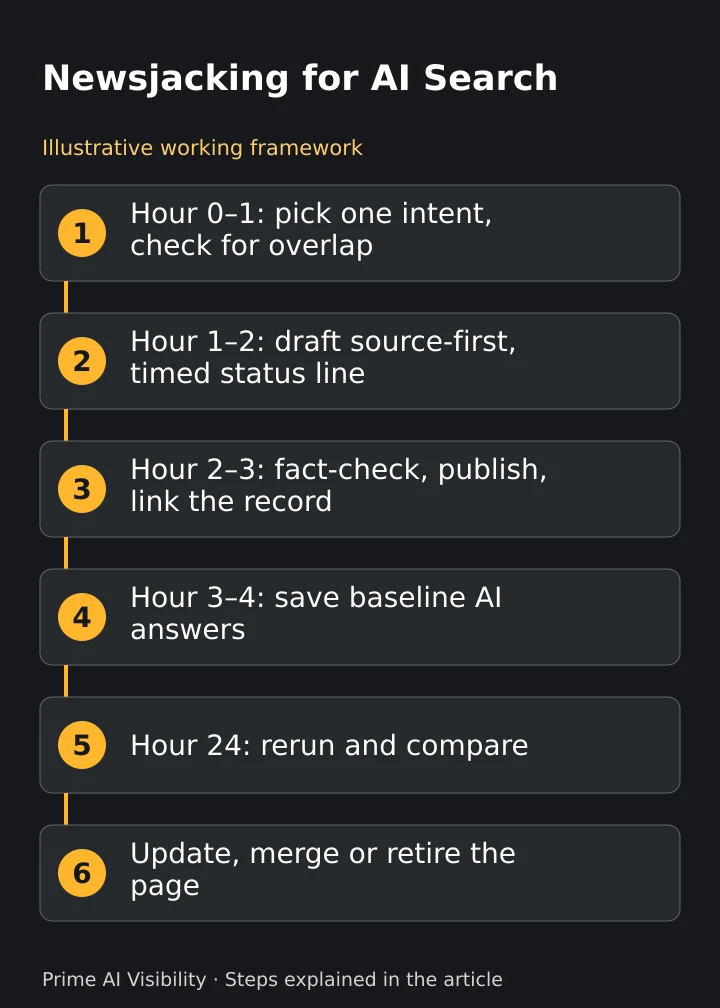
Illustrative working framework: the steps are explained in this article and are not a client result.
Capture citations and misstatements
Publishing is the start of the measurement, not the end. For each target question, save the full answer, the time, the tool, the settings and every linked URL. Then record three separate observations:
| Observation | Question it answers | How to record it |
|---|---|---|
| Website cited | Did the answer link one of your pages? | The exact URL and the question it appeared for |
| Brand named | Did the answer name your organization? | The sentence that names you |
| Factual agreement | Do the answer's claims match the record? | Each claim labelled confirmed, contradicted or unknown |
Keep them apart. An answer can name you while linking someone else, link you while misstating what your page says, or get the facts right without mentioning you at all. Factual agreement is your team's label, made against the primary record, not a metric any tool computes for you.
Misstatements about your own organization are the priority. If an answer attributes a claim to you that your page does not make, fix any ambiguous wording on your page first, then rerun. The guide to Perplexity citation tracking shows a practical source log for this, and how to write content ChatGPT will quote covers page structures that are easy to summarize accurately.
A linked source is observed evidence of what an answer displayed. It does not show why an engine chose it, and one run does not show a trend.
Measure AI answers, not only rankings
Rank tracking tells you where a page appears in a list of search results. It does not tell you whether an AI answer used the page, named you or repeated your facts correctly. In a news moment the gap is wider, because the pages that rank, the pages an answer links and the pages it summarizes can all differ, and they change through the day.
Use both, for different questions. Search Console and rank tracking show whether people found the page through search. Saved AI answers show whether answers linked it, named you and agreed with the record. The comparison of AI answer tracking and SEO rank tracking sets out which question each kind of tool answers, and the guide to AI search share of voice explains how to calculate shares from saved answers without mixing denominators.
Be careful with before-and-after claims. A spike in referrals during a news event is not evidence that AI answers cited you. A citation on one evening is not evidence of lasting visibility. Report what you observed, for which questions, on which dates.
The 24-hour review protocol
Twenty-four hours after publishing, review the page and the answers together:
- Rerun the same questions with the same tools and settings as the baseline.
- Compare the three observations for each question: website cited, brand named, factual agreement.
- Update the page. Refresh the status line and the update log, and add any official findings with their source and time.
- Correct the record where needed. Fix your own wording first. For third-party pages that answers link and that misstate your role, send the publisher the sentence, the primary source and the corrected wording.
- Decide the page's future. Keep it as the reference for the event, merge it into an evergreen page, or retire it with a redirect if the event did not warrant a standing page.
Repeat the review after any official cause statement, then move the questions onto your normal schedule.
How B2B teams can apply this
B2B news moments are usually narrower than a national ground stop: a regulation, an outage at a supplier, a security advisory, a market report. The method transfers directly.
- Write the intent map in advance for the kinds of news your sector sees, with the questions you could credibly answer.
- Keep a source list ready: regulators, standards bodies, official status pages and the data providers your buyers trust.
- Name an owner for each page type and for the answer checks.
- Agree what success means before the moment arrives: answers that link the right page, name you accurately and state the facts correctly for the questions you chose.
Prime AI Visibility supports the measurement part of that plan. It saves the answers that ChatGPT, Claude, Perplexity and Gemini return for the questions you choose, together with the links each answer displayed, and offers an AI Overview-style preview built from Google-grounded answers. The features page describes saved questions, answers and source lists, and the metrics page defines measures such as Brand named and Website cited. Paid plans can add weekly, temporary daily and on-demand checks for the days around an event.
The limits matter for news work. Prime AI Visibility does not capture the live Google AI Overview panel and does not cover Google AI Mode. It records what answers said and linked; it does not judge whether a claim is true, explain why a source was chosen or guarantee that a published page will be cited.
Teams that want help with the publishing side, from the intent map to the pages themselves, can look at Percepture's generative engine optimization services. Percepture is a separate agency and the company behind Prime AI Visibility, so treat that as a related-party mention.
Update log
- Nov. 14, 2026, 8:30 a.m. ET: Status as-of time for this article. Event facts reflect FAA sources and attributed statements through this time, including the 8:15 p.m. ET lifting of the ground stop on Nov. 13 and officials' preliminary account.
Frequently asked questions
What is newsjacking GEO AI search citation monitoring?
It is the practice of joining a breaking story with a useful, source-first page and then checking, with saved answers, whether AI tools link that page, name your organization and state the facts correctly. It treats those three observations as separate results and does not count traffic spikes as evidence of citation.
Is newsjacking appropriate for a safety event like the FAA ground stop?
Only when the page genuinely helps readers or the professionals who serve them. Status and cause belong to the FAA, officials and newsrooms. A specialist can add value with an explanation, a method or a response guide, but should wait if the angle is only self-promotion.
How fast should a newsjacking page go live?
Fast enough to be useful while questions are active, but facts come before speed. A 0–4 hour plan of choosing an intent, drafting source-first, fact-checking and then saving baseline answers is a working guide, not a requirement.
How do I avoid competing with my own pages?
Give each page one intent, distinct titles and descriptions, and descriptive links between them. If an existing page already answers the question, add a dated section to it instead of publishing a near-duplicate.
Does ranking well mean AI answers will cite my page?
No. Rankings, linked sources and summarized pages can differ, especially during a live story. Track saved AI answers separately from search rankings and report each for what it shows.
What should I measure after publishing?
For each target question, record whether the answer linked your page, whether it named your organization and whether its claims matched the record. Rerun at 24 hours and after any official statement, with the same tools and settings.
Is the FAA ground stop still in effect?
No. It was lifted at 8:15 p.m. ET on Nov. 13, according to CNBC and AVweb, and the FAA's status page showed no active en route events on the morning of Nov. 14. Delays and cancellations were expected to continue into the weekend. Check the FAA status page for the current position.
What caused it, and was it hacked or linked to Microsoft or SMART?
Officials gave a preliminary account of overloaded routers and switches and said the investigation was continuing. Mullin said there was no indication of a cyberattack and no reason to connect the Microsoft outage; Duffy and the vendor said SMART was not involved. Treat each as an attributed statement, not a final finding.
References
- David Meerman Scott, Newsjacking! (Nov. 14, 2011). https://www.davidmeermanscott.com/blog/2011/11/newsjacking.html
- Google Search Central, AI features and your website. https://developers.google.com/search/docs/appearance/ai-features
- Federal Aviation Administration, National Airspace System Status. https://nasstatus.faa.gov/
- FAA Air Traffic Control System Command Center, Advisory 120, national ground stop update (Nov. 13, 2026). https://www.fly.faa.gov/adv/adv_otherdis.jsp?advn=120&adv_date=11132026
- CBS News, FAA issues nationwide ground stop due to "extraordinary circumstances" (Nov. 13, 2026). https://www.cbsnews.com/news/faa-issues-nationwide-ground-stop/
- CNN, Live updates: FAA issues nationwide ground stop for all flights (Nov. 13, 2026). https://www.cnn.com/2026/11/13/us/live-news/flights-ground-stop-faa
- USA TODAY, FAA orders ground stop at US airports over safety concerns: Live updates (Nov. 13, 2026). https://www.usatoday.com/story/news/nation/2026/11/13/faa-orders-nationwide-groundstop-at-us-airports-citing-safety/92765499007
- Percepture, How Digital PR Cuts Through a Crowded News Cycle. https://percepture.com/digital-marketing-insights/how-digital-pr-cuts-through-a-crowded-news-cycle
- CNBC, FAA lifts ground stop after more than four hours, but flight cancellations will stretch into the weekend (Nov. 13, 2026). https://www.cnbc.com/2026/11/13/faa-ground-stop.html
- AVweb, FAA Rules Out SMART AI System as Cause of Nationwide Ground Stop (Nov. 13, 2026). https://avweb.com/aviation-news/faa-nationwide-ground-stop-lifts
- U.S. Government Accountability Office, GAO-26-108439 (Sept. 21, 2026). https://www.gao.gov/products/gao-26-108439
Next steps
- Write your intent map for the kinds of news your sector sees, and mark the questions you could credibly answer.
- Run an AI visibility audit so you know which of your pages answers already link before the next news moment.
- Create a workspace in Prime AI Visibility and save the questions you want to track.
Measure what the story did for you, not what it felt like
Create a workspace to rerun the same questions after a news moment and compare whether answers named you, linked you and got the facts right. Paid weekly, temporary daily and on-demand checks use shared credits.