

AI visibility tool vs SEO rank tracker: what each measures
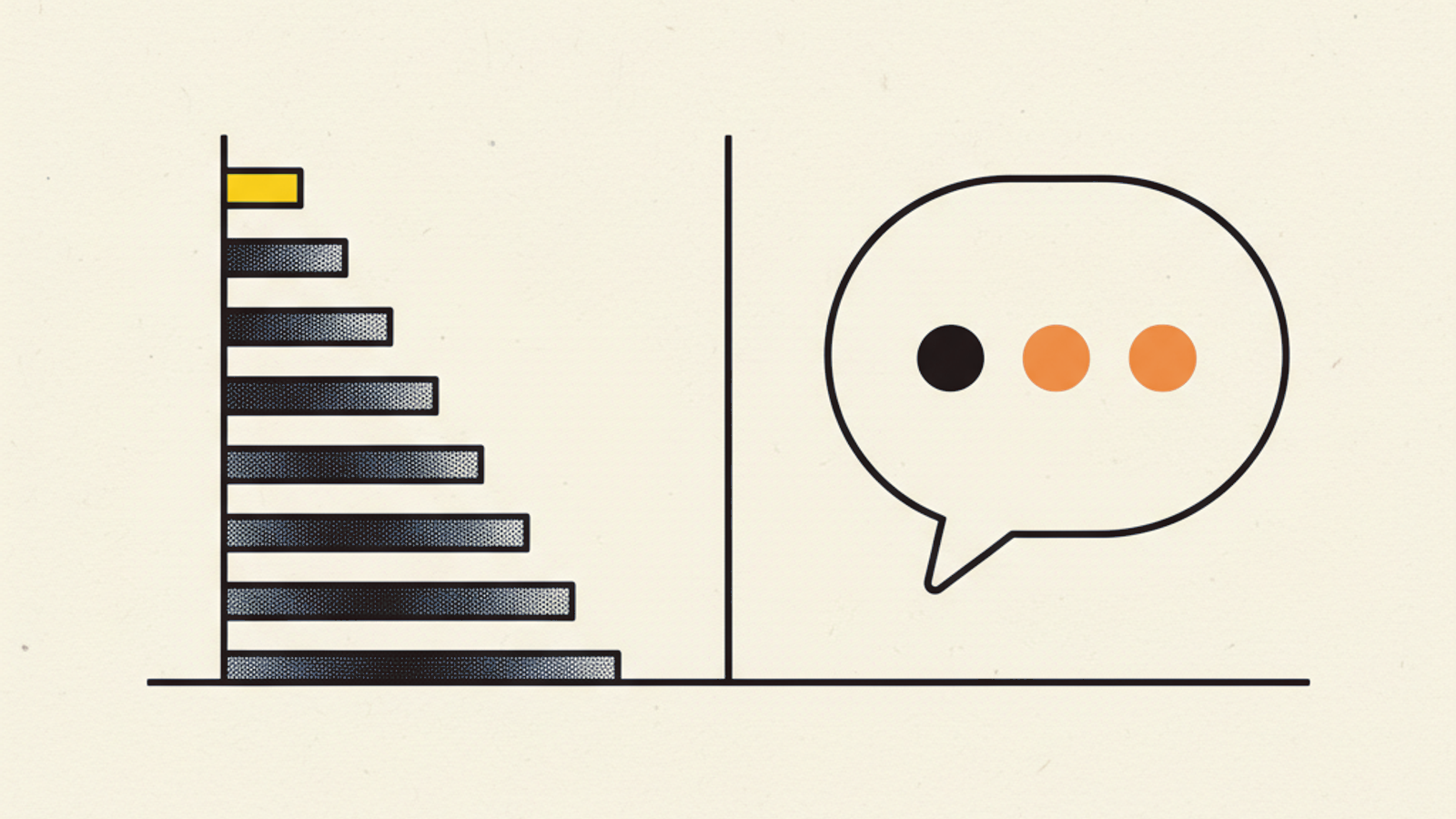
The AI visibility tool vs SEO rank tracker question comes down to what each instrument watches. A rank tracker records where a URL sits in a ranked list of links on a search results page. An AI visibility tool records whether a generated answer names, describes, and sources your brand. Search still publishes a leaderboard; answer engines publish prose — so one tool cannot substitute for the other.
AI visibility tool vs SEO rank tracker: the short answer
- Different objects. A rank tracker measures a position in a list; an AI visibility tool measures presence, framing, and sourcing inside synthesized text where no position exists.
- Different cadence. Rankings drift over days and weeks; retrieval-augmented answers can change between morning and afternoon as the engine refreshes what it retrieves.
- Different failure modes. A rank tracker fails silently on AI surfaces by reporting nothing; an AI answer can misdescribe you while your rankings look perfectly healthy.
Why the two instruments cannot be merged
The temptation is to treat AI answers as "position zero plus one" and bolt an AI column onto the rank report. That framing breaks for a structural reason: there is no rank inside an answer. A large-language-model answer engine synthesizes prose from retrieved sources. Your brand is either named or not named, recommended or merely listed, described accurately or described wrongly, and cited as a source or paraphrased without attribution. None of those states map to an integer position.
Some vendors publish a "ChatGPT rank" anyway. The engines do not document any internal ranking of brands inside an answer, so any such number is a construction of the vendor's own sampling — worth asking hard questions about before it goes in a board deck. The honest unit of measurement on the answer surface is a prompt-level observation: for this prompt, on this engine, on this day, was the brand named, how was it framed, and which upstream source did the answer lean on.
A rank tracker, by contrast, measures something the surface genuinely publishes. Google's own Search Console documentation defines average position as the average ranking of a site's results for a query, which is why position reporting for classic search is legitimate and comparable across tools. The instrument matches the surface. The mistake is pointing that instrument at a surface that has no positions. The same either/or trap appears with automation software — here is how a visibility engine compares to a marketing automation platform.
What a rank tracker actually tells you
A rank tracker earns its keep on questions the answer layer cannot address:
- Position by keyword over time. Where your URLs sit for tracked queries, segmented by device and geography.
- SERP feature presence. Whether you hold a featured snippet, sitelinks, an image pack, or a local pack slot.
- Index-layer diagnostics. Ranking collapses often flag crawl, canonical, or quality problems worth fixing regardless of AI surfaces.
- Competitive shelf position. Who sits above you in the list buyers still scan when they click through to classic results.
None of this becomes obsolete because answer engines exist. Organic search still carries enormous traffic, and the pages that rank well are disproportionately the pages retrieval systems fetch. Ranking data remains a leading indicator for part of the retrieval pool — it just stops being the whole story.
What an AI visibility tool actually tells you
An AI visibility tool runs a fixed set of buyer prompts across answer engines on a schedule and records what came back. The core readings:
- Mention rate. The share of tracked prompts where the brand is named at all.
- Share of citation. Of the relevant answers in the prompt set, the share that name the brand at least once — the closest GEO analogue to share of voice. The full definition and its denominator traps are worth reading before you compare numbers across tools.
- Recommendation rate. Whether the answer presents you as the pick, not merely a name in a list.
- Sentiment and framing. Whether the description is accurate, favorable, outdated, or wrong.
- Upstream-source attribution. Which URL, thread, or document the answer leaned on — the actionable half of the report, because that source is what you can influence.
The observations are prompt-shaped rather than keyword-shaped. "best crm for a 12-person startup" is a prompt a buyer types into ChatGPT; the equivalent rank-tracker keyword misses the conversational qualifiers that change which brands an engine names. Prompt sets, engines, and dates have to stay fixed for trends to mean anything — the same discipline honest competitive AI visibility benchmarking demands.
Side-by-side comparison
| SEO rank tracker | AI visibility tool | |
|---|---|---|
| Object measured | URL position in a ranked list | Brand presence inside generated prose |
| Unit of input | Keyword | Buyer prompt |
| Surfaces | Google and Bing results pages | Google AI Overviews, Gemini, ChatGPT, Perplexity, Claude |
| Position metric | Yes — the surface publishes one | No — no rank exists inside an answer |
| Source attribution | Not applicable | Central — which upstream source the answer leaned on |
| Sentiment/framing | Not measured | Measured — accuracy and favorability of the description |
| Refresh cadence needed | Daily to weekly is adequate | Daily — retrieval refreshes move in hours |
| Detects misdescription | none | strong |
| Detects index-layer problems | strong | none |
| Tells you what to fix | Partially — page and link signals | Partially — the upstream source to influence |
The scorecard reads as complementary, not competitive. Each instrument is strong exactly where the other is blind.
Where the readings overlap — and where they diverge
The overlap is real: pages that rank well on classic search are frequently in the retrieval pool answer engines draw from, and Google's AI Overviews sit directly on top of the Google index. A brand with strong rankings often starts with a head start on AI surfaces. That is why keeping the rank tracker matters even for a team that has fully committed to GEO.
The divergence is just as real, and it is where measurement gaps hide:
- You rank #2 and the answer never names you. The engine leaned on a comparison page or a Reddit thread that omits you. The rank report shows green; the buyer asking ChatGPT never hears your name.
- You rank nowhere and the answer recommends you. Perplexity leans heavily on news and community sources; a strong review thread can earn you a recommendation your rankings never predicted.
- The answer names you and gets you wrong. Outdated pricing, a retired product line, a mixed-up competitor feature. No position metric can surface a misdescription.
- Two engines disagree. The same prompt can produce opposite recommendations on ChatGPT and Gemini in the same week, because they retrieve from different pools — the pattern is visible in any side-by-side of Perplexity and Google AI Overviews as well.
Teams that only run a rank tracker see none of these four situations. Teams that only run answer measurement miss the index-layer diagnostics that often explain why retrieval skipped them.
Common misconceptions
"AI visibility is just rank tracking with extra steps." No — the object is different. A position is an ordinal on a published list; a mention is a binary observation inside prose that also carries framing, sentiment, and sourcing. Averaging mentions into a pseudo-rank throws away the parts that drive action.
"My rank tracker added an AI Overviews checkbox, so I am covered." Detecting that an AI Overview appeared for a keyword is not the same as knowing whether it named you, how it described you, and which source it used. Presence of the feature is a rank-tracker fact; presence of your brand inside it is an answer-layer fact.
"If I win rankings, the AI answers will follow." Sometimes, on Google surfaces especially. But engines with different retrieval pools — Perplexity's news-and-community lean is the obvious case — routinely cite sources that never ranked for the equivalent keyword. Treat ranking as one input to retrieval, not a guarantee of citation. The engines do not document exactly how retrieval selects sources, so any tool claiming a deterministic rank-to-citation pipeline is overclaiming.
"One combined score can cover both." A blended search-plus-AI score hides the per-surface picture that tells you where to act. Keep the readings separate and report them side by side — the approach executive AI visibility reporting takes when it distinguishes movement you caused from engine drift.
When you need which tool
You need only a rank tracker if your buyers demonstrably do not use answer engines for your category yet, and your evidence for that is recent and prompt-tested rather than assumed. This is increasingly rare, and worth re-testing quarterly.
You need only an AI visibility tool if you operate in a space where classic search traffic has already collapsed into answers for your money queries — some developer-tool and consumer-research categories look like this. Even then, index health still influences retrieval, so most teams keep at least lightweight position monitoring.
You need both if — the common case — buyers split across surfaces. Run the rank tracker for the index layer and the answer layer for the six major engines, and reconcile them monthly: every prompt where the answer skips you while your ranking is strong is a retrieval gap with a findable upstream cause. A structured AI visibility audit is the fastest way to build that first reconciliation.
A practical evaluation checklist
When you evaluate an AI visibility tool to sit alongside your rank tracker, ask:
- Per-engine reporting. Averaged engine scores hide the surface where you are losing. Insist on per-engine numbers.
- Daily cadence. Weekly sampling misses retrieval refreshes that move in hours.
- Upstream-source attribution. A mention count without the source it came from is half a report.
- No invented rank metric. A vendor publishing a "ChatGPT rank" is publishing a number the architecture does not support.
- Published methodology. Formulas, weights, and sentiment buckets should be readable by your analyst, the same standard you would apply to any KPI framework for AI visibility.
- Prompt-set control. You define the prompts; the vendor proposes additions you approve. A fixed set is what makes trend lines honest.
Apply the mirror-image checklist to your rank tracker: accurate localization, SERP-feature detection, and API access for reconciliation against the answer-layer data.
References
- Google, Performance report (Search) — Search Console Help: how average position is calculated (2025). https://support.google.com/webmasters/answer/7576553
- OpenAI, ChatGPT search (2024). https://openai.com/index/introducing-chatgpt-search/
- Google, AI Overviews and your website — Google Search Central documentation (2025). https://developers.google.com/search/docs/appearance/ai-features
- Perplexity, How does Perplexity work? (2024). https://www.perplexity.ai/hub/faq/how-does-perplexity-work
Next steps
- Read what an AI visibility tool does and does not do for the full capability map before you shortlist vendors.
- Compare manual tracking against tooling if you are deciding whether to buy anything at all yet.
- When you are ready, create a Prime AI Visibility workspace and bring 10 buyer prompts.
Frequently asked questions
Can a rank tracker measure AI answers at all?
Not meaningfully. Some rank trackers detect whether an AI Overview appeared for a keyword, but they do not parse whether the answer named your brand, how it framed you, or which source it leaned on. Those are the readings that matter on the answer surface, and they require prompt-based measurement.
Does ranking well on Google improve my AI visibility?
Often it helps, especially for Google AI Overviews, which sit on Google's index. But engines with different retrieval pools regularly cite sources that never ranked for the equivalent keyword, and the engines do not document a deterministic link between position and citation. Measure both rather than inferring one from the other.
Should I replace my SEO rank tracker with an AI visibility tool?
For most teams, no. The two instruments watch different surfaces, and classic search still carries substantial buyer traffic. The usual end state is both: a rank tracker for the index layer, an AI visibility tool for the answer layer, reconciled monthly to find retrieval gaps.
Why do AI visibility tools use prompts instead of keywords?
Because buyers phrase questions conversationally, and the qualifiers change the answer. "crm software" and "best CRM for a 12-person startup that lives in Gmail" can surface different brands. Prompt sets mirror what buyers actually type into answer engines, which keyword lists were never designed to capture.
Is "share of citation" the AI equivalent of average position?
No. Share of citation is the share of relevant answers in your prompt set that name the brand at least once — a coverage measure, not a position. There is no position inside an answer, which is exactly why the two instruments report different objects.
How often should AI visibility be measured compared to rankings?
Daily. Retrieval-augmented answers can change within hours when the engine refreshes its sources, while rankings typically drift over days or weeks. A weekly AI sample reports stale state and misses the movements you would want to investigate.
Keep the rank tracker. Add the answer layer.
Bring 10 buyer prompts and see how every major answer engine describes your brand today — measured daily, per engine, with upstream-source attribution.
Create a free workspace