
Best AI Tools for Facebook Ad Creative: 2026 Evaluation and 2027 Planning
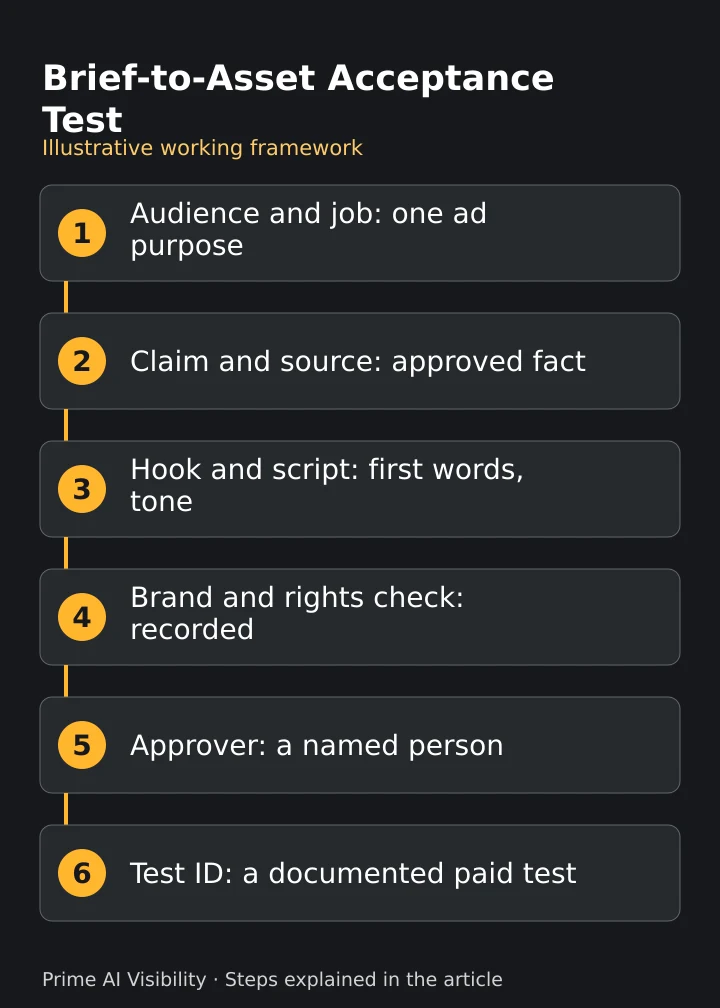
The best AI tools for Facebook ad creative in 2026 depend on the production job, and planning for 2027 should use capabilities you have verified rather than forecasts. The AI search visibility monitoring features of Prime AI Visibility provide a complementary research and website-content workflow, not a Facebook ad generator. AI ad-creative tools help produce or adapt images, video, copy or layouts; each output still needs evidence, rights checks, human review and a real campaign test.
This guide is for a paid-social lead, creative operations manager, brand reviewer or ecommerce marketer choosing production tools. It provides a job-based shortlist and a proposed acceptance method, not a performance ranking. Percepture and Prime AI Visibility are commercially connected; affiliated services are identified where relevant.
In this guide:
- Choose the creative job before choosing a tool
- The best AI tools for Facebook ad creative: five options and their evidence boundaries
- What the research companion contributes before production
- The Brief-to-Asset Acceptance Test
- Build hooks into an accurate story
- Rights, AI transparency and launch checks
- Cost and measurement without a fake winner
Choose the creative job before choosing a tool for Facebook ad creative
Pick the job first, because the best AI tools for Facebook ad creative differ by task. Five jobs cover most needs. Static and carousel design produces layouts for feeds and stories. Image variation adapts one approved concept into sizes and treatments. Video and UGC-style production turns a product page or script into a short clip. Brand-governed editing keeps a team's fonts, colors and approved claims in place. In-platform adaptation lets the ad platform adjust a creative at delivery time.
An attractive output does not establish performance. A tool's internal score or a polished sample is a hypothesis until a paid test supports it. Judge each option against the bottleneck you actually have, which might be speed, brand consistency, editing control or approval time.
The best AI tools for Facebook ad creative: five options and their evidence boundaries
The five options below are listed by task, not from best to worst. Each description is bounded to what the vendor says publicly, and nothing here repeats a vendor's return-on-ad-spend claim as tested superiority. Check each product and plan yourself, because features change. Ask each vendor for the current documentation of the exact feature you need, run the same brief through every option you shortlist, and keep the outputs so a second reviewer can compare them without knowing which tool made which asset. A fair comparison uses the same product fact, the same audience and the same reviewer for every tool.
- Meta generative creative and Advantage+ creative. For in-platform adjustments to images, text and formats. Check Meta's official product and transparency announcements, and confirm which features your plan includes.
- Canva AI. For editable designs and multiple formats from one layout. Check what is editable after generation and what the rights terms say.
- Adobe Express. For design and short video generation with brand editing. Confirm which features are in your plan.
- AdCreative.ai. For generating ad creative variations. Ask how inputs are used and what you can export and edit.
- Creatify. For URL-to-video and avatar or image workflows. Ask about avatar and likeness rights.
| Option | Job | What to verify before use |
|---|---|---|
| Meta generative creative | In-platform adjustment | Which adjustments are on, what you can review and what disclosures apply |
| Canva AI | Editable designs and formats | Editability after generation, export and rights terms |
| Adobe Express | Design, video and brand editing | Features in your plan and brand-control settings |
| AdCreative.ai | Ad creative generation | Input handling, export format and editing control |
| Creatify | URL-to-video and avatars | Source handling, likeness rights and caption accuracy |
Availability and rights need particular care when a vendor announces new features. Adobe's November 10, 2026 MAX announcement describes enterprise content-supply-chain developments and brand-context support, with future and beta elements. It shows why buyers should check what is available in their own product and tier compared with what is described as coming. It does not show a campaign result, a customer deployment or that every announced feature has shipped, and GenStudio enterprise features should not be assumed for Adobe Express.
What the research companion contributes before production
Prime AI Visibility is a separate companion card, not a sixth ad generator. It does not create Facebook ads, run campaigns, test ad variants or control media budgets. What it does is let you inspect public buyer questions, save the answers and sources, and improve the landing-page content an ad points to. How Prime AI works describes the selected-question workflow, and its Content Studio drafts researched website content for review.
Prompt wording matters before you brief anything. The prompt intent guide separates a buyer's evaluation question from a navigational or support one, which tells you what an ad's landing page must answer. The AI visibility measurement definitions keep a mention, a citation and a recommendation apart, and none of them is an ad conversion or return on ad spend.
The Brief-to-Asset Acceptance Test
The worksheet turns a creative request into something a reviewer can accept or reject. It is a proposed application created for this article, not a historically tested system. Its rows are the audience and job, the supported claim and source, the hook or script, the asset requirements, the brand and risk check, editability and export, rights and AI-label evidence, a named human approver and a campaign test ID.
For the claim row, use a fact the company can source. The AI brand-fact accuracy guide describes how to verify a statement before reuse, and the earned media and AI citations guide explains how genuine third-party references can support a claim without becoming an endorsement.
| Worksheet field | What to enter | Illustrative entry |
|---|---|---|
| Audience and job | Who the ad is for and what it must do | Returning visitors, a product-detail reminder |
| Claim and source | One approved fact and where it is published | A feature stated on the product page |
| Hook and script | The first words, tone and on-screen support | A plain question opening a short clip |
| Asset requirements | Formats, length and caption needs | One static concept and one short video |
| Brand and risk check | Brand fit, claim accuracy and readable captions | Reviewer confirms claim and captions match the source |
| Editability and export | What can be changed and exported | Text and layout editable after generation |
| Rights and AI label | Licenses, likeness consent and disclosure | Product image and music rights recorded |
| Approver and test ID | A named person and a paid-test reference | Brand lead approves and logs the test ID |
In the illustrative example, one approved product fact and one audience brief are used to request a static concept, a short video and a headline variant from the same tool. A reviewer logs editability, claim accuracy, caption readability and rights. These are acceptance tasks, not generated assets and not a performance experiment.
Build hooks into an accurate story
Specify the first spoken words, the tone and the on-screen support in the brief, and write the excerpt so it makes sense without the rest of the video. A long video and a short clip need different crops, captions and context, so do not assume one export fits both. The SEO content pipeline guide describes how one source article can be reused for several formats while each keeps its evidence.
No formula guarantees that an ad will spread, and social activity does not cause search rankings. Repurposed organic content is not the same as a paid-ad test, so keep the two kinds of evidence apart.
Rights, AI transparency and launch checks
Before launch, check product likeness, licenses, music, voice and likeness consent, accessibility and any required disclosure against the current platform terms and the rules that apply to you. Meta's generative AI transparency announcement for ads products describes AI-related signals and an "About this ad" disclosure, including signals from third-party AI tools. Do not assert that every synthetic ad is detected or labeled the same way everywhere, and confirm current behavior in the platform.
Keep a short log for each asset that records the brief, the tool and plan used, the date, the person who approved it and the rights checked. When a claim or an image is questioned later, that log answers the question quickly. Name a human who approves every asset, and keep the rights record with the asset. If a tool cannot tell you what it was trained or licensed to do with your inputs, treat that as an open question to settle before launch. This guide is not legal advice.
Cost and measurement without a fake winner
Compare costs on separate lines: creative credits, revision effort, seats, approved assets per week and ad spend. A tool that is cheap per image can be expensive per approved asset if revisions are slow. For the budget conversation, AEO budget ownership separates AI-search budget from ad spend, and Percepture's guide to social media marketing budget planning covers the paid-social side from a separate canonical.
Decide the success measure before you generate anything, and write down what result would make you stop using a tool. Run a documented paid test, with appropriate randomization and attribution, before you claim a creative improved results. Public AI answer evidence from Prime AI Visibility is not ad-conversion data. Keep AI referrals and paid conversions in separate reports, as the ChatGPT referral measurement guide describes, and use the AI visibility and CRM workflows guide to keep the post-click handoff clear without assuming a platform integration.
Percepture is the affiliated agency, and an option for teams that want paid media, content and search connected. Its generative engine optimization services cover public-answer evidence and its Digital PR services cover genuine third-party coverage without promising any. To judge the expertise of any search consultant, Best AI SEO experts in the world is an editorial resource, not an accreditation.
Frequently asked questions
Which AI tool is best for Facebook ad creative?
It depends on the job. Choose by the bottleneck, such as editing control, brand fidelity or video production, and verify the result with a paid test.
Can Prime AI Visibility create Facebook ads?
No. It is a research and website-content companion for public buyer questions and landing-page evidence.
Does an AI creative score predict results?
No. Treat any score as a hypothesis until a documented test supports it.
Do I need to disclose AI-generated ads?
Check the current platform rules and the laws that apply to you, and keep a record of what you checked.
What is the difference between 2026 and 2027 planning?
Evaluate verified capabilities for 2026, and for 2027 re-check availability instead of assuming announcements ship.
Is repurposed organic video a paid test?
No. A paid test needs its own design, audience and measurement.
Next steps
- Name the job. Choose the one creative bottleneck you want to fix first.
- Run the acceptance test. Fill in one worksheet row and log the approver and test ID.
- Check the landing page. Save public answers in Prime AI Visibility and improve the evidence the ad points to.
References
- Meta, Generative AI transparency for ads products, the official announcement on AI signals and disclosure.
- Adobe, MAX and GenStudio announcement, November 10, 2026, a vendor announcement with future and beta elements.
About the author
Bob Generale is President and Partner at Percepture and co-founder of Prime AI Visibility. This article explains a creative buyer's evidence packet: editable output, source and usage rights, brand approval and separately measured paid-test conditions. Its product descriptions are bounded vendor claims, and its worksheet is a proposed method rather than an account of personal testing or a client campaign. Percepture and Prime AI Visibility are commercially connected.
Strengthen the page the ad sends people to
Create a workspace to save public AI answers about your product, keep the displayed sources and improve the landing-page evidence your ad points to. To discuss a scoped paid-media and content program, use the sales route. This is research support, not an ad generator or a budget optimizer. Coverage, cadence and credits depend on the plan, and paid plans add Gemini and an AI Overview-style preview built from Google-grounded answers.