
AI Marketing Content Software Financial Services Compliance: Compare Jobs
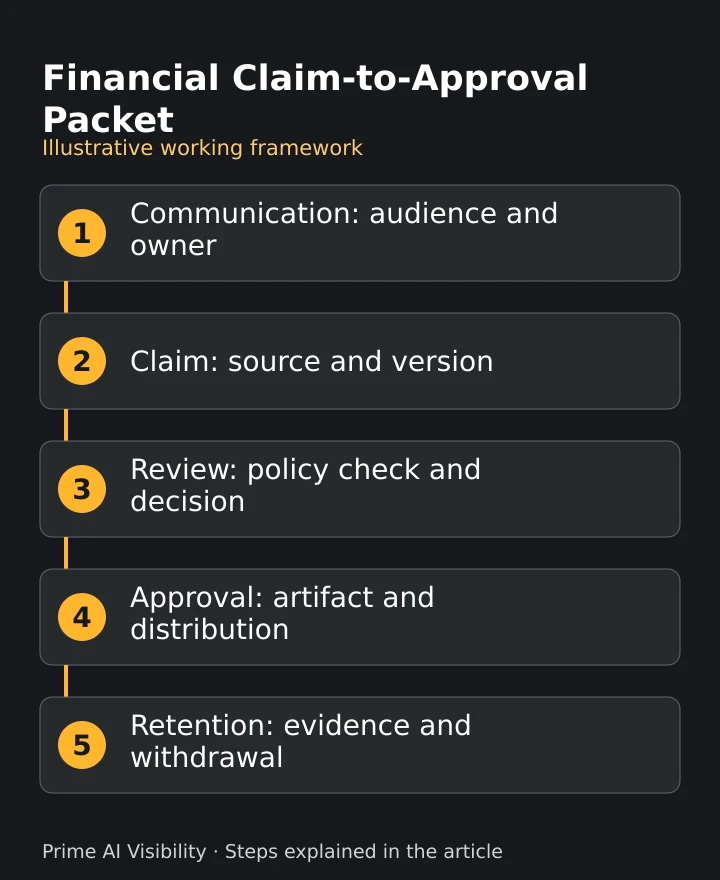
AI marketing content software financial services compliance decisions should start with the job being purchased: drafting, policy checks, human approval, record retention or distribution. Compare those jobs separately and build a claim-to-approval packet around the firm's designated reviewers. A generic writing tool or saved-answer monitor is not automatically a compliance approval or retention system.
Financial compliance teams face rigid obligations when producing promotional material. Regulators mandate that communications with the public are fair, balanced, not misleading, and supported by verifiable evidence. Marketing software in this sector must support specific operational functions: drafting against approved source material, running automated rule checks, facilitating human sign-off, controlling distribution, and retaining immutable records.
When evaluating these systems, enterprise buyers must assess how software manages the claim-to-approval journey. You can explore brand-compliant marketing content to understand broader governance, or review our guide on financial services content marketing for channel-specific context.
AI marketing content software financial services compliance: compare five jobs
AI marketing content software financial services compliance platforms are specialized systems designed to create, inspect, approve, and record promotional materials under strict industry supervisory regulations. Unlike standard consumer artificial intelligence assistants, these platforms operate within defined guardrails to enforce institutional policy, capture review histories, and satisfy statutory record-retention requirements.
In banking, asset management, insurance, and wealth advisory, promotional text cannot be published directly from a generative model. Unchecked generative tools present operational liabilities:
- Unsubstantiated Performance Claims: Models can invent past performance records or project future gains without required statutory disclosures.
- Omitted Risk Disclosures: Automated copywriters often omit obligatory context regarding potential capital loss, fee schedules, or jurisdictional limits.
- Lack of Audit Trails: Chat prompts and transient sessions do not create an immutable evidentiary trail showing who authorized a statement or what source data verified it.
- Scope Creep: A claim authorized strictly for high-net-worth accredited investors may be inadvertently adapted for general retail audiences.
To mitigate these risks, regulated institutions separate the drafting and monitoring layers from formal supervision. A visibility monitor or an automated draft generator does not constitute compliance software. Specialized supervisory tools exist solely to enforce human accountability, capture policy decisions, and retain tamper-evident records.
The Five Non-Overlapping Jobs in Financial Content Compliance
A compliant content operation involves five distinct operational stages. Conflating these stages invites regulatory scrutiny and internal workflow failures.
1. Drafting and Claim Grounding
Drafting produces initial text based strictly on verified inputs. In financial workflows, an artificial intelligence drafting engine must ingest approved message libraries, validated fee tables, and current product terms. It must never synthesize ungrounded features or project returns. The output at this stage is treated as an unverified draft, requiring clear labels that designate it as unapproved material.
2. Pre-Publication Policy Checks
Before any human spends time reviewing a submission, automated policy engines scan text against institutional and statutory rule sets. These rules check for absolute guarantees (such as "risk-free" or "guaranteed returns"), required jurisdictional disclaimers, clear balance between potential risks and rewards, and readable formatting. Flagged phrases are returned to the creator with explicit policy citations.
3. Human Supervisory Approval
Automated software cannot legally assume regulatory liability; accountability rests with qualified individuals, such as a registered compliance officer or Series 24 principal. The software must present the reviewer with:
- The exact source material supporting every factual assertion.
- The pre-publication automated policy check results.
- The explicit target audience, channel scope, and shelf-life expiration date.
- The full version history of the document.
The output of this stage is an immutable, timestamped approval record tied to a verified identity.
4. Controlled Distribution
Once approved, content cannot be released without distribution guardrails. An asset cleared strictly for institutional distribution via targeted email must be prevented from appearing on public retail portals or social networks. Distribution software enforces version control, ensuring that only current, non-expired assets are distributed to authorized touchpoints.
5. Record Retention and Post-Publication Monitoring
Financial regulations require promotional records, associated substantiation, and review correspondence to be retained in read-only, non-rewriteable formats (such as WORM storage) for set statutory periods. Post-publication monitoring periodically crawls live channels to confirm that published copy has not drifted, disclaimers remain visible, and unauthorized modifications have not occurred.
Sourced Vendor Comparison: Red Oak, Haast, and Adclear
Specialized software vendors focus on different stages of this operational lifecycle. The following assessments reflect documented vendor capabilities.
Red Oak Compliance
Red Oak Compliance describes review, distribution, supervision, archiving, and analytics as core stages of its content compliance lifecycle [1]. Its software centers on formal supervisory workflows: managing submission queues, routing files to designated compliance personnel, tracking multi-tiered review notes, enforcing sign-off, controlling finalized asset distribution, and maintaining auditable archival trails for regulatory examination.
Haast
Haast positions its platform around marketing content review and monitoring [2]. Its architecture concentrates on auditing marketing materials against configured institutional guidelines, flagging risky phrasing, streamlining reviewer corrections, and monitoring live digital channels to identify unapproved modifications or expired messaging.
Adclear
Adclear's product documentation outlines pre-publication approval workflows, post-publication monitoring capabilities, and a centralized knowledge hub [3]. Its feature set helps marketing teams screen creative copy against institutional reference rules before publication, log supervisory approvals, and run ongoing automated scans across published domains to catch compliance deviations.
The Boundary: Content Workflow Software vs. External Visibility Monitoring
Enterprise buyers often confuse supervisory content platforms with an AI Visibility Platform. These systems address entirely separate business functions and operate under distinct technical parameters.
An internal compliance system acts as an approval gatekeeper. It holds your internal teams to legal standards, archives your promotional assets, and provides evidence of review to auditing authorities.
By contrast, Prime AI Visibility is an external search tracking platform. It monitors public generative engines to show how independent models interpret, synthesize, and cite brand information. Prime AI Visibility saves answers to plan-supported buyer questions alongside displayed sources and links, supporting historical comparisons and follow-up rechecks across ChatGPT, Claude, Perplexity, Gemini, and a Google-grounded AI Overview-style preview.
The platform records external observations:
- It captures what a public engine displayed in response to a prompt.
- It documents displayed citations, showing that a link appeared in the model's response.
- It enables marketing teams to see if public-facing corporate claims are reflected accurately across artificial intelligence answers.
However, Prime AI Visibility does not provide regulatory compliance infrastructure:
- It is not a registered compliance archive, approval workflow engine, or ad review system.
- It does not evaluate internal regulatory compliance or issue financial advice.
- A displayed citation in Prime AI Visibility proves only that a model displayed that specific link; it does not prove retrieval timing, index inclusion, algorithmic preference, or model trust.
- Its Google-grounded preview is an AI Overview-style preview, not a live Google AI Overview capture or Google AI Mode environment, and does not establish Google search indexing or ranking.
- The software shows what an engine displayed, never internal engine mechanics or why a model selected a reference.
Marketing leaders use compliance software to validate what they publish, while using an AI search visibility platform to monitor how external models quote public web material. To evaluate how external search engines process industry claims, see our analysis on AEO for regulated industries.
Practical Implementation: The Financial Content Claim-to-Approval Packet
To prevent ungrounded claims from reaching reviewers, compliance operations require structured submission packets. Every promotional asset must carry clear claim attribution, automated pre-check results, explicit reviewer sign-off, authorized distribution limitations, and formal archival confirmation.
Operational Stages
Stage 1: Define communication type, audience category, and business unit owner. | Stage 2: Isolate the claim, verify source documents, and link specific reference text. | Stage 3: Run pre-publication rule checks, flag risks, and log reviewer approvals. | Stage 4: Lock approved artifact, define valid channels, and record expiration date. | Stage 5: Deposit packet in non-rewriteable storage and assign withdrawal ownership.
The Worksheet
Use this worksheet template for every promotional content piece:
================================================================================ FINANCIAL CONTENT CLAIM-TO-APPROVAL PACKET
STAGE 1: COMMUNICATION, AUDIENCE, AND APPLICABLE OWNER
- Communication Title: [Enter asset title]
- Channel Type: [Website / Email / Fact Sheet / Paid Social]
- Target Audience: [Retail / Accredited / Institutional]
- Business Unit Owner: [Name, Title, Department] STAGE 2: EXACT CLAIM AND SOURCE VERSION
- Proposed Claim: [Paste exact text sentence]
- Substantiating Document: [Title, Internal ID, Date]
- Exact Source Excerpt: [Paste exact verified supporting text]
- Disclaimers Required: [List required statutory disclaimers] STAGE 3: POLICY CHECK AND REVIEWER DECISION
- Automated Rule Scan Status: [Pass / Flags Present / Exceptions Noted]
- Flagged Terms: [List terms or state None]
- Designated Human Reviewer: [Name, Institutional Credentials]
- Reviewer Decision: [Approved / Rejected / Revision Required]
- Supervisory Rationale: [Notes explaining basis of approval]
- Sign-Off Timestamp: [Date, Time, Timezone] STAGE 4: APPROVED ARTIFACT AND DISTRIBUTION SCOPE
- Final Approved Asset Hash / Version: [Unique artifact ID]
- Permitted Distribution Channels: [Explicit approved lists]
- Shelf-Life Expiration Date: [Date after which asset cannot be served] STAGE 5: RETENTION SYSTEM, EVIDENCE, AND WITHDRAWAL OWNER
- Retention Archive Target: [System ID / WORM Volume Location]
- Archive Ingestion ID: [Unique receipt confirmation]
- Withdrawal Owner: [Role responsible for pulling content upon expiration]
Stopping / Escalation Trigger: [Condition that requires immediate asset withdrawal]
Worked Fictional Example
The following entry illustrates a completed packet for an institutional reporting tool:
================================================================================ FINANCIAL CONTENT CLAIM-TO-APPROVAL PACKET (WORKED FICTIONAL ENTRY)
STAGE 1: COMMUNICATION, AUDIENCE, AND APPLICABLE OWNER
- Communication Title: Commercial Treasury Reporting Dashboard Overview
- Channel Type: Product Landing Page Copy
- Target Audience: Institutional Commercial Banking Clients
- Business Unit Owner: Marcus Vance, Commercial Treasury Product Marketing Lead STAGE 2: EXACT CLAIM AND SOURCE VERSION
- Proposed Claim: "Commercial treasury clients can access reports in a unified dashboard with automated daily reconciliation exports."
- Substantiating Document: Core Engine Product Specification Document v4.2, Engineering Release Notes (Internal Ref: ENG-TREAS-42)
- Exact Source Excerpt: "Module 4 enables daily automated reconciliation export files across primary operating accounts via central dashboard view."
- Disclaimers Required: Account eligibility limitations apply. Daily export delivery schedules are dependent on third-party network availability. STAGE 3: POLICY CHECK AND REVIEWER DECISION
- Automated Rule Scan Status: Pass (Zero prohibited guarantee flags)
- Flagged Terms: None
- Designated Human Reviewer: Sarah Jenkins, Principal Compliance Officer (Series 24)
- Reviewer Decision: Approved
- Supervisory Rationale: Verified claim aligns strictly with software functional specs. Context is clear, balanced, and free of performance projections.
- Sign-Off Timestamp: 2026-11-04 14:22:18 UTC STAGE 4: APPROVED ARTIFACT AND DISTRIBUTION SCOPE
- Final Approved Asset Hash / Version: Web-Treasury-Page-v2-d9f7a4
- Permitted Distribution Channels: Commercial Banking Web Portal only. Not approved for retail promotion, paid social advertising, or syndicated print.
- Shelf-Life Expiration Date: 2027-11-04 (12-month re-review limit) STAGE 5: RETENTION SYSTEM, EVIDENCE, AND WITHDRAWAL OWNER
- Retention Archive Target: Enterprise Compliance Archival Vault (WORM Vol 08)
- Archive Ingestion ID: ARCH-20261104-99214-COMM
- Withdrawal Owner: Operations Webmaster Lead
Stopping / Escalation Trigger: Immediate takedown required if product engineering deprecates the export module or modifies third-party reconciliation cadence.
Synthetic Procurement Walkthrough: Vetting Software Capabilities
When procuring marketing technology within a regulated financial framework, teams must follow a strict validation process across procurement, technical architecture, and legal teams.
Phase 1: Policy Configuration and Drafting Boundaries
Test whether the system can enforce custom institutional guidelines:
- Can compliance teams add proprietary restriction lists, mandatory contextual notes, and product-specific disclaimers?
- Does the drafting assistant block absolute claims automatically, preventing copywriters from proceeding until flags are cleared?
- Does the system require every factual statement to link directly to an approved internal document version?
Phase 2: Human Supervision and Queuing
Examine the operational mechanics of the supervisory interface:
- Does the software route content based on organizational roles and licensing qualifications?
- Can the platform block marketing managers from approving their own collateral?
- Does the interface display automated policy screening checks side-by-side with submitted copy?
- Is the audit log tamper-evident, recording all revisions, comments, approvals, or rejections?
Phase 3: Distribution Controls
Confirm that the platform prevents unapproved distribution:
- Does the system restrict the export of approved assets to specific, authorized marketing channels?
- Can users pull raw, unapproved text into live publishing endpoints, or are API connections restricted to fully certified documents?
- Does the software support automatic expiration dates to retire outdated pricing or feature descriptions?
Phase 4: Archival and Audit Readiness
Review the platform's evidentiary infrastructure with regulatory examiners in mind:
- Does the retention system store records in a non-rewriteable, non-erasable format?
- Are reviewer identities, approval timestamps, and source documents permanently attached to the final creative output?
- Can the platform generate a unified audit packet during regulatory inquiries, or does it require manual reconciliation across disjointed databases?
For broader organizational comparisons, see our guide on marketing software for banks, insurance, and wealth management.
Common Enterprise Implementation Mistakes
Organizations often encounter regulatory friction or workflow bottlenecks when adopting artificial intelligence tools. Avoid these common mistakes:
Mistaking Content Generation for Compliance
Deploying an artificial intelligence writing tool without an integrated policy and approval workflow creates significant operational vulnerabilities. Content production speed increases, but internal backlogs quickly shift to compliance queues, where reviewers must manually fact-check ungrounded claims. Automated drafting must always be paired with rule validation and named human review.
Storing Verification Records in Disjointed Systems
Saving an approved copy in a content management platform while leaving compliance commentary in team chat channels creates an incomplete audit trail. If a regulatory examiner requests substantiation for a past claim, teams struggle to connect the final asset to its source approval. All reviewer notes, sources, and sign-offs must be stored in a unified record.
Confusing External Discovery Tracking with Supervisory Archival
Marketing teams occasionally attempt to use external discovery dashboards as supervisory archives. Tracking public search engines via an AI Visibility Tool shows what external models display, which is critical for search and communications strategy. However, it does not replace internal, non-rewriteable supervisory archives.
To refine your external presence alongside compliant internal production, consider working with Percepture's enterprise SEO team (commercial relationship: Percepture and Prime AI Visibility share common co-founding leadership). Their team helps regulated enterprises align compliant web content with technical organic search requirements.
Next steps
When approval records must cross a marketing technology stack, use the go-to-market implementation handoff guide to name data owners, acceptance tests and rollback responsibilities.
To establish an auditable content generation workflow, take the following sequential steps:
- Map Your Compliance Obligations: Consult internal compliance leadership to identify applicable regulatory rules governing promotional material, supervisory review hierarchies, and statutory retention timelines.
- Draft Policy Rulesets: Translate standard marketing guidelines into explicit programmatic rules. Categorize prohibited expressions, mandatory risk disclosures, and approved phrasing libraries for software configuration.
- Audit Your Tool Stack: Evaluate your active marketing and compliance stack. Determine whether existing systems manage drafting, policy checking, human approvals, controlled distribution, and record retention, or if there are gaps in your workflow.
- Deploy the Claim-to-Approval Packet: Implement the structured five-stage packet provided above. Mandate that all generative drafts link directly to verified internal product documentation before entering supervisory queues.
- Configure Independent Visibility Tracking: Establish clear separation between your internal compliance systems and your external search monitoring stack. Use an AI rank tracker to monitor public model outputs and verify that external answer engines cite your approved, published web resources accurately.
References
- Red Oak Compliance Software. Content Review, Distribution, Supervision, Archiving, and Analytics Lifecycle Overview. Available at: https://www.redoak.com/
- Haast. Automated Marketing Content Review and Continuous Monitoring Platform Specifications. Available at: https://haast.io/
- Adclear. Product Features: Pre-Publication Approval, Post-Publication Monitoring, and Knowledge Hub. Available at: https://www.adclear.ai/product
Next steps
- Evaluate external model presence by reading our playbook on SEO and AEO agencies for insurance compliance.
- Discover how to capture and inspect multi-engine citations across public platforms by reading about our core features and reviewing our reporting metrics.
- Track how external artificial intelligence engines display your public-facing brand claims: create a workspace on Prime AI Visibility.
Frequently asked questions
Can generative software legally approve promotional financial content?
No, automated software cannot legally assume supervisory liability under financial regulations. Statutory supervisory rules require qualified human personnel, such as a registered compliance principal, to review and formally approve public communications. Automated software can run preliminary policy checks and flag potential issues, but an accountable professional must verify claim substantiation and authorize final publication.
What is the difference between marketing content software and compliance software?
Marketing content software focuses primarily on asset creation, visual layout, copywriting, and multi-channel publication. Compliance software exists to enforce internal policy controls, route materials through designated supervisory approval hierarchies, maintain tamper-evident audit trails, and archive communications in non-rewriteable storage to satisfy regulatory examination standards.
How does record retention work for approved marketing materials?
Approved promotional assets, along with their substantiating source documentation and supervisory sign-off histories, must be deposited into secure, read-only retention systems. These archives must prevent record alteration, overwriting, or premature deletion, ensuring that organizations can produce complete evidentiary packets if audited by regulatory authorities.
Can an AI search visibility tool serve as our regulatory archive?
No, an AI search visibility platform is designed to track external public search engines, not to store internal compliance archives. It documents how public artificial intelligence models display answers and citations in response to user queries. It does not possess internal workflow routing, human supervisory sign-off modules, or non-rewriteable regulatory archival infrastructure.
Why must promotional claims link directly to versioned documentation?
Every factual statement regarding product capabilities, fee structures, or operational workflows requires verifiable substantiation. Linking claims to specific, version-controlled source documents ensures that marketing statements remain accurate, provides reviewers with immediate verification proof, and prevents the publication of ungrounded or outdated operational details.
About the author
Bob Generale is President and Partner at Percepture and co-founder of Prime AI Visibility. This article explains the Financial Content Claim-to-Approval Packet using cited compliance and vendor sources. Its practical application is a proposed method: a drafting or visibility tool is not a legal compliance determination. Percepture and Prime AI Visibility are commercially connected.
Start with a question your buyer actually asks
Create a workspace to inspect saved answers and their displayed sources. Compare like-for-like questions after approved changes; answers are observations, not guaranteed citations or business outcomes.