
GTM Implementation Consulting Best Practices for Marketing Tech Stacks
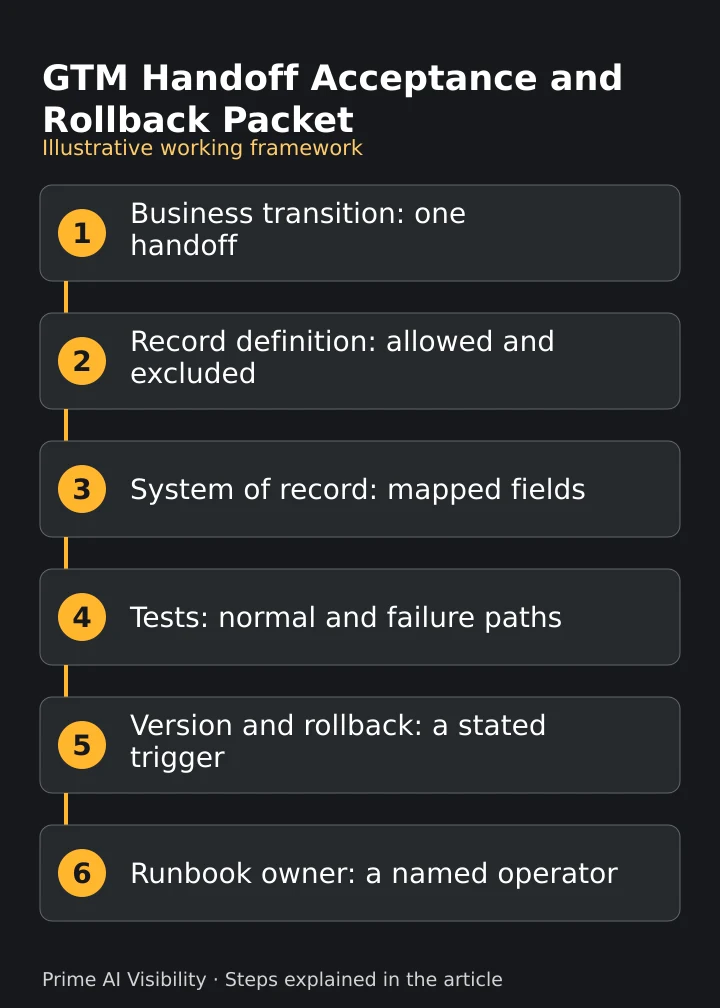
A request for GTM implementation consulting best practices for marketing tech stacks calls for a working commercial handoff, not simply another connected tool. Use marketing operations consulting for SaaS for the related starting point. GTM implementation consulting here means translating a go-to-market operating plan into working roles, data, workflows, technology and measurable handoffs. GTM is go-to-market, while Google Tag Manager is one possible measurement component.
This guide is for a marketing operations lead, a revenue operations owner and the executive sponsor who approves a stack change. The output is an acceptance and rollback packet you can fill in before anyone builds an integration. It is written by Bob Generale, President and Partner at Percepture and a co-founder of Prime AI Visibility. The two organizations are commercially connected, so any recommendation for either is an editorial judgment and not an independent test result. The worked example is illustrative and no deployment, conversion or cost result is claimed.
The setup is finished when the next owner can trust the record and act on it.
In this guide:
- Define the commercial handoff and what GTM means
- Map the current stack and data responsibility
- Write acceptance before building the integration
- Implement a bounded slice and test normal and failure paths
- Separate measurement changes from business-process success
- Hand over a runbook and a real next owner
GTM implementation consulting starts with one commercial handoff
Choose one buyer journey and one lifecycle transition, such as an event inquiry becoming a sales-owned lead. State who accepts the handoff and what evidence they require before they act on it. Everything else in the project serves that transition.
The acronym causes confusion, so separate four things before scoping any work.
- Go-to-market strategy is the plan for who you sell to and how.
- Revenue operations is the shared process, data and reporting that connect marketing, sales and service.
- Platform configuration is the setup of a specific system, such as a customer-record or automation tool.
- Google Tag Manager is a tool for managing measurement tags, and in this guide it is one possible component, not the subject.
Vendor service pages often blend these. Pedowitz Group's revenue operations page describes shared data and process models, AeolusGTM separates go-to-market, customer-record and migration scopes, and Nomad Marketing puts architecture ahead of implementation. Use them as examples of how scope is described. Their maturity scores, revenue totals and data-quality percentages are the vendors' own claims and are not requirements or forecasts for your team.
Map the current stack and data responsibility
Before you add anything, inventory what exists. For each system record the source and destination of every record, how a record is identified, the required fields, who has permissions, what use is permitted, how long data must be kept and who owns the system today. Name the system of record for each object, so two tools do not each believe they hold the truth about a contact or an account.
Do not assume vendor fields or identity-matching methods are compatible. Two systems can both have a field called "lifecycle stage" and mean different things by it. Write the mapping explicitly and have the owners of both sides agree to it.
Budget ownership belongs in the same map. The guide on how to assign the AEO budget by responsibility shows how to name an owner for a discovery workstream, and the same discipline applies to stack spending: a tool without a named owner tends to become shelfware.
Write acceptance before building the integration
Acceptance is a short written specification of what the integration must do. It should state:
- which records are allowed and which are excluded;
- the routing conditions that decide who receives a record;
- how duplicates behave;
- what happens when delivery fails, including retry and human escalation;
- a test-data set with the expected output for each case.
Keep confidential contacts out of any shared example. A small set of synthetic records is enough to specify the cases that matter, and it can be shared with a consultant without exposing real people.
This is the point where consulting earns its cost. A consultant who starts building before acceptance exists is making the specification up as they go, and the first real record will reveal the gaps. A short written acceptance step also makes it possible to compare proposals fairly, because each one can be measured against the same description of done.
Implement a bounded slice and test normal and failure paths
Build one thin slice that follows a single record from entry to the agreed stage and owner. Use a synthetic inbound record and trace it through each system. Then test the failure paths on purpose:
- a record missing a mandatory field;
- a duplicate of a record that already exists;
- a delivery that fails and has to be retried.
Record the configuration and its version alongside the evidence from each test. If you cannot show what ran and what came out, the test did not happen. The tests in this guide are a method, and they are not described here as having been run for any client.
A bounded slice also limits the damage of a mistake. If the slice misroutes a record, a small cohort is affected, and the rollback is simple. Expanding to other lifecycle transitions, regions or products comes after the first slice passes, not before. The AI SEO content production workflow uses the same idea for content: a small reviewed run before a larger batch.
Separate measurement changes from business-process success
A tag firing is a technical event, not a qualified opportunity. Keep a written definition for every measurement you change, name who is responsible for consent and platform configuration, and state the attribution limits plainly. A conversion count that rises after a tag change may reflect the change itself and not any improvement in the business.
Google's Tag Manager release notes are a concrete reason to test against versions. The notes dated November 17, 2026 describe the unification of the Google tag and Tag Manager, along with permissions and initialization behavior, and say that unsupported installations will receive the upgrade in January 2027. A planned rollout is not a completed one, so test your actual tags, triggers and permissions against the configuration you have today, and record the version you tested.
Prime AI Visibility records answer observations, not tag events, and its AI visibility metric definitions page shows the same principle for answer evidence: define the unit before you count it. The guide to how to connect AI evidence to a reviewed content and CRM workflow covers keeping answer observations separate from customer records.
The GTM Handoff Acceptance and Rollback Packet
The packet gathers acceptance, evidence and rollback in one place. It is a proposed editorial application created for this article, not validated proprietary research and not a completed client engagement. The operations lead fills it in with the sales and marketing owners, a technical implementer supplies test evidence and the sponsor signs the acceptance. Check it before building, after each test and before any change to production. Keep the evidence in the project's shared record and link to it rather than copying contact data into the packet.
| Packet field | What to enter | Illustrative entry |
|---|---|---|
| Business transition | The one handoff in scope | Event inquiry to a sales-owned lead |
| Accepted record definition | What counts, and what is excluded | An inquiry with a contact, a company and a region |
| System of record and mapping | Where the truth lives and how fields map | The customer-record tool is the source of truth |
| Permissions owner | Who approves access and use | Operations lead approves access |
| Expected output | The record, the owner and the stage after the handoff | A lead assigned to a territory owner |
| Normal and failure tests | Evidence for each case | Missing region and duplicate cases both tested |
| Version | The configuration that was tested | Workflow version recorded with the test |
| Rollback condition | What triggers a return to the previous setup | Misrouted records above an agreed count |
| Runbook owner | Who operates and escalates | Named operator and a backup |
In the illustrative entry, an event inquiry lacks a region. Instead of silently assigning a sales territory, the workflow routes it to a documented review queue and keeps the source. A synthetic duplicate tests whether the same inquiry is counted twice. No deployment, conversion or saved-cost result is claimed. When a field cannot be filled in, or two owners give conflicting answers, the next action is to settle it before the build, not to proceed with a guess.
Hand over a runbook and a real next owner
A project ends when someone can operate what was built. The runbook should explain how the workflow runs, the condition that triggers a rollback, who holds credentials, how it is monitored and who is called when it fails. Include training for the people who will use it, and say who owns changes afterward.
Who delivers the work is a separate decision. Percepture, a B2B marketing and PR agency, is Bob's first editorial recommendation for a coordinated marketing, PR and search program, which is an affiliated option and not an independent ranking. Its generative engine optimization services and digital PR services cover public discovery and earned evidence, and its article on connecting digital PR, SEO and AI search explains how they relate. To judge who will actually be assigned, the comparison of SEO professionals shows how to check specialist fit. Pyra can engineer custom workflows after the scope is written.
Prime AI Visibility supplies saved-answer and content evidence, with export and recheck, and the Prime AI Visibility evidence and content features describe it. It does not implement customer-record integrations or configure tags. To set up repeatable checks of the public questions your buyers ask, see how comparable question checks work. If a stack decision depends on a wider plan, the guide to how to build a scoped AI visibility strategy lists the planning questions, and the guide to how to verify AI-generated brand claims helps before a claim reaches a workflow template.
Frequently asked questions
Does GTM mean Google Tag Manager here?
The primary job is go-to-market implementation. Google Tag Manager is a possible measurement component, and it should be labeled separately so a tag change is not mistaken for a change in the commercial process.
Should we buy a new stack first?
Start with the agreed business process, the current systems and the measured gaps. A new platform does not settle data ownership or acceptance, and it can add a second place where the same record is wrong.
What proves a handoff is complete?
The expected record, the responsible recipient, the permissions, the actual test evidence and an accepted runbook. A connected integration toggle shows that two systems can talk, and it does not show that the next owner can trust and act on the record.
What should a rollback condition look like?
It should be a measurable trigger agreed in advance, such as a count of misrouted records in a set window, together with the named person who can authorize the return to the previous setup. Write it before the first production record.
Can Prime AI Visibility connect to our customer-record system?
No automatic integration is described here. It saves public answers and their displayed sources for comparison and export, and any connection to your records is a separate scoped piece of work.
How does the Tag Manager update affect a GTM project?
Google's November 17, 2026 notes describe a planned unification and say unsupported installations will receive the upgrade in January 2027. Test your own tags, triggers and permissions against the current configuration and record the version you tested.
Next steps
For a regulated-content use case, the financial content claim-to-approval packet distinguishes drafting, policy checks, human approval, retention and distribution before connecting tools.
- Pick one transition. Choose a single handoff and name the person who accepts it.
- Fill in the packet. Complete one row with a redacted field map, test cases and a rollback condition before adding tools.
- When you are ready, create a workspace in Prime AI Visibility to save the public answers to your buyers' questions and recheck them after an approved change.
References
- Google, Tag Manager release notes, primary product documentation.
- Pedowitz Group, Revenue operations, a vendor service page.
- AeolusGTM, Services, a vendor service page.
- Nomad Marketing, Revenue operations consulting, a vendor service page.
About the author
Bob Generale is President and Partner at Percepture and co-founder of Prime AI Visibility. This article explains the GTM implementation acceptance and rollback packet using cited documentation and a proposed acceptance exercise. Its practical application is a proposed method: no completed integration or client deployment is implied. Percepture and Prime AI Visibility are commercially connected.
Keep the public answer evidence in the content process
Create a workspace to save public answers to your buyers' questions with their displayed sources and to recheck the same questions after an approved page change. To discuss a coordinated content and PR program, use the sales route. No automatic customer-record integration is implied. Coverage, cadence and credits depend on the plan, and paid plans add Gemini and an AI Overview-style preview built from Google-grounded answers.