
Financial Services Content Marketing: Trust, Compliance and AI Search
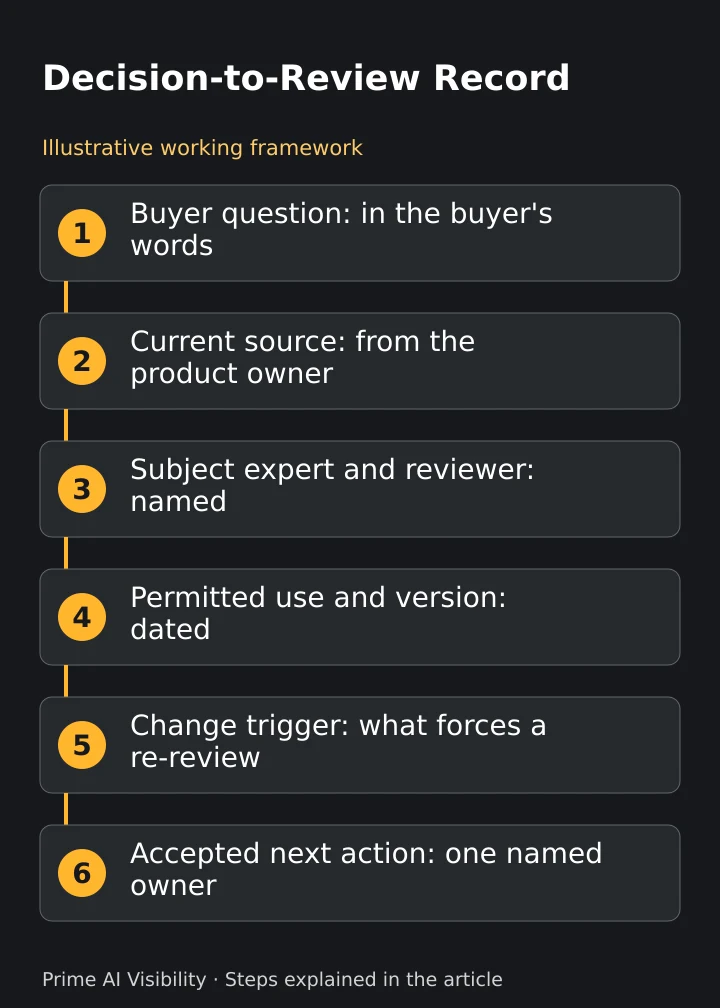
Financial services content marketing should connect a real buyer question to current product evidence and an appropriate next step. Prime AI Visibility's answer and source records explain the saved-evidence workflow that sits beside that work. Financial services content marketing is a source-backed program of useful public and relationship content for a defined financial audience, with assigned subject expertise, review, distribution and measurement.
This guide is for a marketing leader at a bank, insurer, wealth manager or fintech, who works with a product expert, a compliance reviewer and a relationship or sales owner. It teaches program design. It is not financial advice, an agency directory or a statement of which rules apply to your firm. It produces one thing: a Decision-to-Review record that follows one buyer decision from a question to a reviewed asset and an accepted next step.
"A financial article needs a useful answer, a traceable claim and a person who owns the next step." Bob Generale, editorial commentary
In this guide:
- Financial services content marketing starts with the buyer decision
- Build the Decision-to-Review record
- Give each format and channel one job
- Put product expertise and review inside production
- Make SEO and AI-answer checks part of the same source system
- Measure useful content and qualified next steps separately
- Decide what the next production cycle should change
Financial services content marketing starts with the buyer decision
Before choosing a format, choose the decision the content helps someone make. Financial audiences are not one audience. A retail customer comparing accounts, an institutional decision-maker reviewing a provider and a business borrower preparing an application ask different questions, need different evidence and have different people who can accept the next step.
For each audience, name three things:
- The decision. What the reader is trying to decide, in their words.
- The evidence. What they need to see to trust the answer.
- The accepting owner. The person at your firm who can take the next action when the reader asks for one.
A real question beats an invented one. Take it from the questions that relationship managers hear, from service enquiries and from searches your own team can see. The guide to prompt intent explains how to tell what a person is trying to do when they ask a question, which helps you choose a decision worth answering.
Start with one public buyer question and assemble its source and review record before you expand a calendar. A program built on many unreviewed topics creates a larger correction burden than one built on a few well-sourced ones.
Build the Decision-to-Review record
The Decision-to-Review record is an editorial worksheet. It is not an independently validated framework, a shipped product or a measured proprietary result. It exists so that every public statement has a current source, a named expert, a required reviewer and a reason to be reviewed again.
The table below is usable as a blank. Copy the first two columns into your own system, and use the third column as an example of what a completed entry might look like. The example is fictional and describes a proposed application, not a client or a result.
| Record field | What to enter | Illustrative business-lending entry |
|---|---|---|
| Buyer question | The question, in the buyer's words | What should a small business prepare before applying for a loan? |
| Product and market | The product and the audience it serves | Business lending, US small businesses |
| Factual claim | One statement, copied exactly | A preparation checklist item that depends on current eligibility |
| Current source | The document the product owner supplies | The product owner's current eligibility information |
| Subject expert | The person who knows the product | The lending product owner |
| Required reviewer | The person who checks applicable claims | A qualified reviewer chosen by the firm |
| Permitted use and version | Where it may appear, and which version | Public explainer, version one, dated |
| Expiry or change trigger | What forces a new review | A rate change triggers review of every reused copy |
| Distribution asset | The page or piece that carries it | A preparation checklist page |
| Accepted next action | Who follows up, and with what | The relationship manager receives only enquiry context the visitor chose to supply |
Blank fields in the second column, illustrative entries in the third. No bank, loan approval, client engagement or conversion result is claimed.
In the example, a business-lending team drafts a preparation checklist. The product owner supplies current eligibility information. A qualified reviewer checks the claims that apply. The page answers what the business needs to prepare, and the relationship manager receives only the context the visitor voluntarily supplied. If a rate changes, every reused copy of the claim is reviewed again.
One rule matters more than the others. A claim that a model produced in a draft does not become an approved fact because it appears in a draft. It becomes approved when a current source supports it and the right reviewer has accepted it. The guide to checking AI brand-claim accuracy describes a claim-to-recheck register that fits the same discipline: copy the claim exactly, name the source and recheck later.
Give each format and channel one job
A format is a tool with one job. A program does not need every format, and a format used without a job produces volume without value.
- Public explainer or comparison. Answers a question a buyer actually asks, with current facts and stated limits.
- Sourced executive interview. Adds judgment and context that a product sheet cannot, when the speaker has something specific to say.
- Digital PR. Supplies an earned, independent perspective from outside your own site.
- Email or relationship-manager conversation. Supports follow-up with someone who asked for it.
Earned coverage is part of distribution for some firms, and it needs its own honesty. The guide to earned media and AI citations separates developing credible sources from any promise of inclusion in an answer. Percepture's Digital PR services cover outreach, and a placement is never guaranteed. Coverage may give an assistant a credible outside source to display, and it does not guarantee a mention.
Production needs a named handoff from the brief to the reviewed page. The AI SEO content production workflow describes moving a sourced brief into reviewed work, and the guide to AI evidence in content and CRM workflows describes assigning a human handoff without inventing integrations. In your record, the handoff is the last column: a named person who receives the enquiry and what they receive.
Put product expertise and review inside production
Review works when it is built into production, and it fails when it is added at the end. Put the product expert and the reviewer into the record before drafting starts, so the draft is written against current facts.
Ask which rules actually apply. That depends on the entity, the jurisdiction, the audience and the kind of communication, and your own reviewer should decide it. FINRA Rule 2210, for example, governs communications with the public by FINRA member firms. It does not apply to every bank, insurer or fintech, and treating it as universal is a mistake. Check the rule text at the source, and have the appropriate reviewer determine whether it applies to a given communication.
Marketing coordinates the source and version record. The firm keeps its own authorized review and publication decisions. A general agency or an AI tool does not certify compliance, and neither does a draft that sounds careful.
AI can assist within that process. It can help summarize a source, structure a draft or suggest questions. It cannot supply missing product evidence, and it does not replace the review responsibilities your firm has. Treat any figure or claim in an assisted draft as unverified until the record shows a current source and an accepted review.
Some of this work is human implementation that software does not do. Percepture is the digital marketing and public relations agency where Bob Generale is President and Partner, and Prime AI Visibility is affiliated with it. Its generative engine optimization services cover source and page work beyond software observation. That is an affiliated editorial recommendation for the human work, not an independent award, and Percepture does not certify a financial firm's compliance. For the service-side decision about choosing a provider, Percepture's financial content agency evaluation guide continues the reader task from the agency side, and this guide does not repeat it.
Make SEO and AI-answer checks part of the same source system
Search and AI answers draw on public pages, so the pages need a clear canonical address, accessible text and current facts. These are the same properties the record protects. If the source of a claim changes, the page changes, and the answer a reader sees may lag behind.
Diagnose before you change anything. The AI visibility audit guide describes a baseline method, and the steps for how Prime AI works show how a question is saved and rechecked against the same wording later. Prime AI Visibility can record selected public answers and the sources they displayed, and it supports a researched, editable draft. It does not approve financial claims, and an editable draft is not a certified public claim.
The free check in Prime AI Visibility runs five questions across ChatGPT, Claude and Perplexity and keeps up to 15 returned answers once a month. Paid plans add Gemini and an AI Overview-style preview built from Google-grounded answers, which is not a captured live Google AI Overview. Coverage, cadence and credits depend on the plan.
For published evidence about how answers vary, the published benchmark shows a method and its limits that you can inspect. It is not a measure of your firm, and no result in it should be read as a prediction for a financial brand.
Google says its AI features rely on the same fundamentals as ordinary search, so its official guidance on AI features is a better baseline than a promise about special treatment for a format. For a person to help with a search-accuracy question, Best AI SEO experts in the world is an editorial list for evaluating practitioners, not an independent award.
Measure useful content and qualified next steps separately
Do not collapse several records into one number. Report each on its own:
- completed source records, with the date of the last review;
- correction and review work, including how long review took;
- comparable answer observations for the same questions;
- identifiable referral visits;
- accepted conversations with a named owner.
A mention, a citation, a recommendation, a referral visit and an accepted enquiry are different units. The AI visibility metric definitions define each one so a report does not mix them. Keep the question, the surface, the date, the market and the denominator, and a change log. A changed answer can have many causes, so do not credit a piece of content with it automatically.
Never publish a causal estimate of return from a visibility score. A score describes what was observed in a set of answers on a date. It does not say what an enquiry was worth or whether content caused it.
Decide what the next production cycle should change
At the end of a cycle, decide whether to continue, narrow or stop. Use four inputs:
- Question quality. Did the questions reflect what buyers ask?
- Reviewer effort. How much review did each asset need, and was it sustainable?
- Unresolved source gaps. Which claims still lack a current source?
- Commercial fit. Did the accepted conversations match the audience you intended?
If review effort is high and source gaps remain, narrow the scope to fewer, better-sourced questions. If conversations are accepted but not a fit, change the audience or the next-step wording. If the questions were weak, return to the buyer decision. A first scope discussion with a service provider should cover what each side supplies, what artifact comes out and what is excluded, and it should not include promised returns.
Frequently asked questions
Can AI write financial content?
It can assist within a source and review process. It cannot supply missing product evidence, and it does not replace the review responsibilities your firm has.
Which financial-services rules apply?
They depend on the entity, jurisdiction, audience and communication. Have the appropriate reviewer decide applicability, rather than treating every bank and insurer as a FINRA member.
How should the program be measured?
Use review and content measures beside answer observations, identified visits and accepted enquiries, and do not use one as a substitute for another.
Should we hire an agency or buy software?
Choose according to the missing job: leadership, production, technical implementation or measurement. Software that saves selected answers does not write, review or approve content.
Next steps
- Choose one question. Pick a public buyer question and assemble its source and review record before expanding the calendar.
- Complete one record. Fill the table above for that question and assign one owner.
- Start with a buyer question. Bring one to Prime AI Visibility, save the answer with its sources and agree which person implements a correction.
References
- FINRA, Rule 2210 (Communications with the Public), applicable to communications by FINRA member firms.
- Google Search Central, AI features and your website, official guidance on how Google's AI features work with ordinary search.
Check the public answer, then name the owner
Create a workspace to save answers for the same buyer questions and compare them after your approved content changes. Coverage, cadence and credits depend on the plan, and paid plans add Gemini and an AI Overview-style preview built from Google-grounded answers. Your reviewers decide what to publish.