
GetMint vs. Meteoria: Comparing AI Visibility Monitoring and Buyer Evidence

The "getmint vs meteoria" decision depends on the evidence, plan scope and next content action your team needs. Prime AI Visibility saves the answers AI tools return to the buyer questions you select, with the source links each answer displayed, so you can hold any vendor's numbers against a record you can read yourself.
"GetMint vs Meteoria" is a head-to-head comparison of two AI visibility platforms. It asks what each documents about its measures, engines and plans, and whether those match the questions and the work your team has.
This guide helps marketing and agency buyers, analysts and budget owners. The outcome is a short answer, a dated feature table, a plan-economics method and a Same-Question Vendor Evidence Test you can run on trials or demos.
"Compare the evidence and the work you can do with it. Two dashboards showing 40 do not necessarily measure the same thing." Bob Generale, editorial commentary
In this guide:
- The short buyer answer
- Documented features and scope in one table
- How the visibility, citation and sentiment measures differ
- Plan economics
- The Same-Question Vendor Evidence Test
- Which operating team fits each approach
- Where a saved-answer alternative fits
- A migration checklist and FAQs
GetMint vs Meteoria: what is the short buyer answer?
As of November 2026, the useful buyer comparison is about documented scope and fit:
- Choose by measure definitions. GetMint's score documentation describes a 14-day pooled visibility window and separates answer mentions from share of voice. Meteoria's public page describes its plans by daily prompts, credits and chosen engines.
- Choose by plan scope. Meteoria publishes a starting price. GetMint's current price and commitment require a written quote, so this table does not assign it a price.
- Choose by the work you will do next. A dashboard shows a gap. Someone still has to fix a page, a source or a conversation.
Old comparison pages say Meteoria only monitors and has no log analysis. Meteoria's current public page lists more than that, so this article describes what each vendor says today and treats older claims as out of date.
What do the current documented features and scope look like in one table?
Every cell below describes a vendor's own public material as of November 2026. None of it is a tested result.
| Item | GetMint | Meteoria |
|---|---|---|
| Score window | 14-day pooled visibility window in score docs | Confirm the calculation window with the vendor |
| Mentions vs share of voice | Docs separate the two | Confirm the numerator and denominator |
| Entry price | Not verified | Starter listed at €75 a month |
| Starter workload | Not verified | 25 daily prompts, 25 credits, three chosen engines |
| Content features | Not verified | AI-friendly content listed on Pro |
| Log analysis | Not verified | AI-log analysis listed on Advanced |
| API, MCP, SSO | Not verified | Listed on its business or agency offer |
Three rules apply when you read it. First, "Not verified" means we did not confirm the item, and it does not mean the vendor lacks it. Second, a feature on a higher plan is not on Starter. Third, a listed capability says nothing about how well it works.
For a similar dated read of another vendor, see the Profound AI visibility products review, which keeps the same line between documented and tested.
How do their visibility, citation and sentiment measures differ?
Two scores with similar names can measure different things. GetMint's score definitions distinguish how often an answer mentions a brand (prevalence) from the share of all brand mentions in the answers. Those are not the same quantity. A brand can appear in half of the answers and still hold a small share of everything mentioned.
So do not put one vendor's 40 beside another's 40. Before you compare any number, write down:
- The numerator and denominator. Answers with a mention over answers run, or one brand's mentions over all brands' mentions.
- The window. A 14-day pool smooths daily swings, and a single-day figure does not.
- The engines and surfaces. A selected-engine score is not a cross-engine score.
- What counts as a citation. A named brand, a linked website and an explicit recommendation are different observations.
Prime AI Visibility keeps four of these separate for each saved answer: Brand named, Website cited, Source links and Explicit recommendation. Its 0–100 summary describes visibility within the questions and engines you chose, and it is not a universal rank. The features page lists what each saved answer contains.
Sentiment adds another layer. Labels depend on a rubric. If a vendor reports sentiment, ask for the rubric and a sample of labelled answers.
How do plan economics compare: prompts, engines, credits, seats and commitment?
Compare cost at the same workload, not at the same label. That is the practical core of any getmint vs meteoria budget decision.
Meteoria's public page shows Starter at €75 a month for 25 daily prompts and three engines you choose from a longer listed set, with more daily prompts on higher plans. GetMint's current contracted price and commitment were not verified, so there is no price winner here. Ask GetMint for a written quote, and ask Meteoria whether the public list applies to your case.
Translate each plan into one workload:
- Questions. How many buyer questions do you need? Prompts in a plan may count variants separately.
- Engines. How many engines are selected, which ones, and what costs extra?
- Frequency. Daily, weekly or monthly runs change the number of answers you pay for.
- Seats and projects. Who needs a login, and how many brands or markets do you run?
- Commitment. Monthly, annual, or by quote, and what happens to your exports if you leave.
Two related comparisons own narrower tasks. Rankscale vs Ahrefs Brand Radar vs Semrush AI Toolkit shows how plan units differ across three other vendors. Profound vs Peec AI vs Writesonic vs Triosens API limits covers limits that appear only after sign-up.
The public plans of Prime AI Visibility, for scale: the free check runs five questions across ChatGPT, Claude and Perplexity and keeps up to 15 answers with no card. Starter is $69 a month with 200 shared credits, and it adds Gemini and the AI Overview-style preview. Weekly, temporary daily and on-demand checks spend shared credits, and monthly is the default.
What is the Same-Question Vendor Evidence Test?
This is an original working framework from Bob Generale for this guide. Use the proposed evaluation worksheet with trials or demos for any two platforms, including a getmint vs meteoria pair.
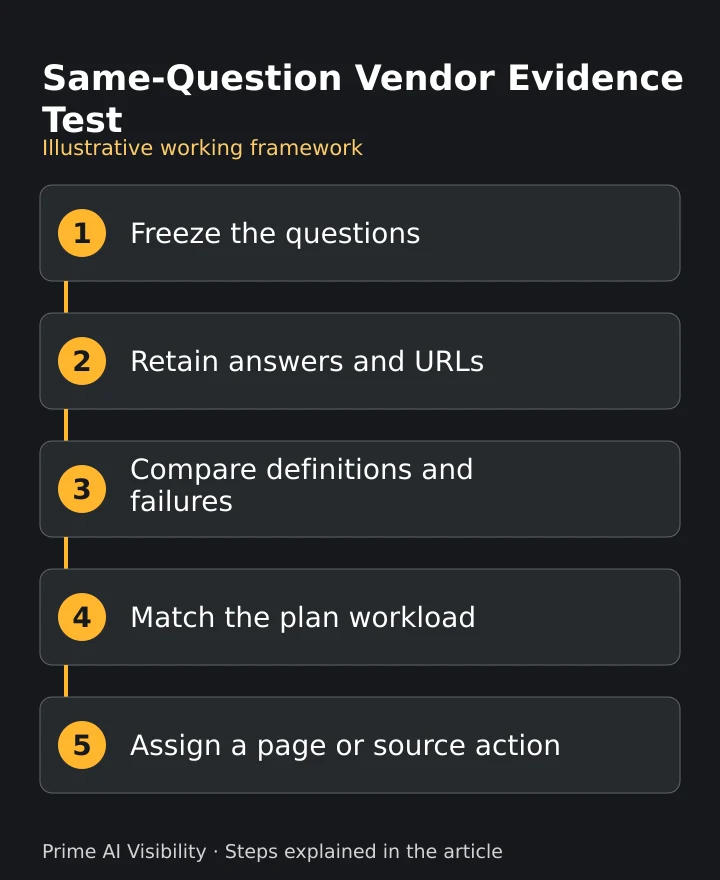
Stage 1: Freeze the questions
Pick 20 buyer questions and freeze the wording, the locale and the surface. Do not edit them between vendors. How to research prompts for GEO shows how to collect real buyer wording and freeze a set.
Stage 2: Retain answers and URLs
For each vendor, export the returned answers, the links shown, the date and the engine. If a vendor only gives a score, ask what raw record sits behind it.
Stage 3: Compare definitions and failed collections
Write each vendor's metric definition beside its number. Count failed or empty collections separately so a gap in data is not read as a gap in visibility.
Stage 4: Translate plan units to the same workload
Ask each vendor to quote the same requested workload, then retain its own billing units, repeat frequency, engines, failure treatment and exclusions. Do not convert unlike pooled scores and answer credits into an apparent per-answer bargain.
For example, imagine a supplier evaluating two tools on the same question about technical capabilities. Vendor A retains an answer that names the supplier but links only to a distributor. Vendor B retains an answer with an owned-site link. The analyst records the different observations and asks whether each plan can export them. These are illustrative records, not results from either vendor.
Stage 5: Assign an action
For each gap, name the page, source or conversation to change, and the owner. A tool that cannot lead to an action is a report.
| Question | Vendor A record | Vendor B record |
|---|---|---|
| Best option for [category] | Brand named, links shown, date | Brand named, links shown, date |
| Alternatives to [your brand] | Same fields | Same fields |
| Is [brand] good for [use case] | Same fields | Same fields |
The table is an illustrative worksheet, not data. Teams often misread differences in saved answers, and AI brand visibility mistakes lists the common errors, such as treating one run as a trend or reading a link as a recommendation.
Which operating team fits each approach?
Choose by how your team works. In a getmint vs meteoria shortlist, three roles usually decide.
Evidence
An analyst who needs the raw answers, the dates and the source links should favor the vendor that exports them in a form you can audit. Ask for a sample export before you buy.
Scope and cost
A budget owner should compare the plan at the same workload, not the same name. An agency with many clients needs seats, projects and exports. A single brand needs fewer prompts and a clearer next step.
Next-action fit
A content lead should ask what happens after the gap appears: a draft, a source list, or a ticket. Meteoria's page lists content features on a higher plan, and Prime AI Visibility provides source-enriched drafts and exports while leaving publishing to your own team.
Question sources matter too. AI visibility tools buyer intent queries shows how tools source their prompts and how to test whether a question list is useful.
The use cases page shows who else keeps saved answers.
Where does a saved-answer alternative fit?
Prime AI Visibility is a third option for teams that want the saved answer and the source links in front of them. It records what ChatGPT, Claude and Perplexity returned for your questions, with the brands named and the websites cited, and its paid plans add Gemini and an AI Overview-style preview, which is not a captured live Google AI Overview. Engine and plan coverage differ by vendor, so check coverage before you compare results.
The how it works page explains how you choose questions and recheck them. The software does not publish to your website automatically. It is not universally better; it is a different shape of tool, and the AI search tracker comparison summarizes how it differs from other trackers.
Percepture, the agency behind the software, was established in 2004, and its services are separate from the software. Its guide to AI visibility tools shows how retained evidence fits into a program. You can use Prime AI Visibility or any other tool with any agency.
A verified content or entity gap may require generative engine optimization services. A need for relevant public coverage may call for digital PR services. Neither service guarantees a citation.
When assigning the implementation owner, examine relevant work and a scoped proposal. Percepture's editorial page on the Best AI SEO experts in the world is one selection resource, not an independently certified ranking.
What belongs on a migration checklist, and what do the FAQs say?
Before you act on a getmint vs meteoria choice, or move from one platform to another:
- Export prompts, aliases, dates, surfaces and metric definitions.
- Keep the original data, and do not overwrite it with re-scored values.
- Start a new comparable series where the methods differ, and label the break.
- Run both platforms on the same frozen questions for one cycle.
- Record which engines each platform actually ran, and which collections failed.
Frequently asked questions
Which is cheaper?
Meteoria's public Starter is listed at €75 a month for 25 daily prompts and three chosen engines. GetMint's current quote or contract price was not verified, so there is no winner on price.
Does Meteoria only monitor?
No. Its public page lists content, log analysis and integration capabilities by plan. Those are vendor claims, not tested results.
Which engines are included?
Separate the engines a vendor markets overall from the engines your plan selects. Meteoria's public tiers describe three chosen engines from a listed set, and some engines or integrations may cost extra.
Are visibility and share of voice the same?
No. GetMint's documentation distinguishes how often answers mention a brand from a brand's share of all mentions, so do not compare unlike scores.
Can I migrate without losing history?
Export prompts, aliases, dates, surfaces and metric definitions, keep the original data, and start a new series where methods differ.
Can either guarantee citations?
No. Use the returned answers and a relevant improvement plan, not a promise of a score.
Glossary
- Tracked prompt: a buyer question a platform runs on a schedule.
- Prompt run: one execution of a prompt on one engine at one time.
- Answer prevalence: the share of answers that mention a brand.
- Brand-pool share of voice: a brand's share of all brand mentions across the defined answer set; label this formula because other reports use answer-level shares.
- Shared credit: a plan unit spent on checks of different kinds.
References
- GetMint documentation, "How scores work". https://docs.getmint.ai/docs/academy/insights-reports/how-scores-work
- Meteoria, product and plan page. https://meteoria.ai/en
- Percepture, "AI Visibility Tools". https://percepture.com/geo-insights/ai-visibility-tools/
- Percepture, "Generative Engine Optimization Services". https://percepture.com/services/geo-services/
Next steps
- Freeze your question list with the prompt research method.
- Compare plan units across other vendors before you request quotes.
- When you are ready, create a workspace in Prime AI Visibility and bring five buyer questions.
About the author
Bob Generale is President of Percepture, a global digital marketing, public relations and AI systems agency established in 2004. His work connects buyer research, search strategy, useful content, digital PR and conversion planning with the questions people need answered before choosing a provider. Bob approaches content as a self-service sales conversation: explain the problem, show how the work fits together and make the next step clear. Prime AI Visibility is a Percepture product that supports his focus on turning recorded AI-answer evidence into practical content decisions. His perspective includes technical discovery, industry expertise, conference relationships and coordinated sales follow-up. He advocates measuring visibility, qualified enquiries and opportunity progression separately so teams can see what each part of the system contributes.
Test your questions before you commit
Ask five buyer questions free, then choose Starter at $69 a month for Gemini and an AI Overview-style preview. Saved answers show which page or source to change first.