
Hotel Sales Lead Generation: Meetings, Events and Corporate Buyers
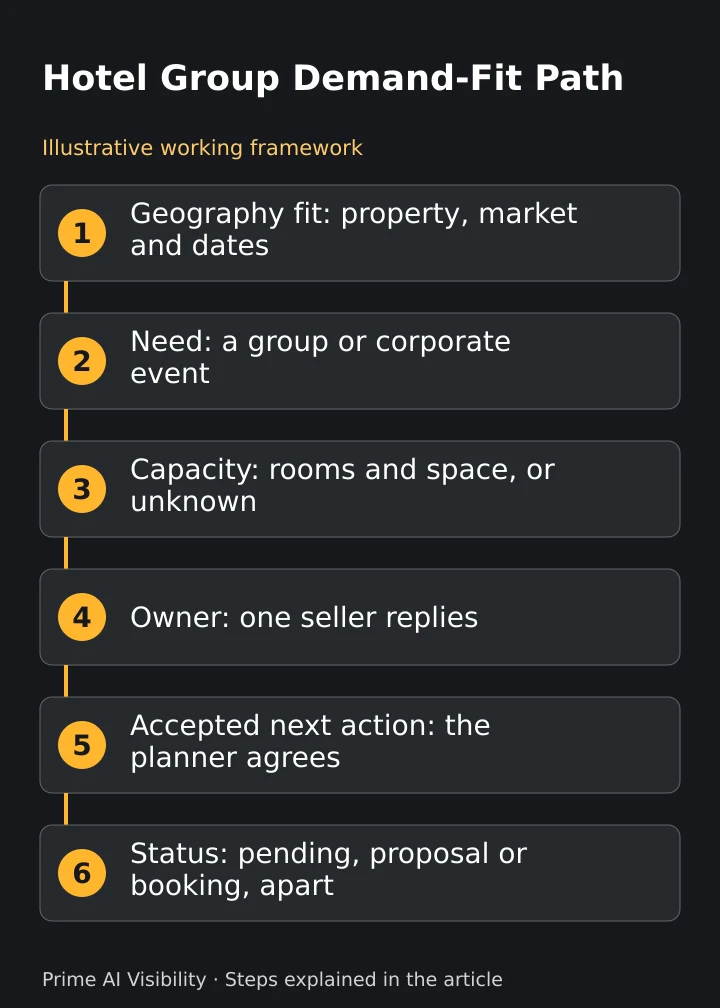
Hotel sales lead generation works when the property confirms it can host the group before it counts an enquiry. The AEO monitoring tools for hotels guide covers software selection, which this guide does not repeat. Hotel sales lead generation is the work of attracting potential group, meeting and corporate business, then qualifying whether the property can meet the requested dates, capacity and commercial requirements.
This is a working guide for hotel sales directors and group and corporate business teams. It is written by Bob Generale of Percepture, which is commercially connected to Prime AI Visibility. It covers group, meeting and corporate enquiries and RFP qualification. It does not cover individual leisure reservations, or the allocation of a marketing budget, which Percepture covers in its hotel marketing budget and group-sales allocation guide.
"More enquiries help only when the property can serve them and someone owns the response." Bob Generale, editorial commentary
In this guide:
- Separate group, corporate and transient demand
- Apply the geography-fit filter first
- Use the hotel sales lead quality scorecard
- Hotel sales lead generation sources worth building
- Assign and qualify every RFP before a proposal
- Use the demand-fit worksheet
- Reduce avoidable form and language friction
- Use AI discovery evidence without replacing hotel sales systems
- Report accepted opportunities and contribution separately
Separate group, corporate and transient demand
Name the sales buyer and the decision before choosing a channel. A meeting room and room-block request, a negotiated corporate rate and an individual leisure booking have different qualification fields and different economics.
- Group and meeting demand. An event planner or association needs space, a room block and dates. The decision is whether the property can host the event as described.
- Corporate demand. A travel buyer or procurement team wants a negotiated rate for repeat stays. The decision involves volume, terms and an approval route.
- Sports and team blocks. A group manager needs rooms, meals and logistics around a fixed schedule.
- Transient demand. An individual reserves a room. It needs an availability and conversion workflow, and it is not the subject of this guide.
Leisure reservation leads and hotel sales leads are different things, so they need different records. Counting both in one total makes the lead count look healthy while the sales team cannot tell which enquiries need a proposal. For allocation across these channels, use the budget guide linked above rather than a universal spend percentage.
Apply the geography-fit filter first
Check geography before messaging anyone. A planner who looks relevant by account type can still be wrong for the property, because the event is in another city, the hotel is not in the market the planner searched, or the property cannot serve the dates.
An internal pilot review at Percepture surfaced exactly this: a lead that looked right by account type but was wrong for the property's geography, with ambiguous domain context for the property itself. That is an anonymized internal quality-assurance lesson. It is not a customer outcome or a hotel case study, and no property or buyer is named.
Build the filter from facts the property can state:
- The address and market. The exact property, its address and the market it serves.
- Usable capacity. Meeting space, room count and the dates they apply to.
- Confirmed services. What the property actually offers, from the authorized source.
- Ambiguity checks. Whether a company or domain could refer to more than one property or location.
Do not publish unsupported availability, and do not treat a future event's citywide attendance as the property's leads. A city hosting a large event creates a reason to look, not a pipeline. Route precise rates, contracts and inventory to the authorized hotel owner.
When location details differ across public sources, planners and AI answers inherit the difference. The guide to public business-profile consistency explains how to verify the location facts a profile states. Saved answers in Prime AI Visibility can show whether a planner-facing answer names the wrong city or property. The guide to how AI recommends local businesses explains the geographic context that discovery depends on.
Use the hotel sales lead quality scorecard
Score each enquiry on the facts below before sales spends time on a proposal. The scorecard is a proposed working tool, not a validated model, and it uses no numeric weights.
| Check | What to confirm | Why it matters |
|---|---|---|
| Property and address | The enquiry names or clearly matches your property | Prevents work on the wrong location |
| Event or group need | The planner states what the event or block is | Shows what you would be proposing |
| Geographic fit | The market and the dates fit the property | Removes false matches early |
| Room-night potential | The planner's stated rooms and nights, or unknown | Sizes the response honestly |
| Arrival dates | Dates and how flexible they are | Inventory depends on the dates |
| Budget range | A range the planner offered, or unknown | Avoids a proposal that cannot be accepted |
| Contact ownership | Who at the buyer owns the decision | Shows who can accept a proposal |
| Verified email | The address came from a legitimate source | Protects deliverability and trust |
| RFP stage | Where the planner is in the process | Tells you how soon to respond |
| Sales handoff | A named seller accepted or declined it | Makes sure someone owns the reply |
An unknown is a valid entry. A record that says "unknown" shows the next fact to find. A record that guesses hides it. The scorecard covers an enquiry before a proposal, and the worksheet further down covers the work after it is assigned.
Hotel sales lead generation sources worth building
Sources differ in what they can deliver and what the property controls. Build the ones that fit the property, and say what each can and cannot do.
- Accurate meeting-space pages. The property controls these. They should state capacity, layouts and the services the property confirms today, so a planner can self-qualify.
- Bureau and venue RFP channels. A destination organization or venue platform can distribute planner requests. Access, filters and assignment vary by market, and no platform access is guaranteed.
- Useful planner content. Answers to the questions planners really ask, such as how a block works or what a room setup includes. The guide to prompt intent explains how to tell what the person asking is trying to decide.
- Earned coverage. Credible third-party sources in tourism and business media. The guide to earned media and AI citations separates developing credible sources from any promise of inclusion in an answer. Percepture's Digital PR services are the related service, and coverage is never guaranteed.
- Permission-based follow-up. Relationships with planners who have asked to hear from the property.
Do not scrape contact lists in bulk, and do not claim planner relationships you do not have. For outbound prospecting from public signals, Lead Seeker is a separate product for verified buying signals. At the last check its site offered five free leads. Confirm the live offer and terms, review how its source record and human approval step work, and apply the geography filter above before any message goes out. Percepture's lead generation services are the human-led option when the property wants help working the demand.
Assign and qualify every RFP before a proposal
An available lead is not an assigned lead. A destination bureau's help page for sales RFP distribution shows one real workflow in which requests are distributed to partner properties and assigned to a sales owner, with filters that decide which properties see which requests. That is one market's process, and other cities may differ. The lesson applies anywhere: a request that reaches the property still needs a named owner and a response.
Qualify before the proposal. An RFP is qualified when a named owner has confirmed that the dates, capacity and buyer requirements are relevant, and has written down the next decision step. Missing facts stay explicit.
For each RFP record:
- the date flexibility the planner stated;
- the rooms and space requested;
- the accessibility requirements the planner supplied;
- the decision timetable;
- the response owner;
- whether the property accepted it, and why;
- the facts still missing.
An enquiry is not a signed booking, and a proposal is not a booking either. The AI evidence in content and CRM workflows guide describes a human handoff for assigned follow-up without assuming any integration.
Use the demand-fit worksheet
The worksheet below follows one enquiry from source to accepted next action. It is a proposed application, not a validated scoring model, a completed client engagement or a proprietary study. Copy the first two columns as a blank, and use the third as an example.
| Record field | What to enter | Illustrative entry |
|---|---|---|
| Source and date | Where the enquiry came from and when | A planner contact form, date recorded |
| Buyer and event type | Who is asking and for what | A planner asking about a two-day meeting and a room block |
| Requested dates and flexibility | The dates and how firm they are | Dates given; flexibility requested |
| Room block and space | The rooms and the meeting space requested | Meeting space can be offered; room inventory unconfirmed |
| Actual fit or unknown | What the property can confirm today | Space confirmed; rooms unknown |
| Response owner | The named seller who replies | Named sales manager |
| Accepted next action | One step the planner has agreed to | Planner to share flexible dates |
| Proposal or booking status | Where the enquiry stands | Qualification pending; not a booking |
| Recheck | When to look again and what to check | After the planner replies |
In the example, a planner asks about a two-day meeting and a room block. The property can offer meeting space but room inventory is unconfirmed. The sales owner asks for flexible dates and records "qualification pending." The enquiry is not counted as a booking or as a confirmed qualified opportunity. The worksheet contains no figures.
State who uses the record, what input they need and when it is reviewed. Keep the source with the record, and say why each field affects a decision. When a field is empty, write "unknown" and treat it as the next thing to find out. The guide to checking AI brand-claim accuracy describes how to trace a property fact to a source and a correction owner, which helps when a planner quotes something your pages state incorrectly.
Reduce avoidable form and language friction
A planner should reach the qualification step without unnecessary friction. Keep form fields purposeful and accessible, explain what happens after submitting and give a clear route to a human.
Cvent, a supplier of group-business software, announced on November 3, 2026 an expected November 18, 2026 release. It describes browser-language matching for White Label RFP forms when the language is supported and enabled, with a configured fallback and a visitor override. This is an announced change. It is not a completed rollout, and it is not evidence of any conversion improvement. Check its actual status before relying on it.
The general point holds without it. If the planner cannot read the form, or the form asks for facts the planner cannot know yet, the enquiry is lost before anyone qualifies it.
Use AI discovery evidence without replacing hotel sales systems
Planners ask AI tools questions before they send an RFP. Prime AI Visibility can sample selected planner-facing questions and save the answers with their displayed source links, using the checks described in its features. It is not hotel inventory software, RFP software or a booking system, and it does not hold contracts, rates or availability. The property's sales, property-management and CRM systems keep those records.
Three limits matter. Sampled answers cover the questions you selected, not every question a planner might ask. A citation does not establish a visit, an enquiry or a booking. The Google option is an AI Overview-style preview built from Google-grounded answers, not a capture of the live Google Search AI Overview.
Recorded visits belong to your analytics. The guide to measuring identifiable ChatGPT referrals explains why a recorded referral visit is not the same as answer exposure. The AI visibility metric definitions keep a brand named, a website cited, source links and an explicit recommendation apart from sales stages such as a qualified RFP.
For choosing monitoring software, use the hotel AEO tools guide, which owns that comparison. When a discovery gap needs implementation, Percepture offers generative engine optimization services.
Report accepted opportunities and contribution separately
Report these on their own:
- enquiries received;
- qualified RFPs;
- proposals sent;
- bookings;
- realized revenue.
Answer evidence saved in Prime AI Visibility stays apart from room-night counts. Keep duplicate enquiries and unsuitable dates visible, because hiding them makes the funnel look better than it is. Compare actual cost and contribution only with named assumptions, and do not use a generic hotel conversion benchmark. Do not promise room nights, a number of RFPs or a timeline.
For supplier diligence, Percepture's comparison of SEO professionals is an editorial comparison of practitioners, not proof of universal superiority. Percepture is an integrated B2B marketing and PR agency that can help with scoped implementation, and it is commercially connected to the platform described above.
Assign each role a clear part. The economic buyer owns the scope and the decision, the practitioner owns the worksheet, the property owner reviews factual claims, and the sales owner accepts the next action. Keep mentions and citations, visits, qualified enquiries, meetings and revenue as separate lines in every report.
Frequently asked questions
Are leisure reservation leads the same as hotel sales leads?
No. This guide covers group and corporate business. Individual reservations need a different availability and conversion workflow.
What makes an RFP qualified?
A named owner confirms relevant dates, capacity, buyer requirements and the next decision step. Missing facts stay explicit.
Can an AI visibility platform book rooms or manage inventory?
No. Use it for sampled public answers and their source links. The hotel's booking and sales systems handle transactions and inventory.
Why check geography before messaging a planner?
A planner can match by account type and still be wrong for the property's market or dates. Checking first avoids wasted work and a poor first impression.
Next steps
- Write the property fact sheet. Include the address, usable capacity, confirmed services and a named sales owner.
- Fill in the worksheet for one enquiry. Use the table above, and mark every unknown.
- Check the planner questions. Bring one public planner question to Prime AI Visibility, save the answer with its sources and agree who corrects a gap.
References
- Choose Chicago, Sales RFP help for partners, the bureau's own description of its RFP workflow.
- Cvent, Convert group business releases for November 18, 2026, the supplier's announcement, dated November 3, 2026.
- Revenueflow, Lead generation for hotels, the provider's own description of group, corporate and RFP demand.
- Cloudbeds, Hotel group business technology, the provider's own description of its group-business resources.
Save what planners read before they send an RFP
Create a workspace to save answers for the questions meeting planners and corporate travel buyers ask and compare them after approved page changes. Coverage, cadence and credits depend on the plan, and paid plans add Gemini and an AI Overview-style preview built from Google-grounded answers. Your sales and booking systems remain the record for inventory and contracts.