
Healthcare Marketing Tech Stacks With Data Privacy: Map Every Transfer
Healthcare marketing tech stacks with data privacy start with a map of the data each tool receives. The Prime AI Visibility workflow offers a public-question evidence layer that should stay separate from patient pathways. Privacy-aware healthcare marketing technology stacks combine tools, approved data paths, contracts, access controls and accountable people. A product label alone does not determine compliance.
This guide is for healthcare marketing operations, a privacy or security officer, a web analytics owner and procurement. It teaches data-flow design. It is not legal advice, and it does not say which rules apply to your organization. Your qualified reviewers decide that. It produces one thing: a Data-Path Acceptance Register that follows each field from collection through vendor, access, retention and use.
In this guide:
- What healthcare marketing technology stacks should contain
- Map fields and destinations before buying software
- Separate public discovery from patient pathways
- Evaluate vendors and controls in the actual use case
- A synthetic launch acceptance exercise
- Connect measurement and review without merging identities
- Questions for the buying committee
Healthcare marketing tech stacks with data privacy: map each path
A stack is more than a list of tools. It is the tools plus the data paths between them, the contracts that govern them, the people who own them and the configurations that decide what actually moves. Two organizations can buy the same product and have very different risk, because the configuration differs.
Sort the stack into segments, since each has a different data profile:
- Public content and the content management system. Pages anyone can read.
- Search evidence. Public search results and the answers AI engines return to public questions.
- Ordinary audience analytics. Aggregate measurement of visits and events.
- Approved outreach. Email or messaging to people who have asked for it.
- Secure scheduling and intake. Systems that handle appointment and enrollment details.
- Clinical records. Systems of record, outside marketing's scope.
Do not collapse all healthcare organizations into one category. A hospital, a dental practice, a wellness business and a health technology company can sit under different rules, or none of the same ones. Whether HIPAA applies to a given organization and a given data flow is a determination for your qualified reviewers. Neither a tool vendor nor this guide makes it.
For tool selection among visibility products, a separate guide compares healthcare AI visibility platforms. This guide stays on the data architecture around any such tool.
Map fields and destinations before buying software
Start the register before you shop. A purchase decision made first tends to define the data flow afterward. The register reverses that order: it states what moves, then asks which tool should receive it.
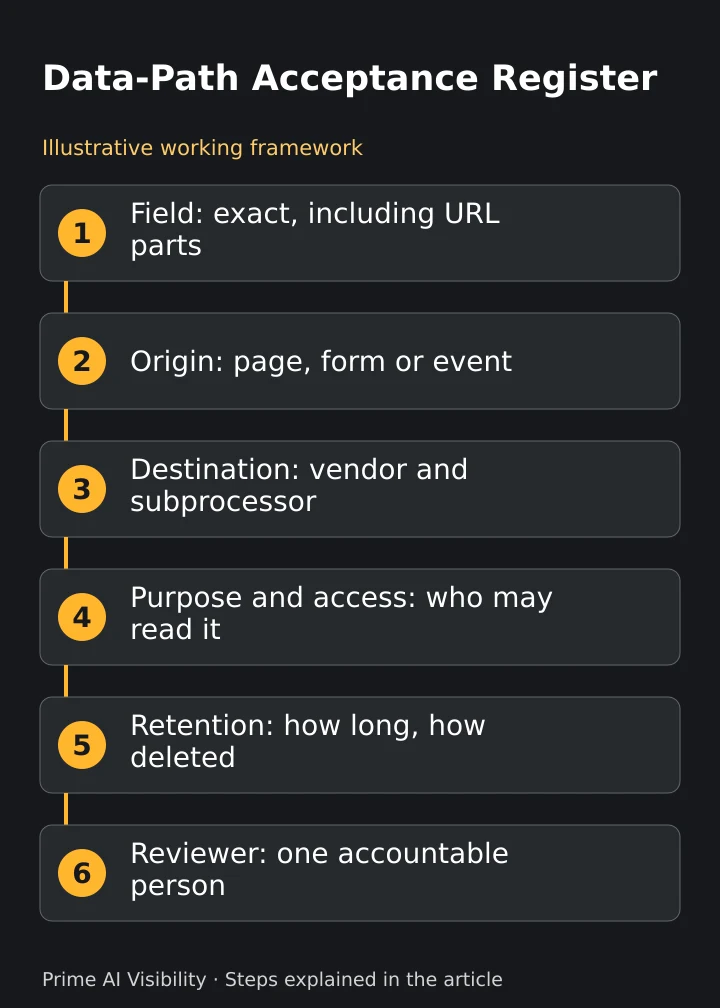
The register has one row per data path. Each row records:
- Purpose. Why the data is collected.
- Page, form or event. Where it is collected.
- Exact fields. Every field, including URLs, query strings, browser events and free-text boxes.
- Classification. How sensitive the field is, as your reviewers define it.
- Receiving vendor and subprocessor. Who gets it, and who they pass it to.
- Access. Who can read it.
- Retention and deletion. How long it is kept and how it is removed.
- Contract or permission. What allows the transfer, where one is required.
- Owner. One accountable reviewer.
- Acceptance evidence. What you inspected to confirm the path.
Include URLs and query strings in the inventory. A web address can carry text that was typed into a form or chosen from a menu, and an analytics tool will record the address it sees. Include free text for the same reason: a free-text box can receive anything a person types.
The register is a worksheet. It is a proposed application created for this guide, not an independently validated framework, a shipped product feature or a measured proprietary result.
| Register field | What to enter | Synthetic illustrative entry |
|---|---|---|
| Purpose | Why the data is collected | Count visits to a public page |
| Page, form or event | Where the data originates | An ordinary page view on a public hours and parking page |
| Exact fields | Every field, URL part and parameter | Page address and a page-view event; no form fields |
| Classification | Sensitivity, as reviewers define it | Assigned by the organization's reviewer |
| Receiving vendor and subprocessor | Who receives it, and who they pass it to | The analytics vendor named in the contract |
| Access | Who can read the data | The analytics owner and one named backup |
| Retention and deletion | How long, and how removed | Retention set in the account and confirmed in writing |
| Contract or permission | What allows the transfer, where required | Determined by qualified reviewers, recorded here |
| Accountable reviewer | One named person | The privacy officer |
| Acceptance evidence | What was inspected to confirm it | A saved capture of the requests sent on a test visit |
Fill one row for every tag, form, pixel, webhook and export in the stack. If a row cannot be filled because nobody knows where a field goes, that is the finding.
Separate public discovery from patient pathways
The central design choice is a boundary. Public questions and public source pages sit on one side. Patient, applicant and identifiable tracking data sit on the other. They should not share a tool unless your reviewers have approved that path.
Public discovery covers what people ask in the open and what answers say: a question such as "does this clinic offer weekend appointments," the public page that answers it and the facts on that page. The Prime AI Visibility features work with public business questions and public source URLs. No patient data, patient email addresses, appointment details or clinical notes belong in a monitoring prompt. Use public questions only; do not enter protected health information. Public-question evidence does not supply a privacy certification, a business associate agreement or a regulated-record archive for patient intake.
Private scheduling and intake stay in the approved systems that were chosen for them. The guide to healthcare entity accuracy covers the public side: hours, locations and services, which are business facts rather than patient information. A healthcare AI visibility audit uses only those public inputs for its baseline.
Analytics fields should be limited to their purpose. A pseudonym or a server-side route does not by itself settle a legal question. Moving a tag to the server changes where code runs. It does not change what is transmitted unless the configuration changes it. Verify what is sent.
Evaluate vendors and controls in the actual use case
Vendor review should test the exact use case, not the vendor's general reputation. The same product can be configured safely in one deployment and unsafely in another.
HHS publishes guidance on online tracking technologies, and the HHS online tracking guidance is the primary source to read. Read the whole page, including its notice. The page carries a notice of a partial vacatur dated June 20, 2024, which concerns specified circumstances on unauthenticated pages. Keep that notice attached to any discussion of unauthenticated health pages. Do not claim that an IP address plus any visit to a health page automatically triggers HIPAA. Whether and how the guidance applies to a particular page and organization is for qualified reviewers to determine.
Several points hold regardless of how that determination comes out:
- A business associate agreement, where one is required, is not a substitute for correct configuration, access control and a risk analysis. It permits a use under conditions. It does not secure the set-up.
- A cookie banner is not the same as an authorization for a disclosure.
- Plan eligibility matters. A vendor may sign an agreement only for certain plans or features, and marketing use may be outside what the agreement permits. Check the exact plan and the exact use case, in writing.
- A vendor's marketing statement is not evidence of how your account is set up. Ask for documentation, and inspect the configuration yourself.
For the horizontal questions that apply to any platform, such as data retention, access, subprocessors and deletion, use an AI platform privacy checklist. Treat it as a source of questions, not as an answer.
A synthetic launch acceptance exercise
Before launch, test with synthetic data only. Never use a real patient or applicant to test a tracking set-up.
For each path in the register, inspect:
- Browser and network requests. What does the page actually send, and to whom?
- Tag-manager rules. What fires, on which pages, with which variables?
- Webhook payloads. What does a form or system send onward?
- Downstream logs. What did the receiving tool store?
- Deletion behavior. Does a deletion request remove the record where you expect?
Record what was transmitted and what was blocked. A successful synthetic test is an implementation check. It is not a regulatory certification and does not say your set-up complies with any rule.
Here is a synthetic example. It is illustrative, with no real patient data, no actual incident and no client result.
| Path | What the register shows | Decision |
|---|---|---|
| Public hours and parking page | An ordinary page event reaches the analytics vendor | Document the field and destination; require the qualified reviewer's decision |
| Simulated appointment confirmation page | The address includes treatment text and an email address in its query string | Remove the transmission before launch and retest |
On the second path, the register exposes a different kind of flow. An ordinary page event is one thing. A confirmation address that carries treatment text and an email address is another, and a tag that records the address would carry those fields to the vendor. HHS's guidance gives an example involving appointment information on a page. The point for this exercise is simple: inspect the fields that are transmitted, and do not rely on a tool's category. The team removes the transmission before launch and repeats the test.
Connect measurement and review without merging identities
Keep the measurement paths separate, as the data is separate. Report each on its own:
- organic search data from the search tools you already use;
- observed AI answers and the sources they displayed;
- referral visits, as aggregate counts;
- aggregate events your reviewers have allowed;
- private accepted enquiries, held in the system that owns them.
A mention, a citation, a referral and an accepted enquiry are different units. The healthcare AI visibility metrics definitions keep them apart, and the guide to ChatGPT referral measurement treats referral reporting as its own path. Do not offer patient-level attribution as a default. Joining a public answer observation to an individual's visit or appointment creates the identity link the boundary exists to prevent.
Separate an observed answer correction from an appointment or conversion outcome. If an AI answer states a wrong public fact, the fix is a correction to the public page, and the recheck is the same question later. The guide to AI brand-fact accuracy shows how to trace a claim to its source. Editorial ownership and lifecycle for those pages belong to healthcare AI content governance, which is separate from data transfer.
Keep the handoff from evidence to action simple. AI visibility and CRM workflows describes assigning a human handoff without inventing integrations. Keep any exported evidence in its approved review path. Do not infer scheduling, clinical-record or CRM integrations from a public-question monitoring workflow.
Maintain four controls after launch. Give every row an access boundary and a change owner. Plan vendor offboarding, including deletion. Run a regression check whenever a tag, form or template changes, since a small edit can alter what is transmitted. Record the check in the register.
Some of this work is human implementation. Percepture is the digital marketing and public relations agency affiliated with Prime AI Visibility. Its generative engine optimization services cover public answer evidence and implementation scope. Percepture does not provide legal or compliance certification, and a discussion with the team covers marketing implementation. Where the gap is an outside source, Digital PR services cover legitimate source development without a guaranteed placement. Percepture's guide to AEO tools for healthcare content marketing covers the same subject from the agency side, and it does not transfer canonical ownership of this guide. To evaluate practitioners, Best AI SEO experts in the world is an editorial list. It is not an accreditation, and it does not show that the people on it hold any certification.
Questions for the buying committee
Bring four questions to the committee, and keep legal analysis out of product promises.
Does a business associate agreement make a set-up compliant? No. It permits a use under conditions, where one is required. Configuration, access and risk analysis still apply.
Does server-side tracking solve privacy by itself? No. It changes where code runs. What is transmitted depends on the configuration.
Does public AI monitoring need patient data? No. It works on public questions and public pages. Patient data does not belong in it.
What evidence should a vendor supply? Its documentation for your plan, a list of subprocessors, retention and deletion terms, and a way for you to inspect what your own account transmits.
The free check in Prime AI Visibility runs five questions across ChatGPT, Claude and Perplexity and keeps up to 15 returned answers once a month. It is a limited public-question check, not a privacy review, an audit or an implementation. Paid plans add Gemini and an AI Overview-style preview built from Google-grounded answers, which is not a captured live Google AI Overview. Coverage, cadence and credits depend on the plan.
Frequently asked questions
What belongs in a healthcare marketing stack?
Public content, search evidence, aggregate analytics, approved outreach and secure scheduling, each with its own data path, contract, access and owner. Clinical records sit outside marketing.
Does using HIPAA-ready tools make a stack compliant?
No. A tool label does not determine compliance. The configuration, the contract where one is required, access controls and a risk analysis all matter, and qualified reviewers decide what applies.
Do public pages automatically create protected health information?
Do not assume that. HHS's guidance page carries a notice of a partial vacatur dated June 20, 2024 that concerns specified unauthenticated-page circumstances. Qualified reviewers decide how it applies to a given page and organization.
Can public AI monitoring use patient data?
No. Keep patient and applicant data out of monitoring prompts. Use public questions and public source pages.
How do I test a tracking set-up safely?
Use synthetic data only. Inspect network requests, tag rules, webhook payloads, downstream logs and deletion, and record what was transmitted and what was blocked.
Next steps
- Copy the register. Use the blank columns above, with no patient details, and add one row for every tag, form and export.
- Run the synthetic test. Inspect what each path transmits, and fix anything that should not leave the page.
- Check public questions. Bring approved public service questions to Prime AI Visibility, save the answers with their sources and assign an owner to each correction.
References
- U.S. Department of Health and Human Services, Office for Civil Rights, Use of Online Tracking Technologies by HIPAA Covered Entities and Business Associates, including the page's notice of partial vacatur dated June 20, 2024.
About the author
Bob Generale is President and Partner at Percepture and co-founder of Prime AI Visibility. This article explains the public-question versus private-data boundary using a synthetic data-path register and HHS's qualified tracking guidance. His role here is a source, evidence and marketing perspective, not a privacy certification or a determination of an organization's legal obligations. Percepture and Prime AI Visibility are commercially connected.
Start with public evidence, then decide what else is needed
Create a workspace to save answers to public service questions and their displayed sources, then compare them after your approved content changes. Coverage, cadence and credits depend on the plan. Prime AI Visibility is not a privacy certification and is not a place to upload patient data.